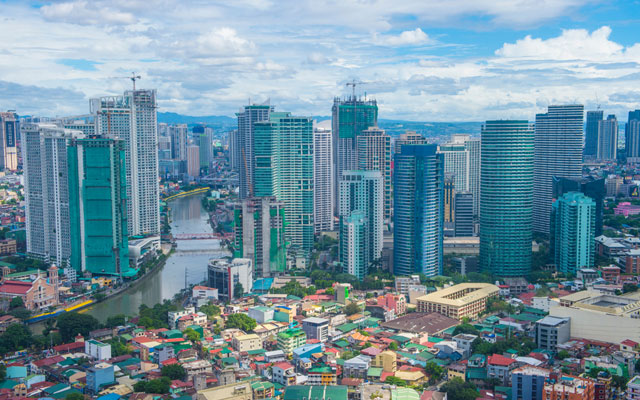
The recovery of Philippines’ inbound and outbound travel is slowing down due to high airfares, a weakening peso, and a logjam in embassies’ processing of visa applications and renewal.
Arjun Shroff, managing director of Shroff International Travel Care, said travellers prefer domestic travel over international travel due to the high costs of airfares, “which has risen by more than 60-80 per cent in some cases”.
Travellers prefer domestic travel over international travel due to the high costs of airfares
Asiareps Travel Services general manager, Ritchie Tuano, agreed that airlines’ high fuel cost “significantly contributes” to the travel slowdown.
He added that the surge of revenge travellers did not cause air travel demand to spike, even though most airlines were not 100 per cent operational.
This, coupled with the longer processing time of visa applications at embassies – which itself is trying to cope with the surge in demand and staffing issues – are all contributing to the slow down, noted Shroff.
Tuano said: “Embassies should be adding more staff, even though temporarily, to hasten the visa processing time.”
Moreover, the weakening of the Philippine peso reached an all-time high this week, and has also made it costlier for longhaul travel. That is why Filipinos are choosing to fly regionally to South-east Asian countries, or other countries that are visa-free, agents observed.
Tourism New Zealand unveiled its first global campaign since 2019, If You Seek, during the Kiwi Link Asia gala dinner held in Singapore last Tuesday.
The campaign builds destination desire by beckoning curious travellers to New Zealand, promising to enrich their experiences through extraordinary travel. If You Seek wants international visitors to not only be mindful of, but also embrace Māori values and traditions.
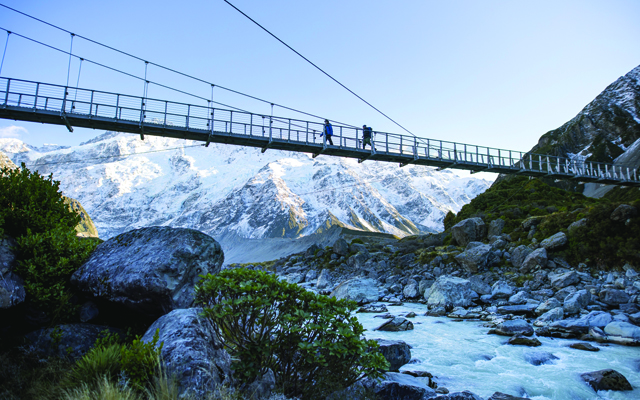
Tourism New Zealand’s campaign aims to attract travellers to visit the destination; Hooker Valley Track pictured
As part of the new campaign, Tourism New Zealand curated itineraries for those inquisitive enough to look deeper and go a little further to discover more authentic, meaningful connections.
Campaign materials include 18 short videos featuring New Zealanders experiencing Aoteroa’s local culture, generosity and natural beauty. They feature locations such as Bay of Plenty’s Whakatāne, a town with rich Māori history; Hooker Valley near Aoraki/Mt Cook, the highest mountain in the country; and the green hills of Waitomo.
After Singapore, If You Seek was rolled out in Japan and South Korea on September 1, and upcoming will be India on September 8. Prior to this, the campaign debuted in China, Australia, Germany, the US and the UK, as well as the domestic market on August 19.
Sellers at Kiwi Link Asia shared that travel demand for New Zealand has not wavered one bit, as there is pent-up interest.
“The number one obstacle at the moment is connectivity, where scheduling is not as regular as it used to be, but that’s going to improve as we get closer towards the end of the year,” Lou Baddiley, manager, international markets, RotoruaNZ, told TTG Asia.
Singaporean travellers, Baddiley noticed, have been researching New Zealand’s beautiful nature and are often return visitors. Aside from Singapore, other medium-haul visitor markets New Zealand is courting include Malaysia, Japan, South Korea, and India; where “India is an emerging market with massive potential”.
Kiran Nambiar, business development director, Destination Queenstown, added: “Singapore has always been an amazing market for New Zealand, and it helps that the dollar is in Singapore’s favour. We’ve never had any challenges marketing New Zealand to Singaporeans, as demand has always been higher than the seat capacity, especially during the high season from October to February.
“The demand is strong, we just hope that the supply will return to pre-Covid levels and at some stage become higher (to help cope with travel demand).”
Another challenge that Nambiar faces is attracting more working holidaymakers/backpackers back to New Zealand, a crucial group that can quickly help rebuild Queenstown’s tourism infrastructure.
“There used to be about 6,000 available jobs in Queenstown that changed every three months. Aside from working holidaymakers filling service job positions, these visitors contribute to both the tourism economy and New Zealand GDP,” Nambiar said.
When these working holidaymakers leave, fond memories of New Zealand will translate to a “lifetime value of visitors where they keep coming back”, pointed out Nambiar, who will in turn, become default ambassadors for the country.
For Patrick Dault, destination and tourism manager, Development West Coast, his challenge in selling New Zealand is different.
“For me it’s about regional dispersal. How do we get travellers to our regions, out of the well-established destinations of Christchurch and Queenstown?” he remarked.
The West Coast is eight per cent of New Zealand’s land mass, offering two million square kilometres of conservation land. It is all about exploring the outdoors and wildlife, enthused Dault, but they have to make sure that “visitors know what to expect”, such as the slower pace of tourism in these areas.
Baddiley concluded: “The key message is New Zealand is open, and we welcome and embrace the Singapore market. One thing the last two years has taught us is that we don’t know what’s around the corner. If you’ve already been to New Zealand, come on back – there’s a whole heap of new stuff that we’ve developed over the lockdowns.”
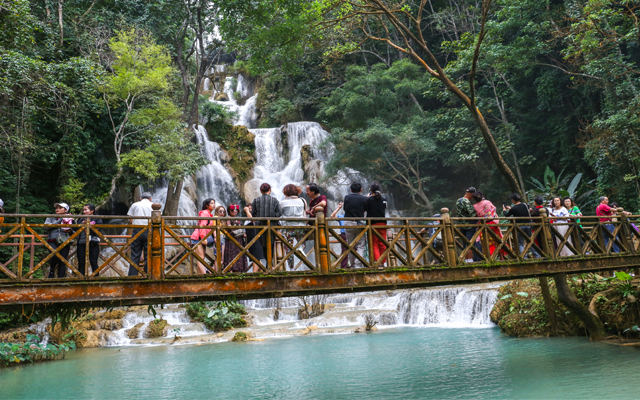
Tourists at Kuang Si waterfall in Luang Prabang, Laos
Travel operators across Laos are racing to certify tour guides and drivers to cope with the surge in demand for organised tours since Laos reopened its borders to international tourists on May 9.
LaoSafe has witnessed an increase in requests for training and certification with the anticipated influx of tourists for the coming season. To date, over 710 tour guides and 270 drivers have achieved LaoSafe certification.
Travel operators across Laos are racing to certify tour guides and drivers to cope with the surge in demand for organised tours; Kuang Si waterfall pictured
LaoSafe is a nationwide initiative designed to create a world-class health and hygiene system within the tourism and hospitality industry, developing sector-specific standards for accommodation, F&B, tour guides and drivers to raise the benchmark of hygiene provision throughout the country and build international confidence in Laos as a safe tourist destination.
Encouraging tour operators in Laos to apply for LaoSafe, Duangmala Phommavong, managing director, EXO Travel Laos, said: “The LaoSafe training that our guides have received has helped them prioritise safety and cleanliness. As a tour operator, I want travellers to know that Laos has safety standards in place for them to travel with peace of mind and confidence.”
A spokesperson of Asian Trails Laos commented that LaoSafe empowered DMCs like them to offer customers a “safe and quality experience” and access a “harmonisation of services and the creation of standards on a national scale”.
While visitor numbers have not returned to 2019 levels, the removal of entry restrictions has given the tourism and hospitality industry a welcome boost after two years of tightly controlled borders.
Pan Pacific Hotels Group (PPHG) strengthens its regional management with the reorganisation of its operational leadership team as the Group expands across Asia-Pacific, Europe and North America.
Reporting directly to Choe Peng Sum, CEO of PPHG, the newly-appointed leaders are organised into five regional clusters.
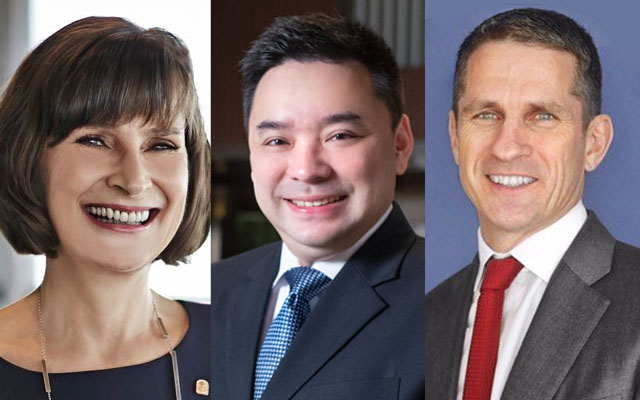
From left: Margaret Paul, Richard Tan and Jeremy Aniere
Margaret Paul will steer the Group’s global launches as the vice president of pre-opening, overseeing a growing pipeline of hotels, resorts and serviced suites. She also takes on the role of vice president of operations for Oceania, where she will oversee six properties in Australia.
Prior to her new dual role, Paul was the general manager of Pan Pacific Singapore.
Richard Tan takes on the role of vice president of operations for Dhaka, Indo-China, Malaysia and Nairobi in addition to his current purview over PPHG’s properties in Malaysia and Indo-China (Vietnam, Myanmar, Thailand, and Cambodia).
Tan will drive the operational performance of the Group’s properties in Dhaka and Nairobi, and oversee 17 hotels, resorts and serviced suites. He has more than 25 years of experience managing serviced suites and hotels in Asia.
Jeremy Aniere assumes the role of vice president of operations for Singapore, excluding Pan Pacific Orchard. Aniere will also drive the operational processes, standards and performance of eight Singapore properties under PPHG.
Amassing over 25 years of international hotel experience, Aniere joined PPHG in December 2021 and helmed Pan Pacific Perth as general manager until June 2022. He was previously the vice president of operations for Accor Greater China (South China).
From left: Anne Golden and Marcel Holman
Anne Golden is the vice president of operations for the UK & North America where she will oversee the operational performance for a total of six properties in these regions. She is also general manager of Pan Pacific London.
With more than 25 years of experience in hospitality, Golden was previously the regional vice president, operations and development with SBE Hospitality Group, London.
Marcel Holman joins as vice president of operations where he will oversee the operational performance of 13 properties across Indonesia, China and Japan. He takes on the role of general manager for Pan Pacific Orchard, Singapore, where he will helm the opening in 1H2023.
With over 35 years of experience in hospitality, Holman was regional vice president of operations – Greater China and managing director of The Langham Hong Kong prior to joining PPHG.
Qantas’ trade partners will benefit from lower pricing when booking Australian domestic fares through the carrier’s next-generation distribution platform from November 29.
The lower fares will be made available to all travel agents, travel management companies and online booking tools accessing content via the Qantas Distribution Platform.
Qantas’ Distribution Platform will offer lower domestic fares to trade partners from November 29
Built using IATA’s New Distribution Capability (NDC) standards, Qantas Distribution Platform was designed to modernise the service that trade partners provide to customers with a wider range of products, features and capabilities.
Since its launch, Qantas has continued to invest in the platform’s capabilities, releasing special offers and new revenue opportunities, growing its network of Technology Partners and expanding the program internationally.
For partners still in the process of connecting to the platform, Qantas will provide extra support in the three months leading up to the launch of lower pricing.
Travel agents who have registered in the Qantas Channel can access Qantas Distribution Platform content via either an Approved Technology Partner, or by developing a direct connection to Qantas’ NDC XML Application Program Interface (API).
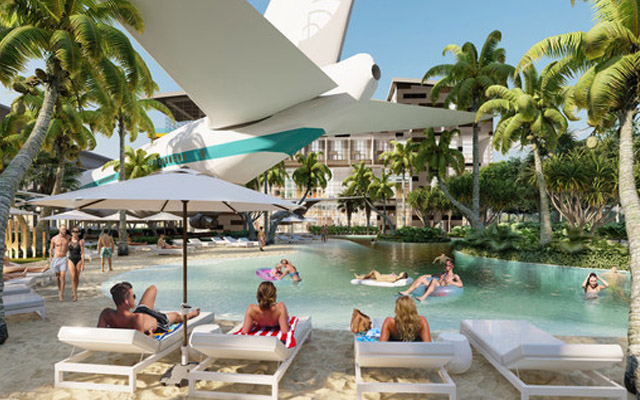
Malaysia-based investment holding company Tiong Nam Group has unveiled plans for the first aviation-themed lifestyle hub in Malaysia, slated for completion in 4Q2023.
Located in Kempas, Johor Bahru, the hub will occupy over 19,000m² of the integrated township and feature the 1975 Avenue & Hotel.
The first aviation-themed lifestyle hub in Malaysia will feature a man-made beach and lagoon pool
Offering 38 keys, the all-suite cockpits and cabins will feature a 70s vintage, aviation-themed interior. Surrounding the hotel is a six-hectare project incorporating two redesigned Boeing 747s, as well as a man-made beach and the lagoon pool that weaves through the entire development.
F&B options will range from casual dining like cafés, bistros, buffet and family-friendly restaurants to pop-ups, international gourmet dining and themed dining. Other entertainment and activities will be revealed at a later date.
The hotel also features indoor and outdoor event spaces that are ideal for corporate travellers and event planners, as well as for social events.
Kenneth Perreau, general manager of 1975 Avenue & Hotel, is confident that the hotel will be able to “operate at a healthy occupancy in the first year of the hotel’s opening taking into consideration the integration, the connectivity, the market size and the authenticity of the extravagance experience we are offering”.
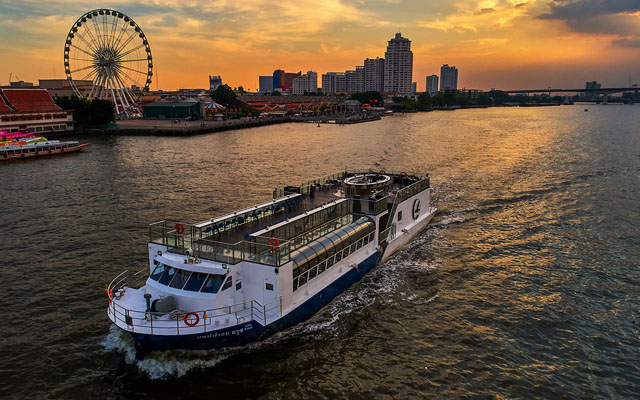
Banyan Tree Bangkok is offering guests a special package to commemorate its 25th birthday.
Guests can choose to enjoy a four-course set dinner at Saffron Cruise
The 25th Anniversary Celebration Package includes a one-night stay at a Horizon Room for two persons, with daily breakfast, and a choice of one of these benefits:
Three-course set dinner at Vertigo
Four-course set dinner at Saffron Cruise (available Friday to Sunday)
Sunday brunch at Romsai
Dim Sum buffet at Bai Yun
Dining credit valued at 3,000 baht (US$81) for use at any of the hotel’s dining establishments and in-room dining
Upgrade to a One Bedroom Suite with club access
60-minute body massage at Banyan Tree Spa
Complimentary additional night at a Horizon Room with breakfast
The package starts from 7,999 baht and is valid till October 31, 2022. Terms and conditions apply.
On August 29, the Sri Lankan government approved five-year multiple-entry tourist visas – with a maximum of six months stay at one stretch – for 35 countries.
While the modalities of the scheme are yet to be finalised, such as the fees, the 35 countries are expected to include Western, Northern and Central Europe and much of Asia including India, Sri Lanka’s largest source market.
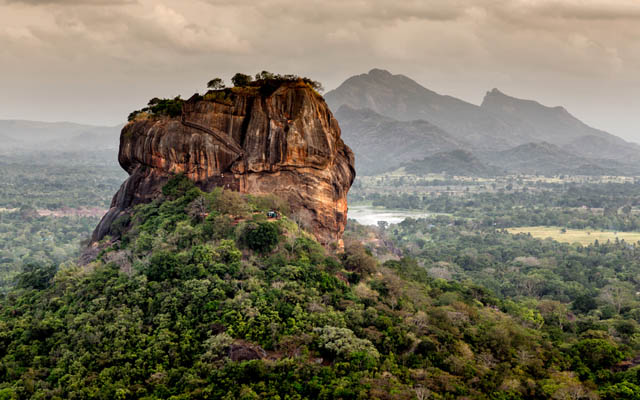
With the new five-year multiple entry tourist visa scheme, Sri Lanka’s tourism stakeholders are hoping for a pick-up in travel this winter season; Sri Lanka’s Sigiriya (Lion Rock) pictured
Sri Lanka’s tourism stakeholders are hoping for a pick up in travel this winter season, as several European countries such as France, Switzerland, and the UK – one of Sri Lanka’s biggest inbound markets – have relaxed their travel advisories against visiting Sri Lanka.
The restrictive travel advisories came into play a few months ago when Sri Lanka was facing a huge economic crisis marred by political unrest, and shortages of fuel and food. The situation has much improved now.
Trevor Rajaratnam, past president of the Travel Agents Association of Sri Lanka, opined that this will help elderly travellers look towards destinations like Sri Lanka to escape a harsh winter, as most of Europe is struggling with a natural gas crisis that could affect the heating of homes this winter.
Long-term visas would also help spur-of-the-moment travellers, Rajaratnam pointed out.
Shiromal Cooray, chairperson of Jetwing Hotels, said the purpose of the five-year visas could be directed at digital nomads who want to spend long periods in the country and come and go freely.
Last year Sri Lanka was recognised as one of the top destinations for digital nomads, emerging second in Club Med’s index of the best places and countries around the world to become a digital nomad.
Sri Lanka is hoping to attract a million tourists this year. Arrivals from January to July 2022 totalled 458,670 compared to 19,335 in the same 2021 period.
However, another travel trade veteran, who declined to be named, viewed the visa modification negatively, as this may open the floodgates for unauthorised businesses by foreigners.
“In many of the tourist hotspots in Sri Lanka, foreigners on tourist visas have opened restaurants, bars, offered the hiring of motorcycles and surfing facilities, and are acting as travel agents – taking away the jobs and livelihoods of locals,” he lamented.
Thailand’s Asset World Corporation (AWC) has set up a new joint venture company with an unnamed investor believed to be Singapore’s sovereign wealth fund GIC.
On July 27, AWC notified the Stock Exchange of Thailand of the joint venture, AWC Hospitality Development, which is 51 per cent owned by AWC and 49 per cent by the investor. Both parties have agreed to jointly conduct its management as the joint venture is not classified as a “subsidiary” of AWC.
AWC’s Melia Chiang Mai officially opened in April
GIC is a shareholder of AWC – the hospitality, retail and commercial real estate group of Thai billionaire Charoen Sirivadhanabhakdi.
“The joint venture will invest in high-potential hospitality projects in Thailand’s key tourist destinations. The company (AWC) will leverage its strength as the leading lifestyle real estate developer, together with its network of world-class hotel brands and ability to strategically manage real estate effectively, to drive this joint venture,” AWC said in the filing.
“This collaboration marks the first of its kind that the company (has) partnered with (a) global institutional investor with expertise and experience in investment management. The collaboration is the new business model that will help the company to create the foundation for new sources of income, which are derived from management fees, including incentive fees based on project performance,” AWC added.
The types of hospitality projects are undisclosed but TTG Asia understands that the acquisitions, all in Thailand, are in progress and the first ones will be announced soon. As of press time, AWC and GIC have not responded to queries.
In its 2Q2022 analyst meeting presentation on August 11, AWC revealed that the joint venture would invest up to around US$300 million in those projects, and derive fee-based revenue from managing the assets.
Meanwhile, AWC reported a net profit of US$39 million in 1H2022, a 100 per cent increase from the same period last year. This was “driven mainly by strong growth in our net operating profit of more than 100 per cent from the Hospitality Business,” said AWC’s CEO and president, Wallapa Traisorat.
AWC’s luxury hotels, in particular, have benefited from Thailand’s reopening. The rise in the number of international visitors, along with the Thai government’s campaign to boost domestic tourism, pushed AWC’s RevPAR in 2Q2022 up by 302 per cent year-on-year, the company said. The Average Daily Rate rose 48 per cent year-on-year to almost reach pre-pandemic levels. The company’s business events segment grew considerably by 407 per cent year-on-year, contributing to the solid performance of the Hospitality Business.
The Retail and Commercial businesses also saw growth as people returned to malls and consumer spending increased. For example, visitor traffic to Asiatique The Riverfront Destination in Bangkok in 2Q2022 rose 220 per cent year-on-year.
Currently, AWC, which owns the largest hotel portfolio in Thailand, has 19 hotels with a total of 5,201 rooms in popular Thai destinations Bangkok, Pattaya, Hua Hin, Samui, Krabi, Phuket and Chiang Mai. The hotels are managed by international operators including Marriott International, Hilton, IHG, Banyan Tree Holdings, Okura, and Melia Hotels International.
AWC also recently announced the exclusivity to develop Nobu Hotels & Restaurants in Thailand in partnership with Nobu Hospitality, starting with a Nobu restaurant on the rooftop of its Empire Tower Bangkok, and a Nobu hotel in a yet-to-be-disclosed location in the capital.
AWC’s target is to double the number of rooms to 8,500 and increase retail space to 415,000m² from 165,000m² by 2024.
Its oft-repeated goal is to support the Thai tourism industry and economy by offering quality projects through working with strong global partners, with the aim to expand its customer base to middle- to high-income groups which are likely to grow in the near future.
This expansion will also deliver experiences that will attract tourists from across the globe to Thailand, AWC stated.
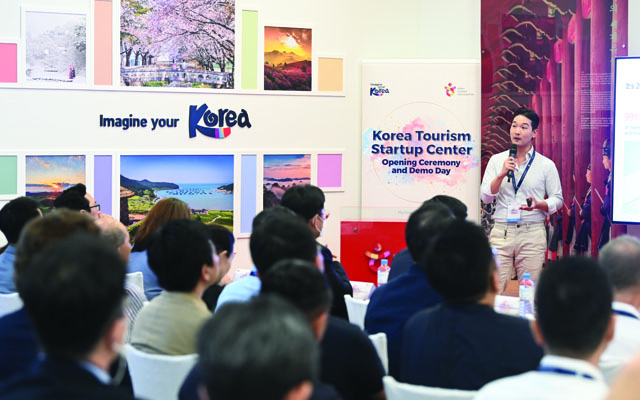
With the set-up of the Korea Tourism Startup Center (KTSC) in Singapore, tourism stakeholders in South-east Asia can look forward to innovative travel tech solutions for their businesses.
The Korean Tourism Organization (KTO) officially launched the travel tech accelerator yesterday with an opening ceremony and demo day where 13 Korean startups from the pilot batch presented their novel ideas in five-minute pitches.
Singapore welcomes Korean startup accelerator to its travel tech space
They were selected from KTO HQ’s Tourism Startup Global Challenge Programme for startups to venture into overseas markets.
Demo day for pitches
On its value proposition, John Lee, CEO of H2O Hospitality, pitched that his startup is able to “triple the direct booking volumes, lower 50 per cent of operating costs and increase 30 per cent of weekday sales on average” for customers.
With 160 employees in South Korea, Japan, Thailand and Vietnam, Lee’s startup provides digital management solutions and services tailored to the customer’s situation for the digital transformation of accommodation facilities.
“We are in a growth stage. We closed our (Series) C round (of funding) last May and hopefully, we can hit the unicorn level real soon,” he added.
Apart from offering a fully-integrated suite of AI-driven travel solutions, one of Globaleur’s unique selling points is having dynamic travel content which CEO, David Lee, believes is crucial for tech companies to stay competitive.
He said: “What I mean by content is destination pictures, descriptions and even general information like geolocation and address. We never borrow so we create our own proprietary content – we currently cover 200 cities and over 125,000 destinations around the world.”
Global airlines, hotel chains, OTAs and tourism boards leverage Globaleur’s customisable end-to-end travel solutions, which are powered by AI, for planning, booking, and itinerary management.
Catalyst to develop innovative solutions
KTSC strives to be the catalyst for these growing businesses to develop innovative solutions that drive the tourism capabilities of South Korea and Singapore.
It also connects startups with officials of the local industry, regional industry players, and reputable VC firms, by offering various programmes for upstarts keen to expand in South-east Asia.
Following the MOU signed between Singapore Tourism Board and KTO in November 2021, KTSC’s formation is also a major timely step forward post-lockdown.
Boot camp for startups
Spanning four days from August 30 to September 2, KTSC Tourism Boot Camp provides the 13 travel startups with masterclasses to help them grow their businesses; introductions to the different public and private organisations integral to the region’s ecosystem; as well as meetings with selected VC firms to discuss their next steps.
Kim Young Hee, director of KTO Singapore, said: “The boot camp and the opening ceremony in Singapore will mark KTSC’s first foray into the travel industry in the new normal. The partnership will put Korea and Singapore in good stead to be gateways for the travel industry in our region.”
After the camp, the startups will proceed to attend industry events, Travel Tech Asia and SWITCH 2022.
Currently, five startups have already set up their entities in Singapore, with more to follow. Discussions between KTSC and local experts are also underway to expand their teams and services in the city-state.
Jang Min Jun, deputy director of KTO Singapore, who is in charge of KTSC, said: “KTSC is excited to be supporting Korean travel tech startups throughout the accelerator programme. We believe that the first batch of 13 travel startups can make an impact on the travel industry in South-east Asia in time to come.”