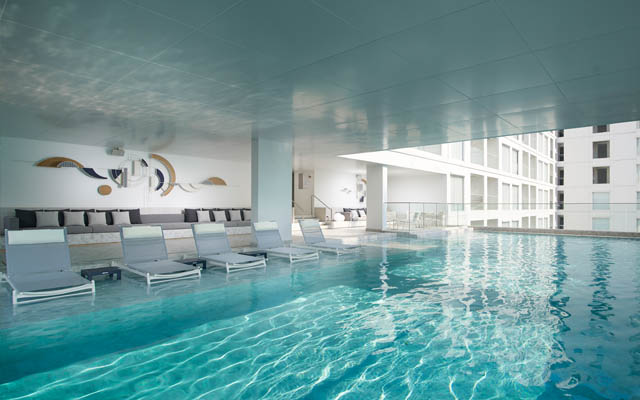
In what is seen as Hong Kong’s biggest relaxation of entry requirements since the start of pandemic control measures in 2020, the city will no longer impose movement controls on arriving travellers.
International passengers arriving in Hong Kong will no longer face Covid-19 movement controls from December 14
Authorities announced on December 13 that the amber health code for arrivals will be scrapped from today, and travellers can go about the city as long as they test negative for Covid-19 on arrival.
The amber code restricts the movement of foreign arrivals for the first three days of their time in Hong Kong, prohibiting them from entering bars and restaurants.
For now, the mask mandate remains – unless when individuals are exercising.
Busan's continuous hosting of fruitful events serves as a constant reminder to the world of its capability as a MICE city (Photo: Busan Tourism Organization)
Busan’s continuous hosting of fruitful events serves as a constant reminder to the world of its capability as a MICE city (Photo: Busan Tourism Organization)
Second-largest city in South Korea, Busan, is a global MICE city whose reputation as an ideal venue option is growing from strength to strength.
In the first half of this year alone, the Busan Exhibition and Convention Center (BEXCO) held over 100 more events than it did all of 2021.
MICE experts highlight the geographical advantages of Busan and its world-class MICE infrastructure as some of the city’s strengths as a top business events destination.
Ideal city to host international events Busan’s coastal environment won it acclaim as South Korea’s only bleisure (combination of both business and leisure) city.
One of Busan’s most compelling draws is the myriad of seaside activities business travellers can engage in.
The coastal pursuits are clustered in “Haevenue”, an area in the Haeundae district in Busan that is at the centre of the city’s MICE infrastructure, including BEXCO and Busan Port International Exhibition & Convention Center (BPEX), as well as a host of accommodation choices and tourist attractions.
Due to its close proximity to the Gimhae International Airport, Busan also doubles up as a transportation hub.
Business success for events So far in the second half of 2022, BEXCO has hosted a diverse range of successful international conferences, such as the International Federation of Freight Forwarders Associations (FIATA) World Congress.
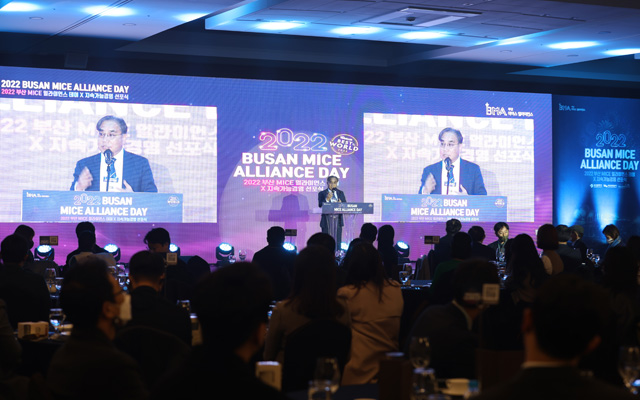
In the second half of 2022, BEXCO has hosted a diverse range of successful events, including the 2022 Busan MICE Alliance Day (Photo: Busan Tourism Organization)
Delegates of events held at BEXCO can enjoy tasty culinary fare and exciting sightseeing opportunities while in town.
One of the world’s 10 busiest ports, the city’s continuous hosting of fruitful events serves as a constant reminder to the world of its capability as a MICE city – one that should not be overlooked when selecting a host city for any upcoming business event.
Sea sports and nautical leisure activities The beautiful beaches of Busan allow for all kinds of seaside leisure activities throughout the year.
Paddle-boarding is popular, and board rentals are readily available at both Gwangalli Beach and Dadaepo Beach.
The best time to go paddle-boarding is in the late afternoon, when the adventurous will be rewarded with stunning sunsets over the water.
Event organisers in Busan do their best to ensure delegates have the time of their lives, and strive to provide a range of tourism products for them to create unforgettable memories.
More events in the pipeline In May 2022, the World Anti-Doping Agency’s (WADA) board of directors selected Busan as the venue for the 2025 WADA World Conference, in a vote of confidence for the city.
The board conducted an initial three-day inspection of Busan in September. The four-day 2025 WADA World Conference is scheduled to commence on October 10, 2025.
Busan is honoured to be hosting the first-ever WADA World Conference to be held in South Korea and sees the event as an opportunity to demonstrate its MICE appeal globally.
While the coastal city’s world-class MICE infrastructure makes it the ideal host city for international events, Busan is not resting on its laurels and is constantly seeking to improve and make every event held on its coastline better than the last.
Interested in organising your next business event in Busan?
For more details on why Busan is the Best Bleisure City, visit here.
Find out more about the MICE support available here.
AirAsia Aviation Group Limited (AAAGL), the aviation arm of Capital A, has signed a Joint Venture agreement with Sivilai Asia to establish a new low-cost airline, AirAsia Cambodia.
Operations are expected to commence in late 2023, subject to regulatory approvals.
The launch of AirAsia Cambodia will further cement AirAsia’s brand in Cambodia and Indochina
The new airline will further cement AirAsia’s brand in Cambodia and Indochina, providing AirAsia with greater access to its domestic market and connecting it to the international markets across South-east Asia, North Asia and beyond.
AirAsia Cambodia aims to further stimulate the Cambodian aviation and tourism industries, launch new destinations, create jobs and bring a true low-cost operation to the country.
Tony Fernandes, CEO of Capital A said: “The value of AirAsia’s network is an insurmountable asset; it will be another flag of extensive connectivity in Cambodia and into the region, namely China, India and North Asia.
“2022 was about restarting our airline to pre-Covid levels. That machine is in place and will be completed by the second quarter of 2023. The second half of 2023 will be when we focus on our continued efforts in growth.”
Vissoth Nam, director of Sivilai Asia added: “As one of the first countries to open up international travel with no quarantine in November 2021, Cambodia has led the way in (South-east Asia’s) air travel recovery journey post-Covid, with the rest of (the) countries in the region following suit.
“An increase in connectivity alongside best value fares, will certainly stimulate demand for air travel amongst the population due to increased airline and destination choices. This will open the doors for students travelling abroad, supporting work-related travel, boosting trade ties, and providing a welcome boost for the growth of new small and medium enterprises.”
Pre-pandemic, AirAsia operated 90 weekly flights from Malaysia and Thailand and is currently flying about 49 weekly flights to Cambodia.
Operating five routes to Cambodia from Kuala Lumpur to Siem Reap and Phnom Penh, from Penang to Phnom Penh (starting January 3, 2023) as well as from Bangkok (Don Mueang) to Siem Reap and Phnom Penh, AirAsia has carried over 10 million guests to and from Cambodia since entering the market in 2005.
Centara Hotels & Resorts has teamed up with Turkish Airlines’ frequent flyer programme Miles&Smiles.
The partnership will offer Miles&Smiles members the opportunity to receive 300 Miles for every 5,000 CentaraThe1 points transferred for use on flights to over 300 international destinations across Africa, Asia, Europe, the Americas, and Oceania.
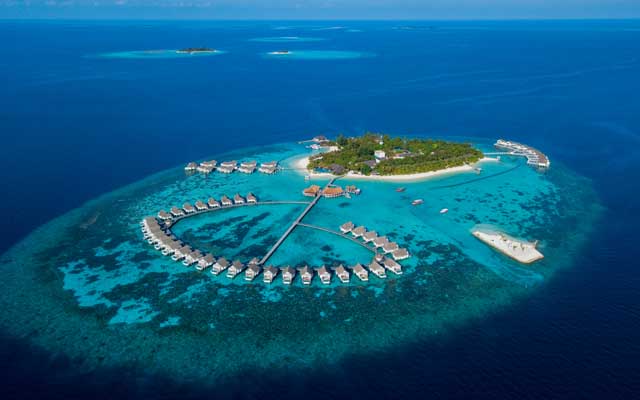
The partnership will enable Miles&Smiles members to earn Miles quicker and redeem travel benefits; Centara Grand Island Resort Spa Maldives pictured
Under this promotion, Miles&Smiles members can convert CentaraThe1 points in exchange for Miles. To take advantage of this offer, members need only transfer the desired number of points from their CentaraThe1 Card member account to their Miles&Smiles member account after logging in on Centara’s website. They can then use the Miles towards free flights, upgrades, extra baggage allowance and other benefits.
In addition, CentaraThe1 loyalty programme members can also enjoy 15 per cent off all participating hotel rates.
The partnership is the latest addition to Centara’s growing airline network which already includes Thai Airways, Singapore Airlines, Thai Vietjet, Go First, Myanmar Airways International, and Vistara Airways.
Tripadvisor looks back over the past year as borders reopen and almost all flight routes being reinstated around the world.
2022 will forever be known as the great travel reboot as travellers learned how to travel again – exploring new terrain, rediscovering favourite places, and making the most of long layovers.
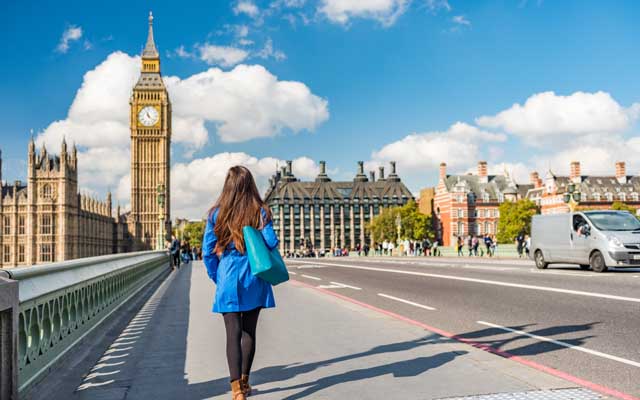
Gaining popularity among travellers with over millions of searches are big cities, such as London pictured
Despite over two years of bookmarking and saving holiday ideas, the big return was overwhelming for some. Recent Tripadvisor research found that ‘Relax and Rejuvenate’ was the main trip purpose for 50 per cent of travellers globally. The most popular search terms were ‘Beach’ with 4.8 million searches, ‘Resort’ with 3.2 million searches and ‘Spa’ that was searched 1.7 million times.
Travellers were extra adventurous and looked to do something wild, wonderful and out of the ordinary to escape their daily routines. Results saw 1,636 shark-diving experiences booked, 16,563 ziplining tours booked and 47,015 ghost & vampire tour tickets sold.
This year, Tripadvisor saw over 16 million five-bubble reviews written, 22 million helpful votes given and 387,000 forum threads created. Travellers rely on tips, reviews, recommendations and suggestions from people who have been to a destination before, and thanks to reviews left by customers, Tripadvisor has become an invaluable resource for the millions who visit the platform every month.
“We love to see our traveller community returning to what they do best – rediscovering the transformative power of travel again, and more importantly, coming together to share with others what they’ve found,” said Hilary Fischer-Groban, senior director of brand experience at Tripadvisor.
Some other celebrated insights from 2022 include nearly 6.5 million new Trips (travel itineraries) created on the platform; more travellers booking private, small group experiences like a reindeer sleigh ride in Finland and a Private Day Tour to Giza Pyramids, Memphis and Sakkara; and big cities gaining popularity with millions of searches for Bangkok, London, Las Vegas, and New York this year.
In addition, travellers shared their trip moments with 18 million new photos uploaded to Tripadvisor, and even the tour guides received applause for sharing their travel secrets and efforts in making travellers feel at home.
Tripadvisor also welcomed nearly 35.7 million new travel buddies to its community, with close to 400 million travellers visiting the platform every month.
Qantas has added a non-stop service between Australia and the US, which the airline indicated is the world’s fourth longest flight.
The Melbourne-Dallas/Fort Worth service will initially operate three times weekly in each direction.
Qantas’ Stephen Thompson and Melbourne Airport’s Jim Parashos launch the new Melbourne-Dallas/Fort Worth service (Photo: Michael Doran)
The outbound flight from Melbourne is scheduled to take 15.45 hours but it is the return that sends this route up the rankings with a flight time of 17.35 hours. The world’s longest flight is Singapore Airlines (SIA) New York-Singapore at 18.50 hours, followed by SIA’s Newark-Singapore at 18.45.
Launching the Dallas flight was Stephen Thompson, executive manager Australian sales, Qantas, who said it was the airline’s eighth new international route opened since Australia dropped travel restrictions.
“Dallas is a hub for our biggest partner in the US, American Airlines, so we can connect via Dallas to more than 200 destinations across the US and to the Caribbean and Latin America,” he said. “We also see enormous opportunities for the American tourism market to come to Australia.”
Flights are timed to maximise connections at both ends of the route with a lunchtime arrival in Dallas and an early morning touchdown in Melbourne. For those looking to venture outside of Melbourne, Qantas and its low-cost subsidiary, Jetstar, offer seamless connections to Australia’s most extensive domestic network.
The Dreamliner carries 236 passengers, with 42 in business, 28 in premium economy and 166 in economy. Thompson told TTG Asia that due to the long distances Qantas operates, it has more premium seats on its 787s than most other airlines.
“We’re very conscious of the need for space and comfort so our weighting for premium classes is far greater than a lot of other carriers,” he added. “The 787-9 is absolutely the perfect aircraft for a Dallas-Melbourne or Sydney route.”
Sabre’s year-end travel report shows that travel confidence has improved as well as the emerging festive destinations of choice for global travellers. Sabre analytics reveal that booking windows for the holiday period are nearing pre-pandemic levels, while the number of Christmas and New Year bookings have soared compared to last year.
Booking windows and improved confidence
Sabre’s booking trends (to the end of October) shows that 60% of bookings for the holiday period were made in September and October this year, versus 55% in 2019. While a higher percentage of bookings were made closer to the holidays this year, the gap is narrowing between 2022 and 2019.
Booking windows for the holiday period are nearing pre-pandemic levels
Booking windows can be a significant metric to determining traveller confidence, as a longer booking window can indicate greater confidence. During the pandemic, there was a higher percentage of last-minute bookings due to uncertainties of travel and border restrictions. Travellers were often less keen to make advanced bookings as they were not sure if the travel situation would change by the time their departure date arrived. Now, with a more predictable travel landscape, people are more willing to make longer-term plans as it is more likely for the trip to proceed as planned.
Looking at international trips originating from the US, where travel restrictions were lifted much earlier in comparison with other regions, a clear recovery picture emerges – 29% of international festive bookings (to the end of October) were made during September and October in 2022, compared to 38% in 2021 and 27% in 2019.
In Asia, 76% of all bookings, (to the end of October) both domestic and international, for the year-end holidays this year were made in September and October, in line with when travel restrictions began to further unwind across the region. In 2019, around 55% of bookings were made in the same months. Recovery in Asia-Pacific has been particularly pronounced in Taiwan and Hong Kong, where travel restrictions have recently relaxed. Hong Kong bookings started 3Q2022 at just 16% of the same period in 2019. By the end of the third quarter, the recovery there was 29%. Taiwan did better, with the quarter starting at a 17% recovery and ending at 45%.
Festive season destination trends
Sabre’s booking analysis shows most travellers are opting for destinations close to home for the upcoming holiday period, with 33% of global travellers choosing domestic travel, compared to 27% in 2019.
Almost half (47%) of passengers travelling internationally from the US have booked to visit Mexico or the Caribbean for the holidays.
67% of those travelling from Asia are choosing to stay within Asia. This was higher (70%) in 2019, with the drop likely due to ongoing border closures in China. Top destinations for Asia are Japan and Thailand, which make up close to a third of bookings. Travellers who may previously have gone to China have switched to Japan or Thailand. Japan, Thailand and China together used to make up a third of trips in 2019.
Globally, the US, Mexico and Japan are among the top destinations for both couples and families, in both 2019 and 2022.
Family travellers globally are increasingly opting to travel to the UAE, whereas Thailand is a popular destination for those travelling as a couple.
For those travelling from North America as a family or couple, emerging top destinations are Costa Rica and Italy respectively.
In addition, fewer travellers from India are choosing Vietnam this year, compared to 2019, while fewer Japanese travellers are choosing Thailand.
Top festive travel destinations globally
Indians like to head to the UAE where the eased travel restrictions, affordable accommodation options and short travel times between the two countries makes it a popular destination.
Those from Canada choose to travel to Mexico or the US due to the short flight times.
For Americans looking to trade the cold winter for sun, sand, and blue seas, Jamaica is only a short flight from the US, as is the Dominican Republic, another popular beach getaway promising sunshine and relaxation to US tourists nearby and at affordable rates. Mexico is also another choice for the US due to the proximity of the countries.
For the US, inbound tourism from the UK continues to look strong in 2022.
South Koreans opt to travel to Thailand or even Vietnam due to the close proximity and frequent direct flights. Another well-loved destination is Japan, especially with the country finally unravelling its travel restrictions.
With passenger numbers increasing, travellers more confident about longer-term plans, and emerging destinations stepping in to replace geographies that remain hard to access, the global travel ecosystem is believed to be poised for further recovery and growth in 2023.
Marriott International has announced plans to widen its electric vehicle (EV) network across Asia-Pacific, in line with the company’s net zero ambitions and global commitment to source a minimum of 30 per cent of its overall electricity from renewable energy by 2025.
By end 2023, Marriott International expects to sign EV agreements to construct and operate 400 EV charging infrastructures in nine markets to be completed by end 2025. These include India, Thailand, Indonesia, Malaysia, Japan, South Korea, Singapore, Australia and Vietnam.
Marriott International will expand its electric vehicle (EV) network across Asia-Pacific, with plans to construct and operate 400 EV charging infrastructures in nine markets by end 2025
“As climate impacts intensify across the globe, there is a growing urgency for us to increase use of renewable energy,” said Neeraj Govil, senior vice president, operations, Asia Pacific (excluding Greater China).
“The planned expansion of our EV network across the region is a significant investment that brings us closer towards our carbon emissions reduction target. This is just the first step in our shift towards using more renewable energy. We remain optimistic and laser-focused on our sustainability commitments and will continue to review opportunities that will lead us to a net zero future by no later than 2050.”
This announcement aligns with the company’s sustainability and social impact platform, Serve 360: Doing Good in Every Direction, and is in support of the United Nations Sustainable Development Goals (SDGs).
Onyx Hospitality Group will strengthen its serviced apartment brand, Shama, with 10 new properties by the end of 2025.
These include nine new properties in Thailand, and one in Malaysia.
Shama expands with 10 new properties; Shama Yen-Akat Bangkok pictured
Currently, the group operates six Shama properties in Thailand and ten properties in Hong Kong and China.
Yuthachai Charanachitta, owner and CEO of Onyx Hospitality Group, said: “The serviced apartment segment has continued its recovery pace since many countries relaxed their Covid-19 travel restrictions. As a result, we are seeing more expatriates relocating to Thailand.”
He added that with South-east Asia rising as a regional economic hub, Thailand is in a strong position to capitalise on this growth as “serviced apartments globally remained resilient, even at the height of the pandemic”.
Shama also recently launched Shama Social Club, which aims to enhance the overall visitor experience, connecting guests to each distinct neighbourhood.








 In the meantime, TTG Asia Media wishes all readers Happy Holidays and a Happy New Year!