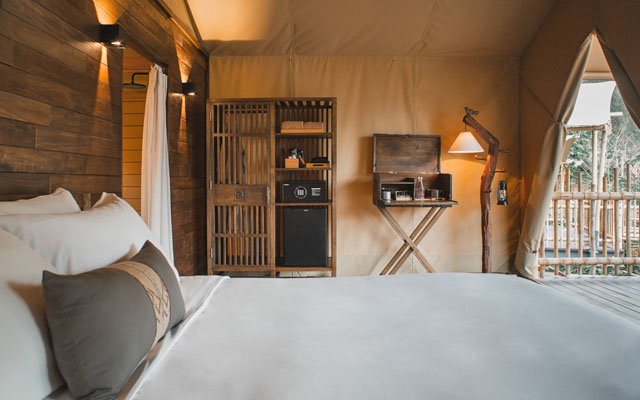
White Desert, established by record-breaking polar explorer Patrick Woodhead and his wife in 2005 to bring travellers into the belly of Antarctica, has crafted a new adventure – a 21-day journey that will take guests to 10 iconic destinations across seven continents.
Named 7 Continent Adventure, the tour is the first product of the White Desert World series, which will welcome other tours in the future.
Kwessi Dunes lodges (pictured) is nestled in the NamibRand Nature Reserve, one of southern Africa’s largest private nature reserves
The tour is said to be as diverse as it is luxurious.
Co-founder and CEO of White Desert, Patrick Woodhead said: “These countries have been chosen because they are unusual, many are hard-to-reach destinations, and they all epitomise the height of adventure without sacrificing a luxurious experience.”
Starting in Mexico City, guests will travel to Colombia, Easter Island, Fiji, Borneo, India, Turkey, Namibia, South Africa, and conclude with White Desert’s signature trip – into Antarctica. The finale even comes with two choices – either White Desert Antarctica’s Greatest Day trip into the 7th Continent, where they will have a few hours on ice, or extend their stay for a further five days in Antarctica before flying back to Cape Town (numbers strictly limited).
The tour will focus on offering authentic, local experiences and highlights will include Caribbean cooking in Cartagena, a graffiti street art tour of Getsemani, and a sailing trip to Club de Pesca for a night of rum, chocolate and salsa music. Guests will also get to sample the best food and drink offerings, experience epic street parties, join in with local traditions, go on off-the-beaten track city tours, enjoy collaborations with artisans and musicians, and more.
Guests will travel around the world in a unique Boeing 757-200 set up in a private configuration with 50 lie-flat seats. All air operations will endeavour to use sustainable aviation fuel where possible and the White Desert World journey will be fully offset.
White Desert World’s 7 Continent Adventure is available for a maximum of 50 guests and will take place from January 10 to 31, 2024. White Desert World’s team will be travelling alongside the group and experienced local guides will be supporting on the ground in each destination. Prices start from US$178,000 per person, with a supplement for an Antarctic extension starting from US$32,000 per person.
White Desert World works with travel agents to retail the experience to their customers.
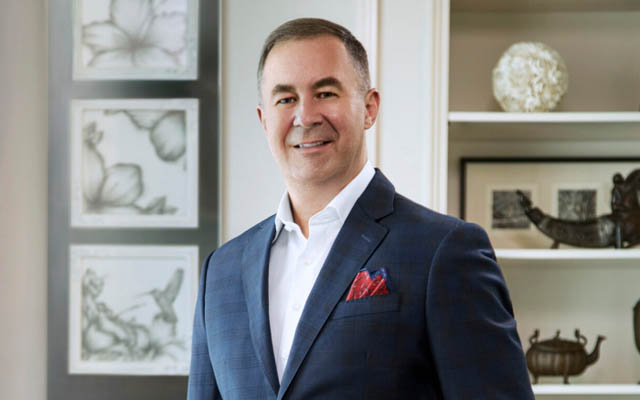
Juergen Kreipl is the new general manager of Four Seasons Hotel Jakarta.
A seasoned hotelier with over thirty years of experience in global luxury hospitality, Kreipl’s enthusiasm is already driving results, with exciting new programming in the pipeline.
He most recently served as general manager of InterContinental Genève in Switzerland.
Family reunions through overseas vacations were a common sight as Covid-19 fears waned, isolation ended and international borders progressively reopened to travellers throughout 2022. This trend looks set to stay, with travel and tourism companies describing family travel as a growing and promising segment.
According to Agoda’s Family Travel Trend survey 2022, conducted in partnership with YouGov and released in December 2022, four out of five travellers will take a vacation with their immediate family in the next 12 months.
Four out of five travellers will take a vacation with their immediate family in the next 12 months, finds Agoda and YouGov study
The survey polled 10,000 travellers aged 18 and above from across Australia, Singapore, Malaysia, Indonesia, Thailand, Indonesia, the Philippines, Japan, Vietnam, Taiwan, South Korea, and the US.
While travelling with friends proves more popular than travelling with extended family, 52 per cent are keen to catch up with relatives on their vacation.
Travellers from Singapore (61 per cent), Taiwan (61 per cent) and Vietnam (59 per cent) are most likely to take at least one trip with immediate family, while the Philippines (47 per cent), Indonesia (40 per cent) and Malaysia (35 per cent) are most likely to plan two or more family jaunts in the coming year.
Family groups have featured strongly throughout 2022 for The Lux Collective’s portfolio of properties across Mauritius and Reunion Island, the Maldives and China, with Asian groups typically drawn to Lux* South Ari Atoll. In China, Lux* Chongzuo in Guangxi and the seven Lux* Tea Horse Road resorts in Yunnan are still attracting the domestic crowd since international travel access had only just eased in February.
The company’s CEO, Paul Jones, said this segment is lucrative, as it typically consists of five to six people per group across two to three generations; families prefer villas or interconnected rooms/suites that offer ample space for everyone, and they stay for six nights on average; family groups also gladly splurge on F&B, spa and group activities within the hotel or resort, observed Jones.
Amenities such as pools, kids’ clubs and family-friendly activities also score well with such multi-generational travel groups.
Family travel “continues to drive increased occupancy” this year, said Jones.
“We see a strong demand for family-friendly accommodation and experiences, as families prioritise quality time travelling together and creating memorable experiences post-Covid,” he said.
Family bookings are on the rise too at Radisson Hotel Group’s resorts. Andre de Jong, area senior vice president, South East Asia and Pacific, told TTG Asia that the Radisson Blu Resort Maldives, for instance, has seen “significant pickup in bookings of the family villa room type”.
The preference for spacious accommodations is not only driven by the need for comfort but also by the desire for more privacy and quality family time.
“We foresee demand continuing to increase with the return of multi-generational travel, thanks to the reopening of the Chinese market. Additionally, we are seeing positive trends in the Australian and European markets, especially during the school holidays,” said de Jong.
He pointed out that “families are increasingly travelling together for leisure and are willing to spend more on accommodation and activities”.
Shared wanderlust is benefitting tour operators too. Nick Lim, Asia CEO at The Travel Corporation (TTC), noted that whole family trips are on the rise for his brands since the resumption of travel, peaking during the school holidays.
Lim said improving ease of travel and greater confidence in vaccine efficacy for children and teenagers have helped to grow the appetite for travel among families. While there are still months to go before the November and December school holidays, families have booked up Trafalgar and Uniworld’s Christmas itineraries.
Escorted tours work great for families, as “(they) can sit back, relax and not worry about planning, safety or the complexity of coordinating transportation”, opined Lim.
He observed that family groups travelling with TTC brands are “worldly and often curious about the history, culture and the way of life of local people”, and they prefer “local, authentic experiences that connect them to their destination”.
“Tours with TTC are enriching for the entire family because children are exposed to the culture of the destination and of their fellow travellers from all over the world. Guests walk away from the destination with more than what history books can teach them,” he said.
A family visiting Italy can participate in Trafalgar’s Gladiators, Gondolas and Gold itinerary, where they will experience life as a gladiator at a Gladiator School in Rome
Family lures
Hoteliers say families from different geographical markets have specific holiday preferences.
Jones noted that European families typically seek out enriching programmes at kids’ club for the little ones, while the adults go for spa, watersports and cooking/pastry classes on their own.
De Jong said US and European families prefer off-site or outdoor activities that allow children to explore and discover the destination and immerse in local culture.
As for the Asian market, both Jones and de Jong agree that families tended to value time spent together.
“It is important to understand the different preferences of families from different markets that will enable them to reconnect with loved ones and create memorable moments together. By tailoring our offerings to cater to these preferences, we can ensure that families have a memorable and enjoyable vacation experience,” said de Jong.
That said, de Jong emphasised that “certain basics” remain for engaging families. Radisson Hotel Group’s family programme, Rad Family, is designed to enable families to create memorable moments together, no matter which property they are spending time at. F&B is an integral part of the programme, where hearty and healthy kid-friendly meals contribute to the complete vacation experience.
Launched in 2019, Rad Family is being rolled out progressively across hotels and resorts in the South-east Asia and Pacific regions. Pilot programmes are in the works for Radisson Blu Phu Quoc Resort in Vietnam and the soon-to-open Radisson Collection Resort Galle in Sri Lanka.
Over at The Lux Collective, collaboration with external partners ensures activity-packed vacations for its guests. A variety of family experiences are brought in throughout the year, such as Expert-led Workshops conducted by professional trainers and collaborators to deliver a mix of education and entertainment for everyone in the family.
Placing further emphasis on quality guest experiences, the company’s flagship brand Lux* recently unveiled a new Life Extraordinary campaign, through which breathtaking adventures, such as swimming alongside the whale sharks as a family, are curated under the banner, Extraordinary Experiences. These add to Lux* resorts’ signature onsite offerings, from tailor-made Lux* ME Spa and wellness sessions to unique guest activities like junk art galleries and film screenings on the beach.
Jones said all properties under the group are designed with families in mind. Interconnecting rooms are available in Lux* Le Morne, Lux* Grand Gaube, Lux* Belle Mare, and Lux* South Ari Atoll, while the Play kids club in all properties offers programmes for the young ones as well as for everyone in the family.
Differences in holiday preferences are also seen through tour choices. Lim noted that different TTC brands attract families with different priorities. For example, families that seek value and choice of experiences tend to pick Costsaver tours, while those that crave enriching experiences tend to gravitate towards Trafalgar tours.
That said, family group bookings are especially strong with Trafalgar.
“Trafalgar has the most comprehensive list of itineraries and experiences of all tour brands, with over 300-plus tours in our arsenal,” said Lim.
This year, Asian families keen to discover Europe can bookmark Trafalgar’s eight-day Christmas Markets of Austria, Germany and Switzerland. The tour calls at magical market stalls and spotlights old-world traditions, local craftsmanship and mesmerising city backdrops.
For families looking to customise their experience, Costsaver’s seven-day Jewels of Italy shines.The tour uncovers centuries of tradition, heritage, and culture, while visiting iconic landmarks such as the Leaning Tower of Pisa.
Young adults who are looking to treat their parents to a premium holiday can consider the nine-day Best of Britain tour from Insight Vacations. Traversing Scotland, Wales and England, families visit the most magnificent sights in the UK, including Edinburgh Castle, Stonehenge and the English Lake District.
Fully on-site this year, the upcoming Thailand Travel Mart Plus (TTM+) 2023, organised by the Tourism Authority of Thailand (TAT), will be held from May 31 to June 2 at the Queen Sirikit National Convention Center, Bangkok.
Serving as an invaluable business and networking platform for the travel trade, this year’s event is expected to attract over 850 participants, including 350 buyers from 50 countries, 400 sellers from across all five regions of Thailand, as well as 100 local and international media.
Buyers include those from key source markets such as Europe, ASEAN, East Asia, America, and Australia, as well as emerging markets such as Eastern Europe, Middle East, South America and South Africa.
The scheduled line-up of TTM+ 2023 features an opening ceremony, updates on Thailand’s tourism offerings, a TTM Talk for buyers and media, on-site appointment sessions, a welcome reception, as well as a product update on the Greater Mekong Subregion.
Participants can also expect buyer-seller appointments along with a networking lunch and business networking happy hour session.
There are also three pre-tour programmes from May 30 to 31 and six post-tour ones from June 3 to 5. The tour programming centres on meaningful travel, placing emphasis on experience-driven tourism activities, as well as showcases Thai cultural values through the kingdom’s 5F soft power foundations of food, film, festival, fight and fashion.
Additionally, TAT is also hosting the Amazing Thailand Culinary City event, alongside the TTM+ 2023, during the same dates and at the same venue.
Building on its stellar record Last year’s edition at Phuket recorded high levels of satisfaction among attendees on the quality and diversity of the programme, as well as business garnered.
The two days of buyer-seller appointments yielded about 8,000 business appointments and generated about 1.29 billion baht (US$38 million) revenue for the Thai economy.
As the TTM+ was held for the first time in Phuket last year, the 277 buyers from 42 countries and international media had the opportunity to see many of the new tourism offerings that have emerged there and the rest of Thailand post-lockdown, as well as the kingdom’s readiness to welcome international tourists in the new normal.
First held in 2001, the TTM+ has gained a reputation in visitor source markets worldwide and within Thailand’s tourism industry as a “must-attend” event on the travel trade calendar.
Held mostly in Bangkok each year since its launch, the event was relocated to Chiang Mai in 2016-17, Pattaya in 2018-19, and then Phuket in 2022 as part of the TAT’s strategy to promote provincial destinations.
Keen to find out more about Thailand’s leading annual travel trade event? For more information on the TTM+ 2023, visit here.
For buyer and seller registration requirements, find out more here.
Email: info@thailandtravelmartplus.com
For the latest news and updates in Thai tourism industry, visit here.
Following the past years of travel lockdown and subsequent resumption, the wider travel and tourism industry has changed drastically – the landscape, how industry players operate, how consumers behave, and what we know of the changing consumer. New observations, predictions, forecasts about today’s travel trends, traveller segments and impetus for travel have been common topics. However, among this list, is the lesser addressed travel intent: visiting friends and relatives (VFR).
In a global survey conducted by GlobalData, VFR trips were the second most common type of travel (46%) pre-COVID (2019). Consequently, VFR trips are expected to be a key driver in the recovery of the travel industry with a forecasted 17% compound annual growth rate (CAGR) between 2021-2025 with an expected 242 million international departures.
Dr Luciano Lopez, Associate Dean, EHL Undergraduate School
What do we know about VFR trips and travellers?
Dr Luciano Lopez, Associate Dean of EHL’s Undergraduate School, and his co-author Dr Thomas Davoine, Assistant Professor at EHL Hospitality Business School have observed a correlation between VFR trips and the source and volume of remittances in their paper titled ‘Remittances and Inbound International Tourism Demand’. A determinant of the potential volume of inbound tourism for the purpose of visiting friends and relatives can be established by the source market of remittances sent by immigrants.
Similarly, tourism receipts correspond to the volume of remittances from its top source markets. In 2017 India received the highest amount of transfers globally with its top three receipt source markets being UAE, USA and Saudi Arabia. The correlation between the top remittance geographical source and India’s key outbound tourism destinations is evident with their top three travel destinations: UAE, Saudi Arabia and USA. Amongst the total recorded tourist expenditures of Indian travellers, USA was tracked to have the highest level of tourism receipts by Indian travellers, followed by Qatar and Saudi Arabia and UAE.
With such insights, we are able to better anticipate the key source markets for VFR trips and are therefore more equipped to tailor the available product and service offerings in the wider travel and tourism industry, (be it airline routes, accommodation and tour offerings), to cater to this segment’s preferences, consumption and travel behaviour and potential expenditure.
Hospitality Finance & Economics Conference 2023
Discover more about Challenges, Opportunities and Innovation in the Hospitality and Real Estate Industries in the 7th edition of the annual Hospitality Finance & Economics (HFE) Conference which will be held in Singapore for the first time this June at EHL Campus (Singapore). Jointly organised by the leading academic hospitality reference, EHL Hospitality Business School and National University of Singapore’s Institute of Real Estate & Urban Studies (IREUS), HFE 2023 provides a platform and forum where industry experts and key academics in the hospitality finance, economics and real estate will provide insights into:
ESG in investment, financing, development and operations
Urban development and environment
Circular economy
Advanced technologies such as machine learning, AI, blockchain, tokenization and metaverse
Big data
Register by 10 June to enjoy Early Bird ticket prices for the upcoming Hospitality Finance and Economics Conference 2023. Tickets are available for purchase here.
Find out more about the Hospitality Finance and Economics Conference 2023, its panel of speakers and presenters, and conference programme here.
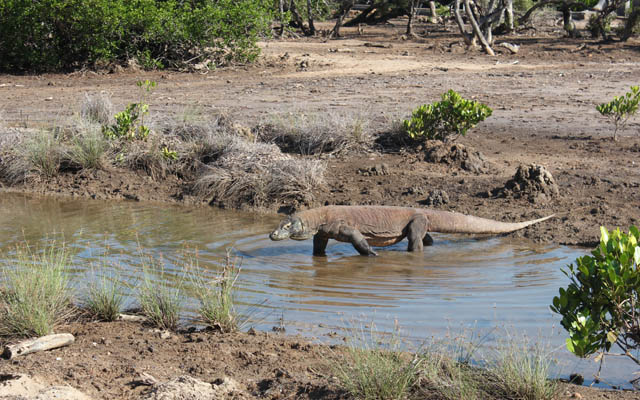
Flobamor, the travel services management of Komodo National Park, has increased the ranger fee (also known as the naturalist guide service fee) as of May 1, a move that travel industry players in the area say will negatively impact the destination’s image.
Tourists to the park are required to pay ranger fees in order to access to certain spots within the park, with varying rates for different areas. New fees range from 400,000 rupiah (US$28) for short tracks to 450,000 rupiah for long tracks per visitor.
Komodo National Park has increased the ranger fees to which travel industry players in the area say will negatively impact the destination’s image
Previously, the rate was set at 120,000 rupiah per group of five tourists.
The fee revision follows soon after Flobamor agreed in January to axe plans to raise Komodo National Park fees.
Abed Frans, chairman of the East Nusa Tenggara (NTT) Association of Indonesian Travel Agencies (ASITA), criticised Flobamor for failing to discuss the move with stakeholders and making the change arbitrarily.
He accused Flobamor of proceeding with fee adjustments under the guise of ranger fees, despite having agreed to cancel its desired entrance fee hike.
Flores Exotic Tours’ director Leonardus Nyoman said that ranger fee hike was unnecessary, as there were no guides accompanying tourists in reality.
“Even if there are, (these guides) are not equipped with basic knowledge about the history of national parks and (some) do not even speak English. Now, tourists are charged a guide fee which costs more than the entrance fee (150,000 rupiah per person on weekdays and 225,000 rupiah on weekends). This is outrageous!” said Leonardus.
To make matters worse for travel players, the fee increase comes at a time when most bookings for the year have already been confirmed and payments made.
Pacto COO Umberto Cadamuro remarked that inconsistencies in park fees could affect Indonesia’s image as a country in the long term and turn partners and overseas clients away to other destinations.
Due to the furore over pricing adjustments, trade players had asked the government to discuss changes with them well ahead of time.
“This helps us in creating new tour package prices. The tourism industry is a ‘future’ business, where what we sell today will only materialise next year,” explained Cadamuro.
Responding to the protest, the Ministry of Environment and Forestry (KLHK), which governs Komodo National Park, has ordered Flobamor to revoke its ranger fee hike.
In addition, Flobamor has to produce within the next four to six weeks a standard operating procedure for raising its service quality to match the higher tariff adjustment. Stakeholders will then assess the suitability of the rates to be applied with the quality of the services to be provided.
Flobamor will also need to demonstrate good governance in its tariff adjustments.
Auckland Airport has reaffirmed its commitment towards building an integrated domestic and international terminal, as well as developing a number of key surrounding projects such as a new Transport Hub and outlet shopping destination Mānawa Bay, all of which will amount to a significant investment of around NZ$3.9 billion (US$2.5 billion).
The terminal integration programme – a significant part of the airport’s wider 10-year-capital programme – will bring domestic travel and international travel together under the same roof for the first time since 1977, via an expansion at the eastern end of the existing international terminal building.
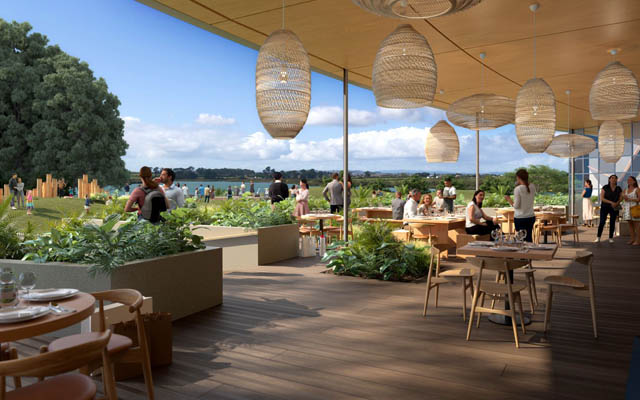
Mānawa Bay will feature an al fresco space
Set to open between 2028 and 2029, Carrie Hurihanganui, Auckland Airport’s chief executive, said that the new integrated terminal “will make Auckland Airport fit for the future”, and provide an improved experience for travellers.
Domestic jet to international transfer will involve a brief five-minute indoor walk, while state-of-the-art check-in facilities for both domestic and international travellers will save traveller time and reduce friction at either end of a flight. The Transport Hub on the doorstop of the international terminal will also offer links to public transportation.
Airlines will be supported by new gates and other facilities to help them speed-up turn-around processes.
The new combined terminal will add floor space across two levels to the existing international terminal building, with the wider integration programme including significant upgrades to airfield pavement and underlying utilities. Some 2,000 additional jobs will be created as a result of the project.
The airport has also set its eyes firmly on a low carbon future, and is investing heavily in sustainability.
“We have worked very closely with major airlines to understand their needs and requirements, including the investment they’re making in larger domestic aircraft, and their planned future low carbon aircraft. We are supporting airlines by installing ground power units at each gate to supply power to aircraft, helping to reduce fuel use,” elaborated Hurihanganui.
Along with ground power units for aircraft, the upgraded airfield surrounding the new combined terminal will provide charging for electric ground handling equipment and vehicles. Design and construction materials for the combined terminal will be selected to reduce the building’s carbon footprint as much as possible, alongside a focus on waste minimisation and water efficiency.
She noted: “Without the right airport infrastructure, any airline aspirations to a low carbon future will not be achieved.”
While the new combined terminal is under construction, domestic travel will continue to operate from the existing domestic terminal. Hurihanganui noted that facilities such as bathrooms, helpdesks and dwell spaces in the existing domestic terminal will also undergo an uplift to ensure travellers remain comfortable.
One of Auckland Airport’s other developments is Mānawa Bay. Currently under construction and set to be completed late 2024, Mānawa Bay will comprise 100 retail shops, an expansive al fresco space, a play zone for kids, and a dining precinct with possibly 13 F&B operators. The dining precinct will have a zero natural or LPG gas policy, which is expected to eliminate up to 57 per cent of greenhouse gas emissions from its kitchens.
Speaking at TRENZ 2023, Hurihanganui shared: “Cutting out the use of gas on site is an important step towards achieving a 5 Green Star rating for Mānawa Bay and supporting Auckland Airport’s decarbonisation pathway to achieve net zero direct carbon emissions by 2030. It is one of several initiatives that we hope will support the way future developments of this kind are planned.”
Mānawa Bay will also support the largest rooftop solar system in the country. With the ability to generate 2.3 megawatts of power, the solar array is planned to support more than 80 per cent of the shopping centre’s anticipated power usage.
The Singapore Hotel Association (SHA) has teamed up with the Singapore Business Federation (SBF) Foundation to establish a S$300,000 (US$225,818) industry-led Compassion Fund for hotel employees in Singapore.
In 2021, SHA had commemorated its 60th anniversary with a pledge of S$150,000 to render emotional and financial assistance for employees in need within the industry, in support of SBF Foundation’s call for trade associations to care for employees in need within the industry.
From left: Singapore Business Federation Foundation’s Janet Ang; Singapore Hotel Association’s Margaret Heng and Kwee Wei-Lin at the launch of the Compassion Fund
SHA’s donation was then matched dollar-for-dollar to set up the SHA-SBF Foundation Compassion Fund.
“Beyond financial assistance, the fund serves as a safety net for our colleagues, providing a sense of security and assurance that SHA and our members are here to support them in times of need,” said Kwee Wei-Lin, president of SHA.
“It will alleviate emotional stress during personal crises, which is crucial in maintaining mental wellness and service excellence at the hotels. Through caring for our own colleagues, this would further amplify our industry’s commitment to care for employees in need,” Kwee added.
SHA, which represents the collective voice of 160 hotel members in Singapore, will inform members how this fund can complement their support system for eligible employees.
How did the idea for Song Saa Private Island come about and what were your priorities? When I first visited the Koh Rong archipelago in 2006, the twin islands were in a state of decline. The waters were over-fished, the forest on one of the two islands had been cut down, the land was covered in rubbish and the reef system surrounding the islands were marred with litter and black sludge from fishing boats.
There was immediately a deep sense of commitment to start picking up the rubbish and work with nearby communities to regenerate the environmental ecosystems. With overwhelming support from communities, we set up Cambodia’s first marine protected area. Within the first 18 months, we saw fish stocks start to come back, with regular sightings of baby barracudas, seahorses and spotted sting rays.
We were able to formalise Cambodia’s first protected marine reserve, Koh Ouen Marine Reserve, in 2007. We were then granted a lease over the twin islands and surrounding reef system with the commitment to invest and protect. In 2012, we built on our conservation efforts to develop Song Saa Private Island resort. In 2013, we launched Song Saa Foundation to continue the extensive conservation efforts and community development initiatives, while promoting responsible tourism.
How important is sustainability in tourism? The dictionary definition is “fulfilling the needs of current generations without compromising the needs of future generations, while ensuring a balance between economic growth, environmental care and social well-being”. However, in tourism, we are sadly way past this. We are in a state of crisis in terms of any kind of global balance. As an industry, we need to be striving for positive impact in and around the areas where we are travelling to, or where our properties are based.
While I truly believe tourism can be a powerful force for good, there needs to be a seismic shift in the industry’s mindset to become collectively aware of, and therefore accountable for, the invisible burden of tourism. Not just the untold impact on the environment, but also on local communities – their heritage and culture. As hoteliers and developers, we need to be working with local governments and ask how we can support them.
How do you embrace regenerative travel? Regenerative travel is more than just selecting a property that is protecting the natural environment and banning single-use plastic. To be a regenerative traveller, it is equally important to look at the property’s relationship to its surroundings and communities. However, we also need to look beyond the walls of the hotel and look at where this property exists within its community and how travellers should show up in these communities when exploring. Whether it’s an ancient temple, pagoda or local restaurant, how we dress and interact is important to help preserve local culture and its heritage.
How do you involve local communities in your projects? I’ve always seen our role to serve the communities in which we work and live. Our commitment to ensuring the well-being of the Song Saa team and surrounding community is equal to that of our guests.
For example, Song Saa Foundation strives to serve the community through a range of initiatives, including medical missions, environmental educational programmes and organic farming support. Some projects are designed for the local community as the end user, such as our Library of Hope, a partnership with Room to Read to increase literacy rates of children in the archipelago.
Other projects are designed to include the local community in the process, such as our Solid Waste Management project, a collaborative effort with the local community to design a management system, including educational workshops, a waste management station and a waste collection team.
What is your latest project, The Song Saa Reserve in Siem Reap? We are currently developing Song Saa Reserve, an extensive 200-plus hectare mixed-use eco-park, setting a foundation for hotels, villas, conservation initiatives and hospitality training centres – all powered by renewable energy. The project entails a strong commitment to the regeneration, restoration and resilience of the project site and its surrounds.
This includes a commitment to rewilding indigenous fauna and flora, the restoration of rainforest and wetland communities, the conservation of Khmer heritage and the sustained improvement of local livelihoods. This is all while partnering with the world’s best developers, hotel companies, designers, technologists, conservationists and thought leaders to create a pioneering destination for residents and tourists to immerse in Cambodia’s cultural heritage, natural beauty and personal charm.
A new report published by the Asian Development Bank has taken a wide view of South-east Asia’s aviation market, tracking its development prior to the pandemic, assessing the impact of the first two years of the pandemic, and looking deeply into the post-pandemic period to offer various recovery scenarios as well as numerous recovery strategies.
Titled Landscape Study on Southeast Asia’s Aviation Industry: COVID-19 Impact and Post-Pandemic Strategy, the report states that the region, as it emerges from the pandemic, faces a short-term future that is somewhat different from 2019.
The report follows the development of South-east Asia’s aviation market before, during and after the pandemic
Chinese airlines are temporarily absent which allows a higher share of traffic to be gained on some routes. Airlines from the Middle East and Türkiye have continued to respond actively to opportunities. It thus assess market opportunities with a renewed focus on intra-South-east Asian traffic and the large and growing India market emerging as areas where the regional aviation industry should concentrate.
The study also addresses infrastructure issues in depth, particularly of capacity shortages around the region’s major and secondary airports and likely delays in new infrastructure; and new technology adoption that enable regional airports to operate more efficiently.
The report states that South-east Asian aviation has been remarkably resilient in the face of a pandemic, which stretched the industry far more than any conceivable financial modelling scenario would have taken it. Companies and governments have innovated and been flexible in their responses. Many taboos were broken out of necessity, and lessons learnt during the pandemic will have a long-term effect on shaping the industry.
The full report can be downloaded for free, while a paperback version is available for sale at US$33.



 He most recently served as general manager of InterContinental Genève in Switzerland.









 How did the idea for Song Saa Private Island come about and what were your priorities?