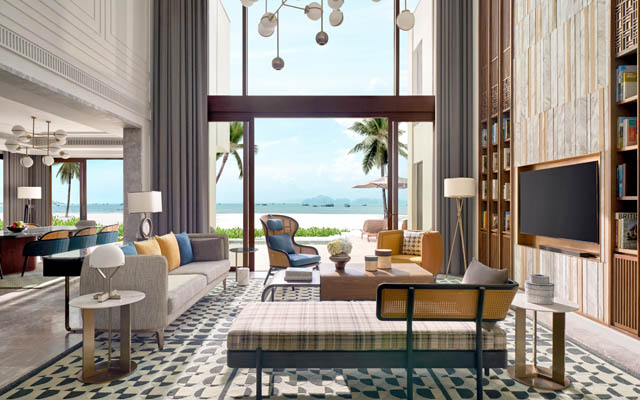
Lacol Khao Yai – A Chatrium Collection has announced a special introductory Discover More offer for travellers who seek an elevated retreat surrounded by the lush landscape of Khaoyai National Park.
Starting at just 3,300 baht (US$89) per room per night, this offer is valid for stays with a minimum of three consecutive nights from now to October 31.
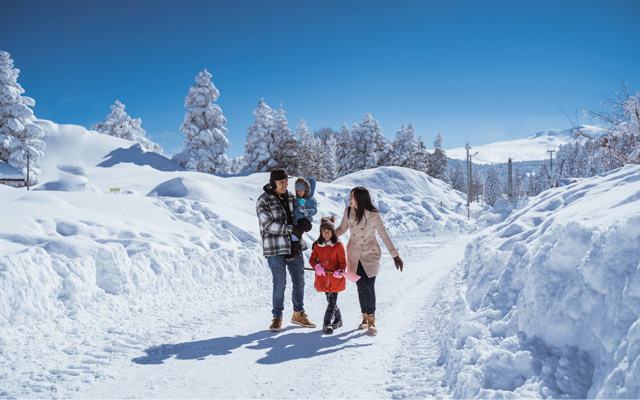
Guests at Lacol Khaoyai – A Chatrium Collection can enjoy the lush landscape of Khaoyai National Park
The package includes daily breakfast for two, welcome minibar, and complimentary in-room Wi-Fi.
The eagerness and confidence to traverse the globe among luxury travellers is palpable, as many have moved away from material extravagance to seeking more emotional fulfilment through the creation of cherished memories with loved ones through quality travel time.
Mark Wong, senior vice president, Asia Pacific, Small Luxury Hotels of the World (SLH), told TTG Asia at the recent ILTM Asia Pacific 2023 that the appetite for travel among the region’s luxury travellers is “voracious”. This is reflected in the group’s average daily rate (ADR) performance – while worldwide ADR has climbed 35 per cent against 2019, that figure in Asia-Pacific is 71 per cent.
Luxury travellers see spending time with family or friends as an essential part of a fulfilled life
Reflecting on the altered approach to travel, Michelle L Woodley, president, Preferred Hotels & Resorts, said: “The world has changed significantly in recent years, and the importance we now attach to our well-being and the well-being of our families is reflected in our travel decisions. Leisure breaks are no longer about pure escapism or a time to switch off, but rather, an opportunity for travellers to reconnect with loved ones, culture, and themselves.”
Booking behaviours are also reflecting a greater demand from luxury travellers for more meaningful, community-led experiences and wellness-centric programming, she added.
Additionally, Preferred has noticed an increase in length of stay – now up to 4.5 nights instead of three – which Woodley said has “positively impacted its Asia-Pacific properties in India, Thailand, Indonesia and Japan”.
This desire for reconnecting with the outdoors and quest for quality travel experiences have also been noticed by Wong, who shared that luxury travellers are “pursuing restorative and recuperative benefits more than ever, and searching for a greater connection to themselves, their families and the world around them, leading to a rise in multi-generational holidays”.
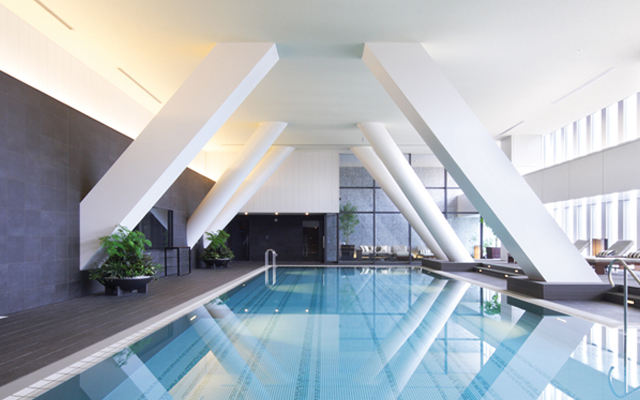
The Capitol Hotel Tokyu in Tokyo is a member of Preferred Hotels & Resorts
That is why SLH’s portfolio of private islands like Raiwasa Private Island in Fiji; the remote Wa Ale Resort which boasts barefoot luxury and a stellar sustainability programme; and Chalets at Blackheath, tucked away in Australia’s UNESCO-listed Blue Mountains among one million hectares of national parkland, have risen in popularity.
Similarly, Paul Jeffels, luxury travel consultant of Thailand-based 360 Private Travel – who handles the Singaporean and Hong Kong luxury outbound market – noticed that reconnecting with family all over the world and combining that with a multi-generational side trip is currently a “huge market”.
There has also been a marked shift back towards the reliance on travel agents.
“Time wasted doing nothing during the pandemic has made luxury travellers focused on maximising enjoying and reducing hassle, which is why our guests are going back to travel agents to plan their itinerary. SLH’s voice reservations division has seen a two-fold increase in calls,” Wong said.
Linda Law, general manager Hong Kong, 360 Private Travel, agreed: “Our clients in Asia are all eager to travel, are now willing – more than ever – to work with a professional travel advisor. Many of them are also open to trying out different (destinations or itineraries) as advised by us.”
As to countries luxury travellers are gravitating towards this year, travel agents provided a mixed bag of responses.
For Elgin Xiao, private designer with Singapore-based Intriq Journey, exotic Egypt has “picked up very fast this year”, while stalwarts Japan and Italy remain favourites.
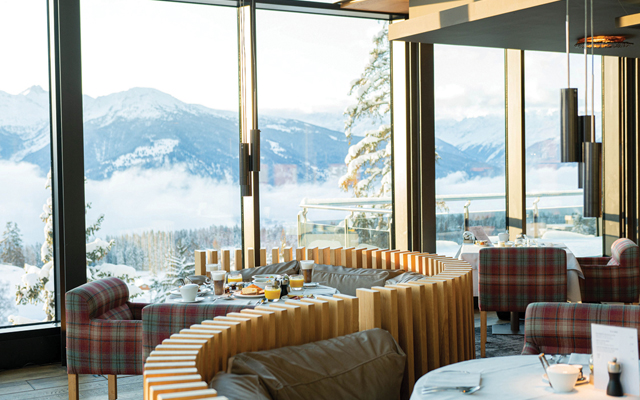
Crans Ambassador, a luxury ski hotel in Switzerland, is a member of the Small Luxury Hotels Group
Law’s Asia-Pacific clients are also opting for Japan and Italy, along with other European destinations like Switzerland, France, and Spain. This observation reflects Heaven’s Portfolio’s summer bookings, with Italy, France, Switzerland, and the UK looking strong, noted Christine Galle-Luczak, founder and managing director of the company, which represents various properties in sales and marketing.
Meanwhile, Jeffels’ Singaporean clients are opting for adventurous destinations like South America, while those from Hong Kong prefer “familiar” options like Japan and Thailand – specifically Phuket and Bangkok.
As for SLH, the group sees Croatia, Norway and Morocco entering its 2023 top destinations list, alongside the top three perennially favourites Italy, Japan, and the Maldives.
This shift towards less popular destinations could be attributed to luxury travellers eagerly wanting to check items off their bucket list.
Preferred’s customers are planning and booking aspirational or bucket list trips to destinations or destination hotels that focus on exclusivity, insider knowledge, and personalised itineraries.
Galle-Luczak is also seeing the younger affluents (ages 18-34) prioritising bucket list adventures, with 30 per cent having done so in the past year. The pandemic has “emboldened the philosophy of ‘you only live once’, so many affluents are moving their bucket list items forward”, she reasoned.
Macau is looking to further enhance its international image as a tourist destination through high-profile events and activities.
Some of these include the Macao International Travel (Industry) Expo in late June and the Global Tourism Economy Forum in September. While these will no doubt attract business leaders, a whole set of fun events is also ready to charm fun seekers. The Macao Government Tourism Office (MGTO) has also lined up Art Macao: Macao International Art Biennale; the Macao International Fireworks Display Contest which returns this September and October for its 31st edition after a hiatus of three years due to the pandemic; the Macau Grand Prix, which celebrates its 70th edition in November; and Light Up Macao at the end of the year.
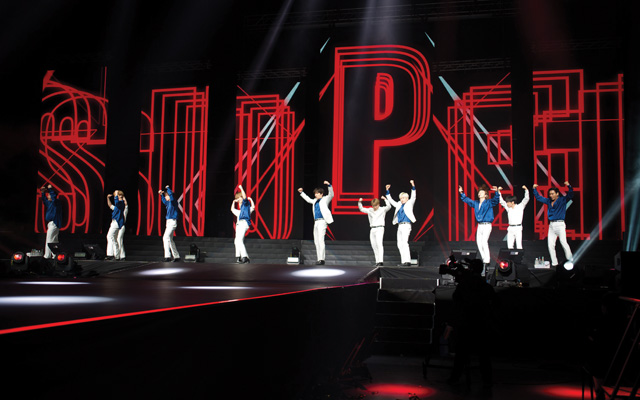
South Korean boy band Super Junior performs at Galaxy Macau
According to MGTO, high-profile concerts, along with spike in non-gaming entertainment hosted by the six integrated resorts (IR) and leisure enterprises, will continue to provide visitors with new impetus to take a vacation in Macau. These non-gaming investment commitments are a requirement that comes with the gaming concession contracts announced in December, all to support the government’s objectives in promoting Macau’s economic and industrial diversification.
In line with this, Sands China has defined its vision and strategy for the next decade. It has set aside 30.2 billion patacas (US$3.7 million) worth of financial commitment through 2032, with 27.8 billion patacas going to non-gaming projects.
President and executive director of Sands China, Wilfred Wong, said at the recent Asian IR Summit: “As IR operators, it is crucial that we continually push boundaries and enhance guest experiences through innovation. We must evolve and reinvent ourselves to stay ahead of the curve and set the benchmark for best-in-class IR offerings.”
Sands China’s focus will include investments in Macau’s dining scene, with an additional 10 outlets set to open. Coming right up is The Gordon Ramsay Pub & Grill and The Mews, which will open later this year.
Over at Studio City, phase two developments have launched. Macau’s all-new, all-weather 10,000m² water park is welcoming guests now, while what is said to be Asia’s first-ever residency concert series is currently underway at Studio City Event Center. The latter kicked off with Hong Kong superstar Joey Yung concerts in April.
Even more will emerge across Macau.
Event specialist, smallWORLD Experience, which has pivoted its focus to the local market following the Covid disruption, is now doing brisk business with entertainment concerts.
Rua de Nossa Senhora do Amparo
Its executive director and partner, Bruno Simões, said: “Large concerts playing at The Venetian Macao and Galaxy Arena (part of Galaxy Macau) have a crucial role in Macau’s destination marketing. They elevate Macau’s status as a destination. This is particularly true in the Greater Bay Area, where most of Macau’s visitors come from. These events not only enhance visitor experiences, but they also ignite retail and casino businesses.”
Simões told TTG Asia that his company was supposed to produce 45 concerts in 10 months in the destination, following a successful bid with the Cultural Affairs Bureau.
“But, because of the pandemic, we ended up doing 25 different concerts and 75 different performances from November 2022 to April 2023,” he said, adding that the events were successful in drawing visitors to Taipa Houses, as well as highlighting the local music scene, fostering local talent, and stimulating local economy.
With community tourism as one of the drawcards, MGTO has approved subsidies for 42 special projects slated to kick off between April and December this year.
These projects encompass themes of enhancing community-based tourism, celebrating gastronomic culture, and promoting maritime tourism. They aim to consolidate the unique characteristics of different districts, incorporate fresh tourist attractions in Macau, and introduce a diverse range of tourism products and experiences by merging various tourism elements.
MGTO has also made it a requirement for event organisers to work with local SMEs.
Ultimately, these efforts will revitalise the community economy.
In terms of access, Macau is seeing improving air services with key international visitor source markets, such as South Korea, Japan and Thailand.
Tiger Air resumed services from Taipei and Kaohsiung from July 1, while Air Macau boosted its services from Singapore from four a week to seven since July 12.
The annual TTG Travel Awards returned yesterday evening with its 32nd edition which commemorated 66 exceptional travel and tourism players across Asia-Pacific.
This year, there were three new inductees into the TTG Travel Hall of Fame, an accolade reserved for those who have taken home a TTG travel award 10 consecutive times. They are Harbour Plaza, Phoenix Tours, and Resorts World Sentosa.
Philippine ambassador Millicent Cruz Paredes (left); and TTG Asia Media’s Darren Tan (right), presented Singapore Airlines’ WK Lim (centre) with the first TTG Travel Hall of Fame accolade
Several recipients that successfully defended their titles include Centara Grand & Bangkok Convention Centre at CentralWorld (Best Meetings & Conventions Hotel), Scoot (Best Low Cost Carrier), Frasers Hospitality (Best Serviced Residence Operator), and Corporate Travel Management Asia (Best Corporate Travel Agency).
For 46 others, it was the first time they ever won a TTG Travel Award. These new winners include Marina Bay Sands (Best Integrated Resort), Kempinski (Best Luxury Hotel Brand), Temple Tree Resort Langkawi (Best Boutique Hotel), Hamad International Airport (Best Airport), and The Standard Mahanakhon (Best New City Hotel).
The Outstanding Achievement Awards category – the only non-voting segment of the awards, with winners determined by TTG’s editorial team for their remarkable contributions to the industry – recognised Singapore as Destination of the Year; Tourism Authority of Thailand for the Best Travel Marketing Effort awards; and Marriott for the Most Sustainable Travel Company award.
The gala event was held at Centara Grand at CentralWorld, and coincided with IT&CM Asia and CTW Asia-Pacific double-bill event in Bangkok from September 26 to 28.
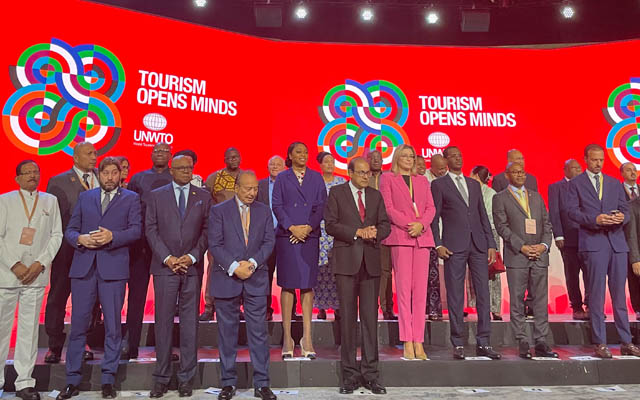
How to invest better in people, planet and prosperity to deliver a greener, more resilient and increasingly future-proof form of tourism was the focus of UNWTO delegates at Saudi Arabia’s capital Riyadh as celebrations continue for World Tourism Day.
On the second day of the organisation’s conference, Tourism & Green Investments, UNWTO secretary-general Zurab Pololikashvili invited the 500 delegates from 120 countries to identify and act on the big questions being asked.
Ministers unite at the World Tourism Day celebration in Saudi Arabia’s Riyadh (Photo: Kathryn Wortley)
Saudi Arabia’s vice minister of tourism Haifa Al Saud said delegates “have the power to shape the industry”, and that the industry can be “a force for good: bringing people together, bridging cultures and providing prosperity”.
Anita Mendiratta, special advisor to UNWTO, said host Saudi Arabia is providing “a benchmark for (delegates) to follow” in this regard, reflected in the nation’s US$7 trillion spending in development on six giga projects through its Vision 2030.
One project on the north-west edge of the country, Neom, is expected to attract up to five million visitors annually while another, Amaala, on the north-western Red Sea coast, aims to be a resort and wellness destination featuring 1,500 luxury hotel rooms.
Integral to all the projects is the integration of tourism with local communities as a source of jobs and economic empowerment while protecting the environment.
“Social cohesion is very important, and we need to see the resilience we have built in the past few years in our tourism plans. We need to ensure the ecosystem works together to withstand ups and downs,” said Saudi Arabia’s minister of investment Khalid Al-Falih on how tourism investment should be approached.
In building for the future, though, it is vital that stakeholders remember to think global when making green investments in tourism, but act local in retaining their own uniqueness, as people are attracted to the authenticity of a place, he concluded.
Hotel and resort design is evolving – from a temporary place to stay at, to a liveable experience that considers the land, community, culture, climate change, and a slew of other factors.
Jose Claudio Silva, design principal of Singapore-based architecture and master planning practice 10 Design, foresaw hospitality building operators, owners and designers to be increasingly “truthful to culture and unique experience within the location and its surroundings”.
Silva: things are changing and will change the way we perceive spaces
“There are places with character, places that will grow beyond just spending a night, having a good sunset (view) or (enjoying) a nice and beautiful experience,” Silva said in an interview at the recent Hospitality Philippines Conference 2023. He remarked that “destinations and hotels” should have “added value for the person”, such as providing a cultural education or more during the hotel stay, for example.
“Things are changing and will change the way we perceive spaces, the way we make social spaces, common spaces; even the rooms will change so that it is a life experience right now,” he emphasised.
However, what is relevant for building planners may not be the same in the future and the principles and preferences of the millennials – the techno-holics – may not be the same in 20 years. Silva pointed out that each generation has life-marking events, like the changes wrought by the pandemic, cyber age and accelerated digitalisation, AI, items of music, smartphones, wars, climate change, and more.
He noted that all these changes will influence not only hospitality building design but transportation, infrastructure and other facets as well, hence there is no straightforward and certain response as to what to expect in the next decade. He shared that this is an issue that the community of architects, master planners and developers are discussing, with consideration on “how to react to these changes”.
For Silva, there is no recipe for designing a hospitality building as each project is unique and the process of design and creativity involves a lot of discussion with his colleagues and clients, expectations from both sides, topographic installation, orientation situation, and the client’s vision.
For example, in conceptualising the design for a project in Davao’s Samal Island, Silva and his team had to take into account the vernacular architecture as an inspiration, and explore the maximum potential based on the value that the land offers, experiences that can be provided to guests, while always aiming to be as integrated and sustainable as possible, sensitive to nature and the project’s surroundings.
Experience Abu Dhabi, the destination brand of the Department of Culture and Tourism – Abu Dhabi (DCT Abu Dhabi) has introduced its Can’t Wait to Winter global campaign which offers back-to-back events that cater to all interests.
The winter line-up has been curated to suit all travellers, be they culture enthusiasts, sports fans, food connoisseurs, adrenaline seekers, or music lovers.
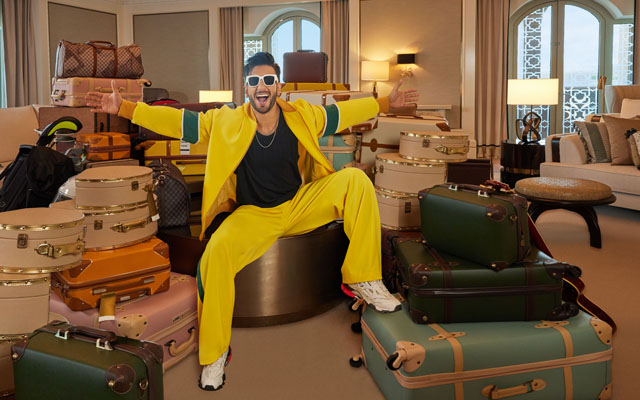
Abu Dhabi’s latest campaign features celebrities, such as Ranveer Singh from India, pictured
The campaign features Indian superstar Ranveer Singh, Chinese-American actress Liu Yifei, and the Gulf region’s legendary comedic duo Dawood Hussein and Hasan Al Ballam sharing their packed itineraries filled with culture, adventure, relaxation, culinary delights and shopping in Abu Dhabi.
The calendar includes the return of the NBA Abu Dhabi Games, Formula 1 Abu Dhabi Grand Prix, UFC Showdown Week as well as the Hyperound K-Fest music festival, concerts from pop artist Robbie Williams and singer Arijit Singh, and theatrical performances of Hamilton and Disney on Ice.
Thrill seekers can look forward to desert dune bashing, quad biking, and indoor adventure hubs – CLYMB, Circuit X and Adrenark, Snow Abu Dhabi and the newly opened SeaWorld Abu Dhabi.
For those eager to immerse themselves in art and culture, they can visit the Louvre Abu Dhabi, explore Emirati heritage at Qasr Al Hosn and House of Artisans, or discover the spirit of Abu Dhabi at Qasr Al Watan.
For relaxation, travellers can unwind at Saadiyat Beach Club or on one of Abu Dhabi’s many pristine beaches, and participate in sunrise kayaking through the mangroves or head to a private retreat on Nurai Island.
SiteMinder’s Changing Traveller Report 2023 reveals that the global intent to travel over the next 12 months is highest among travellers from Asia and Latin America.
In comparison to the global average of 57%, travellers from India (78%), China (76%), Indonesia (65%) and Mexico (64%) all intend to spend more time travelling over the coming year.
Travellers from Asia top the list for intent to travel as well as working during their trip
The proportion of travellers intending to work during their next trip is also highest among Asian and Latin American travellers, at 60% in India, 57% in Thailand, 53% in Indonesia, 47% in China, and 41% in Mexico. These figures drop to 31% in the US, an average of 25% in Europe, and 22% in Australia.
The findings in SiteMinder’s report is an analysis of more than 10,000 travellers surveyed across 12 of the world’s largest travel source markets, including Australia, China, France, Germany, India, Indonesia, Italy, Mexico, Spain, Thailand, the UK and the US. They form part of the four key characteristics underpinning the travel plans and motivations that will impact the global accommodation industry over the coming year:
The enduring explorer: Committed to travelling, regardless of living costs
The digital dependent: Reliant on new technologies and bound to devices
The memory maker: Investing in experiences, in a roaring ‘20s rerun
The conscious collaborator: An open ally to accommodations and the community.
Globally, accommodation is being sought out as a destination unto itself with one-in-two travellers – notably international travellers – looking to spend either ‘most of the time’ or ‘considerable time’ at their accommodation on their next trip. This figure is again highest among travellers from Asia and Latin America, at 81% in India, 77% in Thailand, 72% in Indonesia and 62% in Mexico – a finding that perhaps correlates to the bleisure travel intent within these markets.
Above travel intent and bleisure plans, however, the report shows that the biggest area of leadership within Asia and Latin America is in digitisation. While many travellers globally believe that their booking experience and stay onsite could be better if accommodation businesses were more tech-savvy, this belief is strongest in China and Thailand (95%), Indonesia (92%), India (91%) and Mexico (85%).
In parallel, Asia and Latin America also top the list in:
● Social media influence – when it comes to discovering their accommodation, travellers from within the two regions are the most heavily influenced by social media. While 70% of travellers globally say that social media influences how they discover accommodation options, the figure rises to 97% in Indonesia, 95% in both Thailand and China, 92% in India and 87% in Mexico. By contrast, only 46% of British and 42% of Germans say the same.
● Likelihood to use AI – at least 60% of travellers in the two regions say they are likely to use AI to generate accommodation recommendations. In China, the proportion is highest at 88%, followed by Thailand at 86%. Within the UK and Germany, the proportion is as low as 24% and 23%, respectively.
● Preference for communication through a device – if given the choice between in-person or device communication when at their accommodation, travellers in the two regions prefer communication via a device more than in any other part of the world. China tops the list at 51%, followed by Indonesia at 46%. This preference is lowest among travellers from France (19%) and Germany (18%).
SiteMinder’s chief growth officer, Trent Innes, commented that the research affirms the deep penetration of smartphones within Asia and Latin America, and highlights the urgency among accommodation providers to embrace modern technology.
He said: “All accommodation businesses should be encouraged by the strength of travel intent globally, but especially in the high-growth markets we surveyed – in Asia and Latin America. However, that strong intent comes with expectations for workspaces and, in particular, digitised experiences.
“As these travellers grow in numbers internationally, accommodation providers would do well to review each touchpoint throughout their customers’ journeys, from the planning and booking phases right through to experiencing and beyond. Today’s traveller is a digital dependent and that is truer in Asia and Latin America than in any part of the world. It is therefore important that accommodation providers seeking to attract travellers from within these high-growth regions are able to meet their expectations when it comes to a fully-digitised guest experience.”
SiteMinder’s Changing Traveller Report 2023 is available here.
Ticket booking is now live for the 43rd edition of World Travel Market (WTM) London, which takes place from November 6 to 8 at ExCel London.
After in-depth customer research carried out late last year, WTM London has announced a host of developments to improve the attendee experience and ensure that every member of the travel community extracts as much value from the event as possible.
World Travel Market London will take place from November 6 to 8 at ExCel London (Photo: World Travel Market London)
Not only are the organisers enabling visitors to book tickets well in advance, but the trade show will also open earlier this year to provide an additional hour for visitors and exhibitors to have spontaneous meetings.
There will be new, open-for-all Community Hubs right in the centre of the show, and a Networking Party that will take place within ExCel London on the first evening. WTM Connect Me – the show’s meeting booking platform – will return this year and is available for buyers, VIPs and the media. All attendees will also have access to the official WTM App.
The conference programme will cover eight themes over three different stages throughout the three-day event. The themes – Sustainability, Technology, Geo-Economics, Emerging Markets, Consumer Trends, Marketing, Diversity & Inclusion, and Experience – aim to help the global travel community succeed and thrive by informing, entertaining, and influencing their business decisions.
Other highlights include the 17th edition of the Ministers’ Summit at World Travel Market, in association with UNWTO and WTTC, on November 6; WTM London’s first Diversity and Inclusion Summit on November 7; and a lunch for content creators with global destinations to support collaboration and networking opportunities on November 8.
Tickets to the three-day show will be free until October 31, after which there will be a charge of 45 pounds (US$55) per person.
Juliette Losardo, exhibition director, WTM London, said: “Developments you’ll see at WTM this year are entirely reflective of what our attendees are asking for. We’re bolstering the ways you can maximise value from your visit, with more networking, better business opportunities, a refreshed education programme and a host of new partnerships.”
Centara Hotels & Resorts has unveiled an array of promotions and privileges exclusively tailored for The 1 Members through the The 1 platform.
These exclusive offers encompass an assortment of experiences, including dining options, hotel stays, spa treatments, and more.
Centara The 1 members can enjoy dining, hotel stays, spa treatments, and more via the app
These privileges come in two distinct categories: Free and Points. The former grants immediate access to the privilege without the need for any points redemption, while the latter stipulates the number of The 1 points required to unlock a specific perk.
Once redeemed via The 1 APP, the privileges are conveniently stored in the Coupons section for future use at the respective Centara property.
Customers can easily earn and redeem points for rewards when shopping, eating and more at Central department stores, Central shopping centres and The 1’s partners.
Some highlights include a weekend international and seafood buffet, a 30-minute Neck & Shoulder massage at Cenvaree Spa at Centara Udon, and a getaway at COSI Samui Chaweng Beach.