DidaTravel has signed a memorandum of understanding (MoU) with national travel operator Visit Oman to drive demand from China to Oman.
This announcement was made during ITB Berlin 2024, and will help promote Oman to DidaTravel’s network of 25,000+ travel trade partners in China.
The collaboration will help foster cultural exchange and strengthen ties between China and Oman
The MoU will see DidaTravel offering Visit Oman’s varied portfolio of contracted properties, transfers, and experiences to their extensive B2B network through API integration, while Visit Oman will be able to access DidaTravel’s portfolio of high value, yet hard to reach, Chinese travel trade customers. The two companies will embark on joint marketing initiatives to increase brand awareness and drive travel demand from China to Oman.
Jinyan Li, vice president, global account management at DidaTravel commented that this collaboration “holds immense potential to foster cultural exchange and strengthen ties between our nations”.
Telcos in Hong Kong, Thailand, the Philippines, Australia, Singapore, Taiwan and Indonesia are joining forces to form an alliance and launch a cross-border rewards programme, which aims to deliver greater value to eligible customers when they travel to these destinations.
The Travel Rewards Alliance telcos include HKT, AIS, Globe, Optus, Singtel, Taiwan Mobile and Telkomsel, respectively.
From left: AIS’ Pratthana Leelapanang; Globe’s Darius Delgado; HKT’s Alex Kun; Optus’ Matt Williams; Singtel’s Anna Yip; Taiwan Mobile’s Tony Lin; Telkomsel’s Derrick Heng
The programme is set to be progressively rolled out in the 2H2024 and will allow eligible travellers to enjoy special offers and redeem vouchers for transport, dining, merchandise, services and other incentives from the relevant telcos’ apps conveniently when they visit any of these markets. They can also access customer support from their telco via calls or online while overseas for free.
Eligible subscribers will be able enjoy privileges across the telcos in the alliance, such as loyal programme rewards, cross-border perks, experiences, local data plans, airport transfers, and more.
Amid serene hills, stones, and an ancient volcano, Nglanggeran Eco-Village, one of the UN Tourism’s best tourism villages in 2021, attempts to balance tourism and conservation.
A journey to Nglanggeran ancient volcano, part of Mount Sewu UNESCO Global Geopark, means traversing a landscape that looks much as it has for centuries. At 700m above sea level, the volcano, characterised by enormous chunks of rocks and a mystic atmosphere connects its villages. Sheep graze the valley floor, family farm, and cacao groves intermingle with fields of paddies and the reservoir.
Ancient volcano Nglanggeran in Yogyakarta, Indonesia
Communities in Nglanggeran have depended on the ancient volcano since before recorded history. For generations, residents have made a living by selling wood and stone mined from ancient volcanoes, leaving the area barren and dry, until a group of young people realised that this would not only destroy the beautiful nature, but also abandon its residents.
“30 years ago, all the young men ran away from the village, either as migrant workers abroad or migrated to Jakarta – the only ones left behind were the elderly or babies, including me and 15 other kids,” Sugeng Handoko, initiator and secretary of Nglanggeran’s tourism working group (Pokdarwis) told TTG Asia during a UN Tourism media trip.
“At that time, no one understood tourism. All we cared about was how to keep the water flowing, and the only way we knew (how to) was to plant trees, and we kept up reforestation activities until 1999, (when) a bunch of students came to climb the mountain.”
From groups of 10 students to thousands of people coming to see the ancient volcano, the popularity of the land formation continues to rise and was eventually named the best climbing spot in Yogyakarta. A favourite among mountain climbing fans, its climbing route is also suitable for beginners.
“We saw an opportunity, by making an entrance ticket to the ancient volcano and managing vehicle storage services for visitors. At that time, we only charged fees of 500 rupiah (US$0.03) per pax,” said Sugeng.
Since then, Sugeng and friends tried to develop tourism in Nglanggeran by marketing the ancient volcano as a place for student activities, from camping to gatherings.
However, in 2011, Pokdarwis changed its tourism strategy by selling live-in tour packages. The first guests were 120 high school juniors from Jakarta. They were invited to join the residents in their daily activities, such as farming and hunting for wood and stone on the mountain.
Aris Budiyono, who together with Sugeng initiated Nglanggeran’s tourism working group, recalled that the money made from this live-in package “was very big” and every cent went directly to the community.
“Farmers whose fields were borrowed for rice planting activities, breeders whose livestock were used for students to learn about livestock cultivation, and even stone miners received an income of 50,000 to 200,000 rupiah, quite a lot for them at that time,” said Aris.
The villages continued to bustle with student groups. Lilik Suharyanto, a treasurer of Nglanggeran’s Pokdarwis, shared that there were three to five groups of students every week, ranging from 50 to 150 pax each time.
“Because of that, we need additional workers. We have now employed people outside the five core villages that surround Nglanggeran,” said Lilik.
The growing demand for educational and adventure tourism to Nglanggeran has forced Pokdarwis to be creative with its tourism packages. Lilik said new products would be ready within two or three years, joining 13 activities that are now available. Currently, visitors can join tours of cocoa plantation and factory to learn how to grow cacao trees and transform the beans into various items; take lessons on traditional dance, such as jatilan, reog and mataram; and have opportunities to indulge in the traditional musical art of karawitan.
Nglanggeran’s growing popularity, unfortunately, ran against the villagers’ desire for nature preservation and cleanliness.
Mursidi, head of Pokdarwis, said: “We thought about closing Nglanggeran because rubbish was piling up and blocking the flow of water. Vandalism also made people so angry that they did not want to continue with tourism.”
Conservation was a top concern for residents, as it is tied to the vulnerability of people, nature and culture.
“Nglanggeran’s big picture includes the environment, economic growth, and the balance between them,” emphasised Mursidi.
Visitors to Nglanggeran villages can enjoy the untouched natural environment and go trekking
To address this, Pokdarwis drew up a new tourism strategy that puts locals and conservation at the centre. One action plan calls for limited tourist visits
– no more than three groups of 200 people per group are allowed each week.
Since 2015, Nglanggeran has an e-ticketing system in place and only accepts online reservations. This restriction benefits the mental health of residents.
Sugeng explained that the tourism story is about the local people. He said: “If they are unhappy, tourists won’t be happy either.”
Mursidi added that it was important to “welcoming (tourists) who will value nature as a priceless asset”.
Marketing strategies have also evolved.Previously, promotions were carried out sporadically for the general public. Since 2015, Nglanggeran only targets the upper-middle class, and focuses on tour packages with local activities as the main attraction.
“We no longer simply sell entrance tickets,” Sugeng said.
The new strategy pays off. Nglanggeran’s popularity continues to soar, revenue is on the rise, and residents are happy with the high quality of visitors.
In 2014, before the new tourism strategy was in place, Nglanggeran attracted 325,303 tourists – the highest in its history – who generated 1.42 billion rupiah.
In 2022, tourism revenue hit 2.5 billion rupiah through just 77,725 visitors. In fact, Nglanggeran continued to record an average of one billion rupiah in revenue every year of the Covid pandemic (2020 and 2021).
Reflected on Nglanggeran’s accomplishment in responsible tourism development, Sugeng told TTG Asia that “tourism is not about the numbers”, but how well the host community is empowered as a result.
The SUSTOUR Laos project has been tapping into the country’s sustainability potential, working closely with tourism-related businesses and suppliers on various certifications in a bid to elevate the its rich community- and nature-based status.
“Laos is a nature-based destination, untouched, unknown, and a bit wilder than its neighbours. This is what we should be marketing and developing the country as,” said Connor Bedard, SUSTOUR project manager.
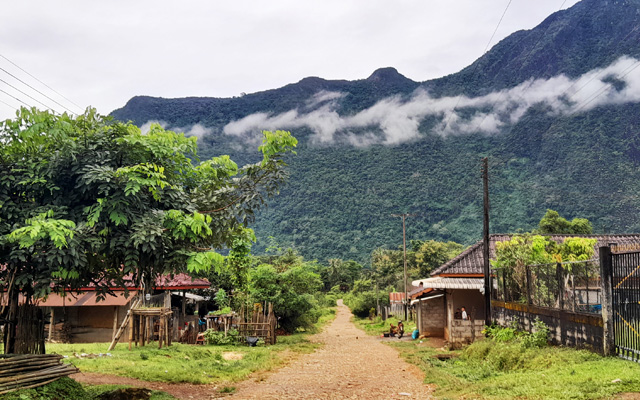
Laos is tapping into its abundance of nature for tourism; community-based tourism village in Vang Vieng, pictured
The project, funded by the European Union and implemented by Plan International Laos, aims to improve sustainability by integrating local tourism businesses into the supply chain through promoting and certifying sustainable business practices.
For four years, with an interruption due to Covid-19, it has promoted sustainable practices by getting more tourism businesses a Travelife accreditation. In addition, a homegrown certification has been developed in the form of Lasting Laos.
Modelled on Travelife, it is aimed at supplier businesses, including MSMEs in F&B, transportation, cultural excursions, tour guiding, handicrafts, and the souvenir sectors.
To date, the SUSTOUR Laos project has directly supported 378 MSMEs, benefiting about 5,500 employees. It has also reached approximately 10 million potential domestic and international tourists through its marketing campaigns, Lao-Visit-Lao and Lasting Laos.
Key achievements in the last year include six hotels being Travelife certified and delivering training to 66 supplier MSMEs. Under the Lasting Laos programme, 71 supplier MSMEs are currently registered and 17 have been certified.
Hotel general manager, Pitchaya Jirathumtanakul, said Angsana Maison Souvannaphoum Hotel in Vientiane, has achieved Travelife certification under the scheme. “We gained (a better) reputation, are able to drive business, and have earned more marketing awareness.”
Pitchaya added that while positioning Laos as a sustainable destination “creates more awareness among visitors who are more sensitive to environmentally-friendly issues”, challenges remain.
“There are cleanliness issues, unorganised tourist destinations, and a lack of capacity to ensure destinations retain their charm. The government should play a big part in managing these issues because they impact the country’s image,” she said.
Under SUSTOUR, social enterprise Ock Pop Tok successfully applied for Lasting Laos certification for its Silk Road Café and handicraft offerings – a move that has proved fruitful in a post-lockdown world.
Veomanee Douangdala, co-founder and executive director, said: “Promoting Laos as a green and sustainable destination was going well pre-Covid. Laos’ borders being closed for over two years put a dent in that effort.
“That’s why the Lasting Laos campaign was so well received when borders reopened. Nowadays, a lot of travellers, mostly from the west, are looking for more sustainable holidays.”
Veomanee added that as an increasing number of travel agencies and tour operators seek sustainable accommodation, restaurants and activities for clients, Laos is on their radar. However, implementing a concrete national sustainable development is key.
She noted that waste management continues to be a major issue to be addressed, starting with education in schools. Burning season, when farmers raze agricultural land in preparation for the planting season, causing severe air pollution, is another challenge.
“Some international organisations could help Laos improve this situation for the benefit of not only visitors but also the local population,” she added.
Despite these efforts, Julie Beaufrère, product manager, Asian Trails Laos, said demand for sustainable travel remains low among agents that it works with.
“Travelife and Plan International are doing a great job raising awareness, but whenever I do sales calls and meet agents in France, or all over the world, there’s maybe a two per cent specific request for this,” she said.
She said challenges lie with local teams’ lack of understanding about how to communicate sustainable initiatives and achievements in Laos. This is coupled with overseas agents figuring out how to position true sustainable travel without greenwashing.
“How do they promote sustainable travel while selling flights that cross the world? In a way, this is good because if they were selling our products without considering that they are polluting a lot and emitting a lot of carbon, it would be greenwashing,” she added.
Despite this, Beaufrère said sustainability should form the blueprint for the future of the tourism industry globally.
She said: “In Laos we’re lucky enough to be a small destination where we all live a community-based life, so preserving communities and trying to lower the negative impact is everywhere.
“It’s just that we do not yet have the words, the implementation or sustainability policies to write this down and prove that things are happening.”
India’s STIC Travel Group has teamed up with Singapore’s leading professional development and enrichment company, Mastereign Group, to introduce the Red Dot Green City programme, a specifically designed product for the Indian market that focuses on educational tours for students, corporates, MICE and families showcasing Singapore’s sustainable living practices.
lsha Goyal, executive director & CEO, STIC Travel Group, remarked: “Travellers today are looking at experiential tours. It took us six months of brainstorming to co-create the programme with Mastereign. This programme will help participants understand how Singapore is a ‘living’ laboratory of sustainability and conservation. These unique tours besides allowing visitors to explore Singapore’s eco-friendly advancements will also club popular tourist destinations like Sentosa Island, blending leisure with learning experiences.”
Goyal: the Red Dot Green City programme will help participants understand how Singapore is a ‘living’ laboratory of sustainability and conservation
To begin with, the duration of the Red Dot Green City programme will be five nights and six days for an average group size of 20 to 25 pax. The programme will have various themes like ‘Urban Farming and Food Security’ wherein participants will be offered the Sky Greens Vertical Farm tour – a unique 90-minute learning experience at the world’s first low-cost, hydro-powered vertical farm. Other themes like ‘Land Use and City Planning’ will include an immersive walk-through experience showcasing the transformation of Punggol – Singapore’s first eco-town.
“Presently, China is a very big market for educational programmes. India is not yet there in terms of numbers but hopefully we will have a first mover advantage with the launch of the Red Dot Green City programme. Other Asian markets where we see potential for similar educational tours include Vietnam and Indonesia,” said Terry Lim, managing director, Mastereign Group.
STIC Travel Group will be promoting the Red Dot Green City programme through both B2B channels and engaging with educational institutes directly in India.
Travel package prices in Malaysia are poised to rise in the upcoming months due to the recent increase in service tax rates, which have surged from six to eight per cent as of March 1, affecting all taxable services.
Zahira Tahir, founder and CEO of Universal Holidays, noted that some hotels have already begun applying the eight per cent service tax rate, while most hotels will implement it during the new contracting period starting April 1. She added that her company will also raise rates by two per cent from next month onwards to offset what suppliers are charging them.
Travel agencies in Malaysia will soon increase their package prices to cater for the rise in service tax; Kuala Lumpur, Malaysia, pictured
Bobby Eng, general manager of Overseas Tours and Travel, mentioned that while his hotel partners are still imposing the six per cent tax, coach vendors and restaurants are now charging the company the revised amount.
Despite this, Eng stated that since they bill clients in foreign currencies like the Hong Kong dollar, Singapore dollar, and the US dollar – and given the weakened ringgit against these currencies – they can still manage to absorb the costs. “For new quotations starting this month, we will be adjusting the package rates by two per cent.”
Expressing concern, Arokia Das Anthony, executive director of The Essence of Asia Tours and Travel, highlighted that the increase in service tax rates could discourage potential tourists from visiting Malaysia.
He stated: “We operate in a fiercely competitive environment where every dollar counts. We cannot afford to lose business to Thailand, Indonesia, or Vietnam. We need to engage in negotiations with our vendors and reassess pricing strategies. Additionally, we must explore innovative ways to enhance the customer experience without inflating costs.”
Kyoto will raise accommodation taxes to fund city infrastructure development and address overtourism ills
The Japan National Tourism Organization (JNTO) has opened an office in Stockholm, Sweden on March 4 to build up destination promotions in Nordic countries, one of its priority markets since 2023.
The office will join manage JNTO’s tourism promotion activity in Sweden, Denmark, Norway and Finland, which were growing markets pre-pandemic. The number of inbound travellers to Japan from Nordic countries has long been increasing, rising from 92,917 in 2014 to peak at 141,004 in 2019.
JNTO hopes its new office in Sweden will help promote Japan to travellers from Sweden, Denmark, Norway and Finland; Kyoto, Japan, pictured
Although the market has not fully rebounded, resulting in only 96,295 arrivals in 2023, confidence is high due to the uptick in Scandinavian visitors at snow resorts this winter and the launch of more flights connecting Japan and the region, including All Nippon Airway’s route between Haneda and Stockholm debuting in 2024.
“Overseas travel is very active in the Nordic region, which has a lot of potential for market development. With new direct flights scheduled to begin in 2024, we will seize this opportunity and work with Japanese tourism-related businesses to attract tourists,” said JNTO in a statement.
The new office will promote sales of Japan tours by local travel agents, develop relations with local media, carry out market analysis, disseminate tourist information to consumers and provide support to host international conferences.
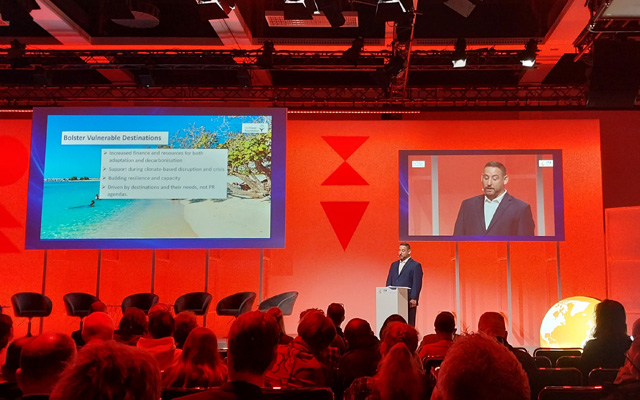
As the tourism industry continues on its challenging journey towards net-zero, it is key that climate justice is kept at the forefront and support is given to the most vulnerable destinations, opined a speaker at ITB Berlin 2024.
Jeremy Sampson, CEO of The Travel Foundation, said a recent report released by the organisation revealed that under a business as usual scenario, by 2050, the tourism industry will be responsible for 66 per cent of global carbon emissions.
Jeremy Sampson speaking at ITB Berlin 2024 on the urgency of climate justice
Aviation is particularly polluting and is responsible for 55 per cent of all tourism’s emissions. Longhaul flights make up 90 per cent of the sector’s global carbon emissions, despite only accounting for 1.9 per cent of all trips.
He noted that while multiple policies are being implemented to decarbonise the industry, it is key that frameworks take into account the carbon economies of developing and less developed countries.
“Some destinations are better placed to transition to a low carbon economy than others,” he said. “How can we ensure destinations that are less developed, or completely dependent on longhaul tourism, are not left behind?”
To achieve this, bolstering destinations must form a crucial part in the next step in climate action and tourism.
“This means target strategies for building resilience for enriching natural resources, not depleting them; for providing nature-based solutions, such as replenishing mangroves and reefs protecting tourism assets, not destroying them; and protecting wider communities from damages that will occur as wildfires spread and the increase in natural storms.”
He said the only way to achieve this is to listen to these destinations and communities’ needs.
Sampson added that with regard to the divide between the Global North and South and decarbonising the aviation industry, serious conversations need to be had regarding climate justice.
“Can we really expect developing economies in the Global South to hold off from building airports and new air routes when they look at the amount of flying and connectivity that Europeans and other economies have already enjoyed? Of course, we can’t do that.”
In April, Travel Foundation will publish a white paper on climate justice and ways the industry can approach the issue fairly.
“We need to ensure that the most vulnerable destinations, often those who have done the least to cause this problem, can be supported. We must start now to avoid worsening the situation,” Sampson added.
He recommended incorporating sustainability and climate action plans into business plans, and, instead of pumping huge budgets into promotion, make “meaningful investment” in these destinations.
“Destinations without the resources to act are often hit with multiple requests to raise standards to help demonstrate the industry credibility and sustainability credentials, but are not being supported to do so,” Sampson said.
“This is a call to action to identify the bigger ecosystem within which you exist and the organisations that are best placed to influence it, and to spend the money and resources that are required to support the change that needs to occur.”
Scoot, the low-cost subsidiary of Singapore Airlines (SIA), has unveiled the six South-east Asian destinations that its fleet of new Embraer E190-E2 aircraft will fly to – Krabi, Koh Samui and Hat Yai in Thailand; and Kuantan, Miri and Sibu in Malaysia.
Expected to begin operations in May, Scoot’s E190-E2 services will offer direct connections to and from Singapore.
Scoot’s addition of new Embraer E190-E2 aircraft to its fleet will fly to six destinations in Malaysia and Thailand
The first E2, aptly nicknamed Explorer 3.0, is expected to arrive in Singapore in April, and will take over Scoot’s existing flights to Krabi and Hat Yai from May 7, increasing flight frequencies to both destinations from 7-times to 10-times weekly.
The second E2 is also scheduled for delivery in April and will allow Scoot to operate to four additional cities – Koh Samui, Kuantan, Miri, and Sibu. Daily flights to Koh Samui will commence from May 13, with the frequency progressively increased to twice daily from early June.
The addition of the second E2 will also allow Scoot to increase its frequency to Miri and Kuantan from three to four times weekly from May 20 and June 3, respectively, as well as launch thrice weekly flights to Sibu from June 5.
Together with destinations served by Scoot’s existing fleet, the airline would operate 103-times weekly flights to Malaysia and 92-times weekly flights to Thailand by June.
After a nightmare 2022 when the airline recorded a loss of 272 million baht (US$7.6 million), Thai Airways International (THAI) entered the new year with cause for optimism following the announcement that net profit totalled 28.1 billion baht in 2023.
According to THAI’s statement concerning its end-of-year report, 4Q2023 saw the carrier and its subsidiaries’ total record revenue, excluding one-time transactions, of 45,170 million baht – 14.4 per cent higher than the same period in 2022.
Last year was the third time that THAI has recorded positive gains in nearly 15 years
On top of a general rebound in aviation and the tourism industry, leading to increased passenger demand and higher ticket sales, THAI cites a restructured debt programme and asset sales as significant contributing factors.
Many of the airline’s creditors have committed to reducing interest payments and extended repayment terms, which will see THAI finish up the court-supervised restructuring ahead of schedule before the end of this year.
By sticking to the agreed timetable and honouring repayment obligations, THAI will be able to return to The Stock Exchange of Thailand and resume trade in 2025, four years after being suspended.
The healthy financials have made 2023 the second most profitable year for the Kingdom’s national airline and is the third time THAI has recorded positive gains in nearly 15 years – a welcome reverse for the company, which filed for bankruptcy in 2020.
With a healthier bank balance, the airline is in the position to enhance its fleet and has signed an order with Boeing for 45 new aeroplanes (with the option to increase the order to 80), the biggest order in Thailand’s aviation history. On top of that, the carrier has also requested three new A350-900s from Airbus to help serve rising passenger demand.



















India’s STIC Travel Group has teamed up with Singapore’s leading professional development and enrichment company, Mastereign Group, to introduce the Red Dot Green City programme, a specifically designed product for the Indian market that focuses on educational tours for students, corporates, MICE and families showcasing Singapore’s sustainable living practices.
lsha Goyal, executive director & CEO, STIC Travel Group, remarked: “Travellers today are looking at experiential tours. It took us six months of brainstorming to co-create the programme with Mastereign. This programme will help participants understand how Singapore is a ‘living’ laboratory of sustainability and conservation. These unique tours besides allowing visitors to explore Singapore’s eco-friendly advancements will also club popular tourist destinations like Sentosa Island, blending leisure with learning experiences.”
To begin with, the duration of the Red Dot Green City programme will be five nights and six days for an average group size of 20 to 25 pax. The programme will have various themes like ‘Urban Farming and Food Security’ wherein participants will be offered the Sky Greens Vertical Farm tour – a unique 90-minute learning experience at the world’s first low-cost, hydro-powered vertical farm. Other themes like ‘Land Use and City Planning’ will include an immersive walk-through experience showcasing the transformation of Punggol – Singapore’s first eco-town.
“Presently, China is a very big market for educational programmes. India is not yet there in terms of numbers but hopefully we will have a first mover advantage with the launch of the Red Dot Green City programme. Other Asian markets where we see potential for similar educational tours include Vietnam and Indonesia,” said Terry Lim, managing director, Mastereign Group.
STIC Travel Group will be promoting the Red Dot Green City programme through both B2B channels and engaging with educational institutes directly in India.