Malaysia
A boost to secondary locales
S Puvaneswary
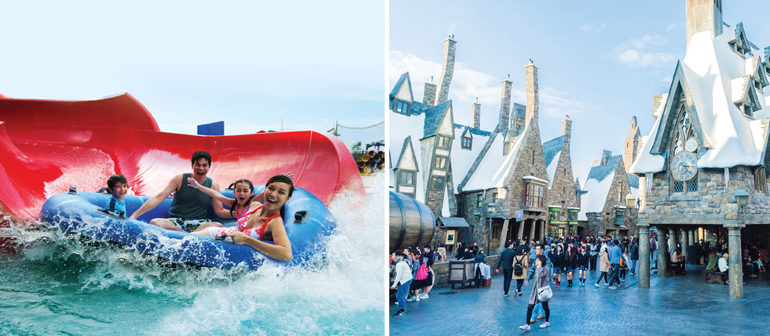
Fast becoming the theme park capital of South-east Asia, the growing crop of theme parks in Malaysia has enhanced the country as a family-friendly destination and spread tourist footfalls out from Kuala Lumpur to secondary destinations.
Ally Bhoonee, executive director at World Avenues, said: “The opening of new theme parks in Perak and Johor have helped us to sell Malaysia to overseas partners with itineraries that go beyond Kuala Lumpur.
“Theme parks such as Legoland Malaysia Resort and Sanrio Hello Kitty Town have helped promote Johor to families. In the past, Johor used to be a passing destination into Singapore,” noted Bhoonee.
“The Lost World of Tambun in Perak has helped us develop one- and two-night itineraries in the state, whereas in the past Ipoh used to be a stopover lunch destination for tours heading to Penang,” he added. “With Movie Animation Park Studios (MAPS) opening in July, it will give us another major attraction to sell in Perak.”
Developed to a tune of RM450 million (US$111.6 million), MAPS is the first animation theme park in Asia with attractions and characters entirely based on cartoon animation themes, according to CEO Darren McLean.
Calvin Ho, senior general manager of Sunway Theme Parks, welcomes the complimentary effect the upcoming MAPS will bring to business at Sunway’s Lost World of Tambun and Sunway Lagoon.
He explained: “More marketing dollars invested in attracting tourists to the country can only be good for the economy. Tourists may want to visit more than one theme park during their entire stay.”
As well, John Chan, business development director, Kris International Traveltours, said the recent growth of theme parks linked to international brands such as Nickelodeon (see Tried & Tested on page 16), Legoland and Hello Kitty Town will grow a new segment of tourists who do not see shopping as a main draw.
Singapore
Building on family-friendly reputation
Paige Lee Pei Qi
While the cosmopolitan Singapore is renowned to be a shopper’s paradise, its appeal as a theme park destination rocketed when Universal Studios Singapore (USS) in Resorts World Sentosa (RWS) debuted in 2010.
According to Michael Chong, manager of global business at Star Holiday Mart, travellers who enjoy theme park attractions in Singapore are mostly families from South-east Asia and China.
Judy Lum, group vice president for sales and marketing with Singapore’s Tour East Group, share similar observations: “Most visitors are groups of young people travelling together or multi-generation families from India, China, Taiwan, Hong Kong and regional countries.
“Singapore’s close proximity allows them to have holidays at theme parks of international standards as most Asian working class do not have long annual holidays to travel to the US or Europe to enjoy such theme parks,” she elaborated.
Apart from USS, the eight-hectare Marine Life Park in RWS has pulled in large numbers of tourists too.
Leong Yue Weng, general manager of interactive indoor edutainment centre KidZania Singapore, which just opened at Palawan Beach on Sentosa Island last month, said theme park operators are enticed by Singapore’s positioning as a family-friendly destination.
However, competition is just at bay. Said Star Holiday Mart’s Chong: “Singapore faces regional and destination competition for theme parks – an example is the upcoming Shanghai Disneyland which will compete with Singapore for theme park tourists.”
Hence, to sustain Singapore’s appeal as a theme park destination, Lum urged theme parks to always “reinvent and refresh” their attractions and keep costs “affordable for surrounding countries” as the Singapore dollar is just too strong against the regional currencies.
Japan
Regular updates fan domestic love affair
Julian Ryall
The Japanese love affair with theme parks started with the opening of Tokyo Disneyland in 1983. Since then, theme parks have grown to become a key part of the domestic tourism industry, with three parks – Tokyo Disneyland, Tokyo DisneySea and Universal Studios Japan – in the world’s top five attractions by attendance.
Japan witnessed a boom in theme parks in the 1980s, Motohisa Tachikawa, spokesman for JTB, pointed out, but not all the smaller ones survived the economic downturn of the following decade.
“Parks need to open something new every year or, at most, every two years because that is what keeps visitors returning regularly,” he said. “Repeat visitors are critically important and if someone feel that one visit was sufficient, they won’t want to return.”
Universal Studios Japan has experienced just that surge in visitor numbers. The opening of the Wizarding World of Harry Potter in 2014 led to a 28 per cent increase in admissions over the following year. To meet the demand, work has recently begun on a new high-rise hotel.
Huis Ten Bosch, the Dutch theme park in Kyushu, will introduce the new Kingdom of Robots attraction this year, a move that “will definitely bring in new visitors”, said Kotaro Takada, director of the corporate planning department.
“Last year, around 200,000 of our guests were from overseas and we’re seeing foreign visitor numbers increasing by as much as 10 per cent a year,” said Chanmum Om, who oversees the park’s foreign promotion efforts. Key to that has been the establishment of offices in South Korea and Taiwan to bring in guests.
Foreign visitors have also helped to increase overall numbers to Japan’s theme parks, Johta Takahashi, USJ’s spokesman said, with the sector in general benefitting from an increase in LCCs flying into Japan, relaxation on visa regulations and the relative weakness of the yen in recent months.
At the same time, more Japanese have been visiting after being dissuaded from travelling abroad due to recent terrorist incidents, primarily in European cities.
China
Theme park boom
Caroline Boey
International theme park operators continue to make a beeline for China as the country becomes a key target market, with Italian luxury car manufacturer Ferrari the latest to announce plans to build a branded theme park in China.
For now, all eyes are on the June 16 opening of the Shanghai Disney Resort, which is three times the size of the 28ha Hong Kong Disneyland Resort (HKDL).
This will this set a new benchmark for theme parks and add a new international dimension to China’s offerings, according to Joy Liao, sales director, Inbound Center, Century Holiday International Travel Group.
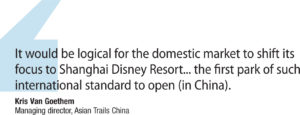
Kris Van Goethem, managing director, Asian Trails China, said it would be logical for the domestic market to shift focus to the Shanghai Disney Resort.
“It is the first park of such high international standard to open here. It is also more expensive for the Chinese to travel (to Hong Kong for HKDL) compared with domestic flights to Shanghai.”
A Legoland park is currently being built in Shanghai by Merlin Entertainments, which already has five attractions in China, with another two (Madame Tussauds and Sea Life aquarium in Chongqing) due to open soon.
Opening in 2019 will be the Universal Studios in Beijing – the third in Asia after Osaka and Singapore – and at 120ha, it is reportedly the biggest in the world, according to a China National Tourism Administration report.
The homegrown theme park scene, meanwhile, is dominated by Chimelong Group and Overseas Chinese Town (OCT) Group.
Guangzhou Chimelong Tourist Resort is the group’s first world-class comprehensive resort housing several of China’s top theme parks such as Chimelong Paradise, Chimelong International Circus, Chimelong Water Park and Chimelong Safari Park.
OCT has established a network of theme parks across China over the past two decades, including Shenzhen’s Window of the World (which showcases replicas of world-famous icons) and China’s first amusement park chain under the Happy Valley brand.
Violet Wang, destination manager at Pacific World, opined that China’s massive domestic market will assure business for the various theme parks in southern China and the Yangtze River Delta.
Hong Kong
Buckling up for rollercoaster ride
Prudence Lui
Hong Kong Disneyland Resort (HKDL) and Ocean Park Hong Kong saw visitor numbers drop last year, but players are downplaying speculations that the opening of Shanghai Disney Resort may further dampen business.
HKDL’s sales director for Hong Kong and International, Martin Leung, said: “We see the opening of new theme parks in the region as advantageous because their presence will help create top-of-mind awareness of theme parks and the Disney brand among guests.”
Similarly, chief executive of Ocean Park Hong Kong, Tom Mehrmann, believes that more theme parks in China will cater to the rising number of the Chinese middle class while strengthening the region’s appeal for longhaul tourists.
“A critical mass of attractions will actually (improve the appeal) of tourist destinations, which is exactly what has been happening in southern China that includes Hong Kong and Macau,” he said.
Still, it seems the industry senses competition from neighbouring destinations and has sought to add new attractions to keep visitor experience fresh.
For instance, HKDL’s Star Wars-themed special events will be introduced this summer, offering rides such as Hyperspace Mountain.
Ocean Park recently launched free Wi-Fi service and has in the pipeline, two new hotels – Hong Kong Ocean Park Marriott Hotel and The Fullerton Hotel @ Ocean Park; scheduled for completion by 2017 and 2020 respectively – and the 64,381m2 Ocean Park Water World (2H2018).
W Travel, managing director, Wing Wong, feels that the theme park market is already mature. “There is not much room for big expansion given (Hong Kong’s) shortage of land. I believe there won’t be any dramatic growth of visitors but new facilities may help to drive more visitors.”
Macau
Casinos still primary attraction
Prudence Lui
The theme park industry is unlikely to exist of get off the ground in Macau, as the small territory – with a minuscule population of just 650,000 – is already dominated by the gaming industry and its integrated resorts, said observers.
John Ap, visiting professor at the Institute for Tourism Studies, said: “The current lull in the casino business would not provide the impetus or likely business environment to warrant development of any large-scale theme park that would be financially viable.
“What potential exists for Macau are family entertainment centres (FECs). Studio City is one of the first casinos to introduce this concept with its current Batman Dark Ride, Golden Reel ferris wheel and Warner Bros Fun Zone. It is expected other casinos will follow suit.”
However, FECs remain secondary, not drawcard attractions, and this is what Macau will be primarily limited to, he added.
Things might change with the debut of Macau’s first theme park, Planet J. Armed with Magic Scroll – a smartphone loaded with apps and connected to a master computer – participants can adopt fantasy personae to act out a series of customised challenges to drive away malevolent forces from the mythical Stone Kingdom.
On the other hand, CITS Macau’s international department manager Cooper Zhang thinks Macau could have emulated Hong Kong in the theme park field. “Macau needs (theme parks) to draw more youth and family visitors. Since land is scarce here, the scale can’t compare to Hong Kong but in terms of creativity, it’s possible to focus on educational and cultural element given the existing commercial tourism offers,” he said.
Gray Line Tours, managing director, Andy Wu, concurred: “In the past, all attention went to the fast-growing gaming industry and other business sectors were neglected. Now, the pace of the gaming industry has slowed and the government stressed on diversification of tourism offerings so I believe more opportunities for theme park development in future.”
This article was first published in TTG Asia, May 6, 2016 issue, on page 15. To read more, please view our digital edition or click here to subscribe.