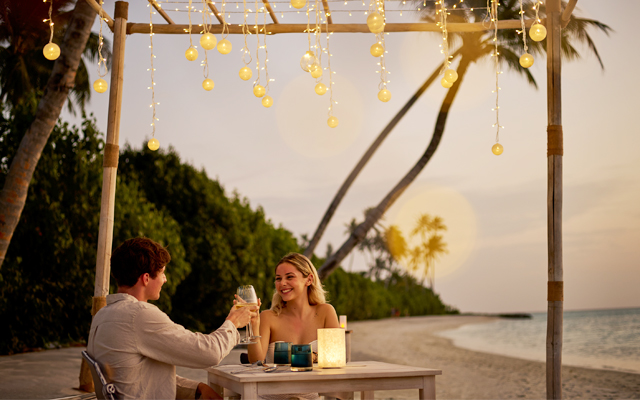
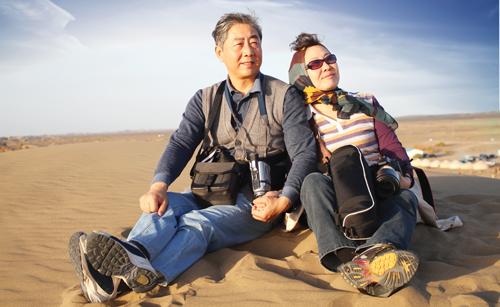
As populations grey in Asia, senior tourists are making up a growing proportion of leisure travellers to become a business goldmine for travel agencies. TTG Asia uncovers the unique preferences of this segment
SINGAPORE
Paige Lee Pei Qi
Singapore has one of the fastest-ageing populations in Asia, and the outbound silver tourist segment is becoming increasingly valued by local agents.
Chan Brothers Travel’s head of marketing communications, Jane Chang, said the company observed a continuous increase in demand from silver travellers, who constitute 40 per cent of bookings to Europe and Asia, and about 60 per cent of bookings to China with a fairly consistent year-on-year growth of about 10 per cent.
Some 35 per cent of Dynasty Travel’s leisure travel segment now belong to the “silver category” of travellers aged 50 and above, according to director of marketing communications Alicia Seah.
And this segment is proving a stable and valuable one too. Said Seah: “They are lesser risks takers (and) will rely on travel agents’ expertise to provide the travel packages – whether group tours or customised travel.”
She also observed a greater willingness among this segment to “pay more to get value for money tours, stay at quality hotels and (sample) the best of local cuisines”.
Seah explained: “With a satisfactory disposable income, less home responsibilities, more time to travel and relatively good health, (seniors) are expected to spend more than all other age groups on their travels.”
Chan Brothers has likewise witnessed “an increasingly strong co-relating trend of higher spending and frequency of purchases” in the senior segments than other age groups, said Chang.
As for preferred destinations, Seah said this group has the appetite to visit lesser explored destinations like Namibia, Tanzania, Iceland, Greenland and Eastern Europe.
MALAYSIA
S Puvaneswary
In Malaysia, changing travel motivations have pegged senior tourists as a significant segment of leisure travellers with desire for particular itineraries and destinations.
“In the past, senior travellers (tended to go) abroad for a (given) reason, such as to visit friends and relatives or attend their children’s convocation. But the trend has started to change with more seniors travelling simply to enjoy the destination and what it has to offer,” noted John Chan, business development director at Kris International Traveltours.
Abdul Rahman Mohamed, deputy general manager, channel management at Mayflower Acme Tours, said: “Many of them are well-travelled, so they like to visit (fresh) destinations such as Latin America, Scandinavian countries and the Balkans. In ASEAN, Myanmar and Laos are popular with this segment as both are relatively new destinations.”
Chan further observed in the segment a returning preference for North Asian destinations in the past two years over traditional favourites like Australia, Europe and the US due to a weak ringgit.
He explained: “China, South Korea and Japan are popular destinations due to the aggressive marketing efforts of the respective NTOs and the travel documentaries on TV about these destinations. With LCCs flying into secondary destinations, many are also venturing beyond capital cities to secondary cities (in North Asia).”
Abdul added: “They also like to be engaged in activities while travelling, so we throw in items such as cooking classes, art appreciation workshops or introductory wine tasting workshops.”
Meanwhile, Desmond Lee, group managing director at Apple Vacations & Conventions, sees an uptick in demand for cruise holidays among senior citizens in recent years. He shared: “This is due to more cruises coming to Singapore, more awareness created by the cruise operators, and more travel agents selling cruises.”
Specifically, cruises appeal to seniors for their all-inclusive packages and offer “a convenient way of visiting destinations without having to move hotels”, said Lee.
HONG KONG
Prudence Lui
With 1.2 million residents above the age of 65, Hong Kong has an active market of silver tourists.
For CTS International Science-Technology & Culture Exchange, the segment makes up half of group tours and 30 per cent of FIT business, according to director Ng Hi-on.
For Sunflower Travel Service, participants over 50 years old comprise “one third of (its) departing tours”, according to managing director Cindy Young. And unlike young travellers who favour OTAs, silver tourists rely heavily on agents as they treasure their time and don’t bother to shop around on Internet.
She added: “We have been (catering to) this segment for years and regularly roll out some unique itineraries (for them). This segment is characterised by higher spending power and medium to high-end travel products.”
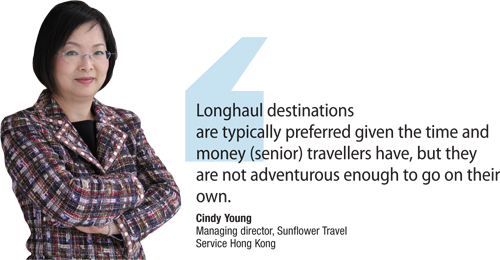
Young added: “(Being) mature and sophisticated travellers, they seek something different such as Inner Mongolia and Africa. Longhaul destinations are typically preferred given the time and money these travellers have, but they are not adventurous enough to go on their own.”
Indeed, more agents are eyeing this segment. Two years ago, Morning Star Travel Services launched a series specially catering for mature travellers.
Director of marketing director, Wilson Yeung, said: “We are approached by associations with senior members to arrange tailor-made private group travel. They choose shorthaul destinations like China and mostly depart on weekdays. Our role is to ensure smooth transportation (and comfortable itineraries involving) wine and dine.”
JAPAN
Kathryn Wortley
Japan’s large segment of silver tourists are increasingly choosing Asian destinations over the traditional European favourites, agents observed.
Europe has historically been a choice destination, but the Japan Association of Travel Agents reported that European tour sales at major agencies in March 2016 fell 4.8 per cent “due to the negative influence of the simultaneous terrorist attacks in Paris and devaluation of the yen.”
According to a representative at the association, a top priority of Japanese silver tourists when choosing a destination is safety and security.
Jumbo Tours in Okinawa Prefecture has seen their European sales fall since last year. “As a result of IS terrorism in Europe, older people are worried about going there,” said Miyuki Kinjo of the company’s outbound division.
Now, Asian destinations are most popular with customers, with Taiwan in top place, followed by Shanghai. “Many seniors are going there on sightseeing tours with their partner or friends, staying an average of two or three nights,” shared Kinjo.
The US is another popular option. “Japanese baby boomers like to visit the US because they absorbed American culture in the 1970s when they were young,” observed Hiroshi Kurosu of JTB Research and Consulting.
Many see retirement as a chance to make travelling to their dream destinations a wish come true, he explained.
Meanwhile, a study by Japan Tourism Marketing shows that, from age 50, Japanese people tend to find planning for trips troublesome, prompting travel agencies to offer greater support.
The research also shows that seniors primarily choose destinations that will boost their health and well-being.
AUSTRALIA
Rebecca Elliott
Aussies are known for their sense of adventure and propensity to travel to far-flung locations, and this desire seems to grow with age, said Australia’s leading outbound agents.
A recent survey by Peregrine found that older travellers are more interested in getting off the beaten track (30 per cent) than Gen Y (25 per cent).
“We have seen an increase in sales to adventurous destinations,” said James Thornton, managing director, Intrepid Group, whose top-selling Eastern European trip for passengers above 50 is Russia, adding that sales to Cuba for this segment is up 158 per cent from last year.
Similarly, Marty Byrne, national travel manager, National Seniors Travel, said travellers aged between 50 and 65 had overtaken younger travellers as the most adventurous group.
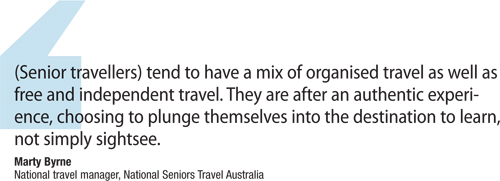
He added: “They tend to have a mix of organised travel, such as a cruise or tour, as well as free and independent travel. They are after an authentic experience, choosing to plunge themselves into the destination to learn, not simply sightsee.”
Haydn Long, Flight Centre Travel Group’s global media and investor relations manager, commented: “Customers of all ages are benefiting from (greater affordability), but particularly retirees because they have the flexibility to travel outside peak seasons when fares tend to be at their cheapest.”
Sujata Raman, managing director, Abercrombie & Kent Australia, said travellers over 55 were outperforming all other sectors and that multi-generational travel was a major trend for Aussie seniors.
“We are finding that grandparents are increasingly driving travel decisions for the whole family,” she said. “The purpose is often to commemorate a milestone event or simply to spend quality time together as a family.”
THAILAND
Michael Sanderson
Thai retirees are increasingly independent and app-happy travellers in familiar Asian countries, but tend to rely on tour operators when venturing farther afield.
MD Tours operations officer Wasuma Sivapiroonthep said Thailand’s baby boomer generation is becoming more tech savvy when travelling aboard but they are not necessarily more adventurous.
Wasuma said Europe, Japan and the US were top destinations, similar to the broader outbound trends from Thailand, although South Korea and South-east Asia were a higher priority for younger travellers. “In Europe they tend to buy tours and go in groups,” Wasuma said.
On the other hand, those visiting Japan tend to opt for independent travel. “With Google, even in Japan they can see everything, from train schedules to hotels. They can Google and book through Agoda,” Wasuma added.
While Wasuma was unable to provide the proportion of MD Tours’ clients in the baby boomer age bracket, she said they prefer relaxing activities like sightseeing and walking tours.
Thai Mice’s Jim Kullapat said while the majority of his company’s outbound customers were business-focused, there had been a recent spike in the number of older travellers arranging trips to Myanmar as it had been off-limits for so long and the country’s temples are top draws for seniors keen to see other cultures practising Buddhism.
Meanwhile, the Thai government’s push for domestic tourism and its attempt to cope with the ageing population by allowing civil servants to delay retirement until 65 may hamper outbound travel from the retiree market in the years ahead.
INDONESIA
Mimi Hudoyo
Unique needs and preferences are surfacing among Indonesian senior travellers, a segment that often travel as part of multi-generational families and within like-minded communities.
Travelling with the extended family is seen as an important activity for bonding. The preferred time to do it is during Lebaran (Muslim end of fasting month) holiday, where offices and schools are closed, usually for one week.
Such travel configurations require special efforts by agents to make sure needs of the different age groups are taken care of.
Putu Ayu Aristyadewi, vice president marketing & communications, Smailing Tour, said: “The elderly travellers may not be able to follow all the programmes that their children and grandkids like, such as climbing the Great Wall. We (arrange for a guide) to stay with silver travellers while their family enjoy the Great Wall.”
Meanwhile, most senior travellers opt for tours specially tailored for the family. Willy Sihombing, owner of Sedona Holidays, Medan, said such tours are usually designed to leave out strenuous physical activities, on top of having itineraries which are less packed with activities.
Another group of silver travellers are those who travel with communities of fellow seniors, which could include friends, prayer groups, sports groups or those who share similar interests.
Adi Pratama, assistant vice president product & market development of Panorama Tours, shared that cruising holidays are becoming popular among these senior communities.
“We see such groups taking cruise holidays together. As they are retirees, they can spend up to a month cruising.
“This is quite a new development. In the past, travellers think that cruising is boring. They started with a short cruise (before progressing to) longer cruise trips,” he added.
Willy remarked: “Not all silver travellers are weak. We have catered a group who were healthy and strong. They took a hiking tour of a tea plantation. The members are 65 years old and above.”
This article was first published in TTG Asia November 2016 issue. To read more, please view our digital edition or click here to subscribe.