TTG Asia
Asia/Singapore Thursday, 22nd January 2026
Page 1627

Pacific World joins hands with Singapore-based Aonia

0

Pacific World and Singapore-based boutique agency Aonia have entered a strategic alliance to enrich their offerings and cater to a global clientele.

“Bringing together (our) strengths will enable us to offer a holistic solution to clients across the Asia region,” said Selina Chavry, Pacific World’s global managing director.

“From event design and production to on-the-ground logistics and meeting execution to measuring ROI, no matter which country they choose to host their event, we’ll be able to accommodate our clients in a more distinct and impactful way.”

Commenting on the partnership, Daniel Chua, Aonia’s chief executive, said: “Together, we can now offer customised boutique service along with the power and presence of a worldwide destination and event management company with local staffing in more than 40 countries and 100 destinations around the globe.”

Sails unfurled for aqua luna II on HK Harbour

0

A new traditional Chinese wooden junk boat, aqua luna II, has joined the aqua luna family to offer harbour cruises of Hong Kong’s iconic skyline.

Commissioned by Aqua Restaurant Group, aqua luna II is the younger but larger brother to the iconic red-sailed junk aqua luna, which was launched over a decade ago by founder David Yeo.


aqua luna II

Measuring 29m in length and holding up to 80 guests on its two decks, aqua luna II boasts sails that feature an ornate blue-and-white dragon of the Ming Dynasty, often seen on antique Chinese porcelain.

In Chinese, aqua luna and aqua luna II are named after Hong Kong pirate Cheung Po Tsai, who sailed Hong Kong waters over 100 years ago and is said to have stored his stolen treasures in the caves of Cheung Chau. Aqua luna is Cheung Po Tsai and aqua luna II is Dai Cheung Po (big brother of Cheung Po) – indicating its greater size.

The aqua luna fleet, with its two traditional Chinese junk boats, offers 45-minute evening harbour cruises while in the day guests can explore locations around the harbour on the aqua luna’s hop-on/hop-off Harbour Discovery Tour.

From May 1, longer daytime cruises are available to a wider list of destinations including Stanley, Cheung Chau and Lamma Island for its nature trail.

A new offering is the Dim Sum Cruises, which allows guests to enjoy signature dishes prepared by Dim Sum Library, Aqua Restaurant Group’s dim sum and modern Chinese restaurant.

To celebrate the launch of aqua luna II complimentary rides will take place on May 13 and 14 for all Hong Kong ID holders (from 12.00 – 17.30). From now until May 31, all the restaurants in Aqua Restaurant Group will be randomly serving dishes and cocktails in Ming Dynasty plates and cups. Anyone lucky enough to be served the Ming Dynasty ceramic will get complimentary tickets for the new aqua luna II.

Rove launches Vietnam adventure tours

0

Specialist adventure tour operator Rove has now expanded into Vietnam, bringing its countries of operation up to a total of eight, in addition to Thailand, Sri Lanka, Mongolia, Indonesia, Cambodia, Myanmar and Laos.

The new tours explore the remote reaches of northern Vietnam, and include activities such as trekking, cycling and kayaking. Designed with both casual and enthusiast adventurers in mind, the trips are conceived to ensure that travellers are given the opportunity to engage with the local communities and experience the spirit of the country, the travel startup stated in a release.

Rove was established by co-founders Holly Richter, formerly of Backroads and Exo Travel, and Struan Robertson, formerly of SpiceRoads, last year.

What happens to tourism coalition when Scowsill, Rifai leave?

0

World Travel & Tourism Council (WTTC) president & CEO of six years, David Scowsill, is leaving this June after six years at the helm of the organisation. With Taleb Rifai, secretary-general of UNWTO, also ending his term this year, it is uncertain if the Global Travel Association Coalition which they founded will be able to remain as cohesive.

The other partners of the coalition are Airports Council International, Cruise Lines International Association, IATA, PATA and the World Economic Forum.

The coalition has been effective in representing the industry to governments with ‘one voice’ on the key issues such as travel facilitation, terrorism, infrastructure development and environmental sustainability.

A 15:40 session this afternoon, Partnerships for transformation – the power of working together, featuring Scowsill and Rifai, should set some light.

Scowsill worked particularly well with Rafai. Among the highlights of his time, the public/private partnership with UNWTO has produced 84 meetings with presidents and prime ministers, where messages about the importance of the sector have been directed to these key leaders.

A press statement said during his tenure as the third president in the 26-year history of WTTC, Scowsill had taken the organisation to new heights, championing the private sector views in high-level governmental discussions and promoting the sustainable growth of travel & tourism.

“It has been a privilege to lead WTTC, representing the global interests of the private sector of travel & tourism, through advocacy with governments around the world. The membership of the organisation has doubled in the last period, but more significant has been the work with governments at all levels on the key strategic issues for the sector,” said Scowsill.

“By making this announcement now, the Executive Committee has time to identify a successor and to work through a smooth transition in leadership. Working with a very talented team, we have consolidated the position of WTTC as the authority in the sector, whether through research, advocacy, or the impact of the global summits. I now look forward to focusing on new opportunities, knowing that I am leaving WTTC in great shape.”

North America, Europe higher up on APAC travellers’ radar: Sojern

0

Travellers from Asia-Pacific are venturing to North American and European destinations in 2Q2017 compared to local and regional ones in 1Q2017, bucking the global trend of fewer travellers planning to visit major US cities this spring, revealed performance marketing engine Sojern in its Q2 Global Travel Insights report.

Singapore and Sydney moved out of the top five most searched beach destinations while Honolulu and Phuket entered the ranking, which according to Sojern demonstrates that early planners are open to new destinations as long as these offer the activity or sight they are looking for.


Waikiki beach, Honolulu

Retaining their placing in the top five are Barcelona, Denpasar and Melbourne.

Comparing the top metropolitan destinations, the company saw Seoul and Taipei drop out of the top five, replaced by Bangkok and Paris. Tokyo, Singapore and London are the other three in the top five.

Sojern further observes that Auckland, Nagoya and Bangkok were edged out from the sightseeing/recreational top five by Okinawa, Rome and Melbourne.

Meanwhile, the company said that with June 23 topping the list of departure dates, “it is clear that Asia-Pacific travellers are looking to take a long weekend to celebrate” the end of Ramadan.

“Asian travel marketers know now that travellers are trying to decide just how long a long weekend they will take – with both the Thursday and Friday before Eid al-Fitr on the top departure dates list,” read a Sojern statement.

“This presents a prime opportunity to engage new customers and Sojern recommends targeting them with a combination of upper-funnel brand messaging to introduce them to your brand and mid-funnel engagement campaigns to nurture them through the funnel.”

World’s busiest airports revealed: ACI

0

The Airports Council International (ACI) has revealed its study of the world’s busiest airports in 2016, with Atlanta-Hartsfield-Jackson (ATL) retaining its top spot with over 104 million passengers and 2.6 per cent growth from 2015.

Beijing Capital International Airport, despite pundit expectations that it would reign supreme by 2015, held onto the second spot. Having grown five per cent to over 94 million passengers in 2016, China’s busiest airport saw subdued growth in previous years as it faced continuing capacity constraints.

In third position again is Dubai, with total passenger traffic growing 7.2 per cent in 2016. As a major connection point for longhaul international flights, the airport is also the world’s busiest in terms of international passengers ahead of London-Heathrow (seventh position).

Asian airlines continued to make inroads in the North American market on key international and trans-Pacific segments across airport pairs, particularly between North America and China. A major Chinese airports serving the trans-Pacific and other international routes is Shanghai Pudong International Airport (PVG), which moved up to ninth spot after growing 9.8 per cent in 2016 to over 66 million passengers.

The Chinese hub also serves the catchment area of Shanghai, one of the most populous city markets in the world and a major centre for trade and business. PVG, which represents over 60 per cent of Shanghai’s passenger traffic in 2016, and Hongqiao, the city’s sister airport, surpassed the 100 million passenger mark in combined passenger traffic.

Other fast-rising hubs is Seoul’s Incheon International Airport, now in 19th place, which experienced 17.1 per cent year-over-year increase in passenger traffic. Even after factoring in the effect of the outbreak of the Middle East respiratory syndrome, which depressed passenger figures during the summer of 2015, Incheon would still have achieved an estimated growth rate of at least 10 per cent.

The continued growth of LCCs on key segments and the start of A380 flight operations of longhaul routes have paved the way for traffic expansions, while another key contributor relates to the consolidating demand of Korean and Japanese international routes. Tokyo Haneda, the world’s fifth busiest airport and Japan’s largest, grew 5.5 per cent in total passenger traffic for 2016.

Thai Airways takes delivery of third Airbus A350 XWB

0

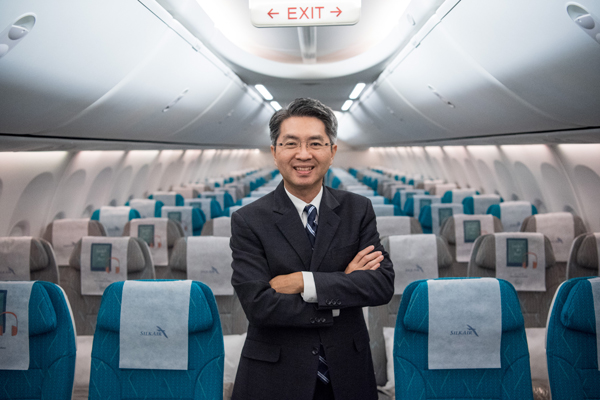
Thai Airways International (THAI) last Friday took delivery of its third Airbus A350-900XWB named Uthumphon. This new twin-engine widebody aircraft will enter into service on May 1 on the Bangkok-Frankfurt route. The Thai national carrier has ordered 12 A350s, with the first two already delivered last year.

THAI’s A350-900 is configured in a two-class layout with a total of 321 seats, comprising 32 in business class, convertible to fully flat beds, and 289 in economy class.


TTG Asia’s Xinyi Liang-Pholsena (first row, third from left); THAI’s Nuttavika Tamthai (first row, second from right) and Matthias Horn (second row, centre); and Airbus’ Sara Ricci (second row, third from right) and Arnaud De La Croix (first row, rightmost) were part of the delegation present at the delivery in Toulouse

Greater transparency for Muslim travellers with new hotel standard

0

Salam Standard has launched the Premium Hotel Classification scheme which rates hotels based on their number and standard of Muslim-friendly facilities and services, with an emphasis on rigorous hotel checks and audits.

The scheme – which classifies hotels under Bronze, Silver, Gold or Platinum tiers – aims to improve quality, standards and transparency for Muslim travellers, while boosting the global visibility of accommodation that meet this demographic’s faith-based needs.

For example, at Bronze-rated properties, all rooms have a shower and toilet or bathtub and toilet and a prayer mat and praying direction (Qibla/Kibblat), or they are available on request, whereas Platinum-rated accommodation offers several additional benefits including halal food that is certified by a recognised body, while the entire premises is alcohol free.

Properties or hotel groups will be subject to checks to ensure they meet the required criteria, with audits conducted by a qualified committee of Islamic tourism experts, including Salam Standard representatives.

The committee reserves the right to reject applications if they do not meet the minimum criteria, and will also conduct regular inspections to ensure standards are upheld at Salam Standard-rated properties.

According Salam Standard, the four-tier system will simplify the user experience by providing Muslim travellers using the service or that of sister company Tripfez with clear guidelines on what is offered, safe in the knowledge it has been checked and audited.

Michelin Guide’s coming to Bangkok in late 2017

0

Following Singapore, Thailand will be the second country in South-east Asia to boast a Michelin guide, announced the Tourism Authority of Thailand (TAT) in a press conference last week.

TAT has entered into a partnership with Michelin Travel Partner to publish a Bangkok edition of the Michelin Guide. Expected to be released by the end of 2017, the Michelin Guide Bangkok will feature a bilingual Thai and English edition that is available in print and digital version.


(From left) Saksan Triukos, managing director of Michelin Siam; Lionel Dantiacq, president and managing director – East Asia and Australia, Michelin Group; Kobkarn Wattanavrangkul, minister of tourism and sports of Thailand; Kalin Sarasin, chairman of the board of TAT; Yuthasak Supasorn, TAT governor

The guide will be jointly promoted by TAT and is projected to boost overall food spending per head of tourists in Thailand by 10 per cent, the NTO said in a statement.

Yuthasak Supasorn, TAT governor, said: “We hope that this partnership between TAT and Michelin will boost high-quality tourism in Thailand, while helping visitors get more out of Thailand’s rich culinary scene. The guide will also inspire local restaurants to improve their quality and raise the bar in terms of gastronomic excellence.”

Bangkok will be the focus of the first Thailand based Michelin Guide, with restaurants and eateries from other Thai destinations to be included in later editions.

In Asia, the Michelin Guide is also available in China, Japan, South Korea, Hong Kong and Singapore.

Chinese travelling more in Japan but spending less

0

The number of foreign tourists arriving in Japan continued its upward trajectory in 1Q2017, although a sharp decline in per capita spending is attributed to Chinese visitors exercising more prudence with their cash.

According to Japan Tourism Agency, an estimated 6.5 million people visited the country in the first quarter, up 13.6 per cent on the same period last year. The total amount those visitors spent came to 967.9 billion yen (US$8.9 billion), up four per cent on the previous year, although the expenditure per person tumbled 8.5 per cent to 148,066 yen.


Souvenir shops at Senso-ji Temple, Tokyo

Significantly, while the number of Chinese arrivals climbed 25.2 per cent to nearly 1.7 million during the three-month period, they spent 14.9 per cent less per person.

“Last year, Chinese visitors’ main purpose for visiting Japan was to go shopping; this year, they are more keen to visit cultural and historic sights and see scenic spots,” said Nori Hayashi, director of sales for Tokyo Asean Service.

“Also, they are spending significantly less on accommodation than previously,” he told TTG Asia. “Before they were staying at big city hotels; now they are choosing cheaper business hotels or Airbnb-style accommodation.

“We are seeing this reduced spending most clearly in Chinese travellers, but also in arrivals from Taiwan, South Korea and Hong Kong,” he added.

Another factor has been the introduction of an import tax by the Chinese government on tax-free goods purchased in Japan, negating the savings.

Yukihiko Hashimoto, of the marketing division of Celebrity Cruises in Japan, agrees that the reduction in spending is most visible among Chinese travellers.

“We are hearing that stores in port cities are working harder to attract Chinese visitors and to encourage them to spend money,” he said.

Despite the reluctance of a large proportion of Japan’s inbound tourists to splash out – a trend that travel agents expect to continue – they say there has been no impact as yet on the price of Japan packages and tours.