TTG Asia
Asia/Singapore Wednesday, 8th April 2026
Page 1576

Aviation roundup: Scoot, SIA-Lufthansa, and more

0

Scoot says Aloha to Honolulu
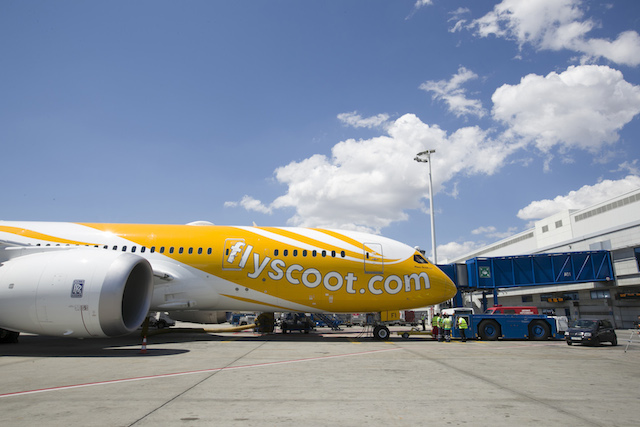
Scoot has started ticket sales for Singapore-Osaka-Honolulu flights, the airline’s second longhaul service after Athens, which debuted in June this year.

Marking Scoot’s maiden entry in to the US, the four-times-weekly flight serviced by the Boeing 787 Dreamliner is slated to commence on December 19, 2017.

With the route’s launch, Scoot will operate non-stop Singapore–Osaka service, in addition to its existing thrice-weekly services to Osaka via Bangkok and Kaohsiung. The total frequency to Osaka from Singapore will therefore increase from six-times-weekly to 10-times-weekly.


SIA, Lufthansa partnership set for launch
Singapore Airlines (SIA) and Lufthansa Group will launch their joint venture cooperation on October 1, 2017 – covering flights between Singapore, Australia and Germany, Switzerland, Austria and Belgium.

On the same date, flights operated by SIA, Lufthansa and SWISS between Singapore and Dusseldorf, Frankfurt, Munich and Zurich will be included in a revenue-sharing agreement between the two airline groups.

Since both airline groups signed the joint venture in November 2015, they have expanded capacity between Singapore and both Germany and Switzerland. This includes the introduction of SIA-operated flights between Singapore and Dusseldorf in July 2016. In March 2017, SWISS deployed its new Boeing 777-300ER aircraft on daily flights between Singapore and Zurich. Lufthansa has also announced plans to re-introduce services between Singapore and Munich from March 2018.


Cathay Pacific ups frequencies
Cathay Pacific will be increasing its services to Madrid, Barcelona, Tel Aviv and Fukuoka.

The airline’s seasonal operation to Barcelona during the summer peak will become a year-round service beginning April 15, 2018. It will start with thrice weekly flights from Hong Kong, before increasing it to four from July 1, 2018.

The new flights will be operated by Airbus A350-900.

In addition, the airline’s existing four-times weekly service to Madrid will be increased to five a week from October 29, 2017.

As well, Cathay will fly more frequently to Tel Aviv, from the current four a week to six from March 25, 2018, increasing to daily throughout October and November.

Meanwhile, Cathay Pacific’s regional carrier Cathay Dragon will be increasing the frequency of its services between Hong Kong and Fukuoka from December 18, 2017.

The airline will initially operate an additional weekly flight to Japan’s fifth largest city, bringing the total number of flights per week to eight, increasing to 11 flights per week between January 14 and March 24, 2018.


PAL links Clark to Basco; adds domestic routes
Philippine Airlines (PAL) has begun flights from Clark International Airport to Basco in Batanes.

The four-times-weekly service is operated by PAL Express, and departs Clark at 11.45 every Monday, Wednesday, Friday, Sunday. The return flight leaves Basco at 14.00 on the same days.

The new route is part of PAL’s development of Clark as a third hub of operations, following Manila and Cebu.

In addition, PAL will open three new domestic routes out of Davao – to Zamboanga, Tagbilaran and Cagayan de Oro – on November 1.


AirAsia begins Bangkok-Tiruchirappalli flights
AirAsia has launched four weekly flights between Bangkok and the Indian city of Tiruchirappalli.

Flight FD110 will depart from Bangkok’s Don Mueang international airport at 22.05 on Mondays, Tuesdays, Thursdays and Saturdays, and arrive at Trichy at 23.55. The return flight, FD111, will depart Trichy at 00.50 on Tuesdays, Wednesdays, Fridays and Sundays and reach Bangkok at 06.10.

Indonesia tries to stem arrival drops from neighbours

0

The Indonesia Ministry of Tourism is looking to tackle declining arrivals from Singapore and Malaysia by leveraging the easy accessibility of the Riau Islands from these markets and intensifying efforts to promote packages.

Statistics from the ministry show that travellers from Singapore decreased 3.94 per cent year-on-year in 1H2017, 5.59 per cent in 2016 and 4.59 per cent in 2015. Malaysia saw declines of 1.19 per cent in 1H2017 and 1.38 per cent in 2016.

The Indonesian government wants to promote the Riau Islands by highlighting the destination’s easy access; bridge on Batam, Riau Islands, pictured

Batam is a significant draw for these markets, with 55-65 per cent of travellers from Singapore and 17-19 per cent of travellers from Malaysia arriving at the island.

The ministry’s director for promotion for South-east Asia, Rizki Handayani, said a 2016 bomb-scare and the lack of new attractions in the Riau Islands have contributed to the decline in arrivals from Singapore.

Price is also an important consideration for Malaysian and Singaporean travellers who choose Johor or Vietnam instead.

Accessibility and amenity are key to attracting the two markets, said Rizki. The government hence sought to maximise idle capacity and boost arrivals by working with ferry operators, hotels and attractions to launch Hot Deals for Weekdays in August.

“Travellers can get cheaper ferry prices only when they buy the package, which can be purchased at our booth at the ferry terminals,” explained Rizki.

She said the government is targeting to sell 105,000 packages by the end of the year. “We have sold 6,000 packages in retail to date and 50,000 packages have been booked by a wholesaler,” she shared.

The government is also working on promotional packages with AirAsia. “AirAsia will cut its prices by 30 to 50 per cent for its routes, not only between Indonesia and Malaysia, but also all of Indonesia in certain periods,” said Rizki.

Star Holiday Mart partners ofo for cycling tours

0

Bike-sharing company ofo and Star Holiday Mart, a JTB subsidiary, have signed an MoU to offer Singapore cycling tours that showcase the city’s heritage, art, food and night scene.

Under the agreement, the agency will create ofo cycling tour programmes, while ofo will provide in-app promotions to tourists.

Ofo and Star Holiday Mart are partnering for cycling tours in Singapore

The programme will kick off with 100 tourists from around South-east Asia, but both parties estimate that there will be more than 100 participants on a monthly basis going ahead.

Lawrence Cao, head of Asia Pacific business for ofo, said: “We see ofo’s partnership with SHM as a strategic move for us to transform holiday experiences in highly urbanised cities like Singapore. We hope by creating customised and unique travelling experiences, we can reignite tourists’ interest in Singapore and allow them to experience the country’s charm beyond its typical tourist spots.

Since its founding in 2014, ofo has connected over 10 million bikes with 200 million global users. Today, it claims about 25 million transactions per day and has provided more than four billion rides in total.

3 lessons travel marketers can take away from Japan

0
Young

At first glance, one would think that Japan’s travel industry was well-positioned for strong growth over the medium term, capitalising on the depreciation of the Japanese yen and the easing of visa requirements for countries in the region.

After all, growth seemed more than healthy – in 2016, the number of visitors rose 21.8 per cent to 24.04 million, while spending grew 7.8 per cent to US$33 billion, both all-time highs. The country in 2Q2017 also welcomed a record of 7.2 million tourists.

But (sustaining growth is hard work) and beneath the impressive numbers are some underlying problems faced by Japan’s travel industry.

Young

Over-dependence on existing origin markets
It’s the classic case of sticking to what you know, and for Japan, that means a myopic focus on the Chinese and South Korean markets, the latter of which grew by almost 70 per cent in the period of April to July 2017. No matter how consistently strong these origin markets are, they are not enough – especially if Japan is to meet its lofty goal of doubling the number of inbound tourists to 40 million by 2020, the year it plays host to the Olympics and Paralympic Games.

Glaringly, Japan is missing out on crucial opportunities to grow its market, such as the US which emerges fourth largest searching origin, as well as the UK and Germany which make the Top 10, as revealed by a report we produced with Google.

Poor conversion rates
Research shows that Japan lags behind other countries in converting non-Asian tourists from ‘considering’ to ‘visiting’, which would explain why non-Asian visitors accounted for just 16 per cent of international tourists to Japan. Japan marketers need to learn more about what actually happens during the user journey in order to push would-be travellers through funnel to conversion – and that means looking at the right data.

Himeji Castle, with Mount Fuji in the background

So what lessons can travel marketers take away from Japan’s situation, keeping in mind these challenges?

1. Look beyond conversion rates
With the heavy emphasis on performance-driven marketing and ROI, there has been too much focus on conversion rates; it’s all about the bottom-line. However, there are other equally (if not more) important metrics that are being overlooked by travel marketers, such as:

• Rate of change in travel intent – Understanding which are the origins with the fastest growing travel intent can help marketers improve their geo-targeting
• Top alternative destination searched by origin – Knowing where they face tough competition (whether from regional destinations or international heavyweights) enables marketers to get in front of indecisive travellers while they are considering which destination to visit
• Timing and planning trends – Being aware of how long users from different countries take to plan their trips, whether this is months in advance or left until the last-minute, will help marketers ensure that their ads reach and engage travellers throughout this window

2. Understand the user’s journey across devices
In our connected world, cross-device is practically a given, but there are additional nuances to users’ online behaviour that travel marketers should take into consideration. It is true, for instance, that APAC travellers are becoming increasingly mobile-first, using their devices mainly as a tool for research, especially when they are higher up in the travel funnel. However, as users move further down the funnel, desktop dominates the share of bookings, standing at 85-90 per cent.

Ultimately, it’s the marketers who pay attention to such details when engaging in a cross-device, multi-platform campaign that would be far more successful in reducing drop-offs and driving conversions.

3. Engage on new channels and ad formats
It’s high time travel marketers think about engaging users on new channels and with new ad formats. This is especially so with mobile ad-blocking on the rise in the region – a problem exacerbated by the fact that the majority of travel-related search activity happens on mobile. With mobile growth increasingly led by an ongoing shift towards video, marketers should also consider using video to inspire travellers to choose their brand, and offering.

Besides side-stepping the ad-blocker issue, the presentation of content in a non-traditional ad format appeals to users who crave authenticity. Already we are seeing travel brands starting to catch on, such as Tourism Australia, which has just partnered up with BuzzFeed as part of a US$10 million push to attract millennial travellers.

On Facebook, there are multiple ad formats too, each designed to captivate and engage in different ways. In addition to the Canvas Ads that can be made up of full screen videos and images, and Carousell Ads that allows users to swipe or click through to see more, Facebook’s Dynamic Ads for Travel in particularly, is completely bespoke to the needs of travel marketers.

Then of course there’s cross-device targeting as part of this multi-channel approach, so marketers can link up user behaviour across multiple devices.

Japan may be the world’s third-largest economy, but to travel marketers, it is still a developing market worth watching and studying for nuanced changes and opportunities – especially as it continues to be pitted against other equally attractive destinations in the region.

Lanson Place appoints new group director of operations

0
Hugentobler

Seasoned hotelier Paul Hugentobler has joined Lanson Place Hospitality Management as group director of operations.

He brings with him over 30 years of luxury hotel management experiences with international chains namely InterContinental and Hyatt International in over eight countries. He spent over 20 years in general manager roles and was responsible for directing project pre-opening and running hotel operations in various key Asian cities such as Shenzhen, Hong Kong, Macau, Taipei and Bali.

Hugentobler

Prior to joining Lanson Place, he was the regional general manager of InterContinental managing 10 hotels in Shenzhen and the West Guangdong region.

In his new Hong Kong-based role, Hugentobler is responsible for overseeing Lanson Place Group’s operations in all regions including China, Hong Kong, Malaysia and Singapore; supervising and directing the group’s guest experience and IT functions, formulating and executing the group’s strategy, as well as expanding and monitoring the group’s business and financial performance, operations and pre-opening projects.

Hugentobler is a Swiss national fluent in English, French and Mandarin Chinese.

Swiss-Belhotel heads for Halong Bay

0
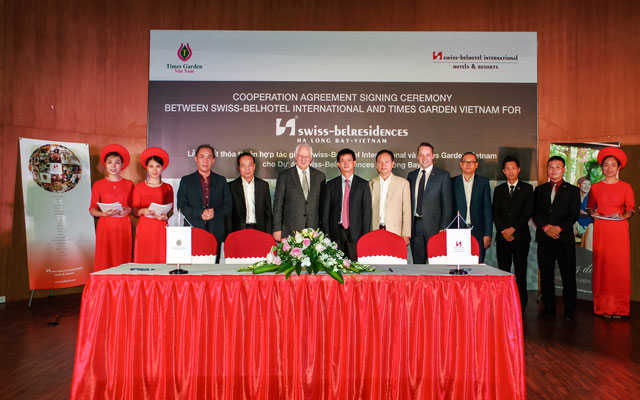
Quang Ninh People’s Committee Le Quang Tung, Swiss-Belhotel International's Gavin M. Faull, and Times Garden's Tran Dinh Lam, alongside other company representatives at the launch event

Swiss-Belhotel International will manage a new property in Vietnam’s Halong Bay, set to open in phases over the next two years.

Located by a new clock tower overlooking Halong Bay, Swiss-Belhotel Suites and Residences Ha Long Bay will comprise 50 shophouses and 236 residence units. The three floors of accommodation and shophouses are scheduled to welcome guests in 1Q2018 and the one-, two- and three-bedroom residences by 1Q2019.

Swiss-Belhotel International’s Gavin Faull (fifth from left), Quang Ninh People’s Committee Le Quang Tung (sixth from left), and Times Garden’s Tran Dinh Lam (sixth from right), alongside other company representatives at the launch event

Facilities at the hotel, developed by Vietnam’s Times Garden Vietnam JSC, include two swimming pools including one for kids, a spa with massage therapies, fitness centre, as well as a jacuzzi and whirlpool.

Keen to be a speaker?

0
Interested parties may apply here https://www.pata.org/speakers-bureau/

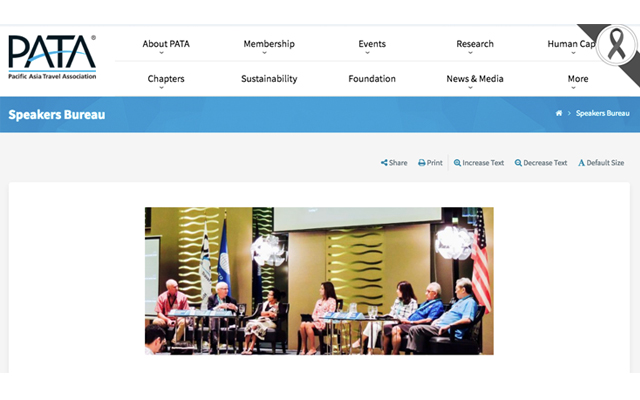
PATA is launching the PATA Speakers Bureau to create a bank of thought leaders keen to speak, present or moderate at the association’s events in the years ahead.

“We believe that many of our members have the expertise and insight to fill the knowledge gaps within our industry,” CEO Mario Hardy said.

Interested parties may apply here https://www.pata.org/speakers-bureau/

Hardy assured that all personal information received will be kept confidential and will be used for internal purposes only.

Interested parties may submit their details here https://www.pata.org/speakers-bureau/, and should note that they are not guaranteed a slot with their submission.

Park Hotel Farrer Park

0

LOCATION Park Hotel Farrer Park is conveniently located above Farrer Park MRT Station – just two stops from Orchard Road’s Dhoby Ghaut MRT Station and several stops from the Harbourfront Interchange that links to VivoCity and Sentosa.

Within walking distance lie City Square Mall and the 24-hour Mustafa Centre – the latter a quintessential stop for locals and tourists alike with its myriad products. The hotel also sits in the heart of Little India, a lively enclave lined with colourful shophouses.

AMBIENCE Away from the polished shine of the Marina Bay precinct, this 20-storey, 300-room hotel owes its quiet, chic vibe to RSP Architects and interior design agency FBEYE International. As evident from its mid-day check-in queues, the hotel has become a favourite among families and student groups since its May 2017 opening.

Duplex Sky Loft

ROOMS The hotel provides the urban comforts, topped with a hint of boutique chic. My door opened to a lofty surprise: a roomy duplex Sky Loft unit looking out over the neighbourhood through floor-to-ceiling windows letting soft daylight in.

Upstairs, the bed is accompanied by a TV, bedside cabinet and balcony outcrop.

Other categories are the single-storey Superior Room, Deluxe Room (with complimentary mini-bar) and Crystal Club Room (with access to the Crystal Club Lounge), as well as the sizeable Premier Loft that accommodates an additional fold-out sofa bed perfect for families.

F&B It may be enveloped by streets packed with hearty local eats, but Park Hotel Farrer Park can easily fill you up with the tasty treats within its walls.

In its lobby sits The Coffee Belt, which prides itself on incorporating local flavours into its signature dishes. The masala chai (spiced tea) is creamy but light, while the pandan brick toast – a brioche slice served with a dollop of pandan custard and coconut ice cream – makes a perfect complement.

The halal-certified Blue Jasmine Thai Restaurant offers classic Thai and street food dishes – another gem that Park Hotel Farrer Park hides on its pool deck.

VERDICT Park Hotel Farrer Park offers the best of both worlds, melding the bustle of the vibrant environs with the well-designed rooms and amenities.

Rates From S$184 (US$139) a night
Contact details
Tel: (65)-6824-8888
Website: www.parkhotelgroup.com/en/farrerpark

New tourism crisis taskforce emerges in Bali

0
Hardened lava at the foot of the volcano Batur with Mount Agung and Mount Abang in the background

With Bali on high alert following volcanic activity at Mount Agung, a Ministry of Tourism-funded taskforce has been formed to handle tourist-related services especially in times of crises.

Spearheaded by the Bali Government Tourism Office and with Bali Tourism Board (BTB) acting as deputy chair, the Bali Tourism Hospitality Task Force pledges to be the authoritative source of information and updates on issues related to Bali, effective October 5.

Hardened lava at the foot of the volcano Batur with Mount Agung and Mount Abang in the background

The task force will also comprise representatives from the Indonesia Hotels and Restaurants Association (PHRI) Bali, Travel Agents Association (ASITA) Bali, and Bali Tourism Institute (STP Bali).

Ida Bagus Agung Partha, chairman of BTB, said: “The formation of the task force has taken the momentum of Mount Agung’s (current activity), but it will not be in existence solely for the issue. The task force will continue to tackle issues related to Bali (such as the closure of the airport as a result of the eruptions of Mount Raung in East Java and Mount Rinjani in Lombok in 2015).”

BTB’s website www.BaliTourismBoard.or.id will now act as the main website through which the task force will disseminate the latest updates. Enquiries with the Indonesian Ministry of Tourism (www.Indonesia.travel) and Bali Government Tourism Office (www.disparda.baliprov.go.id) websites will be directed to the BTB website.

Official statements on crises will be jointly issued by the Ministry of Tourism, Bali Government Tourism Office and Bali Tourism Board, all under the task force.

Indian state turns to SE Asia to reverse tourism fallout

0
Tsomgo lake in east Sikkim, India

In the aftermath of separatist agitation in parts of neighbouring Darjeeling, India’s northeastern state of Sikkim is looking beyond its traditional visitor markets and pinning hopes on South-east Asia to help revive tourism.

Visitor numbers allegedly took a hit in the 104 days of separatist agitation in Darjeeling that forced a shutdown of the destination. The movement has since been called off.

Tsomgo (Changu) Lake, a sacred natural glacial lake on top of mountain in Gangtok, East Sikkim

“There has been a decline to the tune of 90 per cent in tourist arrivals post the agitation demanding ‘Gorkhaland’ (that) began few months back. In September alone tour operators recorded about 40 per cent cancellations. The fact that many countries issued advisories cautioning their citizens to avoid travel to our state hit our international tourist arrivals,” said C Zangpo, secretary, tourism & civil aviation department, government of Sikkim.

The impact could be attributed to the landlocked geography of the state, connected to the outside world through National Highway 10, 70km of which lies in Darjeeling, while Bagdogra airport in the Darjeeling district presently offers the only air link to the state.

As part of plans to reinvigorate tourism, the state tourism department is looking at South-east Asian markets including Thailand, Singapore and Vietnam, primarily focusing on its Buddhist offering. The state is home to about 200 monasteries.

“Traditionally, the US and Europe have been our key source markets for international tourism. Now we are eyeing South-east Asian markets too. To begin with we will host a fam trip for tour operators in Thailand in October and later this year we also plan to organise a roadshow in Thailand,” said Zangpo.

The tourism department is also holding talks with the North Eastern Council to explore advertising opportunities in South-east Asian markets.

As well, the tourism department is working on restoring the destination’s safety image among foreign tour operators, Zangpo said. It will host a fam tour for international tour operators in December on the sidelines of International Tourism Mart (ITM) that takes place in northeast India annually.

“Even during the agitation, National Highway 10 was open for travellers and there was no untoward incident involving any tourists. We are taking the help of different media platforms to dispel any negative notion regarding safety of tourists visiting Sikkim,” Zangpo reassured.

Boding well for tourism, the landlocked state is set to get its first airport in December.

“We expect that once the airport comes up it will result in a significant increase in international tourist arrivals. The rugged terrain from Bagdogra to Gangtok makes the road journey uncomfortable. Air India, IndiGo and Jet Airways have shown interest to operate flights to the new airport,” he said.

Zangpo also shared plans to have direct international air connectivity with Bhutan and Nepal. “If the relationship between India and China improves, we are keen to have air connectivity with Lhasa in Tibet,” said Zangpo.

Sikkim recorded 66,000 international tourist arrivals in 2016 as compared to 37,000 international tourist arrivals in 2015. In the first six months of this year about 33,000 foreigners have visited the state.