TTG Asia
Asia/Singapore Thursday, 9th April 2026
Page 1560

Involve private sector in crisis management: new WTTC president

0

The private sector should be engaged early on in crisis management, be it a health-related outbreak, act of god or act of mad men, said new WTTC president & CEO Gloria Guevara Manzo who has observed that past experiences have proven that this invariably leads to faster recovery.

In her first interview with an Asian media since replacing David Scowsill on August 15, Guevara told TTG Asia on the ITB Asia 2017 sidelines that WTTC research shows that recovery from a crisis takes from two to 30 months, but if governments involve the private sector early on in managing the issue, recovery is faster and consequently fewer jobs are impacted.
Guevara: pushing for planned tourism growth and increase support for female players

She gave the example of the Ebola crisis in Africa where the private sector was not engaged from the beginning and, on top of that, some international authorities painted the entire continent as one country. “There was not even a single case of Ebola in some of the African countries, yet, they saw a lot of cancellations and tourism was impacted,” said Guevara.

One important aspect why the private sector needed to be engaged because, unlike governments which change with election and see new ministers which may be inexperienced or try to reinvent the wheel, the private sector does not change, explained Guevera, who was Mexico’s tourism secretary before joining WTTC and had previously worked with private sector companies including Sabre Corporation.

Guevera is also keen to bridge government and private sector co-operation on safety and security, and effective travel and tourism planning which is linked to the current problem of overcrowding and anti-tourism sentiments in destinations such as Spain.

On the latter, in particular, she’s watching Asia as WTTC’s data shows 10 of the world’s fastest-growing tourism cities over the next 10 years are all in Asia, six of them in China and the other four being Manila, New Delhi, Kuala Lumpur and Jakarta.

Asked what this signals to her, she said: “Europe is right now the largest. If Asia travel and tourism continues to grow at this rate, it will be the largest. The question is, what are they doing to plan for growth and capture their fair share?”

She added: “Growth has to be well-planned and (destinations) have to consider the impact of tourism on natural and cultural assets, as well as the social impact.

“We are talking to our members about validating our agenda for travel and tourism development that is sustainable and inclusive. This is indeed related to the over-tourism issue, and we are partnering McKenzie to come up with specific solutions and best practices to avoid over-tourism (set to be ready by December).

“We want to work with local governments to build the path for tourism benefits to be spread out, for them to have the right flows of visitors, put in context the benefits and the concerns of local citizens.”

And, being the first woman to be elected at the male-dominated WTTC, she is passionate to advance the leadership space for women in travel and tourism.

The industry is powered 50 per cent by women, she said, adding “now we want to make sure we support them to move up (the ladder)”.

– Full report, TTG Asia, View From The Top, January 2018

Bali lowers Mount Agung volcano alert level

0
Alert level lowered based on thermal and visual observation

The volcano alert on Mount Agung in Bali has been lowered from ‘dangerous’ (level four) to ‘high alert’ (level three) after decreased volcanic activity.

“Based on Gunung Agung’s technical data, seismic activity has dropped dramatically in the first three days since October 20, and slowly declined thereafter to this day,” said Kasbani, head of the Center for Volcanology and Disaster Hazard Mitigation (PVMBG) under the Ministry of Energy and Mineral Resources.

Alert level lowered based on thermal and visual data

Drones were deployed to observe activity at the crater and “consistency in thermal and visual data prompted us to lower the status”, Kasbani elaborated.

The danger zone has been decreased from 12km to 7.5km and nine to six kilometres in some areas.

Mount Agung volcanic activity was first raised to high alert on September 18, before being bumped up to dangerous from September 22, triggering booking cancellations to Bali.


PVMBG will continue to monitor the development of Mount Agung’s volcanic activity together with the Regional Disaster Management Agency of Bali Province.

Off-site processing, automation on IATA’s agenda for airports

0
Photo credit: nextt.iata.org/

IATA, in collaboration with Airports Council International (ACI), have launched the New Experience in Travel and Technologies (NEXTT) initiative, which will look into off-site processing options, reducing queues, more efficient use of space and resources, as well as improving data sharing between stakeholders.

This is in light of the projected doubling of air travel demand by 2036, which increasingly necessitates new on-ground concepts that optimise the use of emerging technologies, processes and design developments.

IATA is working towards ensuring the transport of passengers, baggage and cargo will benefit from the latest technology developments. Photo credit: nextt.iata.org

“We will not be able to handle the growth or evolving customer expectations with our current processes, installations and ways of doing business. And accommodating growth with ever bigger airports will be increasingly difficult if not impossible,” said Alexandre de Juniac, IATA’s director general and CEO.

Specifically, NEXTT will look into the possibility of transferring on-site processes off-site, such as security processing, and baggage check and drop-off.

It will also investigate how advanced processing technology, such as tracking and identification technology, and automation and robotics, can improve safety, security, the customer experience and operational efficiency.

NEXTT will also promote the better use of data, predictive modelling and artificial intelligence to facilitate real-time decision-making, a key element in improving the passenger experience, and optimising operational efficiency.

A number of key airports including Amsterdam Airport Schiphol (AMS), Bangalore International Airport (BLR), Dubai International (DXB), Heathrow Airport (LHR) and Shenzhen Airport (Group) Co. (SZX) are already actively involved in a number of projects which explore NEXTT concepts.

For more information please visit http://nextt.iata.org/.

Australia’s Luxury Escapes sets up Indian HQ

0
India regional office a year in the making

Australian travel deals company Luxury Escapes has launched its regional headquarters in India, where vast opportunities in the market have prompted heavy investments in optimising its service for mobile.

Mahesh Thota, general manager of the Indian office, shared that prior to the launch, Luxury Escapes already had a strong and growing customer base in the subcontinent. Today the agency has nearly half a million customers in the region, with the number growing by about 30,000 each month.

India regional office a year in the making

Thota added: “When you consider the proximity of amazing destinations like Dubai, Bali, Sri Lanka, Phuket, Maldives, Vietnam, Bangkok, Singapore and Koh Samui, it is clear there is huge untapped potential.”

As the company looks to replicate its results in Australia, where it launched just four years ago, Luxury Escapes’ general manager Blake Hutchison said: “It’s no secret that India leads the world when it comes to accessing the Internet by mobile phones, so we’ve been investing heavily to optimise Luxury Escapes for the mobile experience. Already close to 30 per cent of our sales in this region take place on a mobile phone, and this is increasing month on month.”

Hutchison shared the Indian office has been a year in the making, with the company working to assemble a local team, get the local offering right, and establish relationships with the region’s hotels and resorts.

Thota, for instance, brings with him more than five years of experience at consultancy Accenture, followed by close to five years with Zomato as assistant vice president.

“This past year we’ve spent considerable time getting a deep understanding of what makes the Indian market different to other international regions where Luxury Escapes operates. While much of what we do will remain the same, we have made a number of customisations to match local travel patterns and preferences,” said Hutchison.

Dual Citadines signings to give Ascott its largest S’pore properties

0

Ascott has secured contracts to manage its two largest properties in the Singapore, both under the Citadines brand.

The 299-unit Citadines hotel in Raffles Place will form part of an upcoming landmark integrated development slated for completion in 1H2021, which will also comprise 29 floors of office space, a food centre and retail outlets.

An artist’s impression of the upcoming Citadines Rochor Singapore

Targeting professionals working in the city’s financial district, the Citadines hotel will boast facilities including a swimming pool, jacuzzi, running track, gymnasium, fitness corners, yoga deck, social kitchen, residents’ lounge, barbecue pits, and outdoor spaces. About 75 per cent of the units are studio apartments, while the rest are loft studio, one-bedroom and two-bedroom apartments.

“We also see opportunities to cater to the new catchment of working professionals with Singapore’s push for decentralisation of offices to new commercial hubs beyond the CBD. Citadines Rochor Singapore enjoys a prime location close to the Ophir-Rochor Corridor and Beach Road area – emerging commercial hubs with large-scale integrated developments, offices, as well as recreational and cultural attractions,” said Ervin Yeo, Ascott’s regional general manager for Singapore and Malaysia.

At the Citadines Rochor Singapore, about 80 per cent of the 320 units will be studio apartments, and the remaining one-bedroom and loft apartments. The property will offer facilities such as a residents’ lounge, gymnasium, launderette, breakfast cafe, swimming pool and outdoor multifunctional spaces for social gatherings and events.

Scheduled for opening in 2020, Citadines Rochor Singapore is part of an upcoming integrated development that will also comprise a retail podium.

Zecha opens a second Azerai in Vietnam

0
Can Tho property to be positioned as affordable luxury

A second Azerai will open in Can Tho, Vietnam this December, mere months after its founder, legendary hotelier Adrian Zecha, launched the brand and the first Azerai in Luang Prabang Laos in February.

Continuing the theme of affordable luxury, Azerai Can Tho is located on an eight hectare islet in the Hau River and offers 60 river, lake and garden rooms priced from US$250.

Can Tho property to have an affordable luxury positioning; photo credit: Azerai

Access to the hotel islet from the city’s arrival pier is a 10-minute ride. The hotel’s entrance overlooks a small lake and a swimming pool, restaurant, lounge and bar. Walkways lead to a comprehensive spa featuring thermal zones, pilates and yoga studios, gymnasium, tennis court and children’s zone with its own swimming pool.

Can Tho is Vietnam’s fourth largest city and is well regarded as the country’s ‘Rice Bowl’ and the Mekong Delta’s leading city.

Raffles Hotel Singapore to fully close for third refurbishment phase

0

The iconic Raffles Hotel Singapore has been undergoing restoration and refurbishment since February 2017, and is currently in the midst of Phase Two.

Phase Three of the restoration will commence on December 13, 2017, when the hotel will be fully closed. The hotel will reopen in 2H2018.

The hotel is preparing to close for several months for renovations

When the property reopens, Raffles Hotel Singapore will have three new suite categories – Residence Suites, Promenade Suites and Studio Suites – increasing the total suite count from 103 to 115.

The new Residence Suites, comprising four one-bedroom and one two-bedroom suites, will be located in the Raffles Arcade and are named after local cinemas during the early to mid-1900s. Suites names are Alhambra Suite, Diamond Suite, Marlborough Suite, Odeon Suite and Theatre Royal Suite.

There will also be two new Promenade Suites that overlook Beach Road, named Lady Mountbatten Suite (wife of Lord Louis Mountbatten) and Lady Sophia Suite (wife of Sir Stamford Raffles), which were converted from existing boardrooms.

There will also be new Studio Suites added, in addition to the existing Presidential, Grand Hotel, Palm Court, Courtyard and State Room Suites.

As well, once reopened, the Raffles Arcade will boast a refreshed Raffles Gift Shop that will house a History Gallery to illustrate the heritage of Raffles Hotel. The arcade will also be home to a brand-new Raffles Spa.

Signature restaurants and bars since the 1900s, Long Bar, Tiffin Room and Writers Bar, will continue to be part of of the hotel’s dining experiences when it reopens.

Meanwhile, Jubilee Hall has been converted into a new 300-guest ballroom, named Jubilee Ballroom. The space also comes with an air-conditioned pre-event foyer.

All other event spaces will also be refreshed, including the East India Room, Casuarina Suite as well as outdoor venues Palm Garden, The Lawn and Gazebo.

M’sian trade upbeat over SME, medical tourism allotment in Budget

0
Funds set aside for infrastructure development, SME loans, medical tourism promotion give trade many reasons to cheer

Malaysian prime minister Mohd Najib Abdul Razak last Friday presented the national budget for 2018, unveiling a RM2 billion (US$471.5 million) component for the SME Tourism Fund, which provides soft loans to eligible tour operators with an interest subsidy of two per cent, among other tourism sector allocations.

Apart from the SME Tourism Fund, RM500 million has been set aside for the development and promotion of tourism through infrastructure upgrades, as well as marketing for homestay and eco-tourism programmes.

Funds set aside for infrastructure development, SME loans, medical tourism promotion give trade many reasons to cheer

Other highlights include expanding eVisa regional hub by facilitating visa application worldwide, especially for expatriates, foreign students and the Malaysia My Second Home programme; and allocating RM250 million to the Eastern Sabah Security Command (ESSCOM) to enhance security controls at Sabah and Sarawak borders, including RM50 million for coastal surveillance radar.

Notably, the government has also allocated RM30 million to the Malaysian Healthcare Travel Council. Among other purposes, funds will go towards promoting Malaysia as the Asian Hub for Fertility Treatment and introducing the Flagship Medical Tourism Hospital programme, which offers special incentives for private hospitals to attract medical tourists.

Malaysia Healthcare Travel Council (MHTC), CEO, Sherene Azli, commented: “We welcome the allocation and are excited with the budget announcement to spur further growth of the medical tourism industry. Since 2011, the industry has shown tremendous potential recording a double-digit annual growth, ranging between 16-17 per cent every year. In 2016, the healthcare travel industry grew by 23 per cent from 2015, compared to the average growth rate of 15 per cent from 2011-2015.”

Malaysian Association of Tour and Travel Agents’ (MATTA) president, KL Tan, said the tourism allocations answer MATTA’s calls for continued incentives for inbound and domestic tour operators to help new and small players, many of which are Bumiputera companies.

“MATTA had proposed for funding for capacity building in the travel sector and RM2 billion was allocated to SMEs for training programmes, grants and soft loans under SME Corporation Malaysia. (Also), the allocation for infrastructure development will strengthen rural tourism and homestay, including eco-tourism facilities like jetties, toilets and signages.”

He further expressed optimism that the expansion of the eVisa regional hub, Malaysia “is certain to attract more visitors from countries with access to this facility”, and that airport expansion would bring greater comfort and convenience to travellers.

“As safety and security are paramount, allocating RM250 million to ESSCOM is essential for the safety and security of tourism and economic activities in the East Coast of Sabah, which is currently experiencing an influx of China tourists, especially to Semporna,” he added.

Fiji Airways rolls out off-airport check-in at Denarau resort

0
http://www.accorhotels.com/5706

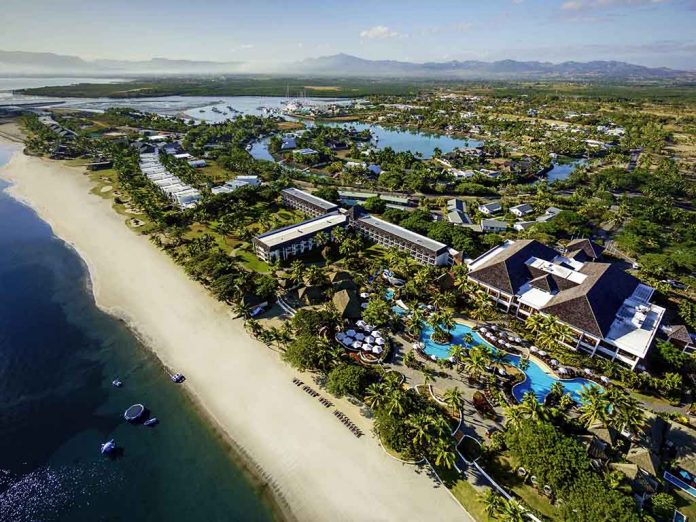
Fiji Airways is introducing a flight check-in feature at the Sofitel Fiji Resort and Spa on Denarau Island, believed to be a first for the Pacific.

Speaking at the official launch yesterday morning, Fiji Airways’ managing director and CEO, Andre Viljoen shared: “We’ve designed this experience so guests simply get to the resort lobby and check themselves and their bags in for their Fiji Airways flights. We issue the boarding passes, tag and take bags off guests, leaving them free to enjoy Fiji for a few more hours.”

Guests can complete check-in at the resort, including for baggage; photo credit: AccorHotels

All bags are transferred to Nadi International Airports and loaded onto guests’ respective flights.

Viljoen said this frees guests up for meals, recreation, and shopping before making their way to the airport. At the airport, guests can then bypass the check-in process and head straight to security.

Fiji Airways had earlier piloted the resort check-in feature and received “overwhelmingly positive response” from guests during the trial phase, according to a statement from the airline. The feature was also activated during the Fiji International Golf tournament at Natadola and the Pre-COP 23 convention at the Sheraton Fiji Resort earlier in October.

The airline anticipates that more resorts in Fiji would get on board to offer the complimentary service to guests.

[Sponsored Post] Leading Companies Better At Collaborating To Reach Their Simplification Goals

0

With new technology proliferating and business traveller needs and expectations evolving, travel managers are struggling to manage complex, multi-layered travel programmes. According to new research from the Association of Corporate Travel Executives (ACTE), underwritten by HRS, travel managers recognize this challenge and understand that simplifying their programmes could yield benefits—but simplification initiatives face competing priorities.

The new study, Simplifying Managed Travel, finds that traveller safety trumps the agenda: Most buyers (94 per cent) say duty of care is a key priority; 82 per cent say it is their top priority. With 72 per cent rating it a key priority for their managed travel program, simplification follows behind cost reduction (88 per cent), data security (84 per cent) and improving traveller satisfaction (75 per cent).

However, travel managers recognize that simplification initiatives can support their other strategic priorities. For example, 47 per cent of travel managers say that simplification will improve duty of care, and 39 per cent believe it will reduce the overall cost of their travel policy.

Travel Managers Struggle to Translate Priority into Action

Despite recognizing the importance of simplification, travel managers see a gap between intention and execution. Reflecting the strategic importance placed on traveller safety, duty of care is the travel buyer’s top priority for simplification: A majority (83 per cent) say duty of care requires immediate action (62 per cent).  Data security appears second on buyers’ list of simplification targets.

Disconnects between buyers’ simplification priorities and their actual behaviour, however, indicate barriers to pursuing strategic goals. The execution gaps for duty of care and data security are large relative to other priorities, with more than one-in-five buyers saying they are not currently translating their traveller safety (23 per cent) and data security (24 per cent) concerns into action.

Suppliers and Internal Stakeholders Must Become Partners in Simplification

Today’s complex travel programmes encompass multiple partners and stakeholders—internally and externally. To be effective, simplification initiatives often require support from these parties. While nearly one-in-five buyers do not get support from peers in other departments, most report that internal stakeholders are on board with simplification initiatives:

  • Procurement is most often regarded as a partner in simplification (57 per cent);
  • Internal risk/security and communications staff follow (40 per cent);
  • IT support (36 per cent) and human resources (28 per cent) lag other departments.

Third parties can supply relevant tools and expertise, providing support to travel buyers’ simplification initiatives. Buyers welcome this assistance: More than half of buyers not currently receiving help from travel providers say they want it. Internally and externally, the data suggests that the travel buyers who say simplification is a top strategic priority are better at collaborating to reach their simplification goals.

“The value travel management provides to a company is increasingly measured in optimised processes and cross-department collaboration,” explained HRS CEO Tobias Ragge. “The study shows this close collaboration is vital and that leading companies build on their internal stakeholder network, but they also rely on the data, advice and support of external partners to reach their strategic goals.”

Driving Effective Simplification

Simplification is a key route for travel managers to achieve their business objectives. However, facing the hurdles of limited resources and differing levels of support from internal and external stakeholders, buyers must ramp up communication with suppliers, other departments within the organization and with the travellers themselves.

The study can be downloaded https://corporate.hrs.com/int/simplify.