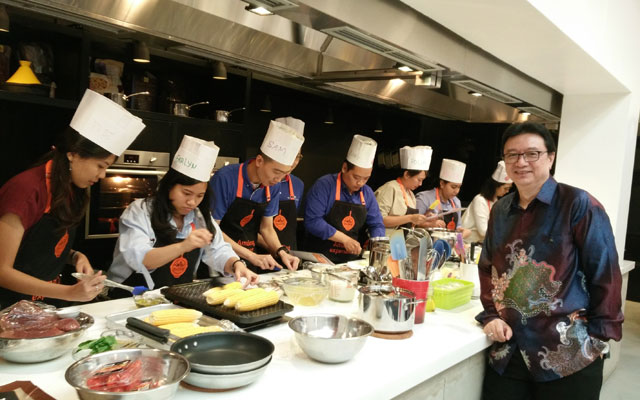
Princess Cruises recently held a cooking challenge for over 50 travel agents in Jakarta as part of its relationship building programme with the local travel trade. Attendees were grouped into teams to prepare a simple four-course meal under two hours, following which everyone came together to enjoy their fruits of labour.
Prior to the cooking challenge, Princess Cruises made a presentation on its global portfolio of new 2017/2018 itineraries to Alaska, the Mediterranean, the British Isles, as well as Sapphire Princess‘ new homeporting itineraries in Singapore from November 2017 to March 2018 for sailings in the region.
Farriek Tawfik (in blue), Princess Cruises’ director of South-east Asia, joins travel agents in the cooking challenge
Sofitel Kuala Lumpur Damansara
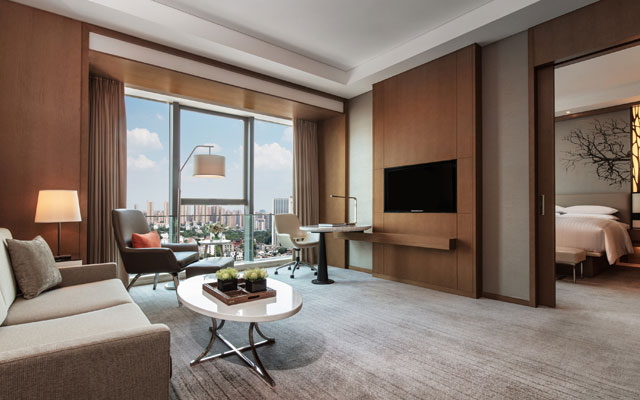
Part of a 3.4ha integrated development in Damansara Heights, Sofitel’s first property in Malaysia offers 312 guestrooms – ranging from 43m2 to 105m2 – each furnished the brand’s signature MyBed, free Wi-Fi, and in-room amenities from Lanvin and Hermès. Guests staying in suites will also have access to the Club Millésime lounge that overlooks the city’s skyline. Recreational facilities include an outdoor pool, fitness centre and a spa offering the country’s first Moroccan Hamman bath treatment. There are also five restaurants and bars, as well as six meeting rooms and a pillarless 1,100m2ballroom for 800 guests.
Yotel Singapore
Asia’s first Yotel will open along Singapore’s Orchard Road on October 1, 2017. There will be 610 cabin-esque rooms in total, ranging from 13m2 to 52m2. Each room will feature the brand’s adjustable SmartBed, free Wi-Fi, rainshowers, smart TVs and a work desk with multiple power sockets. Recreational facilities such as the Club Lounge, gym, terrace and a 20m-long swimming pool on the 10th floor. There is also a restaurant and bar called Grains & Hops. The hotel is now open for bookings.
Samsara Ubud
Nestled in Bali’s lush Payangan district is Samsara Ubud, which boasts 17 villas across four configurations. Each Balinese-inspired villa starts from 122m2, and comes with a private heated infinity pool, an outdoor area and a Makassar marble bathroom with a deep-soaking bathtub. Facilities on the property include The Kelusa restaurant, Chakra Spa, gym, sauna and two heated outdoor pools. Activities such as a Mount Batur sunrise trek or visit to the nearby Kelusa village can also be arranged by the hotel.
Courtyard by Marriott Changsha South
Marriott International has opened its first Courtyard-branded property in China’s Hunan province. The hotel boasts 260 guestrooms, each furnished with a working area, high-speed Internet access, HDTV, mini bar and sofa. Guests also have a choice of five pillow types. Apart from the Executive Lounge on the top floor, other facilities include a 24-hour fitness centre, a lobby lounge with a tea bar and the all-day dining eatery Pavilion. For business events, the property has 1,000m2 of event space across three multifunction rooms and a grand ballroom.
Grand Élysée La Résidence
The 32-key Grand Élysée La Résidence stands five minutes away from Siem Reap’s popular Pub Street, and is 20 minutes away from UNESCO-listed Angkor Archaeological Park. Amenities on-site include an outdoor swimming pool, pool bar, a restaurant, club lounge, two spa treatment rooms and a mini gym.
Pan Pacific Hotels Group (PPHG) has appointed Larry Lv as general manager of Pan Pacific Beijing, opening on August 20.
Most recently the general manager of Shangri-La Hotel Jen Shenyang, Lv brings more than 20 years of hospitality experience from various cities such as Shanghai and Hangzhou in China with him.
The native Chinese has worked for established hotel chains such as Shangri-La, Ramada and InterContinental Hotels Group, where he took on assignments for hotels under the Intercontinental, Holiday Inn and Holiday Inn Express brands.
Now that the ASEAN Open Sky Agreement is finally ratified, getting the airport infrastructure planning right and ahead of demand growth are the greatest challenges the region needs to overcome, say industry chiefs
Andrew Herdman Director general
Association of Asia Pacific Airlines
The Asia-Pacific region is already the world’s largest aviation market in terms of both passenger and freight traffic volumes, and is expected to continue growing at five to six per cent annually over the next two decades.
Andrew Herdman
This year, four billion people worldwide will travel by air, with a third of them being carried by Asian airlines. By 2035, this region alone will account for over three billion air passengers annually, according to IATA projections.
The growth of aviation also delivers wider social and economic benefits, and nowhere is this more evident than key markets in ASEAN, where tourism is a significant contributor to national GDPs, and air links are crucial to the movement of people and goods across large archipelagos. At the same time, steadily rising incomes and growing numbers of middle class consumers across the region are further accelerating the growth of air travel.
Nevertheless, the relentless growth in travel demand also raises a number of associated challenges for the ongoing development of the industry, notably in relation to infrastructure capacity. At current growth rates, the Asian air travel market will continue to double in size every 12-15 years.
Some air travel markets in Asia have grown even quicker, highlighting the need for clear long-term vision and commitment to investing boldly for the future, not just incremental expansion. It is critically important that the associated aviation infrastructure, including airports, runways, terminal capacity and air navigation services, keeps pace with the projected growth in demand.
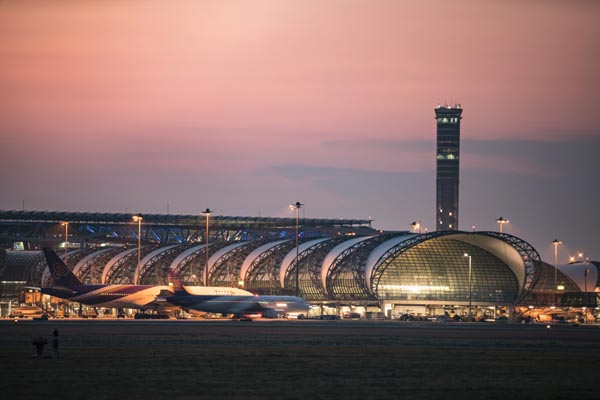
Several airports in the region are already experiencing problems with air traffic congestion, especially during peak hours of the day. Some busy airports in ASEAN, including Jakarta, Manila and Bangkok, are operating well above their designed capacity, threatening to degrade service performance and constraining the development of new routes and flight frequencies. Vietnam provides a further illustration of the potential for rapid growth in air travel in line with broader economic and social development, now being backed up with major investments in new airport infrastructure.
Major Asian hub airports including Hong Kong and Singapore are adding much needed additional runways, but developing such infrastructure involves complex planning decisions and multi-year construction programmes.
Air traffic congestion and infrastructure bottlenecks can quickly lead to degraded service levels for both passengers and airline operators. Flight delays can cause significant frustration to passengers, and the effect is compounded if it leads to missed connections and consequential delays to other flights.
Governments have a key role to play in providing proper regulatory oversight and coordinating the necessary long-term planning decisions required for timely development of aviation infrastructure.
Air travel offers exciting growth prospects, but continued progress can only be effectively sustained when all relevant parties work closely together in active cooperation and collaboration.
Sumesh Patel President, Asia-Pacific
SITA
IATA estimates that by 2036, 7.2 billion passengers will travel by air annually, nearly doubling the four billion air passengers expected in 2017. The Asia-Pacific region is expected to lead this growth, accounting for over half of the new passengers over the next 20 years, and China will take the top spot as the world’s largest aviation market in/around 2029.
Sumesh Patel
With the sheer number of travellers passing through our airports, plus more flights and aircraft to be managed, it’s no surprise that we see a lot of infrastructure investment in this region. However, as passenger volumes are increasing way faster than new airports or terminals can be built, airports need to get smart about the way they handle this growth. In many cases, innovation and technology can be the answer.
The latest of these is biometrics technology, which integrates with existing airport infrastructure, including industry standard equipment such as check-in kiosks, bagdrop units, gates for secure access, boarding and automated border control. The SITA Smart Path technology allows a passenger’s biometric details to be captured through a facial scan at the first touch point in the journey such as a check-in kiosk. The biometric record is checked against the passenger’s travel documents and a secure single token is created.
Then, at every additional step in the journey – whether it’s during self-bag-drop, at border control or aircraft boarding – passengers simply complete a facial scan without having to present their passport or boarding card.
The ability to integrate seamlessly at so many touch points would make at least 70 per cent of the journey faster, smoother and less stressful for passengers. A trial with Brisbane Airport for Smart Path has been launched.
Another area is self-service, where passengers can check-in at a kiosk, choose their seats and print their boarding passes and bag tags; and drop off their baggage at automated bagdrops.
In Asia, airports are increasingly turning more to self-service to manage increasing passenger numbers. For example, at Changi in Singapore, SITA is providing a combination of self-service check-in kiosks, self-bag drop and self-boarding to increase passenger throughput. It is also evident that self bagdrop successfully increases efficiency, with passengers being able to drop their bags in less than 20 seconds, as experienced at major airports in Australia like Melbourne and Brisbane.
Technology can provide many benefits to airports – the ability to handle more passengers within the constraints of existing infrastructure, while ensuring a fast, seamless and stress-free journey for travellers.
On the top of ASEAN airlines’ wish list: infrastructure investment
Nicholas Ionides, divisional vice president public affairs, Singapore Airlines
We would like to see the authorities take a proactive approach and long-term view of airport planning, and that includes making sufficient aircraft contact stands available, leveraging new technologies to improve the check-in, immigration and security check experiences, and increasing runway capacity wherever possible to reduce aircraft holding in the air and on ground. Such investment in infrastructure is necessary to support the continuing growth of tourism and air travel in this region.
Francis Loi, head of commercial, Jetstar Asia
The policy of open skies has to be followed with soft and hard infrastructure and improvements. LCCs need terminals that deliver quick aircraft turnarounds at a low cost.
The real issue is slots at the airports. Though traffic rights have been liberalised, there is still airport congestion across some of the major airports in ASEAN, such as Manila and Bali. In markets like these, there has to be more easing of slots to airlines to enable them to grow.
Singapore and Jakarta airports are addressing this, in terms of improving efficiency. Others are addressing this with the expansion of runways and terminals.
Jaime J Bautista, president and COO, Philippine Airlines
My wish is for airports to focus on infrastructure because this will lead to the growth of the aviation industry in the country. For the country’s aviation industry to fully maximise the potential of ASEAN Open Skies, we should have the facilities to support the market growth.
The Philippine administration should study the possibility of building a new international airport in Manila or expand existing airports. Terminal 2 at Ninoy Aquino International Airport, for example, is designed to accommodate 28 million passengers per year. At present, it is handling 34 million per year – way beyond its allowable capacity.
Improvements can also be made to existing airports outside Manila like Clark International Airport. Efforts are underway to improve fuelling facilities, airline catering and ground handling.
Ecotourism has been a lifeline for northern Vietnam, a region known for its remarkable landscapes and cultures, but can it prevent over- commercialisation and overexploitation?
North Vietnam – in particular Sapa – is shaping up to be the country’s ecotourism hub, as more operators develop tours and homestays connecting with local ethnic minority communities, predominantly Hmong and Dao.
Jack Bartholomew, general manager of Ground Asia, said: “The potential in north Vietnam is huge. You have a whole range of ecosystems – forests, national parks, limestone ecosystems and a massive potential for cultural preservation as the area is home to numerous tribes and ethnic groups.”
Nguyen Thu Trang, director of sales and marketing at Mai Chau Ecolodge, agreed: “Ecotourism is undoubtedly a burgeoning niche market within the Vietnam tourism industry.”
Besides an increase in ecotourism products, Shu Tan, founder and director of Sapa O’Chau, said the highway connecting Hanoi to Lao Cai, which debuted in 2015, has been key to opening the area up to visitors as it cuts the bus journey from 12 hours to six.
She said: “The increase in accessibility allows tourists to spend more time seeing Vietnam rather than travelling from one place to another.”
However, as development in Sapa picks up pace – triggering an oversupply in hotels and guesthouses, and a surge in room prices – tourism is trickling into nearby, less-developed provinces.
Other areas in north Vietnam, Lang Son, Ha Giang and Son La, are also growing in popularity. Despite the lack of infrastructure, their off-the-beaten-track appeal has seen more international visitors incorporating these destinations into their itineraries, noted Bartholomew.
In February, a masterplan to develop Mau Son tourism zone in Lang Son was given the green light, and 1,500ha was devoted to developing a range of tourism products relating to the landscapes and the native Dao, Tay and Nung ethnic minority culture. A target to attract 800,000 visitors by 2025 has been set.
But industry players are quick to point out that careful development is essential for the region to retain its authenticity. Waste management plans, for instance, need to be put in place to preserve the unique environment and ecology.
Expressing her concerns about the downsides of ecotourism, Nguyen said: “(Ecotourism) can have a detrimental effect instead. As a destination’s popularity grows, resources sometimes become overtaxed and natural attractions suffer from (congestion). Visitors can also disrupt wildlife, resulting in changes to their feeding and mating habits.”
Overdevelopment is another concern, especially as domestic tourists surge.
“What you see now is handful of sites getting a massive number of visitors while many others remain unvisited,” said Bartholomew. “It also means the tourist dollar isn’t reaching those other places.”
Stressing the need for proper development plans in ecotourism destinations, Bartholomew added: “Hopefully some lessons can be learnt (but) the outlook is positive; the potential is huge.”
This article was first published in TTG Asia August 2017 issue. To read more, please view our digital edition or click here to subscribe.
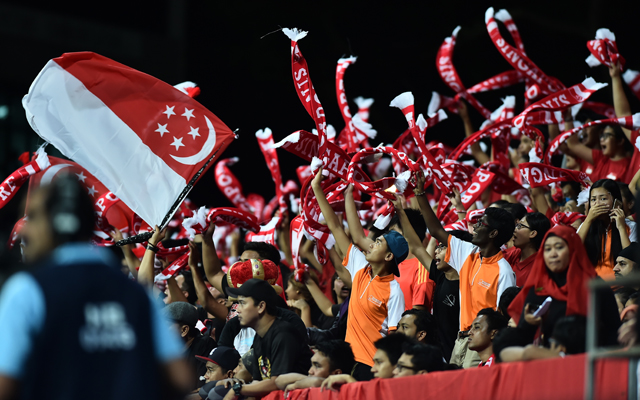
Tour packages built around the Games in Kuala Lumpur are selling well; Singapore supporters at the 2015 SEA Games pictured
Singapore’s New Shan Travel is taking a big step into the sports tourism arena with packages for the coming SEA Games.
New Shan Travel is the appointed travel agent supporting Sport Singapore, formerly the Singapore Sports Council, which decided this year to use tour packages to rally spectator support for Singapore athletes, said New Shan’s group general manager, James Tang.
Tour packages built around the Games in Kuala Lumpur are selling well; Singapore supporters at the 2015 SEA Games pictured
This week’s departures, which feature the opening ceremony and Laos-Singapore football match at SEA Games, have been sold out. Packages departing next week are selling fast, Tang added, with local Olympic hero Joseph Schooling’s swim events featured in some of the programmes.
Packages also include activities and meals centred on healthy living, in line with Sport Singapore’s focus.
“Team Nila (a group of sports events volunteers spearheaded by Sport Singapore) is the majority group that’s going out, but we have also seen (take-up) by corporates, individuals, local institutions and polytechnics,” he shared.
This has awoken the agency to opportunities in sporting event tourism. It has been “great exposure” to a new area of business for the relatively “old school, old brand” agency as it evolves with the times, said Tang. “It is about trying to develop the kind of portfolio that allows us to (broaden our expertise).”
Tang is confident that more sports tourists will turn to New Shan following its SEA Games exposure. “We last week got an enquiry from a group of 30 wanting to visit Australia for a marathon event. I thought that was very encouraging.”
Lionsgate first outdoor branded theme park will feature a Hunger Games zone
Lionsgate is planning a South Korean theme park featuring seven zones devoted to its successful franchises such as The Hunger Games, The Twilight Saga and Now You See Me as well as the upcoming Robin Hood movie.
In partnership with Landing Jeju Development, Lionsgate’s first branded outdoor theme park will be developed in the Jeju Shinhwa World, an integrated development that will also be home to luxury hotels such as Four Seasons Resort Jeju Island.
Lionsgate first outdoor branded theme park will feature a Hunger Games zone
Spanning approximately 122,000m2, Lionsgate Movie World is expected to commence construction in 2018 and open in 2019.
It is also the largest destination attraction to date in Lionsgate’s three-year-old portfolio of branded theme parks, entertainment centres and other attractions in the US, Europe, the Middle East and Asia.
Movie scenes will be recreated through rides, attractions and 4D Intellectual Property-reproduced streets and towns. Each zone will also feature themed restaurants, cafes, souvenir shops and entertainment performances.
Floatation devices required for those identified to be "at-risk"
Following a spate of tourist deaths on the Great Barrier Reef last year, snorkellers identified as “at-risk” will soon be required to wear floatation devices when snorkelling in Queensland waterways, according to a report by the Australian Associate Press (AAP).
As well, tourism operators will be allowed to request declarations from these “at-risk” individuals before they enter the water.
Floatation devices required for those identified to be “at-risk”
Apart from floatation devices, the select snorkellers also need to wear a different coloured vest or snorkel to be more easily spotted from a vessel, which must be equipped with an automatic external defibrillator.
Meanwhile, a new recreational diving code of practice is expected to be announced in the coming weeks.
Journey of Me report reveals varying travel preferences in Asia-Pacific
Amadeus, in collaboration with YouGov, has centred on the diverse preferences, behaviours and demands characterising the region’s travellers in its Amadeus Journey of Me Insights traveller survey.
In terms of where they prefer to receive trip information, 62 per cent and 70 per cent of Australian and New Zealand travellers respectively chose email. Chinese travellers, on the other hand, are most likely to prefer to be contacted via messaging services like WeChat (41 per cent), and almost half of all Thai travellers want to be contacted through social media.
Journey of Me report reveals varying travel preferences in Asia-Pacific
Recommendations that help save money was the top choice for Malaysian travellers, while Vietnamese travellers prefer recommendations that help ensure their safety.
Offering an example of how starkly travel preference can vary, Amadeus said that while 84 per cent of Singaporeans travellers think it’s important that service staff in their chosen destination speak a language they understand, only four per cent of Hong Kong travellers think the same.
And while 70 per cent of Japanese travellers surveyed have never used a sharing economy service for trip accommodation, almost half of Indian travellers say they do so ‘often’ and ‘very often’.
The research further revealed that online booking sites, travel review sites, along with word of mouth, have the largest influence on Asia-Pacific travellers’ trip planning. These were also ranked the top three sources from which Asia Pacific travellers have received relevant travel recommendations.
Travelport has established an “interconnect arrangement” with Ugo Transfers to give agents access to a range of ground transport services in 100 countries.
Agents using Travelport Marketplace can download the Ugo application to browse, pre-book and confirm their customers’ ground transport arrangements in advance.
Travelport’s senior director for products and solutions in Asia-Pacific, Tony Hopwood, said that accessing the Ugo app through Travelport’s Smartpoint will allow agents to “create a faster and more efficient workflow, improving the response time for their customers”.
Ugo Transfers recently established a specialised service centre that allows for requests to cater to larger groups and other customised options.










 Jack Bartholomew, general manager of Ground Asia, said: “The potential in north Vietnam is huge. You have a whole range of ecosystems – forests, national parks, limestone ecosystems and a massive potential for cultural preservation as the area is home to numerous tribes and ethnic groups.”