

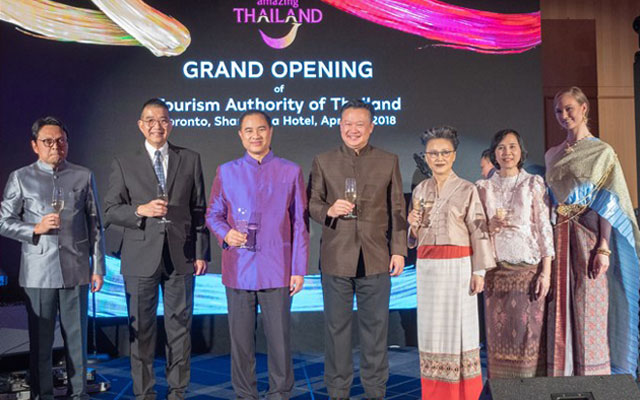
The Tourism Authority of Thailand (TAT) this week opened an office in Toronto, its third address in North America after New York and Los Angeles, and 28th overseas.
Kalin Sarasin, chairman of the TAT board, said: “We chose Toronto, the capital city of Ontario, because it is a vibrant, multi-cultural city and one of the largest metropolitan areas in North America. We believe it will be a perfect location to cover Canada, which has been identified in our current marketing plan as a high potential market with a long average length of stay and strong purchasing power.”
Moreover, Ontario was the largest source of Canadian travellers to Thailand in 2017, with a market share of 45 per cent.
In 2016, the average length of stay for the Canadian travellers in Thailand was approximately 18 days – double the average length of stay of the overall market – with daily expenditure of around 172 CAD (US$134) per person.
And from 2013 to 2017, revenue from the Canadian market rose six per cent on average in five years.
Elaborating on TAT’s efforts in Canda, Kalin said: “We are working with local partners to develop new products and introduce new local experiences in Thailand that fit with the targeted segments including the Baby Boomers, Gen X and Gen Y. They (show strong) interest in beach, culture, health and wellness, weddings and honeymoons, and our gastronomical delights.”
In conjunction with the launch of its Toronto office, TAT also launched the Amazing Thailand’s Open to the New Shades campaign in Canada. Tanes Petsuwan, TAT deputy governor for marketing communications, gave a 4D presentation of the campaign, highlighting five categories of products: gastronomy, nature and beach, culture, way of life, as well as art and craft.
In 2017, Canadian visitor arrivals to Thailand totalled 258,392, up by 5.52 per cent over 2016. This contributed to income of 845.9 million CAD, representing a 7.6 per cent growth.
At the end of this year, TAT projects revenue growth of 8.46 per cent from the Canada market.
















Tourism spend is on the rise globally, with the Chinese coming in as the top spenders and Russia and Brazil making strong recovery last year, according to the latest UNWTO World Tourism Barometer.
All top 25 source markets, comprising emerging and advanced economies, in the barometer reported higher spending on international tourism in 2017.
The BRIC economies are a standout. China consolidated its leadership as the biggest spender in travel abroad in 2017 with US$258 billion in expenditure (+5 per cent in local currency). The other BRIC economies also all substantially increased expenditure in 2017.
Rebounding from weaker spending in previous years are Russia, which climbed three places to re-enter the top 10 at eighth place with US$31 billion (+13 per cent), and Brazil, which moved up eight places to number 16 with US$19 billion (+20 per cent).
India, another key emerging outbound market, continued its rise with nine per cent growth in spending to US$18 billion, moving up four places in the ranking to 17th.
Advanced markets also reported robust performance in 2017, led by the US as the second largest outbound market to spend US$135 billion (+ nine per cent).
Expenditure from Germany (the third largest market) and the UK (fourth) both increased three per cent, and France (fifth) saw a one per cent increased.
Australia (sixth) reported seven per cent growth and Canada (seventh) a nine per cent increase. Completing the top 10 are South Korea (ninth), where expenditure grew by nine per cent, and Italy (10th), which increased by six per cent.
Beyond the top 10, notable increases in tourism spending were seen in Sweden (+14 per cent) and Spain (+12 per cent).
These strong results in outbound tourism are consistent with the seven per cent increase in international tourist arrivals in 2017. Demand for travel was particularly high in Europe, where arrivals increased eight per cent last year.