A gallery featuring semi-submerged sculptures – ruled anti-Islam under outgoing president Abdulla Yameen – was torn down in dramatic fashion last Friday.
Images circulating on social media and news outlets show police demolishing the sculptures using saws, axes and ropes on the eve of the presidential election, which Yameen lost to a liberal candidate.
Photo credit: Twitter/@PoliceMV
1 of 3
The gallery opened at the Fairmont Maldives Sirru Fen Fushi in July, featuring a series of statues named the Coralarium.
The artwork designed by British artist Jason deCaires Taylor were touted to marry art and marine conservation, but Yameen ruled them offensive to Islam and ordered for their destruction.
Travel industry players TTG Asia spoke with in July had suggested that this was a political play rather than a reflection of public and religious sentiment.
Melco Resorts’ Morpheus is a new entrant to Macau’s luxury scene
Despite a new swathe of rooms coming on-stream this year, hoteliers in Macau remain confident that demand will continue to outpace supply and prop up business.
This could be attributed in part to the rebound of visitor arrivals. For 1H2018, Macau’s Statistics and Census Service (DSEC) indicated that visitor arrivals totalled over 2.6 million in June 2018, up 9.4 per cent year-on-year.
Melco Resorts’ Morpheus is a new entrant to Macau’s luxury scene
Overnight visitors in 2017 grew by 7.2 per-cent year-on-year to pass 1.4 million, according to DSEC figures.
Meanwhile, occupancy rates for all hotel types reached 89.8 per cent, an increase of 4.3 per cent. Room rates grew 7.1 per cent from MOP$1,252 (US$154) to MOP$1,342 during the same period.
Occupancy wise, five-star hotels performed well to record a 7.8 per cent uptick, while the three-star category was the only one to have experienced a decline (-2.1 per cent).
Crowne Plaza Macau, for instance, continued seeing high occupancy in 1H2018, and a double-digit growth in average rates.
General manager Dominique Berhouet explained: “Although Macau is questioning the issue of oversupply, (new openings such as) Morpheus and MGM Cotai are targeting the casino market, a different market from what Crowne Plaza Macau (is going after).
According to Macau Government Tourism Office, mainland China is still the top visitor market to Macau, and most of the new rooms have found utilisation with casino goers or junkets.
Moreover, the Hong Kong-Macau-Zhuhai Bridge, which is approaching completion, represents an important new gateway to Macau and “should help to further develop the Hong Kong and Guangdong area market,” said Berhouet.
Sharing similar views, vice president of operations at JW Marriott Hotel and The Ritz-Carlton, Rauf Malik, said both properties have not had to adjust rates despite the new openings as demand for rooms remains high.
“If visitors from these other cities grow two to three per cent each year, then already there won’t be enough rooms to accommodate the influx of visitors,” said Malik.
“We continue to see tremendous demand from China, Hong Kong, South Korea and Japan, all of whom are interested in the newly developed Cotai area. Even with the addition of new hotels, we remain optimistic about occupancy rates,” he added.
Mandarin Oriental, Macau, as the only non-gaming international hotel located on Macau Peninsula, has seen significant increases in its performance indicators since January 2018 compared to 2017.
Director of commercial strategy, David Lam, said the luxury hotel’s target market is different from others located in Cotai, drawing guests seeking pampering experiences and personalised services.
Like Berhouet, Lam expects the soon-to-be-operational Hong Kong-Zhuhai-Macao Bridge to be one of the key developments for Macau’s tourism.
“This is expected to (bring in more) double and multiple-destination tourists arriving at Hong Kong International Airport.”
Service includes Wi-Fi connectivity for to up to 64 tourists via their guide's portable station, a directional finder device to locate specific tour members, and more
Travel technology suppliers are rolling out mobile Wi-Fi solutions targeting travel agents amid surging demand for on-tour connectivity.
“The first thing our customers want when they arrive for a tour is Wi-Fi or data connection, and it can be a hassle to purchase SIM cards,” shared Jarvis Fong, founder & director of Tripneasy, speaking to TTG Asia at the recent PATA Travel Mart in Langkawi.
More Internet on-the-go options for travellers
While youths make up most of his groups, Fong explained that elderly tourists are also shunning SIM cards because of the difficulties in communicating with local telecommunication shops.
“As tour agents, having a Wi-Fi egg is giving them a level of convenience and customer service,” he told TTG Asia.
Exhibiting at PATA Travel Mart are two mobile Wi-Fi providers: GlocalMe and iFree Group. Both players offer SIM card-free devices for 4G networks that can support multiple device connections.
iFree has been working with Malaysian travel agents and aviation partners – such as Hong Kong airlines, Tigerair, Thai Airways and China Airlines – to push its mobile Wi-Fi product. Its most recent office has opened in Jakarta.
Under its promotional campaign, iFree is distributing reusable SIM cards to its partners for their travellers. Partners can earn five per cent of the value topped up into each SIM card.
Hilton is ramping up its manpower and portfolio growth in Asia-Pacific destinations such as India, Myanmar and China.
The group has invested a full suite of staff – from new offices to leadership changes – to build up its base in India, and is planning to make further inroads with the launch of the Conrad brand in Bangalore and Pune, said Alan Watts, president, Asia-Pacific.
Watts: building up a base in India with plans to double footprint in the country
He shared that Hilton plans to double its footprint in the country within the next five years.
Christopher Nassetta, president and CEO of Hilton, said: “We are going into very large business in India. We have 17 hotels open there and an equal amount in the pipeline.
“We’ve made some progress (since previously) we did not have the right relationships or leadership to be successful, but we have both of these right now. Although the economy is really good in India, it’s complicated (to open hotels), so we have to be disciplined and focused.”
In Myanmar, Hilton opened a third property in March this year, and reportedly has two more hotels in the pipeline for Bagan and Inle Lake.
Meanwhile, the group will launch a holistic strategy in China to meet the growing demand from the middle-class market.
Nassetta explained: “The emerging middle class around the world is indisputable. We still have a luxury strategy in China with Waldorf Astoria and Conrad, but the bulk of demand growth will be from the mid-market. We have extended-stay brands like Tru, which is in the US and will likely arrive in this part of the world in the not-too-distant future.”
Midscale brands already available in Asia are Hampton by Hilton and Hilton Garden Inn. For the luxury market, Hainan and Sanya are soon to welcome a Waldorf Astoria property each, while 11 Conrad sites are now under construction in China.
In South-east Asia, where Hilton derives nearly 40 per cent of revenue from F&B outlets, the hotel giant has launched a training programme for F&B and culinary department staff across 37 hotels.
The F&B Operations Academy will run for seven months each year, and comprises a series of webinars hosted by seasoned F&B practitioners in Hilton, as well as a workshop facilitated by training provider TMI Consultancy.
In its inaugural year, the programme saw participants from six countries: Indonesia, Malaysia, the Philippines, Singapore, Sri Lanka and Thailand. The F&B Operations Academy workshops will continue to be rolled out across South-east Asia over the course of the year.
Asia DMC offers "sustainability-approved" packages
Asia DMC is making further strides in its carbon offset programme through a partnership with Carbon Trade Exchange (CTX).
The companies are working together to measure the carbon footprint that travellers are creating.
“Sustainability-approved” packages are also offered, providing responsible travel advice, and the option for guests to offset the carbon volume from their trip for just US$1 per person per day.
Asia DMC offers “sustainability-approved” packages
Furthermore, CTX enables buyers and sellers to transact carbon credits electronically in a transparent and secure environment. Each purchase will be attributed to the UN and/or Gold Standard certified projects such as solar energy, wind farms, reforestation and cook stove projects to counteract the emissions that cannot be avoided during the trips.
Through its HG Foundation, Asia DMC has endeavoured to reduce energy and water use, choose sustainable suppliers, eliminate the use of plastic and implement child and animal-welfare policies.
A part of the company’s carbon offset programme was launched in 2017 through the Roots and Fruits campaign, in line with its target to achieve carbon-neutral status by 2020.
“Alongside the rapid growth, the global travel and tourism industry is facing a number of complex social and environmental challenges,” said Linh Le, group managing director of Asia DMC. “Whether it’s the private, public or non-profit sector, we must all play a role, preferably in collaboration, to minimise the negative environmental impacts whilst maximising the positive ones.”
Skyscanner has developed a one-stop flight search service with Yahoo search that will enable Hong Kongers to simultaneously view flight details as they research a destination, introducing greater ease to their itinerary planning and budgeting.
The new service, currently only available in traditional Chinese, has been launched in Yahoo’s desktop and mobile website in Hong Kong and Taiwan, and is expected to be gradually rolled out across other regions.
Yahoo users can more easily enjoy Skyscanner’s flight search and comparison features
The partnership will see Skyscanner flight search features embedded into Yahoo search pages on desktop and mobile devices. When users search with designated keywords on the page, flight search bars powered by Skyscanner will appear.
Users can then adjust a series of filters, such as round-trip or one-way flights, number of passengers, cabin class, origin city and destination, and trip dates.
Upon pressing the Search Flights button, they will be re-directed to the Skyscanner website, where they can proceed with the booking.
Lorraine Cheung, head of audience at Yahoo, said the search engine will continue to explore adding more features to support travellers in different aspects of their trip planning.
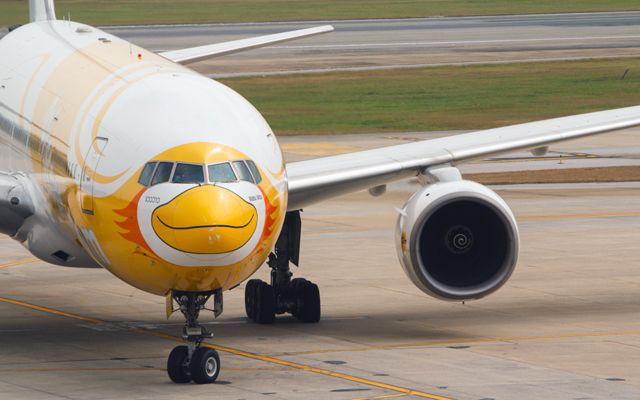
NokScoot to add Osaka to Japan network
From October 28, NokScoot will launch thrice-weekly Bangkok-Osaka flights, served with the Boeing 777-200 wide-body jet configured with 415 seats. On Mondays, Wednesdays, Fridays and Sundays, flights depart Don Mueang International Airport at 23.50 for arrival at Kansai International Airport at 07.10 the following day. It then leaves Kansai International Airport at 08.30, arriving back in Bangkok at 12.45.
Phuket links to South Asia get a boost
GoAir will commence flights to Phuket from October 11, and to Malé, the capital of Maldives, from October 14. The carrier will operate thrice-weekly services from Mumbai to Phuket and Malé respectively, and twice-weekly flights to the two destinations from Delhi. It also intends to start flights to Phuket and Malé from Bengaluru in the “very near future”.
Vietnam Airlines to launch Danang-Osaka flights
Vietnam Airlines will launch the first non-stop flights from Danang to Japan on October 28, serviced with Airbus A321 aircraft. The seven return flights each week will depart from Danang at 00.20, and from Osaka at 09.30. The duration on each sector is estimated to be around four and a half hours.
Cebu Pacific takes off for Macau
Starting December 7, Cebu Pacific will operate four-times weekly flights between Cebu and Macau. Every Monday, Wednesday, Friday and Sunday, flights leave Cebu at 18.50, and arrive in Macau at 22.00. Return flights leave Macau at 22.45, and arrive in Cebu at 01.45 the next day.
Hackers are stealing miles from frequent flier accounts
Stolen frequent flyer accounts and rewards points are a hot commodity on the dark web, according to a study by Comparitech.
Looking at listings on Dream Market, Olympus Market and Berlusconi Market, the research firm found that dark net prices of stolen frequent flyer miles are resold “at a fraction” of their real-world value.
Hackers are stealing miles from frequent flyer accounts
Airlines points are typically worth between one and two cents each, according to the Comparitech article, bringing the value of 100,000 miles to US$1,500-US$2,000.
This is compared to US$884 for 100,000 miles under the KrisFlyer, Emirates Skywards, ANA All Nippon and Asia Miles programmes, accurate at the time of Comparitech’s research.
Stolen miles are used for retail redemptions, resold to grey market mileage brokers, or exchanged for rewards such as flight upgrades, which are then sold on to unsuspecting customers on websites.
Unlike with flight purchases, “members are not required to enter a password or PIN number when spending points at retailers, and retail staff often don’t ask for an ID”, the article states.
It is this lack of verification that has made frequent flyer miles a profitable target for hackers and thieves.
“And because most of us don’t use or check our frequent flyer accounts very often, the theft can go unnoticed for months”, according to Comparitech.
While it’s against the terms of service for most rewards programmes, points are sometimes resold by grey market mileage brokers, who typically buy unused points and use them to get business- and first-class upgrades and other bonuses for their clients, stated the article.
Hackers steal miles by breaking into personal accounts. They obtain credentials through various ways, including breaching a data server or phishing individual account holders.
To prevent miles from being stolen, Comparitech has the following recommendations:
– shred your boarding pass after a flight
– never post a photo of your boarding pass online
– use a strong and unique password for your frequent flyer account.
– monitor your account for suspicious activity
– don’t put your airline account number on a baggage tag
– avoid using public Wi-Fi to access your account
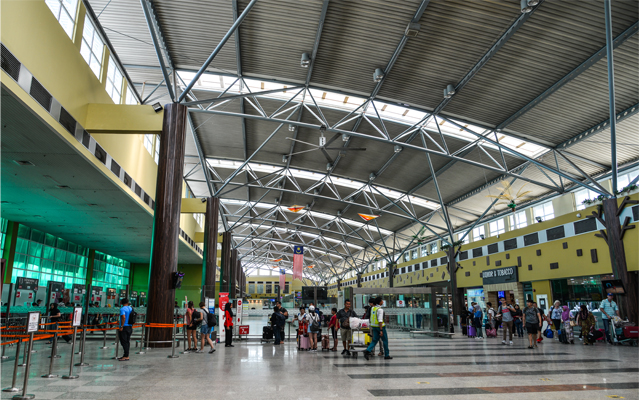
MAH is trying to get more Middle Eastern airlines to fly to Langkawi; Langkawi International Airport pictured
Now in hot pursuit of foreign carriers, Malaysia Airports Holdings (MAH) is offering financial support for overseas airlines, as well as negotiating for the launch of flights along strategic routes.
Mohamed Sallauddin Mat Sah, general manager, airline marketing at Malaysia Airports, expressed hopes for Qatar Airways and one unnamed Indian airline to commence flights to Langkawi by this year-end.
MAH is trying to get more Middle Eastern airlines to fly to Langkawi; Langkawi International Airport pictured
MAH is in talks with Qatar Airways on launching flights to Langkawi, although the return route to Doha has not yet been decided. For now, Qatar Airways could either fly direct from Langkawi to Doha, or via Penang (Langkawi-Penang-Doha).
Enticing Middle Eastern airlines to fly direct to the island destination of Langkawi is in line with Langkawi Development Authority’s ambitions of growing foreign arrivals and attracting more high-yield tourists from the Middle East.
Currently, foreign airlines flying to Langkawi are limited to only five cities – Singapore, Chengdu, Kunming, Guiyang, Guangzhou and Shenzhen.
Despite the lack of international air connectivity, Langkawi has proven a popular choice with travellers. In 2017, Langkawi International Airport registered 2.7 million passenger traffic movements with a 14.6 per cent increase in international passengers. From January to June 2018, international passenger traffic movements increased by 23.9 per cent compared with the same period in 2017.
There is also untapped potential in the Indian market. At present, no India-based airline flies to Malaysia, with existing routes served only by Malaysia Airlines, Air Asia and Malindo Air.
K Thangavelu, Grandlotus Travel Agencies managing director, believes that the destination as well as Indian travellers stand to benefit from having an Indian airline, with its strong domestic network, fly to Malaysia.
He said: “Passengers will benefit from better airfares if they take a connecting flight from the same airline. Currently, the Malaysia–India route is served by scheduled airlines from Malaysia flying to the main cities in India. Indians travelling from smaller cities will have to travel to metro cities and the main capitals of India to take these flights.”
To sweeten the deal for new foreign airlines, MAH has a support programme for new airlines flying to Malaysia which includes landing fee waiver for a year.
Furthermore, Malaysia Airports together with Tourism Malaysia will continue to offer funds supporting airlines’ promotion of Malaysia in overseas markets through the Joint International Tourism Development Programme. The programme, which was introduced this year, will be extended into 2019.
Correction: An earlier version of this article misstated that Qatar Airways was looking to commence flights to Malaysia by this year-end. The airline already has flights to including cities such as Kuala Lumpur and Penang. The story has been updated.
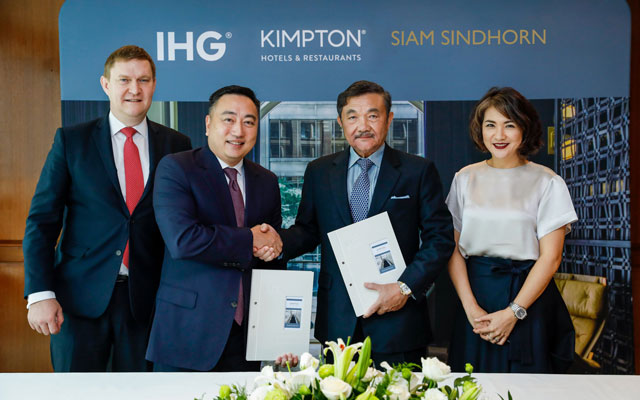
From left: IHG's Kenneth Macpherson and Clarence Tan; and Siam Sindhorn's Chalaluck Bunnag and Chonpreya Pacharaswate
Bangkok will welcome a Kimpton hotel when InterContinental Hotels Group (IHG) brings the boutique brand, which it acquired in January 2015, into the Thai capital come 2020.
Kimpton Bangkok will mark the brand’s first in Thailand, and second in South-east Asia after Bali.
From left: IHG’s Kenneth Macpherson and Clarence Tan; and Siam Sindhorn’s Chalaluck Bunnag and Chonpreya Pacharaswate
The outcome of a management agreement between InterContinental Hotels Group (IHG) and Siam Sindhorn, Kimpton Bangkok will feature 349 guestrooms, including 124 serviced residences.
The new-built property will offer two dining establishments, a hotel swimming pool, gym, spa and seven meeting rooms. Serviced residence occupants will have access to the executive club.
It will be located an hour’s drive from Suvarnabhumi Airport, in the heart of Bangkok’s Langsuan area and beside Lumpini park, and will form part of the 8.9ha Sindhorn Village mixed-use development with retail and dining options.