Seoul-Danang is the fastest-growing passenger route in Asia-Pacific, in a new study release by Routesonline at Routes Asia 2019, which took place from in Cebu last well.
More than 2.2 million passengers took a flight between the two destinations in 2018, compared with 1.3 million just 12 months earlier, translating to a 71% rise in the number of passengers.
The Seoul-Danang route is the fastest-growing route in the Asian region; Danang’s Golden Bridge pictured
According to OAG Schedules Analyser, two-way capacity on the Seoul-Danang route jumped by 73% in 2018 to 2.8 million available seats. A total of 10 carriers served the market, up from nine in 2017.
Jin Air had a 20% capacity share of the total number of seats on offer last year, with Korean Air on 15.1% and Jeju Airlines on 13.2%. In total there were almost 12,100 flight departures on the route, compared with fewer than 7,500 in 2017.
In second place is Manila-Iloilo, which connects the capital of the Philippines with Iloilo City on Panay Island. Total passenger traffic increased by nearly 48% in 2018 to more than 2.1 million passengers.
Overall two-way capacity rose by 49% in 2018 compared with the previous year, OAG figures show, increasing to 2.5 million seats. Cebu Pacific commanded a 50.5% capacity share, followed by Philippine Airlines with 31.3% and Philippines AirAsia with 18.2%.
In joint third in the list are two domestic routes. The first links Indonesia’s capital Jakarta with the port city of Palembang, while the second connects Hyderabad in south India with Bengaluru. Both routes saw passenger numbers increase by 20% in 2018.
Routesonline’s research found the top 100 passenger routes to/from and within the Asia-Pacific region during 2018 using the latest data provided by Sabre Market Intelligence. The list was then ranked by percentage annual growth when compared with the same period in 2017.
In 2018, Asia-Pacific received an inbound volume of around 688 million visitors, almost 50 million more foreign arrivals than in 2017, according to PATA’s Asia-Pacific Visitor Forecasts 2019-2023.
Amid this tourism boom, traveller expectations are continuing to evolve and the industry faces an increasing need to meet fragmented requests from customers including the desire for richer content, wider choices and greater personalisation.
For agents to deliver this transformation successfully they should ensure that technology complements and improves the human touch in order to provide an enhanced customer experience.
To navigate this changing environment and to help the industry understand some of the drivers impacting the sector, global travel IT provider Amadeus spoke to several industry leaders.
Experts discuss customer-centric trends agents need to consider as part of their long-term strategy
The cloud will improve collaboration with travellers for a more personal experience “Cloud technology is a driving force for transforming the offline model of the travel agent. The cloud enables agents to have access to all cloud-based bookings regardless of location, whether this would be through a mobile phone or a tablet. As consumer expectations are growing, we’re seeing travellers wanting more of a collaborative effort when booking a trip with an agent. A seamless way to enable this collaboration is by taking the customer out of a brick-and-mortar store to a café with a tablet and work together to develop an itinerary. This human interaction is where retail travel agents have an opportunity to really inspire the traveller.”
IoT will create a seamless trip where travellers are connected to their travel agents at every stage “IoT has the ability to connect customers with travel consultation throughout the entire stage of the travel experience. For agents, a global or universal passenger name record (PNR) will allow travel consulting to change according to any requests from the customer. As for travellers, agents can provide a universal ‘travel pass’ that can be used for a trip, without separate boarding passes, hotel check-in, bus passes, and even theme park tickets. This universal travel pass would also handle multiple currencies, where travellers won’t need to worry about exchanging currencies when travelling between different countries.”
– Alfred Kam, chief operating officer, Travel Expert Group
Voice will be the way we book travel in the future “If you think about it, talking to each other is the most natural thing humans do. Nowadays, typing and swiping seem as an effective way of communicating as we’re unable to have a natural conversation with a machine. But as AI and voice-enabled devices become smarter, typing or swiping will become secondary. When the process becomes seamless, voice will be the future of booking travel. Travel agents are then able to take advantage of this and sell high value and high engagement products via voice.”
– Nishank Gopalkrishnan, CEO, Triposo
Blockchain will create more secure, direct transfer payment methods “As consumers become more conscious about their data, privacy, and online presence, there will also be a need for more secure and direct transfer payment methods. Credit card payments, such as Visa and Mastercard, are facing digital challenges. This is where Blockchain can revolutionise traditional methods by allowing all transactions and ticketing to be safe and secure. Blockchain technology will also offer an efficient way to integrate different services providers in a distributed environment.”
– Kelvin Ko, assistant manager, business development, Travel Expert Group
NDC will transform travel distribution as we know it “A majority of travel distribution today in the airlines and hotel space is complicated. The myriad of pricing options, fare types, loyalty programmes and multiple players doesn’t ease the shopping process, even for a suave online shopper. Travel agents will continue to see product requests from multiple sources for travel providers – therefore seamless integration with EDIFACT, NDC, and other API connectivity, plus hotel, ground transportation, and theme park tickets will be essential. Travel agents will need to evolve to offer integration with non-travel related content and value-add services will be a success factor for future travel agents. For example, instant translation, personal travel guide in various languages, and friend matching app for travel companions.”
High network speeds will facilitate 3D/VR/AR technologies for a more engaging and immersive booking experience “Technology will enable travel agencies to transform into ‘digital travel agents’ through high-speed networks, enabling 3D, VR and AR technologies. The booking process will become a trip planning experience, where agents will be able to provide more content, information and booking details.”
– Alfred Kam, chief operating officer, Travel Expert Group
Read more about the future of the travel retail industry here.
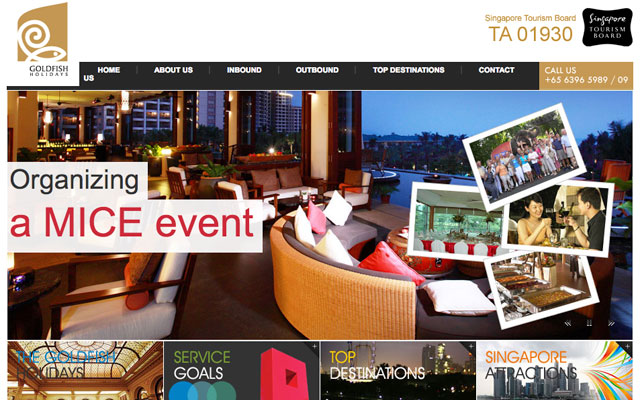
The Singapore Tourism Board (STB) has suspended Goldfish Holiday Makers (travel agent licence number 01930) with immediate effect until further notice.
A screenshot of Goldfish’s website
The suspension, in accordance with the Travel Agents Act (Chapter 334), is
a result of the company’s failure to submit its audited statement of accounts within six months after the close of its financial year.
During the suspension period, Goldfish Holiday Makers is required to fulfil its existing obligations to its customers, but will not be allowed to accept new travel bookings.
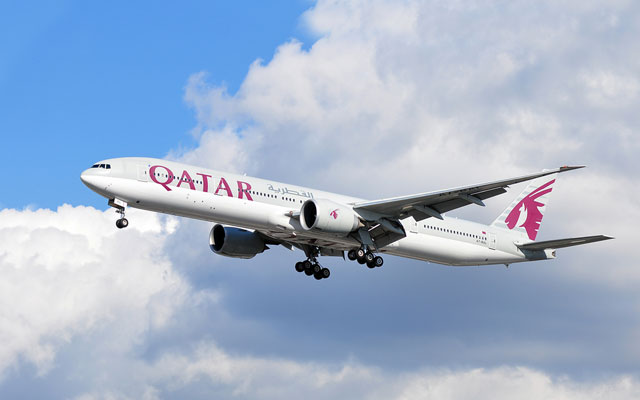
Qatar Airways announces seven new destinations
Qatar Airways has added seven destinations to its network, two of which are in Asia.
The destinations are Lisbon, Portugal; Malta; Rabat, Morocco; Langkawi, Malaysia; Davao, the Philippines; Izmir, Turkey; and Mogadishu, Somalia.
The airline has also unveiled its new Economy Class experience. Features include a a 19-degree recline system, additional legroom, dual trays, 13.3-inch 4 K widescreens, type ‘C’ fast charging USB port, and faster broadband.
In addition, the in-flight dining experience has been enhanced with new retail-style tableware, a menu offering more choices, 25 per cent larger main courses, 20 per cent larger appetisers and 50 per cent larger desserts.
Hainan Airlines launches two routes from Shenzhen
Hainan Airlines has mounted two direct flights to Dublin and Tel Aviv from Shenzhen.
The first route, to Dublin, is operated twice-weekly on Mondays and Fridays with a Boeing 787 Dreamliner. HU755 will depart Shenzhen at 01.30 and arrive at 07.00. The return leg HU756 will take off from Dublin at 09.00 and arrive back in Shenzhen 05.30 the following day.
The Shenzhen-Dublin route is Hainan Airlines’ second direct route between mainland China and Ireland.
Similarly, its Tel Aviv flight will operate twice-weekly on Mondays and Fridays on a Boeing 787-9 Dreamliner.
HU743 departs Shenzhen at 01.35 and arrives in Tel Aviv at 07.35, while return flight HU744 will depart Tel Aviv at 13.10 and arrive in Shenzhen at 05.00 the following day.
The Shenzhen-Tel Aviv route is Hainan Airlines’ first direct connection between mainland China and the Middle East.
Thai AirAsia X expands China network
Thai AirAsia X will launch a direct flight to Tianjin from Bangkok’s Don Muang Airport. The four-times weekly flight (Tuesday/Thursday/Friday/Sunday) will begin on May 3, 2019.
Thai AirAsia X currently flies direct to China on the Bangkok (Don Mueang)-Shanghai route.
JAL and Vistara enter codeshare partnership
Japan Airlines (JAL) and India’s Vistara Airlines have entered into a codeshare partnership.
As part of the agreement, Japan Airlines will add its JL designator code to some 32 Vistara-operated daily flights across India, covering seven cities of Mumbai, Kolkata, Chennai, Bengaluru, Hyderabad, Ahmedabad and Pune.
The two airlines already have an interline through check-in partnership, thanks to an MoU signed in September 2017. Vistara is the only codeshare partner for Japan Airlines in India.
Both airlines will operate out of Indira Gandhi International Airport’s Terminal 3.
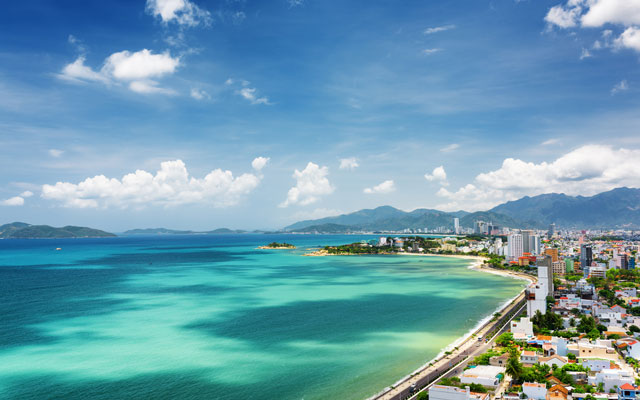
Nha Trang may be on the cusp of change as international flights arrive at the new Cam Ranh airport and Vietnam grows in popularity among Western Europeans, but the coastal city remains bogged down by negative perceptions within the travel trade.
Before the airport opened, the destination was traditionally reliant on Chinese and Russian groups arriving on charter flights. Now, some resorts are turning their attention to new international markets.
Nha Trang is the only city beach in Vietnam, but it’s a hard sell for European agents
For example, Ingo Rauber, general manager at Sunrise Nha Trang Beach Hotel & Spa decided to move the resort’s focus away from Russian and Chinese groups “because we didn’t see the revenue coming in for incidentals for hotels”, and are targeting Western European markets instead.
Since the resort changed its marketing, business from its two traditional feeders went down 50 per cent, while Western European guest volume grew by about 25 per cent.
With the opening of Cam Ranh international airport last year, travellers no longer have to go through Hanoi or Ho Chi Minh City to arrive in Nha Trang.
“However we are still missing Western European tourists because flights coming in are mostly through Bangkok, and travellers arriving in Bangkok in the morning will miss the day’s connection to Cam Ranh. Leaving Nha Trang you need to wait six to seven hours at the airport in Bangkok to catch the flight back home. That’s the biggest problem right now,” said Rauber.
Moreover, Nha Trang remains encumbered by its reputation within the travel trade and a perceived lack of suitable hotels for the Europeans.
“Nha Trang is still not yet popular with the Western European market… It might be because of the reputation among tour operators, not so much consumers,” said Frank Wiegand, director of team sales Europe, Focus Asia.
“There are two disadvantages: first of all, while Cam Ranh is changing, in Nha Trang most hotels don’t have direct beach access. There are some on islands off the coast, but guests in many hotels have to cross the street to get to the beach,” he continued.
Additionally, German travellers usually like three- or four-star, “small, local” resorts, which are lacking in Nha Trang, Wiegand pointed out.
“I’m not too fond of Nha Trang as it can be quite crowded and there are too many hotels,” said Moreten Westergaard, sales and production manager at Voya Travel in Denmark, which is adding Asian beach destinations to its Indian Ocean and Latin America core.
While some industry players liken Nha Trang to Phuket, trade buyers maintained that the Vietnamese beach city still lags behind its Thai counterpart.
Thailand beaches remain top choice for beach extensions in Indochina round-trips, said Alberto Maffizzoli from Tui Italia’s planning department, with Phuket most popular for the winter season and Samui for the summer season.
In comparison, Vietnam is known just “a little bit” for its beaches. “In Vietnam, Phu Quoc is (the top choice). I’ve been trying to develop Nha Trang, but at the moment it remains a new destination as it is not known on the market yet,” Maffizzoli said. “Everyone wants to go where everybody else is going.”
Similarly, Westergaard prefers beaches in Thailand for the availability of quieter, more “barefoot luxury” resort options, citing the example of the 9 Hornbills Tented Camp and Koyao Island Resort in Koh Yao Noi, near Phuket.
There are, however, glimmers of hope for Nha Trang.
“I see an enormous increase in interest for Vietnam, and there’s always a beach extension in itineraries. We are around 125,000 Dutch going to Vietnam last year. Three years ago it was 65,000,” said Frank Schretlen, sales director, the Netherlands, Vietnamtourism – Hanoi JSC.
He added: “People have been to Thailand and they want something else of South-east Asia.”
While some buyers point out that Russian and Chinese groups have made the beach less appealing to travellers from other markets, Schretlen pointed out that there are spaces in Nha Trang that are more popular with Europeans.
Wiegand added: “It’s a pity that Nha Trang is such a hard sell in Europe. Personally, it is a really nice place. If I go to the beach I still prefer to have restaurants and bars, and Nha Trang is the only city beach in Vietnam.”
Thomas Cook China, a joint venture between Thomas Cook Group and Fosun Tourism Group, has signed an agreement with Hanatour Japan to establish a DMC in Japan.
The partnership is aimed at growing inbound tourism business from China as the new joint venture company will develop new products and services for the growing number of Chinese independent travellers.
Japan is the fastest growing destination for outbound Chinese travellers
Alessandro Dassi, CEO of Thomas Cook China, said in a statement: “Our new partnership with Hanatour Japan will give Thomas Cook China greater access and better control of the hotels and services we offer in Japan, allowing us to accelerate growth into this key market for Chinese travellers.”
Byung-Chan Lee, president and CEO of Hanatour Japan, added: “We believe that inbound tourism from China will continue to grow over the next five to 10 years. Our new joint venture with Thomas Cook China gives us an opportunity to better leverage our existing resources to gain a share in this market.”
Japan is the fastest growing tourist destination for Chinese travellers and is one of the largest destinations for Thomas Cook China’s outbound business. In 2018, over eight million Chinese travellers visited Japan, an increase of 12 per cent over the previous year.
The much-anticipated Jewel Changi Airport, several years in the making since the project broke ground in 2014, will finally open its doors on April 17.
Jewel, with its distinctive dome-shaped, glass-and-steel facade, was designed by a consortium led by renowned architect Moshe Safdie.
Jewel is set to be the new landmark at Changi Airport
When the 10-storey development opens, an early check-in lounge, serving passengers of 26 airlines, and a left luggage service will be available on the passenger end.
More than 90 per cent of Jewel’s 280 retail stores and eateries are expected to be ready by April 17. Anchor tenants include Nike – with the largest store in South-east Asia – Marks & Spencer, Muji, Zara, Uniqlo, Shaw Theatres with IMAX and FairPrice Finest. Five Spice, the food court operated by Food Junction, will also feature over 10 local brands, such as Faai Di by Ka-Soh and Fu Lin Yong Tofu, which have more than 20 years of culinary heritage.
The Canopy Park and its attractions, situated at the topmost level of Jewel, will open in mid-2019. Highlights include a five-storey garden with 2,500 trees and 100,000 shrubs, as well as two walking trails. There is also a 40m-high Rain Vortex – the world’s tallest indoor waterfall.
Jewel will be open for public viewing from April 11-16, but visitors are required to register online for the preview. A total of about 500,000 tickets will be available.
Aerial view of paddy field at Sekinchan, Malaysia.
To capture a larger slice of the European market, Tourism Selangor is intensifying efforts to promote the abundance of offerings in the Malaysian state.
Abdul Rashid Asari, Selangor state government chairman of standing committees for cultural and tourism, Malay tradition and heritage, believes that a new crop of hotels, infrastructure, ecotourism and cultural attractions will put the destination in good stead to attract the European market.
Aerial view of Sekinchan paddy fields
He said: “We have a lot to offer in the city that will appeal to the taste of the Europeans.”
Key attractions include the Selangor Fruits Valley, Sekinchan paddy fields, Sky Mirror in Kuala Selangor and Sunway Lagoon – the oldest and largest theme park in Selangor, according to Abdul Rashid.
Having received some 300,000 tourists from Europe in 2018, Abdul Rashid hopes to grow the market by at least 10 to 20 per cent this year.
To raise awareness of the destination, he said Tourism Selangor has beefed up its online presence through social media channels, and will be participating in more events and tradeshows this year.
European buyers at ITB Berlin are seeing potential in Selangor, which is gaining traction among European travellers, most of whom were previously more familiar with destinations like Langkawi.
While Maren Spohr, junior product manager Asia, Art of Travel Germany, has yet to see any interest from her clients in Selangor, she sees potential in the exotic offerings there.
Spohr said: “The luxury travellers are interested in exclusive resorts which offer unique experiences, so it will be a good selling point if we can find such offerings.”
Neil Gregory, representative from Vavoyage in the UK, said: “Selangor would appeal largely to the special interest groups which forms a smaller percentage of the mass market.
“It would be better if there are a lot of new mass market developments,” he suggested.
Overall, awareness of Malaysia is visibly drummed up this year, with Tourism Malaysia being the official partner country at ITB Berlin this year.
“I believe Malaysia’s cultural uniqueness is a big draw for the European market,” commented Mohamaddin Bin Haji Ketapi, minister of tourism, arts and culture for Malaysia. “As such the highlight of our presence at ITB this year will be the cultural aspects that we bring to the show.”
Malaysia’s participation as ITB partner country was deemed an instrumental step leading up to the Visit Malaysia 2020 campaign, as Malaysia targets 30 million arrivals and tourist receipts of RM100 billion (US$24 billion) by 2020.
Meanwhile, the move is also part of Tourism Malaysia’s efforts to rebuild promotions in Europe since Malaysia Airlines suspended flights to the key European cities of Frankfurt, Amsterdam and Paris in 2015 and 2016, while working to collaborate further with foreign airlines and foreign tour operators to sell the destination. – additional reporting S Puvaneswary
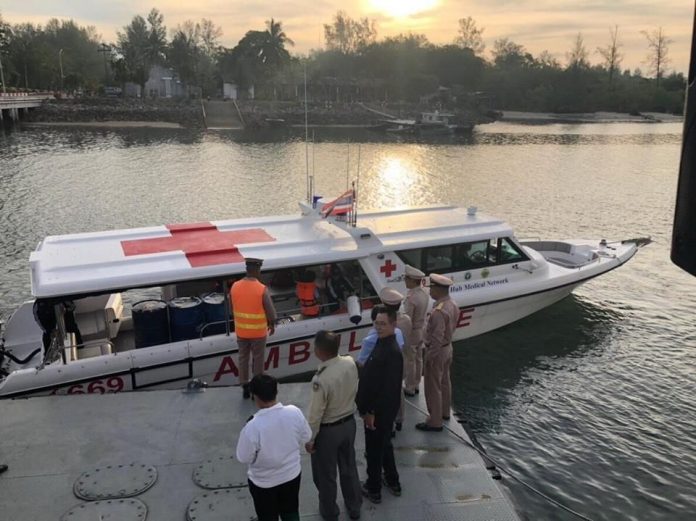
Thailand now has a fully equipped medical boat plying the waters around the Similan and Surin islands – part of Phang Nga province – to handle traveller emergencies, according to a report by The Nation newspaper.
Currently, the medical boat has assisted 30 injured tourists this season, seven of whom were in critical condition. The current tourist season runs from October through May, with the peak being from December to April.
The medical boat is specifically to aid tourists that need help. Photo credit: PattayaOne News
There are three levels to the emergency service. Level 1 is when the medical team stationed on-site is ready to provide initial aid and treatment, refer critical cases to appropriate facilities and train volunteers in first aid. Level 2 entails an effective system for reporting incidents, with a command base linked to the southern regional centre. Level 3 involves coordinating agencies in the provision of sea-based medical services, accident prevention and a warning system.
The vessel and service are maintained by the Phang Nga Public Health Office and the Royal Thai Navy’s Third Naval Base, assisted by other agencies.
According to The Nation, the vessel is part of a sea-based public-health action plan that addresses medical emergencies around islands and national marine parks. In addition, the boat carries supplies for health officials stationed on the islands.
Phang Nga province draws 4.7 million visitors a year, earning 51.9 million baht (US$1.6 million) in tourism receipts.
Walt Disney Company’s senior vice president, global e-commerce of consumer products division, Kanika Soni, will soon join TripAdvisor as president of the latter’s hotels business unit, effective April 15.
In her upcoming role, Soni will oversee TripAdvisor’s hotels business, representing a substantial part of the company’s total revenue. Reporting to Stephen Kaufer, TripAdvisor’s president and CEO, she will be responsible for product, engineering, sales and marketing for hotels.
Before joining Disney, Soni led the online and global digital marketing teams at Tesla Motors, in addition to leadership roles at both Gilt Groupe and McKinsey & Company.