Malaysia has temporarily banned all cruise ships from entering the country’s ports due to the increasing number of Covid-19 cases, putting a further damper on the tourism industry.
The decision, which will take effect immediately, was made following instructions from the Health Ministry and Transport Ministry.
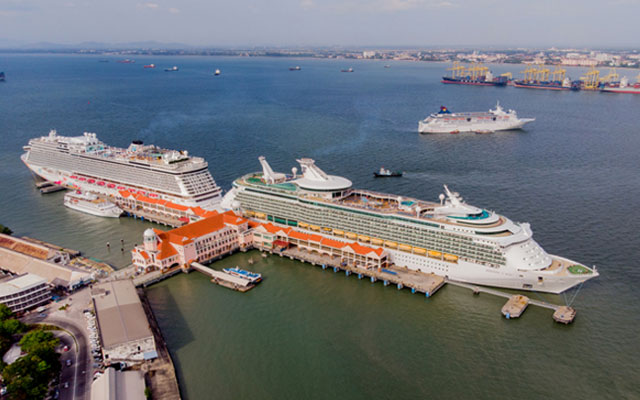
Malaysia issues blanket ban on all cruise ships; Swettenham Pier Cruise Terminal in Penang pictured
Malaysia’s health director-general Noor Hisham Abdullah said in a recent Facebook posting: “The entry and transit of cruise vessels, passengers and crew members require considerable medical resources to be made available at ports for screening and treatment purposes.
“During this difficult period, it is important that more medical resources are concentrated at hospitals to attend to medical emergencies and undertake preventive measures.”
Last year, Penang recorded 449,885 cruise passengers, while Port Klang received 360,000 passengers, with 150 cruise liners calling on the port.
Malaysia joins several countries which has banned cruise ships from entering their ports, including Taiwan, Hong Kong, Japan, and the Maldives.
The Philippines’ International School of Sustainable Tourism (ISST) will host the Asian Ecotourism Network’s (AEN) first International Ecotourism Travel Mart (IETM) in September.
IETM was hatched during last year’s AEN conference in Vietnam when it was noted that despite the many global travel marts and exhibitions for general tourism such as ITB Berlin, World Travel Mart and ASEAN Tourism Forum, there were none for ecotourism.
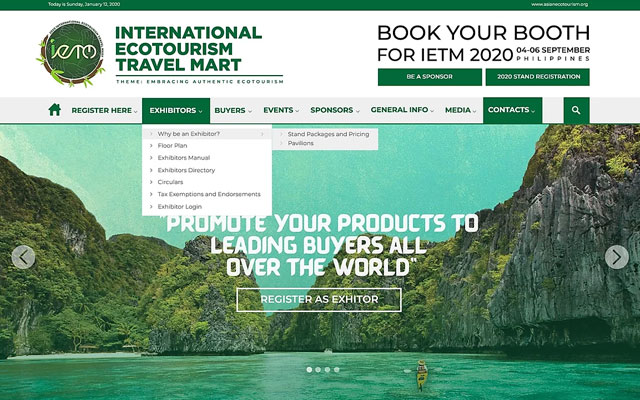
A screenshot of the soon-to-launch website for International Ecotourism Travel Mart which will take place in Manila this September
ISST bagged the hosting as there were no other bidders, its president and founder, and former tourism secretary, Mina Gabor told TTG Asia.
AEN is the regional initiative of Global Ecotourism Network (GEN).
The IETM is slated to be held from August 31 to September 6 at the Philippine International Convention Center Forum, coinciding with 2020 as the year of celebrating biodiversity.
Gabor said the 18 AEN member countries have confirmed their participation, while other countries have also indicated interest.
With the theme Enhancing Authentic Ecotourism, IETM will have a strong focus on international ecotourism buyers and sellers, while exhibitors will showcase a strong ecotourism component, green technology and sustainable green practices.
The travel mart will also host an Ecotourism Training course component where 36 speakers and trainers from around the world will tackle wide-ranging topics from disaster risk control and management to climate change and community development.
PATA Philippine Chapter chairman Bob Zozobrado said that as the chosen partner for IETM, they will be campaigning for the participation of local and overseas schools, while details are being finalised in their role in organising tours and accommodations and possibly, transport and transfers.
With a deluge of travel mart cancellations in 1H2020 due to the Covid-19 scare, buyers and sellers are requesting to be accommodated at IETM. Priority will be given to those with a portfolio of adventure, nature and ecotourism, and those primarily in ecotourism areas and destinations, Gabor said.
She added that IETM will be poised to deal with the evolving Covid-19 situation, with a strong emphasis placed on health and safety.
Gabor further shared that the first day of the IETM, which will be open to the public, will showcase the natural environment with demos on jungle survival course, special vegan and drinks preparation, and daily performances in native costumes.
To drum up public awareness, they are working with the Department of Education to run an ecotourism essay competition for students, as well as organising an eco-run along Roxas Boulevard in Manila.
IETM will also showcase the ASEAN Centre for Biodiversity, including major ecotourism sites; four indigenous villages in Indonesia, and the Philippines, among others; as well as four villages in the Pacific islands.
Qatar Airways, Singapore Airlines (SIA), and Emirates have all announced that they will waive fees for date changes in light of the Covid-19 outbreak.
Qatar Airways’ customers can change the dates of their booking without charge should their travel date falls between March 6 and June 30, 2020. Fees for booking alterations will be waived if reservations are changed at least three days before departure.
Qatar Airways among airlines to offer more flexible booking policy for travellers
Qatar Airways will provide customers the additional option of exchanging the flight ticket for a travel voucher, where the unutilised value can be used for future travel, valid for one year from its date of issue.
Qatar Airways’ customers wishing to cancel their flights altogether can avoid incurring a refund penalty if they do so three days before departure.
Similarly, SIA will waive change fees for tickets issued between March 6 to March 31 for travel to and from all destinations. The new travel date must commence before March 31, 2021.
For Emirates, customers will be able to change their travel dates without penalties, if their tickets are issued between March 7 and March 31, 2020. Flight changes can be made to any date within an 11-month range, within the same booking class. Changes can also be made on the day of the flight, provided they call at least two hours before.
Also, Emirates’ Skywards members who have booked to travel between March 1 and June 30 will receive a 20 per cent bonus in tier miles.
Passengers are advised to contact the respective airlines with specific details of their flights for confirmation. Fare differences or applicable taxes still apply.
The three airlines’ new policy, introduced to provide convenience for passengers amid imposed travel restrictions and flight reductions, apply to flights booked directly with them, as well as through travel agencies.
All airlines have taken additional precautions to stem the spread of the virus, such as disinfecting aircraft, as well as the use of advanced air filtration systems, which remove 99 per cent or more of the viruses in the cabin.
The Flight Centre Travel Group (FLT) has strengthened its technology roadmap with the acquisition of a 22.5 per cent stake in TPConnects Technologies for an undisclosed sum.
The Dubai-based TPConnects was founded in 2012 by Rajendran Vellapalath, who will continue to run the business with his management team.
Flight Centre Travel Group invests in TPConnects Technologies to boost its tech capabilities
It is one of the first International Air Transport Association (IATA) NDC and ONE Order focused travel technology companies.
FLT has also entered into a commercial agreement with TPConnects to access Software as a Service (SaaS) functions and use its IATA NDC Certified Travel Aggregator platform, which aggregates NDC and GDS content.
NDC and ONE Order are key transformational projects, launched by IATA to modernise and simplify airline distribution.
Greg Parker, executive general manager of FLT’s global air distribution business, said: “This investment ensures we are at the forefront of developments in an exciting new era of distribution and connectivity and that our company and customers have access to the widest choice of airfares and content, including offers that sometimes sit outside the traditional channels.”
HMP has launched HMP Master, a new cloud-based hotel management platform that claims to help hoteliers to streamline hotel operations, boost financial performance, and enhance guest satisfaction.
Launched simultaneously in South-east Asia and the US, HMP Master has been designed to boost operational performance, enhance management efficiency, integrate reservations, sales and marketing, and facilitate staff engagement. HMP can be used on mobile, tablet, iPad or desktop.
HMP Master helps hoteliers to boost operational performance and enhance guest satisfaction
The new software streamlines three areas: operations, financial control and business intelligence, including reporting, analytics and forecasting.
“Our aim is nothing less than transforming property management and digital service delivery for boutique hotels and their clients,” said Henry Pham, co-founder and CTO of HMP, which has offices in Silicon Valley, Bangkok and Danang, Vietnam.
Pham is helming the development of the integrated HMP platform in partnership with YAANA Ventures, based in Bangkok.
On operations, HMP has a reservations system, with an option of an integrated booking engine on the hotel’s website. The system tracks business-on-books, daily average rate, and more in real time. It makes maintenance easy to track, as staff can report on work in progress with a few clicks on the HMP app on their mobile phones.
On business intelligence, HMP lets hoteliers know in real time, through dashboards, which OTA, DMC or travel agent is generating most business. It allows managers to adjust rates which interface with reservation channels such as Expedia, Agoda, Booking, AirBnB, Hotels.com, TripAdvisor and many more.
“HMP operates on the principles of elegant simplicity. In addition, we’re making HMP available at user-friendly prices consistent with smaller hotel operations,” said YAANA Ventures’ Mark Remijan, who is also startup CEO of HMP Master.
There are three subscription levels, starting with HMP Direct for small hotels, which offers a booking engine, an OTA channel manager, and a basic dashboard with function analytics.
Designed for hotels with up to 70 keys, the HMP Master gives full access to the 360-degree functionality platform.
Meanwhile, HMP Master Pro targets hotels of up to 150 keys. For chain hotels, HMP Master Pro offers an enterprise solution, which includes customisation and a master dashboard spanning multiple properties.
Prices start at special introduction rates of US$119 per month.
Singapore-based real estate developer Pontiac Land will be launching Fari Islands in the Maldives come 4Q2020.
Located in the North Malé Atoll, a 50-minute speedboat ride from Malé International Airport, Fari Islands will be home to three hotels, a marina, and a purpose-built hospitality campus.
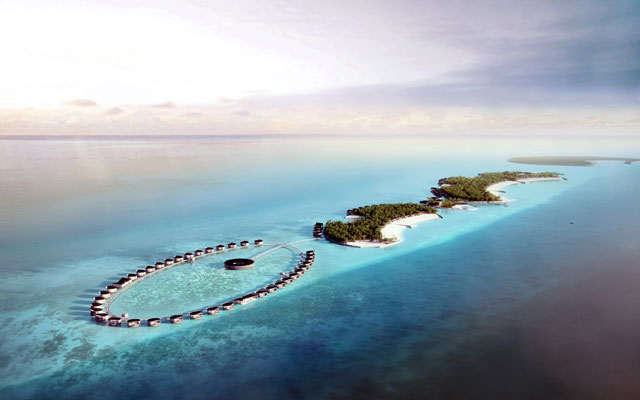
Fari Islands to open in the Maldives come 4Q2020; The Ritz-Carlton Maldives Fari Islands pictured
The properties on Fari Islands will be managed by a trio of luxury hotel operators, namely, Capella Hotels & Resorts, The Ritz-Carlton Hotel Company, and Patina Hotels & Resorts. Each of the hotels opening at Fari Islands will be located on its own island.
Hotel guests will enjoy access to Fari Marina, which is built around a vibrant beach club, and will feature a host of boutiques and F&B options.
Meanwhile, Fari Village will be dedicated to developing the next generation of hoteliers, with employees being able to enjoy access to a range of recreational facilities and amenities, continuous development opportunities, and an active social calendar.
Following its cancellation of ITB Berlin 2020, Messe Berlin has launched itb.com, a new year-round online networking platform for the world’s travel industry.
The global website spans a bridge between real-life meetings and digital networking, and features innovative tools for business, networking and exclusive content, said Messe Berlin in a statement.
itb.com will allow travel and tourism businesses to continue networking 365 days a year
Martin Buck, senior vice president, Travel+Logistics, Messe Berlin GmbH, said: “In these very difficult times, the tourism industry needs ITB more than ever. That is why, at the forward-looking events of the ITB Virtual Convention, leading speakers from ITB will be discussing how the world’s travel industry can harness intelligent strategies to make sure it remains future-proof even in a challenging environment.”
During the ITB Virtual Convention, which will run from March 5 to 11, 2020, viewers can follow more than 20 exclusive live streams and videos in English and German, some in real time, some time-shifted, on itb.com. Afterwards, they will be made available as videos on demand.
All registered attendees at ITB Berlin 2020 may access the AI-based Travel Network, which is a self-teaching system which continually offers users relevant travel industry contact information. Those who had not previously planned to visit the show in Berlin can also register now.
Travel Network users can set up a profile, match interests, be contacted and network. They can also follow other users, exchange contact details, chat and set up appointments.
“Virtual rooms” are being made available online where users can hold meetings which they had scheduled prior to ITB Berlin 2020. A video link enables face-to-face meetings – it is also possible to communicate via an audio link only.
As well, itb.com has the latest news from the World Travel Trends Report and ITB Berlin News, the official Show Daily of the event – which this year will be a weekly edition.
Memories Group has made appointment changes to two of its properties in Myanmar.
From left: Thibaut Stettler and Eric Laurent
Thibaut Stettler has been appointed hotel manager of Awei Metta resort in Yangon. With more than 12 years of experience in the hotel sector, the Swiss national began his career with Memories Group as a business development associate before taking on the position of hotel manager, Keinnara Hpa-an, an eco-lodge situated in Karen State.
Outgoing general manager Eric Laurant will assume the same position at sister resort, Awei Pila, situated in the Mergui Archipelago. The Frenchman was previously general manager for JA Resorts & Hotels in Dubai and several luxury resorts across Myanmar, and is also an experienced sommelier.
Following its travel ban on China, Indonesia has now expanded its ban to travellers from Italy, South Korea and Iran – regions hardest-hit by Covid-19 – as it seeks to curb the spread of the deadly disease.
The new travel restrictions, which started yesterday (March 8), will leave Indonesian trade players to fall into even deeper limbo after the loss of the Chinese sector – their second-biggest source market.
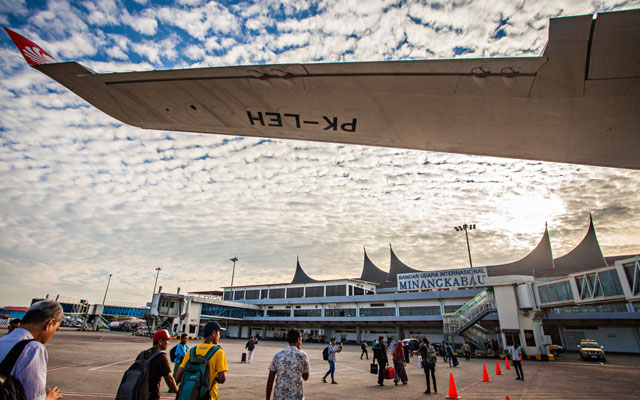
Indonesia expands travel ban to include Italy, Iran, and South Korea; passengers in Minangkabau International Airport in West Sumatra, Indonesia pictured
The banned regions are Tehran, Qom, and Gilan in Iran; Lombardi, Veneto, Emilia Romagna, Marche and Piedmont in Italy; and Daegu and North Gyeongsang in South Korea.
Travellers who have been in those regions in the last 14 days would not be allowed to set foot in Indonesia, according to Retno Marsudi, minister of foreign affairs, who announced the policy on March 5. She explained that this was in response to WHO’s latest report on the spike in reported Covid-19 cases in the three countries.
The diplomat added that travellers with no travel history to the aforementioned regions had to show a valid health certificate issued by health authorities in those three countries to airline officers during check-in process.
Before arriving in Indonesian airports, travellers are required to declare their travel history in health alert cards distributed by the Health Ministry of Indonesia.
Indonesians returning from Iran, Italy, and South Korea, especially from the aforementioned regions, are required to undergo additional medical examinations at entry points.
AB Sadewa, corporate secretary of Panorama Destination, expressed anxiety over the travel ban as it could possibly extend to other European countries if the outbreak remained.
He said that the bulk of his inbound guests traditionally came from Europe, with Italy making up 20 per cent in the West Europe market alone.
“Italy ranks the fourth after the Netherlands, Germany, and France,” he said.
Sadewa said that he had sent a letter to his business partners in Italy, asking them to prepare a health certificate.
He added, however, that the technical details about the ban remain unclear as it does not state whether it applies to citizens who happen to be based in the aforementioned regions, or for those who are official residents there with identity cards as evidence.
Posing a similar question is Adjie Wahjono, operation manager of Aneka Kartika Tours, who said that it would be hard for Indonesian authorities to check the area of origin of foreign tourists from those three countries.
Although Italy was not his market, Adjie was worried about the possible restriction that Indonesia might impose in the future on travellers from his major markets, such as Germany, France, and Scandinavia, in the event of a surge in the number of reported Covid-19 cases there.
However, he noted that the safety of the locals is key in the authorities’ handling of the epidemic. “Local tour operators need to understand that this restriction is made to protect us. (If the number of cases of Covid-19) soar in Indonesia, do we have the capacity to solve that issue?” he said.
Following the minister’s announcement, Santika Indonesia Hotel and Resorts in Bali received a deluge of cancellations from Italy, Iran and South Korea for room bookings from March to May, revealed its general manager of business development and marketing communications, Sudarsana.
Both South Korea and Italy make up eight to 10 per cent of Santika’s markets, respectively, while Iran comprises less than that. However, Sudarsana said that cancellations made by FITs and groups from those three countries were impactful because they happened after the huge loss of Chinese tourists.
Similarly, the Ramayana Hotel in Bali has also been hit by a wave of cancellations, especially from Iran.
“Honestly, I am sad and disappointed. But I can understand (the travel ban) because this is a (force majeure). We are also aware of the risks that Iranian clients face if they were to visit Indonesia. In general, in Bali, (tourism businesses) are incurring financial losses (from the loss of the inbound Iran market) as the holiday season for the Iranians starts on March 15,” said Susiati, business development manager of Ramayana.
It has been a booming trend for Iranians to take a vacation in Bali during their holiday season, and their visitorship can soar up to around 20 per cent, according to Susiati.
The ban is especially painful for Susiati as she had just returned from Iran from promoting her properties there, where she sought to attract Iranians to fly to Bali during their holiday seasons, which take place from March 15 to April 15, as well as in September and October.
She said that the cancellations from her Iranian clients came from the entire country, and not just blacklisted regions like Tehran, Qom, and Gilan.
Susiati further shared that the loss of the Iran market was of huge concern since they typically opted for week-long stays. “And they visit Indonesia during the low season, as opposed to the Australian and European tourists who come during the peak season,” she added.
She suggested for the government to help the tourism industry by allowing healthy travellers to enter Bali, instead of banning all travellers from the aforementioned countries.
After the launch of the travel restriction, Garuda Indonesia announced that regular direct flights from and to Incheon, Seoul, would not be affected by the government’s travel ban.
The seven-times-weekly flights connecting Seoul to Jakarta and Denpasar will run as per normal, according to Irfan Setiaputra, president director of Garuda Indonesia.
The airline said in a statement that it will continue to coordinate with the ministry and related authorities to follow up, especially in terms of what preventive actions airlines can have to mitigate the risk of the spread of Covid-19 from and to the affected regions.
For instance, Garuda Indonesia disinfects its aircraft as well as provides hand sanitisers and masks for crew and passengers. It also replaces the HEPA filter in aircraft from and to destinations affected by the outbreak, and checks its on-duty cabin crew members routinely.
Six more Asian Trails branches – Cambodia, Laos, Myanmar, Thailand, Indonesia and Malaysia – have received the Travelife Partner award in recognition of their long-term efforts in sustainability and Corporate Social Responsibility.
To be awarded, organisations must comply with more than 100 criteria relating to an operators’ office management, product range, international business partners and customer information.
Asian Trails earn Travelife credentials across six destinations
The Travelife standard covers the ISO 26000 Corporate Social Responsibility (CSR) themes, including environment, biodiversity, human rights and labour relations; and is formally recognised as being in full compliance with the United Nations-supported Global Sustainable Tourism Criteria.
Describing the new awards as a milestone for the company – as all of Asian Trails’ offices in South-east Asia are now Travelife Partners – CEO Laurent Kuenzle said Asian Trails’ commitment to sustainable practices has always existed.
“Whereas many of these criteria were already part of Asian Trails’ processes for years, others had to be newly implemented,” he told TTG Asia.
“Awareness and education are key criteria that needed to be addressed with managers and staff, suppliers and clients. Many of these may be understood in the Western world, but not in the Asian context of doing things today,” he added.
Kuenzle: Sustainability is an ongoing process that requires constant refinement and raising awareness among supply chain partners
The latest achievement follows Asian Trails Vietnam’s acquisition of the award in 2018. With this, Asian Trails China is the only branch within the group that has yet to be awarded.
Kuenzle explained: “Due to the Covid-19 situation in China and the resulting skeleton crew at our China office for many weeks, we were not able to formalise all the necessary criteria in time to achieve Travelife Partner status in China. We will work on this during the course of 2020 and hopefully achieve our sustainability objectives in China in the next few months.”
Achieving Travelife Partner status is not the end of the road for Kuenzle’s team.
“Sustainability needs constant and continuous efforts in improving processes, raising awareness among suppliers, and education, etc. The Travelife Partner status is a recognition of our efforts towards sustainability, but it doesn’t end there,” he remarked.
“I believe that as good citizens on this planet, our industry needs to work towards more sustainable operations. This is the main objective.”
In a press statement, Naut Kusters, manager of Travelife for tour operators, said: “I am delighted to see that sustainability in the tour operators sector is gaining momentum. The award of… Asian Trails Cambodia, Laos, Myanmar, Thailand, Indonesia and Malaysia will inspire other companies in those countries to follow the same path.”
Travelife, which has been established with the support of the European Commission, is the leading international sustainability certification for the travel sector. More than 35 national travel associations are promoting the scheme to their members, including the British Travel Association and the Pacific Asian Travel Association.
Since 2012, more than 600 Asian companies have been trained in CSR with the support of the Dutch government CBI programme. They are now working step-by-step towards more sustainable operations.