Hong Kong’s Artyzen Hospitality Group, a subsidiary of Shun Tak Holdings, has signed a hotel management agreement with Chongqing Yuelai Liangjiang International Hotel and Convention Management to develop a hotel under the lifestyle hotel brand Artyzen Habitat in Yubei District, Chongqing.
Touted as a “lifestyle sanctuary” catering to the upscale market, the upcoming 363-key hotel spanning 31,500m2 will house a brand hallmark social space Townsquare that is designed to become the centre of work, play, dine and pop-up retail activities.
A rendering of the upcoming property
Artyzen Habitat Yuelai Chongqing will be situated in the core of Liangjiang New Area in Yubei District, close to Yuelai International Convention and Exhibition City. This area has been developed to integrate international business, exhibitions, conferences, leisure tourism and cultural creativity.
With the inclusion of this new project, the Artyzen Hospitality Group has eight hotels in the pipeline and six hotels operating in Beijing, Shanghai, Macau and Hawaii.
Data and analytics will continue to be one of the key drivers of the commercial aviation industry going into a new decade, predicted travel data and analytics expert Cirium, but it warned that analytics will have to become much more human-centric, with a significant focus on end-users.
David White, director, market development at Cirium, said: “The past decade’s biggest challenge for commercial aviation has been to safely keep up with a rate of passenger demand that is straining the systems’ capacity. The skies are crowded, the competition is fierce, and operational environment is extremely complex. Airlines and airports have had to get much smarter about how to use technology, data, and process to squeeze additional capacity out of limited resources.”
Aviation industry leverage big data analytics to facilitate predictions and forecast demand, but there needs to be greater focus on end-users: Cirium
Here are the top 5 aviation and travel trends to watch in 2020 and beyond, according to Cirium’s industry experts:
Human-centered data and analytics 2.0
While big data and analytics became popularised in the previous decade, there is still a lot of untapped potential. The race to extract meaningful and valuable information out of new data sources has only just begun.
Steve Wilson, data scientist at Cirium, said: “The amount of data being generated by aircraft, locations and devices is increasing. Getting this data wrangled and into decision makers should help make the industry more efficient. This mountain of data being created – something like 100 billion GB annually as estimated by Oliver Wyman – can be used for forecasting and predictions. Deep learning models, despite not being quite capable of general artificial intelligence, should prove really useful in reaching gains and improvements for the industry.”
If you think of data-driven intelligence as a series of phases, then 2020 will herald the human-centered phase of our data evolution. The previous phase was about using structured and unstructured data to answer questions after an event. The next phase will be a matter of anticipating behaviour and providing answers before questions need to be asked.
Predictive maintenance
Quality data is the foundation for any type of predictive capability. Now that the technology needed to collect, process, prepare and structure massive amounts of device data exists, there is a good chance machine learning could evolve enough in the next decade to monitor patterns and events in real-time.
“There is already a focus on data collection and analytics to drive aftermarket service revenue growth for aircraft manufacturers, MRO service providers and systems suppliers,” said Andrew Doyle, director, market development at Cirium.
“The next step is development and deployment of predictive maintenance algorithms enabling replacement of critical components prior to failure, leading to a significant reduction in aircraft technical delays.”
Airline revenue management
The power of predictive analytics doesn’t stop at the physical parts of an aircraft. Airlines and airports are getting better at predicting consumer demand and optimising price or inventory to maximise revenue growth. For example, airlines now have tools at their disposal to accurately forecast demand on a cabin level, thereby getting a look at their true profit in a market.
“If you look at the US domestic market, both American and Delta have come out with growth plans that are above the industry three to four per cent growth rates,” said Nathan Greer, sales engineer at Cirium. “Delta is managing this by upgrading to larger aircraft, while American is doing the same, in addition to reconfiguring aircraft with additional seats.”
Accommodating predicted demand isn’t something airlines will be able to do alone. It will take collaboration and connection across the industry to achieve new levels of revenue growth.
“Certain Asian markets are the fastest growing in the industry. The challenge for the 2020s will be to expand the ability of airlines, airports, and ANSPs to share data and collaborate across the region in order to keep traffic flowing, passengers safe, and to deliver a quality service. Tokyo’s 2020 Olympics will be a good test for the overall network,” White said.
A current barrier to increased collaboration among airlines and airports is the reluctance to share data. Trust and ownerships of data remain major issues in the industry. However, the key to making progress in maximising revenue in 2020 and beyond will be a less restricted exchange of data. The benefits of this exchange will mean a more seamless journey towards developing more sophisticated, enhanced analytics.
“In the decade to come, I think we can expect to see technology largely improving airline and airport operational efficiency,” said Joanna Lu, head of consultancy, Asia, at Cirium. “Data and information sharing among stakeholders in the industry shall be improved to face the headwinds.”
Dynamic personalisation
It’s widely known people buy experiences, not products. In the decade to come, each part of the trip experience will be impacted through personalisation powered by machine learning – from in-flight services to pre-trip planning and disruption recovery.
While the 2010s were an era for change in the way customer problems were addressed, the 2020s will be a time where brands get smarter about every single customer touchpoint. The next logical step after customer service is customer engagement. It’s no longer sufficient to quickly answer questions and resolve problems. The time has come to create ongoing interactions between customer and company, shaped by the customer profile.
“Airlines are stepping up their game to adapt and engage individual traveller types by analysing their preferences, behaviour and demographics,” said Charles Brossman, senior product manager at Cirium. “They’re launching new and exciting customer engagement strategies to interact with them. This makes customers feel noticed and appreciated, which is critical to building brand loyalty.”
Tailoring messages and services to individual travellers is the expectation right now, particularly among Millennials. Yet, most airlines and other travel service providers still don’t have the right mix of data, technology and people to achieve a personalised experience customers will remember. The opportunity to impress and win over travellers on an emotional level is still wide open.
Cirium’s marketing director Carrie Mamantov said: “Automated personalisation will finally be coming to travel. A few airlines are getting all their data organised and breaking down the siloes to better link up the different dimensions of customer information. Look for loyalty to build with the brands who can predict needs and behaviour based on the omni-channel experience finally becoming more actionable.”
Providers across the industry will endeavour to link their value to traveller data. From manufacturing to tech services, every part of the ecosystem has an opportunity to be valuable to airlines and travellers.
Eco-consciousness
The travel industry has been one of the major targets of environmental criticism in recent years. Air travel accounts for about 2.5 per cent of global carbon dioxide emissions, after all.
Airlines are already having to take stronger action to minimise their carbon footprint. In this new decade, they will also be expected to ensure fuel efficiency isn’t outstripped by growing demand.
“We are seeing the very early stage of electric aircraft now flying in Canada,” said Alistair Rivers, director, market development at Cirium. “There will be pressure to reduce operations of current fuel-operated aircraft. I live in hope of a coordinated single European sky from an air traffic control point of view as this has massive potential to save both fuel and time by allowing aircraft to fly more directly.”
Thai Airways International (THAI) and THAI Smile has launched Save Food Save the World, a food waste management project designed to minimise waste in food production, in collaboration with Food Innopolis, and the National Science and Technology Development Agency (NSTDA).
Under the programme initiated by the Ministry of Natural Resources and the Environment (MSDHS), THAI Catering will reduce its food waste and cabin waste as well as environmental impact, on top of enhancing effective resource management, said the airline in a statement.
From left: THAI Smile’s Charita Leelayudth, NSTDA’s Narong Sirilertworakul, and THAI’s Sumeth Damrongchaitham signed the MoU for the food waste management programme
In Thailand, food waste accounts for 33 to 50 per cent of all solid waste, according to recent studies. Reducing food wastage is one way of curbing greenhouse gas emissions. As such, the United Nations has set food waste reduction as one of its Sustainable Development Goals, aiming to halve per capita global food waste at the retail and consumer levels by 2030.
Under this project, THAI estimates that it will reduce 400kg of food waste per day, saving approximately 20 million baht (US$648,298) per year. In the first year of the project, THAI will focus on reassessing the food manufacturing process and supply chain, beginning from ingredient procurement, THAI Catering food production, menu planning, packing and loading, and cabin waste management.
The airline will also work towards cutting cabin waste from inflight meals by making available a pre-selected menu for passengers to select their meal preferences prior to the flight. This initiative, which is expected to reduce food waste from in-flight meals by 20 per cent, will be introduced on THAI’s Europe-bound flights in 2020 and on all flights in 2021.
In addition, MSDHS will be leveraging technology in its fight against food waste, for example, by studying ingredients used by the airline so as to identify the appropriate technology that will reduce food waste during the meal production process.
Through its various efforts, THAI expects to reduce food waste by approximately three per cent year-on-year.
Similarly, THAI Smile aims to improve efficiency and reduce waste that comes from inflight meals. Some 1.4 per cent of THAI Smile passengers refused their inflight meals last year, according to official data.
In 2020, THAI Smile expects to reduce food wastage by 16.5 tonnes per year: 5.7 tonnes from domestic flights and 10.8 tonnes from international flights, which is the equivalent of 100,000 meals per year.
THAI said that it has been operating with sustainable development as its top priority, with the goal of becoming a sustainable airline by 2023.
As Vietnam’s domestic tourism market continues its upwards trajectory, one local start-up is aiming to solidify the country’s fragmented industry.
Avid traveller Trịnh Dình Minh has relished visiting new destinations across his homeland while pursuing an engineering and IT degree. Trinh and his friends would visit then less-known areas, such as the northern mountainous provinces of Ha Giang, Moc Chau and Bac Kan.
Trịnh created Tago.vn to create a more seamless experience for travellers
Said Trinh: “Then, most tourism was focused on popular places, such as Halong Bay. We realised the potential of these (less-visited) destinations and decided to create scheduled tours, which were very popular.”
In 2011, Trinh launched PYS Travel, and organised private tours to more off-the-beaten-track spots that were geared mainly towards the domestic market, with some international arrivals.
Fast forward to 2016, Trinh noted a spike in demand for domestic travel. However, the booking process proved cumbersome, with tourists largely having to book transport, accommodation and activities separately.
Wanting to provide a one-stop online shop for domestic travellers while offering tourism players an additional platform to promote and sell their products, Trinh set about partnering with airlines and hotels to create Tago.vn, a subsidiary of PYS Travel. The company was launched in 2017, offering tourists a variety of options for holiday packages that included flights and accommodation.
Trinh said: “Tago.vn was born to help people make their holidays easier and happier. We wanted to provide a one-stop-shop solution for customers, so they can book and enjoy trips easily, which encourages more travelling. (Using the platform) is convenient, time-saving and gives customers better prices than booking each service separately.”
The average trip length for Vietnamese holidaymakers is four days, as compared to seven nights for other Asia-Pacific countries, according to a Visa Global Travel Intentions report.
Since its launch, Tago’s customer base has grown from 9,500 annually to more than 12,000 in 2018, putting it on track to hit nearly 18,000 this year, and expand to over 34,000 by 2021.
Gross merchandise value has also increased from US$1.2 million in 2017 to US$2.2 million last year. This is estimated to reach US$3.8 million this year, and grow to more than US$7.5 million by 2021.
Having secured partnerships with hospitality giants, including Vinpearl, FLC Hotels & Resorts, as well as Accor and Flamingo, Trinh said that Tago offers companies an easy and additional avenue to sell their products.
He added: “For suppliers, like hotels, they have more channels to sell. As Tago sells packages instead of just hotel rooms, the prices are hidden so hoteliers can (decrease) prices during the low season without creating any conflict with other selling channels.”
AAT Kings has rolled out a selection of not-for-profit day tours and short breaks across New South Wales, Victoria and South Australia, designed to provide immediate support to tourism communities that have been affected by recent bushfires.
Launched in collaboration with Empty Esky and regional tourism businesses in Australia, the Bushfires Relief Giveback Experiences have been developed respectfully and in conjunction with local communities, and all trips are 100 per cent not-for-profit for AAT Kings.
AAT Kings has rolled out a collection of trips to assist communities most affected by the bushfires; Hampden Bridge in Kangaroo Valley pictured
During the trips, AAT Kings will bring guests and their empty Eskies – an Australian brand of portable coolers – to visit local markets, cafes and stores, where they will have free time to wander through the town, chat with the local shopkeepers and fill their Eskies with locally-made products.
The itinerary includes a trip to Kangaroo Valley and morning tea at a local café, before heading to Nowra Farmers Market, where guests can taste and buy local produce and fill up their #emptyesky, with every cent going directly to the farmers.
Guests will also get to meet some of the locals who will tell stories of recovery post-bushfires, and share firsthand how best to help these destinations.
Matthew Cameron-Smith, managing director for AAT Kings, said: “We’ve worked with local businesses to bring much-needed benefit through the tourism economy directly back to restaurants, cafes, farmers’ markets and local stores, to start providing immediate support to the regions that need it the most.”
Erin Boutros, co-founder of Empty Esky, commented: “Since the Empty Esky campaign launched, we have witnessed first-hand how powerful the Australian spirit is. The ‘Empty Esky’ trips will lead the way in effectively supporting bushfire affected towns as they recover.”
More trips and short breaks will be announced in the coming weeks, said the company in a statement.
Currently, bookings can be made at aatkings.com/bushfire-recovery, or via a local travel agent.
The Ministry of Culture and Tourism of the People’s Republic of China has issued an urgent order on Friday to tour companies across the country to suspend sales of group tours, hotel accommodation and flights in order to curb the spread of novel coronavirus.
China’s latest suspension of tours and sale of hotel accommodation and flights join the government’s lock-down of Wuhan and 11 neighbouring cities in Hubei province
According to the notice, which was shared with TTG Asia by AceVentures (OMT) Travels Consultancy, a specialist in global travel products and services for both the leisure and MICE markets, tours that are in progress are allowed to complete as planned, and the Ministry has advised tour operators to be alert to the health conditions of their travellers.
It isn’t clear from the notice, written in Mandarin, if the stop-sale applies to both inbound and outbound tours and travel products.
James Yeow, group chairman of OMT Group of Companies, told TTG Asia that overseas agencies are still allowed to sell group and FIT products into China, but he doubted there would be takers as fears of infection mount.
China’s National Health Commission announced today that there are now 1,287 confirmed cases of patients infected with the coronavirus, while the death toll from the virus has risen to 41.
Yeow has declined to reveal the number of group and FIT cancellations his company has received for China inbound and outbound movements, saying only that there has been “a lot”.
The stop-sale follows the Chinese government’s ongoing lock-down on Wuhan and 11 neighbouring cities in Hubei province to stem the spread of the virus.
As Asian inbound markets settle into maturity for Japan, the country is now looking farther afield to plump up arrival volumes from the US, Europe and Australia – western markets primed for opportunity, thanks to publicity from the 2019 Rugby World Cup and the approaching Tokyo Olympics and Paralympic Games in May.
These longhaul markets have also been identified for their high expenditure potential. According to a 2018 case study conducted by the Japan National Tourism Organization (JNTO), Australian visitors spent approximately 7.6 per cent more per head compared to Chinese visitors, with the bulk of expenditure – 39 per cent – allocated to accommodation. These trends are representative of the overall difference between the western and Asian markets, said Michinori Yamasaki, executive vice president, JNTO.
Nara Park is home to hundreds of free-roaming deer
“We are seeing a relatively low rate of business from the western markets now, and visitors from these markets have high spending (power). If we boost the number of visitors from the western market alongside the Asian market, we will be able to achieve our goals of raising our total visitor numbers and expenditure,” Yamasaki affirmed.
Currently, Japan’s inbound numbers are on track to meet the country’s 2020 goal of 40 million international visitors, with the period of January to October 2019 registering almost 27 million arrivals. Of these, Asia held the lion’s share of Japan’s inbound traffic, with 85 per cent coming from China, South Korea and Taiwan.
Hence, JNTO has begun its efforts on the longhaul front, launching the Enjoy My Japan campaign in 2018 to target travellers from the US, Europe and Australia, which Yamasaki identified as “markets with high potential in boosting visitor numbers”.
The campaign features enhanced digital marketing efforts that directs consumers to regional government tourism websites, in order to diffuse tourism throughout the lesser-known prefectures of the country.
Moreover, JNTO is also expanding its global presence. Opening soon is an office in Mexico City, with plans to establish offices in other cities, revealed Yamasaki.
More recently, JNTO worked with local prefectural governments and suppliers to launch the 100 Experiences in Japan book detailing hidden gems and obscure activities that are now open to international guests, signalling the increasing receptiveness of Japan’s smaller towns and cities to foreign visitors.
In Nara Prefecture, Kansai Nara Treasure Travel is one such DMC that is broadcasting the destination’s lesser-known activities to its trade partners, many of whom hail from the western markets.
Seiho Fukui, the DMC’s assistant sales manager, explained: “When visitors think of Nara, many only know the deer park and Todaichi Temple. They don’t know about all the other things they can see and do. We want to explain more about this prefecture to travel agencies around the world, through tradeshows like Visit Japan Travel Mart and on our website.”
Travel company Arttrav is also expanding its business beyond publishing travel guides, and is now diving into organising wellness group tours for international visitors. Its co-founder Yucaco Kimura told TTG Asia that Arttrav is working closely with DMCs and hotels around Japan to open up their secluded natural attractions and luxury resorts to small group tours.
However, as the Tokyo Olympics and Paralympic Games approach and Japan braces for a spike in activity in the city, concerns are surfacing that tourists may be put off by sky-high hotel prices and overcrowding.
Tadashi Kaneko, executive vice president, JNTO, explained: “The number of visitors we are expecting during the Olympics and Paralympics (period) will create a crowding-out effect. There will be a visitor spike in a concentrated area during this period, and hotel prices will rise. People will hesitate to visit Japan – we have already observed such an impact on longhaul travellers, who tend to plan early.”
Kaneko also voiced his worry that tourists may also continue to avoid Japan even after the Olympics and choose other destinations.
To mitigate this, JNTO is rolling out a slate of measures over the coming months, focusing on three areas: lodging, location and period of travel. To promote a shift in lodging away from Tokyo, JNTO is working to raise awareness of the availability of convenient accommodation options in the suburbs an hour from the city centre.
Additionally, JNTO will focus on promoting local gems in outlying regions, which are expected to be even less crowded as local tourists flock to Tokyo for the Games.
Kaneko expressed confidence that this option will be “especially attractive for repeat visitors”. Currently, repeat travellers make up 60 per cent of all incoming traffic, and 80 per cent of these come from Asian countries.
Thirdly, he said JNTO will “strongly suggest travellers avoid the period of the Tokyo Olympics and visit Japan in a different season”. JNTO will also launch a “strong final push” this year to encourage visitors during the rest of the year beyond the Olympics.
Responding to the ongoing outbreak of novel coronavirus, Trip.com has moved to offer free cancellations for bookings to and from Wuhan up until January 31, and customers whose itineraries are affected by the Chinese government’s suspension of outbound transport from Wuhan.
Trip.com eases concerned customers’ worries around the flu outbreak with free cancellations of affected trips
In a statement issued today, Trip.com detailed the measures it will be taking:
Travellers who have been diagnosed with the coronavirus pneumonia, quarantined by the authorities for further assessment, express symptoms of fever within one week of travel, or have been in close contact with the above-mentioned groups may make refundable cancellations on all products and services booked through Trip.com
All domestic and international flights bookings to and from Wuhan until January 31 may be cancelled free of charge
Trip.com will offer free cancellation guarantees on Wuhan-bound hotel reservations, attraction passes and car bookings until January 31
Trip.com will do its utmost to co-ordinate with railway operators, working with customers who have booked train tickets to Wuhan to minimise any costs incurred by cancellations, wherever possible
The company will continue to monitor developments around the virus outbreak.
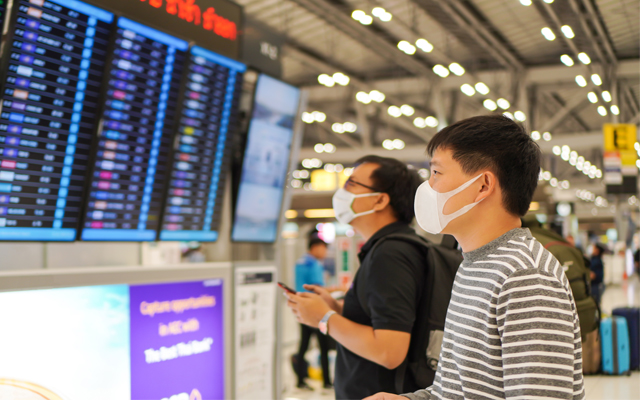
Chinese authorities have closed off the Chinese city of Wuhan, which is home to more than 11 million people, as it struggles to contain the deadly coronavirus outbreak, according to a report by The New York Times (NYT).
From Thursday, all public transport, including trains, buses and ferries, in Wuhan have been shut down, while all flights and trains leaving the city has been stopped.
Authorities in China have shut down all public transport in the central city of Wuhan as part of efforts to contain a deadly coronavirus outbreak, a train station in Wuhan pictured
The sudden restrictions, which was announced on Chinese state media hours prior to it being implemented, comes as the virus’ death toll reaches 17, with nearly 600 confirmed cases across China, as well as in Taiwan, Japan, Thailand, South Korea and the US, according to China’s National Health Commission.
All the fatalities have been in Hubei, the province around Wuhan.
The report quoted the Chinese authorities as saying that the measures in Wuhan were needed to “effectively cut off the transmission of the virus, resolutely curb the spread of the epidemic, and ensure the safety and health of the people”.
They further said that an end date to the restrictions would be announced at a later time, added the report.
The fast-spreading virus, which first emerged at the end of December, has stoked fears that it would burgeon to the scale of the SARS epidemic, which broke out in China in 2002 and 2003, and spread rapidly, resulting in more than 800 deaths worldwide.
As the number of victims grow, governments around the world have implemented entry screening measures at ports of entry, and the World Health Organization is weighing the declaration of a global emergency over the new virus, said the report. Similarly, immigration and health authorities are on high alert and taking precautionary measures.
Given the massive scale of the shutdown in Wuhan, medical experts have voiced concerns over the potential fallout, the NYT reported.
Tom Inglesby, director of the Johns Hopkins Center for Health Security, was quoted by the report as saying that a city the size of Wuhan has “tens of thousands of connections with the outside world that are coming and going all the time, bringing food and medicine” and that “the complexity and downside cost of (the lockdown) will be potentially very high”.
The shutdown occurs at a time when millions of Chinese citizens travel within China and beyond its borders for the Lunar New Year holidays.
An estimated 30,000 people fly out of Wuhan on an average day, according to air traffic data. The city is the hub of industry and commerce in central China, home to the region’s biggest airport and deepwater port.
Louis T Collection has appointed Shane Lee as hotel manager to lead its first Taiwan property, CESVI.
Lee joins the team this month in preparation for the March opening of the 28-room boutique hotel – made entirely of shipping containers in Taiwan’s port city of Kaohsiung.
Having spent most of her hospitality career between Bali and Taiwan, Lee was most recently the executive assistant manager to the general manager at Westin Yilan Resort in Taiwan. Prior to that, she was the general manager at Bali Graha Asia, where she ran the company’s two different private villa properties in Canggu, a popular beachtown area on the island.
She has also served at various properties including W Hotel Taipei, Silks Place Taroko Resort, in Taiwan’s Taroko National Park, and ClubMed Bali.