

As room demand weakens, new hotel revenue sources awaken

For almost two decades since 2002, Singapore-based Global Hospitality Solutions (GHS) has established a profitable business in helping hotel partners be present in the entire customer journey in travel and tourism, from engaging travellers to driving purchase and eventually rewarding for loyalty.
But with a large part of their business being in room bookings, GHS found its existence challenged when the pandemic hit in early 2020.

“There was zero tourism. And so, our work suddenly became focused on helping our hotel partners survive – which in turn ensures our own survival,” recalled CEO Bernard Quek.
To develop different and more stable ways for hotels to get business amid recurring lockdowns and continued international travel restrictions, GHS adjusted its technology platforms to facilitate F&B orders and delivery, voucher sales and e-gifting services.
GHS’s transformation birthed Social Media Hospitality Salesbot, which enables hotel room bookings and voucher sales via Facebook and Messenger, online F&B ordering for takeaway or delivery, and restaurant reservations via a chatbot as well as WhyQueue Hotel e-Store, which powers a private e-store for both hotel companies and individual properties.
However, Quek discovered that the business pivot required more than just a technology change. By stepping into F&B purchase and delivery services, GHS now has to put on a new operational hat and play the role of a coordinator that connects customers with transport vendors and hotel partners.
He detailed: “When it comes to selling a room, the customer puts in arrival and departure dates, selects rooms, books, pays, and the transaction is complete. With online F&B purchases, the customer selects what he wants, and puts in his delivery address which must be linked to Google Map for us to instruct our delivery partners. This process can get complex beyond Singapore, such as in the Philippines where there are many regions and zones.
“We have to work with our transport partner – in Singapore, it is Lalamove – to ensure the hotel meal, chocolates or wines are delivered to the customer in good condition and in accordance to our hotel partners’ brand and service standards. And should there be delays, we must sort things out.”
GHS’s WhyQueue Hotel e-Store now supports various hotel companies and properties, such as Grand Hyatt Singapore, Grand Hyatt Jakarta in Indonesia and Wyndham Hotels and Resorts across Asia-Pacific. It recently won over Marco Polo Hotels and will be establishing an online store for the chain’s properties in Manila.
According to Quek, hotels have a lot to gain by moving into online retailing. Citing an example, he said a hotel client in Singapore generated seven-digit revenue “over the last couple of months” from just F&B delivery alone.
Online retailing can also cushion hotels from recurring lockdowns. When Singapore went into Phase 2 partial lockdown on May 16, which restricted staycation guest movement and prohibited dining in at eateries, Hyatt’s online orders grew 300 per cent in a day.
For now, Quek observed that major hotel companies and high-end properties were more open to the idea of shifting to online retailing and F&B delivery, compared to smaller, local properties. But even with a more open mind, it was not easy for these companies and hotels to move out of their traditional business in room sales.
“Most have never done F&B delivery as a key segment of their business, so we must guide them in every step of the way. Today, F&B is a very important part of hotel business. To do F&B business now requires hotels to relearn concepts. For example, hotels cannot sell a delivered meal at the same price as a dine-in meal because the customer is not paying for the hotel ambience and service,” said Quek.
He said Hyatt properties have done well in transitioning a part of their F&B business to takeaway and home delivery. They had the foresight to set a much lower, more practical price range for food orders. An Impossible Burger served at a Hyatt hotel restaurant would cost about S$30 (US$22.70) or S$40; the same meal for takeaway costs S$12.

Quek opined that e-gifting is another valuable lifeline for hotels. The service allows corporate clients to purchase hotel vouchers for their staff and/or business partners, which can be used to redeem a specific product – such as a two-night stay in a deluxe room at a specific hotel – or a range of products, such as premium toiletries or gourmet treats.
“E-gifting supports the future of work. Many people are working from home, so bonding is gone and organisations are looking to make up for that loss of engagement through thoughtful gifts that their staff or business partners can enjoy at home, be it a nice meal or a bottle of wine,” said Quek.
Even when movement restrictions ease and post-pandemic travel resumes, Quek is confident that online retail will remain useful for hotels. “Consumers have formed a habit to send gifts of food, wine and other goodies to people they love and miss during the pandemic, and e-gifting will continue to have a place even as movement restrictions ease. There is still room for improvement in overseas e-gifting, and what we do can help to enable this service,” he said.
GHS is growing its Social Media Hospitality Salesbot and WhyQueue Hotel e-Store solutions most prominently in Singapore, Indonesia and the Philippines now, with plans to expand into Vietnam, Hong Kong and Taiwan soon.
Connecting critical dots in luxury tourism

ILTM Asia Pacific will take place online again this year. How will this work?
We are very much looking forward to it. While we would prefer to be in Singapore with a live event, it’s still not the right time to do this, especially with such a big international audience in attendance. So, for the event happening from July 20 to 22, we have created a framework consistent with the virtual editions delivered by ILTM during 2020, providing a platform from which luxury travel brands can access the top luxury travel agents representing the highest net worth of clients across the Asia-Pacific region.
Designed to provide international and regional suppliers with new business opportunities and enhance industry and media relationships, ILTM Asia Pacific will deliver one-to-one online meetings, plus direct messaging between buyer or media and suppliers, in addition to opportunities to learn from content and industry insights throughout the three-day event.
ILTM is an opportunity to expand business and knowledge not just internationally, but also regionally.
Are there opportunities for luxury travel buyers and sellers to continue interacting after ILTM Asia Pacific 2021 concludes? How will the ILTM team facilitate that?
All of the pre-scheduled appointments will mean both buyers and sellers meeting together. As with every ILTM event, that establishes the connection and we would expect that both parties will continue with their relationship should business require it.
For all those participating in the virtual event, all content will be available online post-show for a period of a month.
What else is new for this virtual event?
We will also have Asia-Pacific’s most influential travel editors who speak to the High Net Worth (HNW) luxury consumer through their printed magazines, and digital online publications. (These editors) will also participate in the meetings, and can choose the exhibitors they wish to interact with.
ILTM undertook research with Barton in late-2020 to understand the current state of luxury travel among the region’s HNW consumers. Can you give us some highlights of your findings?
Despite the effects of Covid-19 persisting globally, many of the 55 countries that make up the Asia-Pacific region have been considered excellent examples of resilience during a period that has upended the travel industry like never before.
Asia-Pacific is the fastest growing wealth region in the world, which was what identified it as a key location for the travel industry to expand into long before Covid-19 was known. The wealth growth trend seen in Asia-Pacific prior to the pandemic has only paused (during the pandemic), and in some cases, it has even increased. That means, the region still has the fastest growing HNW population anywhere across the globe.
Given the very strong link between wealth and luxury travel spend from the region, this means very strong growth in Asia-Pacific’s contribution to the total spend on the Global Luxury Travel Universe.
The full report will be made available to all participants of ILTM Asia Pacific.
How is participation shaping up for the virtual event this year?
The Asia-Pacific region is key to international and regional luxury travel brands because it is such a huge market and one that has remained stable as the Barton research shows. So, it’s no surprise that we expect some 200 suppliers to be participating in meetings with a similar number of hand-picked agents and advisors who will come from across Asia, Australia and the Oceania.
A taste of the suppliers that will be joining include bespoke experiences, luxury yachts, iconic brands, boutique hotels, private islands, and cruises – a diverse mix with representation from brands including Accor, Belmond, Conrad, Hyatt, Kerzner International, Mandarin Oriental, Seabourn, Shangri-La and Wharf Hotels as well as destinations ranging from Aspen, Catalonia, Madrid and the Seychelles through to individual properties and experiences such as Capella Hanoi, Patina Maldives, Aurora Experiences, Quark Expeditions, Rocky Mountaineer and The Broadwick Hotel in London.
Are there certain segments of luxury travel suppliers that you are surprised to see, or see more of, at the 2021 edition? Why do you think they have responded especially well to the second edition of ILTM Asia Pacific 2021?
ILTM is a key business driver to the luxury travel industry and the virtual event has been supported by the industry as a much needed (business platform). We have people returning to join us after attending the ILTM World Tour conducted in the later part of 2020 – and that is great to see.
As there are limited live events currently taking place, ILTM Asia Pacific 2021 gives people the chance to re-engage and catch up with the luxury buyers of this fascinating and developing region.
We have a good mix of international and regional luxury travel brands (that were with us) at our previous shows, but also many new ones such as Aurora Expeditions and the Broadwick Hotel in London to name just two.
Another outstanding element is that we have a good percentage of buyers – 15 per cent – that did not join the last virtual event. We will also be bringing in approximately 35 premier Chinese buyers.
What would you say is the biggest motivation for luxury travel players to join the event this year?
Asia-Pacific is still the fastest-growing wealth region in the world and it is home to some of the world’s most prolific travellers – over US$363 billion is spent on the Global Luxury Travel Universe annually. With the financial resource, design and inherent ability to pivot during incredible disruption, Asia-Pacific travellers should be seen as pioneers of the new luxury travel landscape, providing the much needed economic injection the industry needs and has been waiting for. So, it makes sense to be part of this turnaround for our business community.
Will we finally see an in-person ILTM Asia Pacific materialise in 2022? Will it still be in Singapore?
We are absolutely planning for ILTM Asia Pacific to be a face-to-face event in 2022 and yes, our home will be Singapore.
TTG Asia is the only official trade media partner for ILTM Asia-Pacific 2021. Watch out for the ILTM Asia-Pacific 2021 special in the luxury travel bumper issue of TTG Asia this July. For more information on the event, email steve.oloughlin@reedexpo.co.uk.
Experience Western Australia at Hyatt Centric Victoria Harbour Hong Kong

Hyatt Centric Victoria Harbour Hong Kong has joined hands with Tourism Western Australia to launch a staycation package themed after the destination.
The We Miss Western Australia package is the fourth instalment of the property’s Tour the World in Hong Kong series launched in 2020 to satisfy locals’ travel wanderlust amid the pandemic.
Guests can pretend they have taken off to the Southern Hemisphere and pose for pictures against the giant backdrops of the Hutt Lagoon (Pink Lake) and a gentle whale shark, or take a selfie with the plush toy quokkas.
They can also enjoy products from Australian skincare brand Jurlique and a Western Australian-themed set menu at Cruise, including wild scallops and octopus and one bottle of Margaret River wine.
The package includes one-night accommodation in a Harbour View 1 King Bed or 2 Twin Beds bedroom, breakfast buffet for two persons at The Farmhouse, guaranteed infinity pool access for one session (50 minutes per stay), and souvenirs from Tourism Western Australia, among others.
Available now till August 31, 2021, the We Miss Western Australia package is priced at HK$1,680/US$217 (Mondays to Thursdays), and HK$1,880 (Fridays to Sundays, PHs and eve of PHs), excluding a 10 per cent service charge.
SiteMinder launches new hotel distribution solution
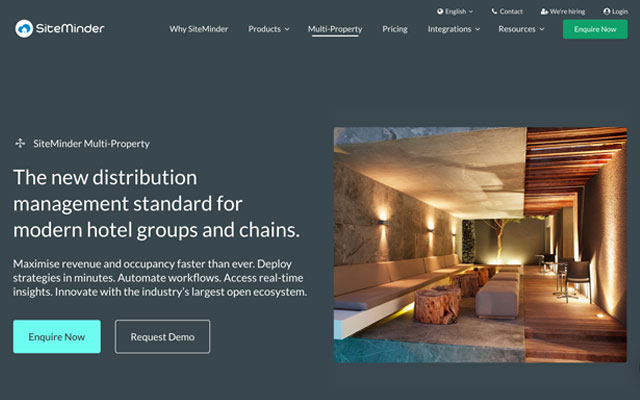
SiteMinder has launched SiteMinder Multi-Property to set the new distribution management standard for modern hotel chains and groups, by giving revenue teams critical distribution controls in place of the obsolete features and high costs that typically come with legacy systems.
The technology makes it possible for hotel chains and groups of all structures – from brands to clusters – to centralise the management and distribution of their rates, and easily onboard new hotel properties and staff.
With SiteMinder Multi-Property, hotel chains and groups can enter rate plans once and have the details disseminated across all their properties – a scale that is unmatched by other distribution technologies due to SiteMinder’s open connections to 1,000 property management systems, channel managers, booking channels and hotel applications.
Additionally, hotel chains and groups can use SiteMinder Multi-Property to launch enterprise-wide campaigns at a fraction of the time they used to, run continuous health checks of their set-up, and produce customised reports.
In a statement, SiteMinder said that Multi-Property “comes at a crucial time as travel markets reopen around the world and hotels remain challenged by a resource and skills shortage”.
“By simplifying the complexity involved with distribution for hotel chains and groups, SiteMinder’s technology will allow revenue teams to boost their efficiency, stay nimble and drive stronger revenue outcomes than ever before,” it added.
Speaking on the reasons for creating SiteMinder Multi-Property, SiteMinder’s chief product officer, Inga Latham, said: “We’ve worked closely with revenue and distribution professionals for many years and know that, more than any other hotel segment, multi-property groups are held back by traditional technology and fragmented structures. Legacy distribution systems have imposed high costs and provided a vast array of features and functions, which often go unused.
“SiteMinder Multi-Property lets hotel chains and groups manage their distribution on their terms. It gives them a greater capacity to innovate and compete with less time and resources. Consumer expectations have also increased over the past year and, with SiteMinder Multi-Property, hotel chains and groups can guarantee a smooth experience in the back-end to support the guest experience.”
According to SiteMinder, Multi-Property is now being used by hotels in every region globally. Early adopters include Minor Hotels, Quest Apartment Hotels, TFE Hotels, Nesuto Hotels, and StayWell.
Ascott rolls out telehealth, telecounselling and travel security advisory services
The Ascott has partnered with International SOS to offer its guests global access to a suite of telehealth, telecounselling and travel security advisory services.
Now available to Ascott’s guests across nearly 200 properties in 86 cities and 27 countries, these complimentary services are part of the brand’s enhanced Ascott Cares commitment to improve the overall wellness and safety of its guests.
Guests who require telehealth assistance or telecounselling can call the property’s front desk from their apartments, to be connected to an International SOS health expert at one of its 27 Assistance Centres, all of which operate 24/7 and provide assistance in 99 languages and dialects.
Depending on the guest’s medical condition, International SOS’ health experts will provide medical advice or may refer the guest for teleconsultation, in-person consultation or telecounselling with their global network of over 90,000 accredited medical service providers, including clinics and hospitals.
International SOS will also provide guests with travel security advisory and assistance. This includes advice on security matters including the choice of safe ground transportation, as well as verification and updates on in-country incidents, such as street protests, natural disasters, travel restrictions and security threats.
Ascott will also work with International SOS to implement in-property security protocols and safeguards, and arrange travel security solutions for its guests.
Kevin Goh, CapitaLand’s CEO for lodging and Ascott’s CEO, said that the new services ensure that “our guests can have greater peace of mind that they are able to receive on-demand quality care from medical and security experts, and feel safe when they stay with us”.
He added: “These value-added services as part of our enhanced Ascott Cares commitment are particularly crucial amid the global Covid-19 pandemic. With the need for social distancing and uncertainties from travel restrictions, our guests are able to have immediate access to these services from the comfort of their apartment.”
APAC airline traffic remains dismal in April: AAPA

International passenger demand continued to linger at the significantly depressed volumes seen since April 2020, according to preliminary traffic figures released by the Association of Asia Pacific Airlines (AAPA).
The ongoing Covid-19 pandemic and surges in transmission across many Asian economies have resulted in renewed border control restrictions as well as domestic lockdowns, quelling hopes of any meaningful resumption in international travel markets.
In total, Asia-Pacific airlines carried just 1.1 million international passengers in April. Although this was an improvement over the same period in 2020 when international passenger volumes plunged precipitously, it represented just 3.5 per cent of passenger volumes recorded in the same month of 2019.
Available seat capacity was only four per cent of levels registered in 2019, with the international passenger load factor averaging 26.4 per cent for the month.
Subhas Menon, AAPA director general, said: “The emergence of different variants with higher transmissibility rates has deterred Asian economies from reopening their borders, with extended quarantine requirements further suppressing international travel demand. Bilateral travel corridors offer hope for a recovery, yet remain susceptible to disruptions, as evidenced by the second postponement of the Singapore-Hong Kong travel bubble, reflecting the extremely challenging operating conditions faced by airlines.
“In Asia, the relatively slow pace of vaccinations continues to undermine the region’s economic recovery, in particular, the travel and tourism sectors which have been badly hit. Accelerating vaccination rollouts will be key to paving the way for the restart of the travel industry. However, governments are still facing numerous challenges, including supply constraints and logistical issues.
“Meanwhile, Asian airlines continue to play a pivotal role in supporting international efforts to save lives, through the delivery of much-needed medical supplies. However, the majority of the region’s carriers, with their international passenger business severely curtailed, continue to burn through cash every month. Some airlines are undergoing major restructuring, whilst others are raising further equity.
“As Covid-19 becomes endemic in society and borders progressively reopen, the collaboration of multiple stakeholders such as governments, airlines, airports and service providers, as well as the implementation of harmonised risk-based measures in accordance with ICAO and WHO guidelines, will be needed to restart international air travel in a smart, safe and sustainable way.”
Fresh lifeline for Malaysia’s tourism sector with govt’s latest stimulus
The Malaysian government has unveiled a RM40 billion (US$9.7 billion) economic stimulus package to cushion the impacts of a nationwide two-week total lockdown which kicks off today (June 1).
The overall value of the Pemerkasa Plus programme includes a direct fiscal injection from the government worth RM5 billion.
Announcing the details via a televised address yesterday, prime minister, Muhyiddin Yassin, said the financial aid comprised of 12 initiatives based on three main objectives, namely, enhancing public health capacity, supporting business continuity and advancing the people’s welfare agenda.
Aid for the travel and tourism sector includes RM1 billion for a bus and taxi hire purchase rehabilitation scheme that will allow eligible bus and taxi operators to obtain a loan moratorium for up to 12 months, with the option to extend the loan period for up to 36 months.
Tour vehicle drivers, taxi drivers and e-hailing drivers will each receive a one-off aid of RM500. Hoteliers, shopping centres and theme parks will enjoy electricity bill discounts of 10 per cent from July to September.
The prime minister also said that SMEs that are not allowed to operate during the movement control order (MCO) 3.0 had been given the option of automatic approval of bank moratoriums for three months or a 50 per cent reduction in loan repayments for six months.
The government has also allocated RM1.5 billion for a month’s worth of the Wage Subsidy programme under the Social Security Organisation for all affected economic sectors, with a limit of 500 employees per application.
Commenting on the latest government stimulus, the Malaysian Association of Tour and Travel Agents (MATTA) president, Tan Kok Liang, said the association welcomed many of the initiatives outlined as it would help tourism players, especially travel agents, to stay afloat during this crisis.
He added: “Foremost amongst these is the push for the rollout of the vaccination programme which will help pave the way to a quicker reopening of borders, and thereby, the revival of tourism and all its related economic subsectors.”
Tan also hailed the rehabilitation programme for buses – a move that MATTA has been calling on the government to make since the early stages of the pandemic.
He said: “We are thankful that the government has taken the bold decision to intervene on behalf of bus owners as the previous moratoriums did not apply to leasing companies.
“MATTA estimates that our members alone own more than 9,000 vehicles classified as tour buses, many of which were purchased from credit and leasing companies. To put into context, a 40-seater tour bus costs between RM490,000 to RM580,000. The debt which is impossible to service given these trying times has the potential of crippling the tourism ecosystem if not dealt with swiftly and decisively.”
However, Tan also appealed to the authorities for a longer extension of the moratorium and wage subsidy programme until year-end, as well as to provide travel agencies with a grant of RM10,000 each to help them cover fixed costs and overhead costs.
Room for growth

When a nationwide lockdown in Malaysia left hotel rooms across the country sitting largely vacant, Hanley Chew saw a window of opportunity to help hoteliers put their distressed inventories to good use.
That led him to set up online hotel booking platform JustTonite in February, at a time when Malaysia was under its second movement control order and the hotel industry was suffering with occupancies less than 15 per cent, even in the nation’s capital, Kuala Lumpur.

“There were more than 50,000 unoccupied hotel rooms daily in the capital alone. Nationwide, the number was in excess of 100,000. I created JustTonite solely with the intention of assisting hotels to fill up their unoccupied inventories for the same night,” shared Chew, founder and CEO of JustTonite.
The platform offers same-day, room-only bookings with check-in from 18.00 onwards. “This unique model was very welcomed by the hotel industry as it focuses only on the segment of unoccupied rooms for the night that will (otherwise) not generate any revenue,” said Chew.
Chew, who has been in senior management in the hotel industry for the past 28 years, shared that it was initially a challenge to explain the concept of distressed inventories to hoteliers.
“Many thought JustTonite was another OTA coming into an already very crowded marketplace. Many a time, I got ‘lectured’ on rate parity and hotel positioning, a topic which I am way too familiar with,” he elaborated.
“The industry ethics on rate parity only applies when all parties are selling the same product. In the case of JustTonite, we are selling a different product which is of restricted use. We are only selling (hotels rooms based) on a time segment – (a concept) which no hotels nor OTAs are focusing on.”
The platform was launched with 30 hotels in Kuala Lumpur and Selangor. That number has since increased to more than 100 hotels nationwide, and Chew is optimistic that the platform will grow to 300 hotels by year-end.
Hoteliers are allowed to list their inventory free-of-charge on the platform. A transaction fee is charged only when a booking materialises, with payment made to hotels immediately through the payment gateway.
Chew now plans to expand the platform to Singapore as he sees similarity in booking preferences between Singaporeans and Malaysians in that they desire a user-friendly booking platform with fixed, consistent rates.
To that aim, JustTonite has appointed Infinity Hospitality Asia as its partner in Singapore, effective July 1. Chew shared: “Its role will be to introduce this new concept of marketing distressed inventories to the hotel community in Singapore, and to reach out to staycationers through various marketing initiatives.”
The ambitious Chew is also in discussions with an organisation based in Dubai to promote this innovative model to all seven GCC countries. If all goes according to plan, the roll-out will start in the UAE this September.
JustTonite’s success in Malaysia has given Chew a long-term vision of adding value to the entire travel ecosystem, based on the similar concept of creating an effective distribution channel for distressed inventory.
Chew explained: “Airlines, car rental companies, bus operators and theme parks have similar distress inventories during low or no demand periods. All these industries have enough data to know which periods have low demand, and will need platforms like JustTonite to assist them. Each industry, however, defines distressed inventories quite differently.
“We are currently engaging with the captains of these industries to first understand their definition of distressed inventory. Through some proprietary tools we developed in-house, we determine a matrix to price these inventories effectively.”
Chew added that this pandemic season is the “perfect time” to introduce the concept of distressed inventory management via JustTonite as “hotels and many travel-related industries are currently undergoing some stages of ‘reset’ for their businesses”.
Sheraton debuts family programme in Greater China

Sheraton Hotels & Resorts has launched the brand’s first family programme, Side by Side, designed to foster inter-generational bonding through immersive activities.
Rolled out at the brand’s collection of 13 resorts in Greater China, the Sheraton Side by Side Family Programme allows guests to experience the resort’s dining and leisure facilities, while enjoying a variety of activities with their families, as well as unique local experiences in the destination nearby.
Parents and children can take part in a tropical sunset carnival and a traditional Hainanese Li bamboo folk dance, bonfire activities by the sea and a coconut bowling game at the Sheraton Shenzhou Peninsula Resort.
Meanwhile, families can learn about the local food culture through cooking and tasting the authentic Jiaodong cuisine at the Sheraton Yantai Golden Beach Resort, or bond over arts and crafts workshops and pottery-making sessions at the Sheraton Grand Xishuangbanna Hotel.
At the Sheraton Shanghai Chongming Hotel, guests can start the day off with a ride along the resort to the sunrise viewing spot and enjoy a breakfast picnic while welcoming the first rays of light. Located on the banks of the Bailu Lake in Huizhou, families staying at the Sheraton Bailuhu Resort, Huizhou can cycle around and enjoy a picnic by the lake.
Guests who book one night or more in a standard room or suite under the Sheraton Side By Side Family Package enjoy exclusive benefits, including a welcome amenity, access to all family activities, guaranteed connecting rooms for larger family groups, as well as early check-in and late check-out. Also, as part of the package, daily breakfast for two adults are included and kids under 12 eat for free (up to two children, ordering from the kids’ menu and accompanied by an adult dining on the regular menu).







The new mid-year revision of the Asia Pacific Visitor Forecasts 2021-2023 from the PATA indicates a hard year ahead in 2021 but with recovery occurring thereafter, albeit in a very uneven fashion.
The latest prediction is based on the most recent data and information at its base, amid the extreme volatility in the travel and tourism sector brought on by the Covid-19 pandemic and the resultant containment policies and measures enacted in order to prevent its continued spread.
With the original PATA Asia Pacific Visitor Forecasts 2021-2023 report, projections for that period were made using estimated baseline data for 2020, albeit on the latest data for each of the 39 destinations within Asia-Pacific. During the intervening months to date, however, not only have new data become available, but a range of other factors have surfaced as well, leading to this scheduled review of the forecasts with these new developments factored into them.
Across all 39 Asia-Pacific destinations, the difference in the estimated values used in the original forecasts and those with the most recently released official arrivals data was a positive gain of 3.8 per cent between the two. From an initial forecast of 121.843 million international visitor arrivals (IVAs) in 2020 in the original series, the actuals can now be updated at 126.475 million.
The contraction rates and loss of arrivals still remains severe however, with an overall reduction between 2019 and 2020 of more than 577 million foreign arrivals. Those losses, unfortunately, are forecast to continue throughout 2021 for most sub-regions, under all scenarios. The exception is Asia, which is predicted to have a positive annual growth of almost 51 per cent year-over-year, under the mild scenario.
That singular result can be expected to move the Asia-Pacific overall position to an annual increase of a little more than 27 per cent, between 2020 and 2021, but only under the mild scenario. All other positions remain negative over that period.
The good news, however, is that 2022 looks to be promising, with annual increases across the board, ranging from gains of 105 per cent to 320 per cent under the mild scenario, to between eight per cent and 75 per cent even under the severe scenario. It is important not to be seduced by such large annual percentage increases however, as despite those gains, the absolute volume of arrivals remains well below the 2019 benchmark for IVAs, even out to 2023 under some scenarios.
The expected results for 2021 average just 23 per cent of the 2019 volume at best. During 2022, that is expected to increase to between 27 per cent and 61 per cent depending on the scenario, reaching between 51 per cent and 99 per cent by 2023, again, depending on the prevailing scenario at that time.
The surge in annual arrivals between 2020 and 2021 into Asia under the mild scenario is expected to come from mostly Northeast Asia source markets, with the Russian Federation also adding a welcome boost in numbers. Collectively, this top five source market cluster is expected to add an additional 29 million IVAs into Asia between 2020 and 2021, representing some 80 per cent of the predicted increase into the region over that period.
Along with the volume increases, there are likely to be some significant annual percentage growth gains into Asia between 2020 and 2021. Although these increases are more than robust, the actual impact on the absolute volume of arrivals is minimal, however, they do represent strong interest in the destination region and are certainly worth tracking over time to evaluate longer-term potential.
Liz Ortiguera, CEO of PATA, explained: “Expectations for a return to the past should be shelved and more attention paid to those source and destination markets best preparing to drive recovery within Asia-Pacific. Travel recovery is being driven by a complex range of factors from the varying market policies regarding virus control and containment to local citizens’ sentiments on vaccine take-up.
“Success will come to those that efficiently implement science-based best practices to control the pandemic in their home markets to restore both source market government and consumer confidence. In the travel industry, a ‘duty of care’-based approach in delivering services and products will support a more sustainable recovery.
“On a positive note, our forecast projects a pent-up demand for travel experiences in the Asia-Pacific region. Flexibility in marketing and delivering new experiences to engage travellers as corridors open up will be critical.”