TTG Asia
Asia/Singapore Saturday, 11th April 2026
Page 1490

Seda Vertis North, Philippines

0

Location
The only hotel in Vertis North shopping mall stands in Quezon City, a burgeoning business district with varied entertainment, dining and retail options. The hotel is a stone’s throw from the MRT North Station, in the heart of an ever-expanding shopping area. Trinoma Mall sits beside the MRT and serves as a meeting point for groups, buses and coasters to Clark in Pampanga and other provinces up north.
Club Room

Rooms
Departing from the boutique scale of the six older Seda hotels, Seda Vertis North’s 438 keys is nearly double the number in other Sedas.

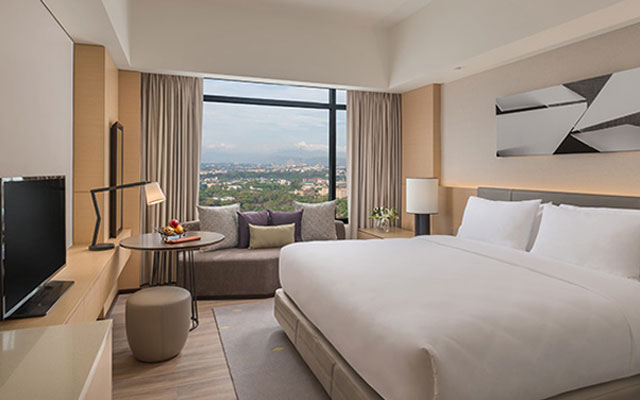
In the minimalist yet inviting Club Room are two comfy beds and a spacious en suite suite bathroom. A thoughtful touch is the triangular sofa with round accent table that easily holds a meal or a laptop. Paired with an ottoman, the table can be transformed from dining to meeting or working purposes.

Facilities
Compared to other Seda properties, the hotel has a bigger ballroom at 700m2 and more function rooms.

In the lobby, several kids milled around the wooden table with Mac computers. Families larked around the pool area, while business people utilised the club lounge. Other facilities include a spa, a gym and areas for morning yoga and Zumba.
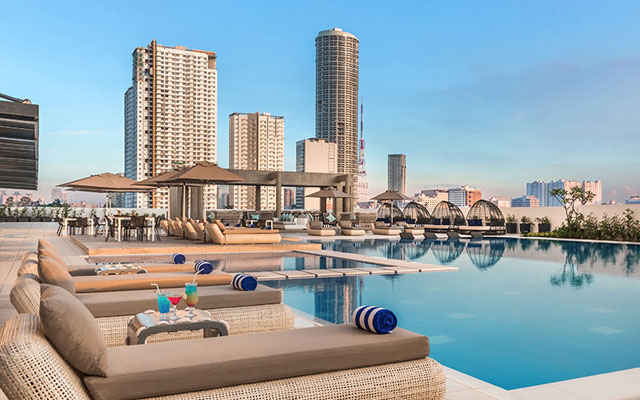
Pool area

F&B
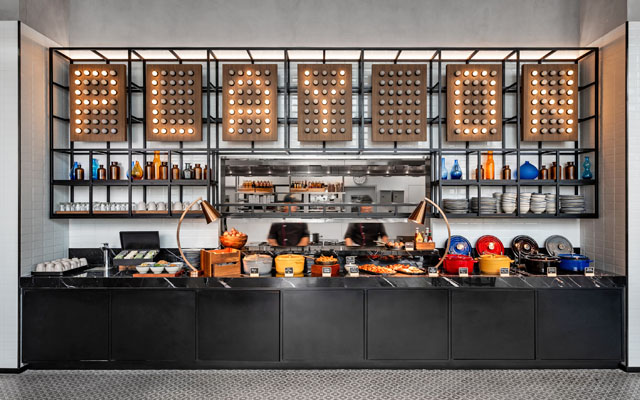
After a taste of creative pica pica (finger food) at Shoot Up Roofdeck Bar, including choclate-coated crunchy chicharon (fried pork rinds), we were expecting a special treat when we were invited to the Chef’s Table. Still, we were unprepared for the extent to which chef Kerpatrik Boiser went to make this lunch the most memorable part of our staycation.

After we were seated at the country-style ballroom kitchen, the team got to preparing an eight-course feast. All courses did not disappoint, but worthy of special mention was the melt-in-the-mouth foie gras served with braised beef. The red-wine marinated pears, goat’s cheese and balsamic dressing in our salad whetted appetites, while the chocolate ala Bomb was a delightful ice cream surprise.

The Chef’s Table gets a 10 for the venue, presentation, creativity and service, without detracting from food and flavour.

Service
Great. We remember the chefs who could also sing, the reception staff who looked for our goddaughter when she arrived late via MRT, and the lady at the Club Lounge who allowed us to enjoy breakfast beyond the appointed time.

Verdict
This homegrown hotel brand proves that it is on par with foreign brands.

No of rooms 438
Rates From US$106/night
Tel: (63) 2 739 8888

Amadeus and Flight Centre strike distribution deal

0
Flight Centre agents will use Amadeus Selling Platform Connect and integrated mobile and business intelligence capabilities

Amadeus has announced it will be one of the partners providing distribution technology for Flight Centre Travel Group’s business across 17 countries in EMEA and Asia.

Flight Centre will also be a driver customer in the creation of Amadeus’ new NDC-enabled solution, as well as give input into its design for travel sellers.

Flight Centre agents will use Amadeus Selling Platform Connect and integrated mobile and business intelligence capabilities

This means travel sellers like Flight Centre will be able to give customers a richer choice of fares and the option to book NDC-powered ancillary services within an already familiar working environment, according to Amadeus.

Flight Centre’s travel agents will adopt Amadeus Selling Platform Connect and integrated mobile and business intelligence capabilities in the following markets: EMEA (the UK, Ireland, Netherlands, Germany, Finland, Sweden, Denmark, Norway, South Africa, Namibia and the UAE) and Asia (Singapore, Hong Kong, Malaysia and India). In Australia and New Zealand, Amadeus will also provide technology solutions for some of Flight Centre’s OTA businesses.

Rajiv Rajian, executive vice president of business travel at Amadeus, said: “As we progress on our NDC-X programme, we’re also evolving our entire travel platform to bring together all relevant content from any source (GDS, NDC, proprietary APIs, and aggregators) to be distributed via any channel or device. The first evolution of our platform is underway and will give travel sellers, like Flight Centre, access to more content, and will give airlines (greater) flexibility to distribute their products and offers.”

Amadeus is aiming to attain NDC level three certification as an aggregator this year, followed by delivering a first fully scalable solution to travel sellers worldwide in 2019.

Uber pulls out of SE Asia with seizure by rival Grab

0
Grab says the Uber app will continue to operate for two weeks, while Uber Eats will run until the end of May

Grab is acquiring Uber’s operations and assets in South-east Asia including Cambodia, Indonesia, Malaysia, Myanmar, the Philippines, Singapore, Thailand and Vietnam.

The move marks Uber’s further retreat from international operations, following the sale of its China business to local rival Didi Chuxing in 2016 and Russian business to Yandex last year.

Grab says the Uber app will continue to operate for two weeks, while Uber Eats will run until the end of May

As part of the deal, Uber will take a 27.5 per cent stake in Grab and Uber CEO Dara Khosrowshahi will join Grab’s board.

The online-to-offline company will integrate Uber’s ridesharing and food delivery business in the region into Grab’s existing multi-modal transportation and fintech platform.

Anthony Tan, Grab’s group CEO and co-founder, said the acquisition “marks the beginning of a new era” and the merger will drive better cost efficiency and services for customers in the region.

However, the Competition Commission of Singapore (CSC) stated that it has not received notification of the merger, reminding that along with Singapore’s competition laws, it prohibits mergers that may result in a “substantial lessening of competition”, the Singapore’s Straits Times reported.

CSS indicated it could “require the merger to be unwound or modified” to prevent an erosion of competition”.

In a statement, Grab said it believes the acquisition will add to vibrant and competitive ride-hailing, delivery and transportation spaces, and stated it will make a merger notification to CCS.

Uluru climbing ban a step in the right direction, tour operators say

0
The ban is widely supported in Australia (photo credit: Stanislav Fosenbauer / Shutterstock.com)

A ban on climbing one of Australia’s iconic tourism sites has been accepted as a necessary decision by local tour operators, with some calling for restrictions on even more sacred sites in various parts of the country.

The Uluru-Kata Tjuta National Park Board will impose a ban on the controversial practice of climbing Uluru, also known as Ayers Rock, in the heart of the Northern Territory’s “Red Centre” from October next year.

The move has prompted speculation that other sacred sites would follow suit, sparking a debate between those who want to protect the sites and those who want respectful visitors to continue to have access to these locations.

The ban is widely supported in Australia’s tourism sector (photo credit: Stanislav Fosenbauer / Shutterstock.com)

But Intrepid Travel’s regional director Brett Mitchell thinks the decision to ban the Uluru climb for them is uncomplicated. “For us, that decision should have come a lot sooner,” he said.

“Yes, it’s a (bucket list thing for some travellers) to get to Uluru but once you’re able to explain why it’s sacred, those that might have been inclined to climb it will conclude that it’s a no-brainer not to climb it. So we haven’t had any negative feedback in that sense.”

The ban has long been supported by Tourism Central Australia, where CEO Steven Schwer believes the change won’t impact tourist numbers to the region. “The (tourist demand to climb Uluru) used to be a lot more prevalent than it is these days,” he said.

“Less than 20 per cent of all visitors who enter the park now climb the rock and the numbers are continuing to diminish. And what’s interesting is there are far more people who complain that the rock climb is still open than those who complain about it being closed.”

More than 300,000 people visit Uluru every year, with tourists choosing to climb the rock despite a sign by the traditional land owners expressing their wishes for visitors to avoid climbing the spiritually significant landmark as that is seen as offensive to the Anangu people.

Advocates for the ban have also cited safety issues, pollution and environmental degradation. There have further been reports of visitors disrespectfully stripping on the rock or using it as a toilet because of the lack of facilities.

“There are so many other ways you can experience the Ayers Rock these days that there’s no reason to climb it,” said Schwer. “There are segue tours around the base, also bike tours, helicopter flights, camel tours, the SkyShip which is an aerial experience, a Sounds of Silence dinner (to name a few) so it’s really just not necessary anymore to climb to feel like you’ve been there and experienced it.”

Mitchell would also welcome restrictions placed on other sacred sites in Australia like Purnululu National Park in Western Australia or Gariwerd National park in Western Victoria’s Grampians area. “Mass tourism is a concern and particularly in Australia where we’ve just got a very fragile environment. It’s a growing issue globally,” he said, adding that tourism has an important role to play in sustainability.

Ronnie Lan, general manager of Great Holidays, which specialises in inbound tourists from China, says his clients will be disappointed about the ban but will accept it. “It’s just the way it is,” he remarked. “I don’t think it will sway tourists to other destinations because Uluru is (quite) unique.”

The ban has also put into question continuing access to climbs on hiking attractions like Wollumbin-Mount Warning in North-east New South Wales and St Mary Peak in South Australia’s Flinders Ranges.

Prince’s expansion gains speed outside Japan with StayWell acquisition

0
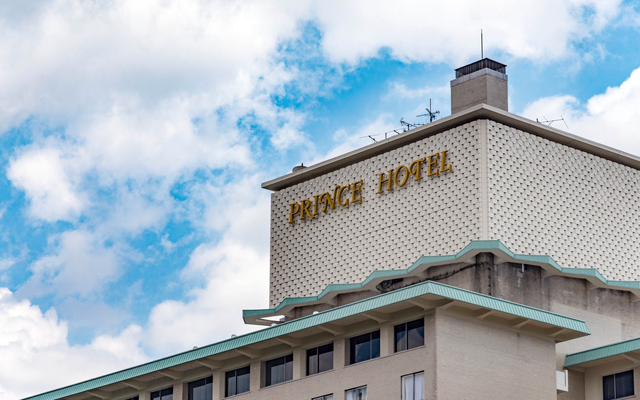
Building awareness of the Prince brand beyond Japan (photo credit: Prakhob Khonchen/Shutterstock.com)

Half a year since acquiring Australia’s StayWell Hospitality, Japan’s Prince Hotels is set to make its mark beyond its home ground, with two new brands about to be unveiled and plans to more than double the combined portfolios in 10 years.

For Prince Hotels, which has a stronghold in Japan, the acquisition has given it geographic diversity, and hence better “protection from peaks and declines, economic time frames and environments”, said Stan Brown, former executive vice president of Prince Hotels and now chairman and director of StayWell Holdings.

“The biggest difference is the risk is not just in Japan anymore. One example is right after the (Tōhoku) earthquake in March 2011, it was very difficult for hospitality players in the country, and for Prince especially because we didn’t have hotels in other regions,” he elaborated.

Making Prince brand better known outside Japan (photo credit: Prakhob Khonchen/Shutterstock.com)

The goal is to grow the combined StayWell and Prince portfolios from about 88 properties today to 250 in 10 years, approximately 100 of which will be outside Japan and 150 of them StayWell hotels. A check on the hotel websites shows Prince now has seven overseas hotels, while StayWell’s full portfolio of 36 is outside Japan.

“Prince and Seibu have expertise and talent in Japan, but not (beyond). StayWell, operating in eight countries, brings (the relevant) expertise and language skills to the table,” Brown noted.

But a larger and more diversified portfolio is just one part of the strategy. Victor Osumi, managing executive officer of Prince Hotels, said: “One of the main reasons for expansion outside Japan is to create brand awareness, which will feed inbound business to Japan. Inbound used to be 20 per cent of total business, and we now have 36 per cent. It’s becoming a huge piece of business, but we want that to continue to grow.”

With Singaporeans making up 800,000 of Japan’s inbound visitors and other South-east Asian markets fast growing, “we really need the brand in Singapore and Bangkok”, Osumi continued.

Simon Wan, president and director of StayWell Holdings, added that Jakarta and Kuala Lumpur are also on the expansion map. Beyond South-east Asia, expansion will also take place in Australia, New Zealand, Japan, Taiwan, Oceania, the Middle East, Europe and the US.

To build recognition for Prince outside of Japan, the company will introduce a new five-star brand, which Brown says will have the name “tweaked a bit but with Prince still the key component”.

Another new lifestyle concept will be rolled out, with properties piloting a mobile app that allows users to select rooms and enjoy quicker check-in, Wan told TTG Asia. Such innovations, he said, are long overdue in the hospitality sector and would allow hotels to better cater to the needs of today’s guests and wrest bookings back from OTAs.

Brown further shared: “The parent company has a stronger balance sheet, so it will allow us to develop (while) still keeping the brands that we have. Prince has significant brand equity – probably the most of any brand in Japan, so we’ll keep Prince within Japan.”

He added that StayWell brands likewise “will stay”, with slight tweaks to the Park Regis brand.

Even as the company expands, Brown hinted that its moderate scale will remain a strategic anchor, adding that the portfolio will be kept to around half a dozen brands.

“Because of the big players and the consolidation that has occurred, you have saturation in given markets. A lot of owners look at us as (not having that) saturation so they get much quicker response when dealing with us. This has been one of our key strategic successes,” Brown said.

Qantas-Emirates alliance renewed for another five years

0
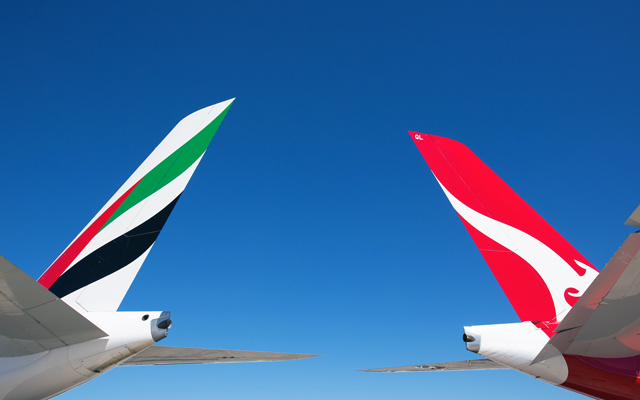
Offering more destinations on their joint network, greater schedule choice and increased frequent flyer benefits

The Australian Competition and Consumer Commission (ACCC) has reauthorised an existing partnership between Qantas and Emirates until 2023.

The approval came on the heels of Qantas inaugurating Perth-London services, a more direct alternative to the traditional routes with stops in Dubai, Hong Kong or Singapore. The Australian carrier on Sunday also swapped Dubai for Singapore as a stop along its popular Sydney-London route, in addition to a recent announcement to enter into a partnership with Singapore Airlines and Changi Airport to promote Singapore as a preferred transit point.

Offering more destinations on their joint network, greater schedule choice and increased frequent flyer benefits

Signalling a continued importance of Dubai connections from Australia, the renewed joint business agreement will see Emirates and Qantas offering more destinations on their joint network, greater schedule choice and increased frequent flyer benefits, according to Thierry Antinori, Emirates’ executive vice president and chief commercial officer.

Qantas International’s CEO Alison Webster commented: “With three options to get to Europe; via Perth, Singapore and Dubai, and greater frequency across the Tasman, the ACCC’s decision allows us to continue to jointly provide the best network, the best service and the best frequent flyer programmes for millions of customers travelling between Australia/New Zealand and the UK and Europe.”

Red flags up over lack of lifeguards on Phuket beaches

0
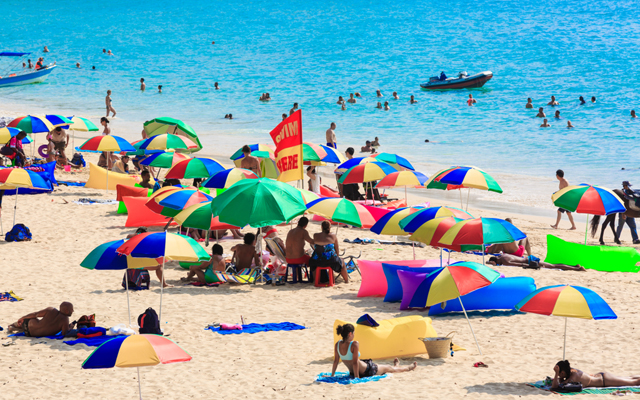
No lifeguards despite after a company was contracted to provide the service

The International Surf Lifesaving Association (ISLA) is requesting for the US State Department to issue a level three travel advisory warning of the “extreme danger” in waters surrounding Phuket, according to a report by The Phuket News.

A level three advisory cautions travellers to avoid travel due to “serious risks to safety and security”.

No lifeguards despite after a company was contracted to provide the service

Factors considered in ISLA’s decision include “the global drowning epidemic”, the south-west monsoon in May that makes Phuket’s waters dangerous and the fact that hundreds have drowned in the waters in the past decade.

Moreover, ISLA pointed out that the Phuket Provincial Administrative Organisation (PPAO) does not provide professional ocean lifeguard service despite collecting money form US citizens for the service in the form of a hotel tax.

Quoting an ISLA resolution, The Phuket News reported: “ISLA requests that this level three travel advisory remain in place until the existing internationally certified lifeguard force is fully funded, operational, and able to provide lifeguard services that meet international standards.”

The Phuket News also understood from Daren Jenner, ISLA’s warrant marine safety officer – Phuket specialist, of the controversy surrounding PPAO’s “quick and quiet” awarding of a 13 million baht contract to Laikhum to provide 98 lifeguards on the destination’s beaches from March 1 through September 30, announced only on February 28.

Laikhum has yet to post any lifeguards at any Phuket beaches. Under the contract, the company cannot do so until it has provided a list of names of the lifeguards it will hire to the PPAO for approval.

Update [March 27, 14.30]: The original article was updated to correctly reflect the value of the contract awarded to Laikhum.

Expedia tweaks name in corporate brand refresh

0
Expedia Inc is now the Expedia Group

Expedia has changed its corporate name and branding to Expedia Group to “better reflect its identity as a leading global technology company”, the OTA said in a press release.

The name tweak also acknowledges the unique contribution of each individual brand to the Expedia Group, the release state, including Hotels.com, Egencia, HomeAway and Trivago, among others.

Expedia Inc is now the Expedia Group

“We are excited to introduce the new Expedia Group name and identity to better reflect the global nature of our business, more clearly articulating who we have become and who we aspire to be,” noted Mark Okerstrom, Expedia Group, president and CEO.

The stock will continue to trade on Nasdaq under the EXPE ticker symbol.

Last month, the Priceline Group also made a similar announcement of changing its name to Booking Holdings to reflect its growing portfolio and to acknowledge the significance of its Booking.com service.

SIA first to take delivery of Boeing 787-10

0
xxxx

Singapore Airlines (SIA) has become the world’s first airline to take delivery of the Boeing 787-10 – Boeing’s newest aircraft variant and the longest in its Dreamliner range – due to enter commercial service next month.

The aircraft – the first of 49 787-10s that SIA has on firm order – was delivered at a ceremony in North Charleston on the evening of March 25, 2018.

A celebratory occasion as the Boeing 787-10 reaches its first airline customer: Rolls-Royce’s Dominci Harwood, Boeing Commercial Airplanes’ Kevin McAllister and SIA’s Goh Choon Phong

SIA’s 787-10s will be used for flights up to eight hours. Osaka and Perth will be the first scheduled destinations to be served by the new aircraft, from May 2018. Prior to the introduction of these services, the aircraft will be operated on selected flights to Bangkok and Kuala Lumpur for crew training purposes.

The 787-10s will feature SIA’s new regional cabin products, configured with 337 seats in two classes, featuring 36 Business Class and 301 Economy Class seats.

Constructed using lightweight composite materials, the 68m 787-10 is the longest variant of Boeing’s Dreamliner range of aircraft. Customers can look forward to customisable lighting preferences with large electronically dimmable windows, cleaner air, and a quieter and smoother ride.


Malaysia lays out recovery plans as 2017 tourist arrivals fall short of targets

0
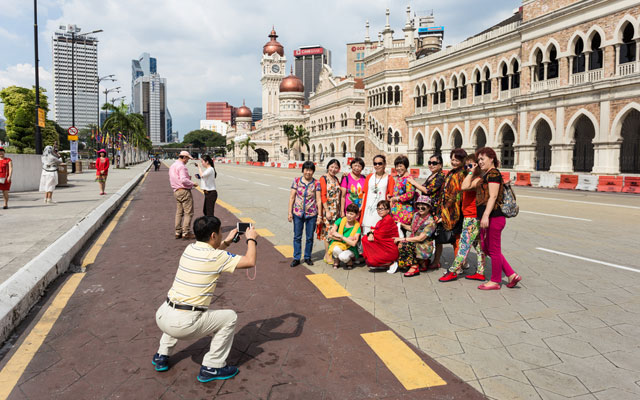
posing in front of the Sultan Abdul Samad building in Kuala Lumpur

Despite a weak ringgit that was perceived to boost inbound tourism, foreign tourist arrivals to Malaysia totalled 25.9 million in 2017 with a yield of RM82.2 billion (US$21 billion), a far cry from the targeted 31 million tourists and RM114 billion yield.

Last year’s arrival figures indicated a three per cent decline over 2016, although yield posted a marginal 0.1 per cent increase in 2017 to RM82.2 billion.

Tourists posing in front of the Sultan Abdul Samad building in Kuala Lumpur

It was a mixed bag of performance for ASEAN, a key market source accounting for 75 per cent of total arrivals to Malaysia.

Regional markets that saw a decline in 2017 include Cambodia (-32.1 per cent), Myanmar (-14 per cent), the Philippines (-11.2 per cent), Indonesia (-8.3 per cent) and Singapore (-6.3 per cent).

On the other hand, double-digit growth was registered for other ASEAN markets such as Brunei (+19.4 per cent), Vietnam (+14.8 per cent), Laos (+27 per cent) and Thailand (+3.1 per cent).

Arrivals from India, another major market for Malaysia, tumbled 13.4 per cent from 2016 to 552,739 in 2017.

Keen to arrest the decline for India, whose arrivals have been on a downward slide since 2015, Tourism Malaysia has embarked on a six-month joint marketing and promotion campaign with Akqua Sun Group, a destination marketing company based in India.

The campaign, which runs from January to June, utilises a comprehensive promotion mix, implemented across print and online advertising, trade networking roadshows to meet top travel agents, participation in consumer and trade tourism fairs, workshops and product briefings on Malaysia, familiarisation trips and joint promotions.

Tourism Malaysia’s director-general, Mirza Mohammad Taiyab revealed there are plans to set up a Tourism Malaysia office in Kolkata, adding to offices in Delhi, Mumbai and Chennai. With AirAsia flying daily between Kolkata and Kuala Lumpur, the regional office will help to boost tourist arrivals from West Bengal and neighbouring states.

Mirza suggested that congestion at the entry points into Malaysia, especially during peak periods, as a possible reason driving tourists to consider other destinations.

To address the bottlenecks, the government has stepped up efforts to make entry clearances by land and sea faster and more convenient, especially during peak travel periods for the respective markets, said Mirza.

In January, the Immigration Department issued a statement that steps have been taken to ease congestion at the main gateway, Kuala Lumpur International Airport, by opening support counters for passenger inspection during peak periods.

The state government of Johor is also looking at ways to ease traffic congestion along the Causeway and the Second Link. Options being considered include increasing the number of toll booths at the Second Link, better traffic management at both checkpoints, which includes separating bigger and larger trailers from smaller lorries for faster clearance and increasing the number of security personnel during peak hours.