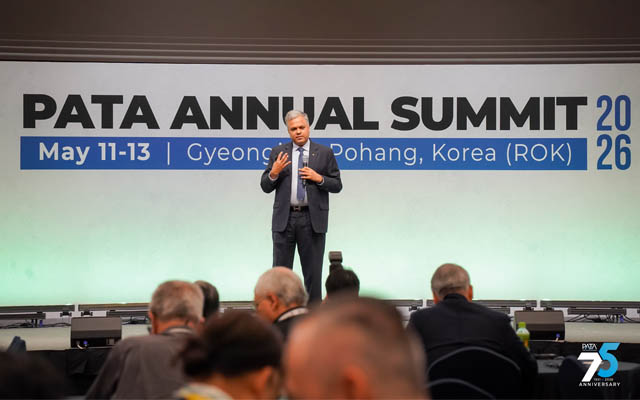
Recognising Asia-Pacific as the world’s aviation growth engine, a recent presentation by OAG Aviation’s commercial and industry affairs leader for APAC and MEA, Mayur Patel, underscored the importance of continuous infrastructure development to keep pace with growing travel demand.
His presentation, delivered at the PATA Annual Summit in Gyeongju, South Korea, noted that Asia-Pacific’s aviation industry has recorded annualised growth of 5.2 per cent over the past 25 years, double the global average.
Patel described the performance as “encouraging and positive, especially when you’ve got half of the world’s population – 4.8 billion – people residing here”. He added that he sees “global opportunity to do more business together”.
To build the foundation for the next decade of growth, Patel emphasised the importance of infrastructure investment, noting that many airports are already expanding with future demand in mind.
Patel said: “Hong Kong is moving its airport capacity towards 120 million passengers and is (enhancing its) infrastructure with a third runway and new terminal. It is also getting new airline capacities into the system.
“Singapore’s Changi Airport is looking towards 140 million passenger capacity by mid-2030, and the fifth terminal is now under construction to get more passengers into the air hub.
“At Incheon International Airport (South Korea), the fourth runway is completed and a fifth is being planned, with the aim of serving a capacity of 106 million per year.”
Expansion projects are also underway across the region, including at Suvarnabhumi Airport in Bangkok; Long Thanh International Airport, currently under construction east of Ho Chi Minh City; second airports planned for Delhi and Mumbai; and 25 airports under construction across China in 2025 alone.
Patel said most airports in the region currently handle between 65 million and 80 million passengers annually, with many aiming to process between 120 million and 250 million passengers over the next decade.
“There will be significant capacity (to support) airlines that are ordering new aircraft that will need to be filled by more passengers,” Patel remarked.
He noted that Asian carriers have more than 5,800 aircraft on order – double the total of any other region – which is expected to add 1.38 billion seats across Asia-Pacific over the next decade.
As most future fleets will comprise narrow-body aircraft, Patel said low-cost airlines will have greater opportunities to expand, creating new city pairs, opening new markets and attracting different traveller segments.
However, Patel stressed that growth must also be resilient.
“Aviation profit margins are very thin (2.3 per cent, which is far below the 3.9 per cent global average), so we’ve got to be very smart about how we operate and sustain growth,” he said, adding that airlines must optimise yield, not just seat capacity, to avoid fragile networks driven by profitless growth.
Further, modern airport technology, particularly biometric systems, will ensure efficient growth. Using Hong Kong and Singapore as examples, Patel noted that travellers can complete immigration procedures quickly while keeping their passports in their bags.
Next, Patel discussed the evolution of the low-cost carrier model as a contributor to resilient aviation growth.
“The low-cost carrier model has been one of the great success stories of Asia-Pacific aviation; 22.5 per cent compound annual growth since 2000 is a remarkable track record. But as these networks mature and unit costs inevitably rise, the primary challenge shifts from growth to profitability. The era of simply adding routes and seats is giving way to a more complex question: how do you sustain margins when the structural cost advantages that defined the model begin to erode?
“The natural response is the hybrid model, carriers that retain the cost discipline of a low-cost operation while layering in the product and service flexibility of a full-service airline. We’re already seeing this play out across the region. Travellers today are not a homogeneous group. A millennial leisure traveller, a corporate road warrior, and a premium family holidaymaker have fundamentally different expectations. A carrier that can serve all three, without the overhead of a traditional full-service structure, has a genuine competitive advantage – a good example of this is India’s IndiGo Airlines.”
Patel added that resilience will also depend on smarter aircraft with lower unit costs, greater point-to-point connectivity, diversified demand, and the expansion of ultra-longhaul services. He cited Qantas’ Project Sunrise, scheduled for 2027, which will connect Sydney and London non-stop in approximately 22 hours.