New search rules are changing the way hotels are being discovered

Brought to you by Cvent
Traditional SEO is no longer enough to keep hotels visible to corporate buyers and event planners.
“As travel and meetings sourcing increasingly shifts towards generative AI platforms, hospitality sales leaders are facing a new challenge: the AI Discovery Gap,” says Graham Pope, vice president – International, Sales, Cvent.
He explains how this shift is impacting visibility and the strategies that properties can take.
According to Cvent data, organic click-through rates (CTRs) have fallen sharply from 1.76% to 0.61% as AI-generated search results increasingly answer queries directly, reducing the need for users to click through to websites.
For hotels, this creates a serious sales challenge. Event planners and corporate buyers are no longer browsing pages of search results. Instead, they are asking AI engines highly specific questions, such as: “Find a venue in Singapore for 200 people with a sustainable menu and a rooftop breakout space.” If an AI engine cannot accurately interpret a property’s data, the hotel may not even be considered, and a potential sales opportunity is gone before an RFP is even created. Understanding the mechanics of these platforms is essential.
We’ve outlined the foundational pillars for mastering AI-driven group business in our latest industry resource.
From SEO to GEO
To remain visible, hospitality leaders must evolve from traditional Search Engine Optimisation (SEO) towards Generative Engine Optimisation (GEO).
For the modern hotelier, GEO is about ensuring your property’s MICE offerings show up in AI search results in response to increasingly complex buyer prompts.
Hotels must now optimise for AI comprehension and hyper-personalised buyer journeys.
This begins with clean and structured data. Hotels need accurate information that clearly shows their offerings, such as ballroom size, exact audiovisual capabilities, meeting capacities and configurations, sustainability credentials, room inventory, and breakout configurations. Properties that present their information in a way that AI engines can interpret, in response to the conversational way planners search, are more likely to appear in recommendations.
Consistency is equally important. If meeting room capacities, room inventory, sustainability credentials or venue descriptions differ across a hotel’s website, OTA listings, destination directories and sourcing platforms, AI engines may struggle to determine which information is accurate. These discrepancies can trigger AI “confidence drops”, reducing the likelihood of a property appearing in recommendations.
Work with your partners to ensure that your property’s info is accurate and up-to-date.
Hotels should also ensure their digital content reflects local context. Information about proximity to convention centres, business districts, airports, attractions and transport links can help AI engines match properties more effectively to specific planner requirements.
Deeper AI focus areas for hotel sales teams
Beyond visibility, AI is also reshaping how hospitality sales teams manage pricing, planning, and lead generation.
- Hyper-dynamic group pricing
Traditional static or seasonal corporate rates are becoming increasingly ineffective in fast-moving markets.
AI-powered pricing systems that can evaluate multi-property availability, market demand, and historical conversion data in real time to instantly recommend optimal group pricing will allow hotels to respond more dynamically to market shifts while maximising conversion opportunities.
- AI-driven event diagramming and digital twins
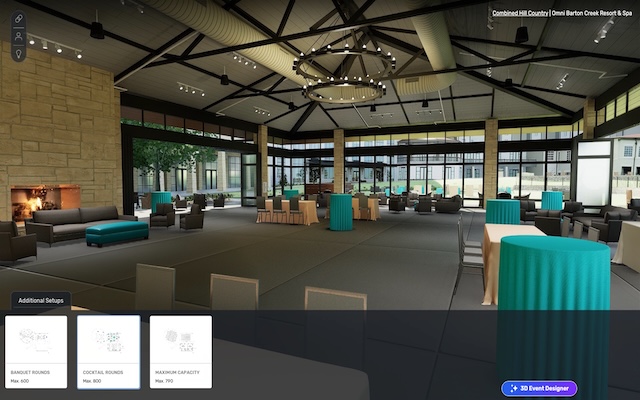
Event planners now demand interactive, digital simulations over static floorplans. 3D diagrams of your floorplans are a key piece of content to help your hotel appear in AI search results.
By feeding AI systems this 3D data, your property becomes discoverable for specific setups, enabling planners to visualise instantly, where they can map out seating, production layouts, and breakout scenarios in real time.
It also helps boost AI rankings, providing the structured data AI agents need to match your venue against precise buyer requirements.
By doing so, it gives buyers the confidence to book faster by eliminating the guesswork.
Rather than just being a mere planning tool, 3D diagramming is now essential in this era of AI-driven search results, ensuring your hotel stays visible to next-gen buyers.
- Predictive lead scoring and automated RFP triage
As sales teams face growing operational pressure, predictive AI tools can help prioritise opportunities more effectively.
AI systems can automatically evaluate incoming RFPs based on close probability, historical booking patterns, and profitability potential, helping sales teams focus their attention on the highest value leads instead of manually sorting through every enquiry equally.
- The unified guest and buyer profile
Another critical shift involves breaking down fragmented data silos between project management systems, central reservation systems, and MICE systems.
Integrating these datasets into a unified, AI-analysed profile allows hotels to create more seamless personalisation across corporate accounts, repeat group bookings, and multi-city programmes.
For sales leaders, this creates opportunities to better understand buyer preferences and deliver more relevant recommendations across the customer journey.
A leadership imperative
The AI transition is no longer solely a matter for the IT or digital marketing departments. It is increasingly becoming a sales and revenue acquisition issue.
To remain competitive, hospitality leaders must invest in clean data infrastructure, regularly audit their AI visibility, and treat their digital footprint as the primary information source feeding global AI engines.

Learn more on how to leverage AI as an advantage across sales, marketing, operations, and the guest experience with Cvent’s e-guide – Mastering AI for Group Business in 2026 – complete with tools.
Graham Pope is vice president, International, Hospitality Cloud at Cvent. With more than 22 years of experience across hospitality, events, and SaaS, he works closely with hotels, venues, and destinations on commercial strategy, demand generation, and technology-led growth. A frequent speaker at industry events, including Cvent Accelerate and IMEX Frankfurt, Graham is known for his perspective on hospitality trends, event-led growth, and the role of AI and data-driven insights in helping organisations drive smarter decisions, stronger customer engagement, and long-term revenue performance.