Sydney will host the 2027 Australian Tourism Exchange (ATE), as Tourism Australia advances a long-term strategy to lift high-yield international visitor spending to as much as A$69 billion (US$45.5 billion) by 2035, amid a near full recovery in inbound tourism.
The announcement was made in Adelaide on May 14 as Australia’s biggest annual travel tradeshow wrapped up after four days, having attracted more than 2,900 attendees, including buyers from 32 countries, surpassing last year’s attendance of 2,700.
The decision sees ATE return to Sydney for the first time in five years.
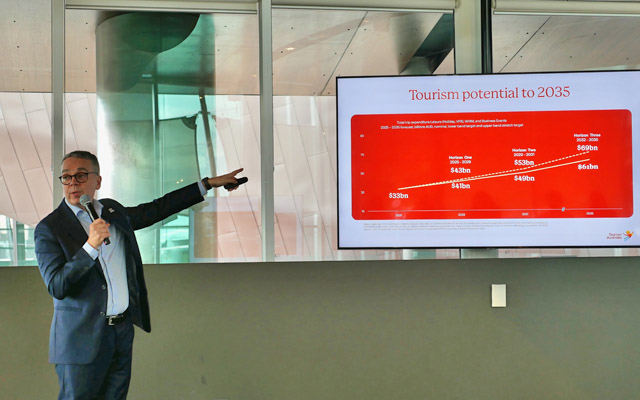
At ATE26, Tourism Australia managing director Robin Mack outlined the organisation’s Tourism 2035 strategy, positioning aviation growth, high-yielding travellers and global destination competitiveness as central to the next phase of Australia’s tourism expansion.
Fresh Australian Bureau of Statistics data released during ATE26 showed international arrivals reached 9.1 million for the 12 months to March 2026, up almost 10 per cent year-on-year and equivalent to 99 per cent of 2019 levels. International overnight visitor expenditure rose 14 per cent to A$56 billion.
Leisure travel continues to drive the recovery, with leisure arrivals rising almost 10 per cent to 7.1 million over the previous 12 months. Holiday visitors were a key growth driver, climbing almost 13 per cent to 4.1 million.
Growth was recorded across almost all key inbound markets, with Greater China continuing to rebound strongly. Arrivals from China rose 21 per cent, while Hong Kong increased 24 per cent over the previous 12 months. Britain climbed 19 per cent following a record 2025 for Australian visitation, while Japan and Singapore grew nine per cent and seven per cent, respectively. South Korea also surpassed 400,000 visitors for the first time. Continental Europe maintained solid momentum, with arrivals from France and Italy increasing 16 per cent and 17 per cent respectively. Vietnam was the only market to record a decline, while India remained flat.
Latest tracking showed a dip in visitation numbers in April, due to the impact of disruptions related to the Middle East situation. Despite this, Mack said forward capacity into Australia remained resilient. “We will still have more seats into Australia for the rest of this calendar year than we had last year,” he said, citing Cirium scheduling data.
Tourism Australia’s new 10-year strategy is focused on attracting more high-yield visitors, particularly leisure travellers, working holiday makers and business events delegates. Modelling conducted with L.E.K. projects expenditure from these segments could rise from A$33 billion in 2025 to between A$61 billion and A$69 billion by 2035, with an interim target of A$41 billion to A$43 billion by 2028.
Importantly, achieving those targets will require an estimated 4.4 million additional international airline seats.
Mack said expanding awareness of the country’s broader tourism offering would be one of Tourism Australia’s key priorities.
“We want to be famous for more things,” he said, pointing to food and drink as an area where international perception still lags Australia’s offering.
Major events are expected to play a central role in Tourism Australia’s growth strategy, particularly in the lead-up to the Brisbane 2032 Olympic Games. The Rugby World Cup in 2027 and upcoming T20 cricket events are also being positioned as key opportunities to stimulate international visitation.
Tourism Australia is also expanding its trade engagement efforts. About 7,000 agents were added to its Aussie Specialist Program in the past 12 months, taking the network to a record 40,000 qualified agents globally. Its flagship G’Day Australia mega-fam will bring 300 agents to Darwin in October after attracting triple the number of applications.