TTG Asia
Asia/Singapore Saturday, 4th April 2026
Page 1758

Charting new paths to growth

0

Serviced residence chiefs tell Paige Lee Pei Qi and Xinyi Liang-Pholsena how hospitality consolidation and competition from home rentals are shaping their expansion and distribution plans
online-oct14_serviced-residences

Lee Chee Koon
CEO, The Ascott

Ascott has been studying industry trends to stay ahead of the curve. With the rise of the sharing economy and the consolidation of hospitality companies, we have established strategic alliances to leverage our capabilities and create a seamless O2O (offline-to-online and online-to-offline) experience.

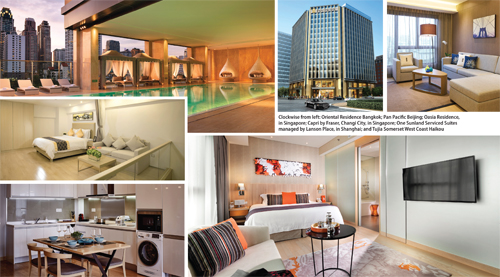
We are embracing technology, tailoring the customer experience and transforming our business model to include the sharing economy. Last year, Ascott took a stake in Tujia.com International, China’s largest and fastest-growing online apartment sharing platform. On top of listing our properties, we also operate serviced residences in China under the new Tujia Somerset brand to cater to the booming middle-class travel segment. The joint venture will integrate Ascott’s strengths in managing properties as well as Tujia’s online capabilities.

Ascott’s partnership with Tujia is on the right track as Tujia’s annual transactions are growing at a phenomenal 300 per cent year-on-year and a record was set with single-day orders exceeding 56,000 roomnights. The growth of the sharing economy is set to continue and Ascott is ready to harness this opportunity.

Early this year, we partnered Chinese e-commerce giant Alibaba Group’s online travel service platform, Alitrip, to reach out to over 100 million Chinese travellers. Ascott is also accepting contactless payment modes to enhance customer experience. For instance, stays booked through Alitrip can be paid via Alibaba’s Post Post Pay service at our properties in China, allowing qualified guests to reserve apartments without paying a deposit and enjoy express check-out.

We are also expanding our global network with the support of strong capital partners like Qatar Investment Authority (QIA). Through Ascott’s fund with QIA, we have acquired four prime properties in less than a year in London, Paris, Melbourne and Tokyo for US$270 million. We are on track to achieve our global target of 80,000 units by 2020 through management contracts, investments, strategic alliances and franchises.

oct14_quote-leecheekoon

Choe Peng Sum
CEO, Frasers Hospitality

We can certainly expect more mergers and acquisitions (in the hospitality sector) to take place. The merger between Marriott and Starwood is a real game changer as they force other chains to re-evaluate their offerings and assess the need to join arms with other players, be it large or small chains, to better equip themselves for this increasingly competitive landscape.

This is exactly what Frasers Hospitality has done with the purchase of Malmaison Hotel du Vin group, two best-in-class hotel brands, doubling our offerings in Europe and further strengthening our global expansion plans to achieve our goal of 30,000 units by 2019.

Global expansion is very much on the agenda of Frasers Hospitality, and we are always on the lookout for growth opportunities, be it organically or through acquisition. The goal is to strengthen our position in cities where we already have an established presence and explore new opportunities in emerging markets with steady FDI inflows. Frasers Hospitality is open to acquiring established brands that may be small or even small brands that need to be rebranded and not limiting to just Europe.

Airbnb is here to stay and it would be foolish to ignore the impacts they have made on the hospitality industry. It has caused companies to rethink their entire distribution strategy and hotels are now looking to merge with distribution channels to improve their online distribution.

The entire consumer landscape of instant gratification and technology advancements, as reflected in the emergence of brands like Uber and Airbnb, has kept us on our toes. It has pushed us to enhance guests’ experience, be more efficient in responding to guests’ feedback and is a good reminder that our customers are at the centre of everything we do. This is vital as customers will vote with their feet as choices abound.

Richard Tan,
Vice-president, serviced suites, Pan Pacific Hotels Group

While the entry of alternative accommodation providers may mean more competition for the long-stay pie, it has also inspired us to rethink our value proposition and how we can continue to create and deliver value to our customers.

For us, this means focusing on the basics of good old hospitality and providing consistent, top-notch service to our guests. As a hotel company that owns, develops and manages 40 properties around the world, we are relatively smaller than other hotel chains, but that’s also an advantage because we can be closer to our customers and property owners.

Being in the digital age means we don’t need to have scale to connect directly with our customers; our online presence gives us global access to market to the rest of the world. This will become increasingly important as more people travel and the availability of alternatives like Airbnb will make travelling even more compelling.

In developing cities, long-staying guests are starting to appreciate the facilities of a hotel and recognising this, we converted a number of hotel rooms (e.g. Pan Pacific Tianjin, Pan Pacific Xiamen and Parkroyal Yangon) to cater to this rising demand. As one of the first few adopters of this “hybrid” model, we are in a good niche to also convert hotel guests to long-term residents at our serviced suites, which supports our growth in an organic manner.

We believe in pursuing partnerships strategically and seizing the right opportunity to venture into a new market. Our growth strategy focuses on building a network of hotels in key gateway cities and destinations, so location is one of the most important considerations.
For example, Pan Pacific Serviced Suites Puteri Harbour (opening 2018), which is located at a premium waterfront lifestyle development in Iskandar, Johor, sits in close proximity to medical and healthcare services, educational institutions and entertainment facilities. Pan Pacific London (opening 2019) will feature both hotel and serviced residences, and is located next to Liverpool Street station in the CBD.

Arthur Kiong
CEO, Far East Hospitality

To capture the interest of a new generation of travellers, corporate bookers and “bleisure” travellers, our service residences are providing more customised value-added offerings and differentiate our guest experience across our locations and serviced residence brands. This diversity not only enables us to address the different market segments but also provides our guests with an experience beyond the expected.

Our strategy is to provide all this at attractive price points with the prime locations of our serviced residences. In Singapore, for example, we have Far East Hospitality serviced residences in the Orchard district, Clarke Quay, Robertson Quay as well as Hougang, so our guests can choose the ones closest to their offices or the hot spots they would like to explore.

We just launched the Oasia Residence, the first Oasia brand in the serviced residence category, in Singapore’s West Coast near business parks and education institutions to meet the rising demand in an area where the current serviced residence supply is relatively low. Integrated into the Seahill residential development, the 140-unit Oasia Residence will offer full service apartments and facilities such as a swimming pool, gymnasium and a tennis court.

The Oasia Residence will add another 140 rooms to our service residences portfolio by the end of this year, coming at an opportune time as the region continues to mature and there is more demand for serviced residences from travellers.

We have several offerings under the Oasia brand that includes hotels (Oasia Hotel Downtown, Oasia Hotel Novena), hybrid models (Oasia Suites Kuala Lumpur, our first overseas venture for the Oasia brand), as well as serviced residences (the upcoming Oasia Residence).

Peter Henley
President & CEO, Onyx Hospitality Group

With the rising popularity (of Airbnb), travellers are increasingly introduced to home-style accommodation. This benefits operators like Onyx Hospitality Group, as we have a significant number of residence-style hotels and serviced apartments in our portfolio and pipeline. Our properties combine the convenience and draw of home-style facilities like fully-equipped kitchens, with the assurance and consistency offered by dedicated and professional teams.

As a fast-growing regional hotel company, Onyx offers a portfolio of brands. This includes Shama, a collection of serviced apartments in key city locations, as well as residential-style properties at selected Amari locations and Oriental Residence Bangkok.

Onyx has a rapidly expanding portfolio of 41 operational hotels, and another 20 in the development pipeline. We have a robust pace of new hotels signing, averaging 10 new deals being signed each year for Amari, Ozo and Shama.

Today, the group has an equal number of hotels within Thailand and internationally. We anticipate this ratio to transition towards 30 per cent within Thailand and 70 per cent internationally by 2018 as we continue to expand regionally.

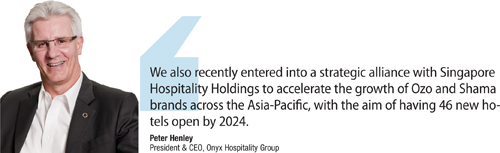
We also recently entered into a strategic alliance with Singapore Hospitality Holdings to accelerate the growth of Ozo and Shama brands across the Asia-Pacific, with the aim of having 46 new hotels open by 2024.

Singapore Hospitality Holdings is helmed by hospitality entrepreneur Laith Pharaon, and the group’s hospitality investments include Amari Havodda Maldives (managed by Onyx), several projects with Soho House, and past experience with Six Senses, Hyatt and Four Seasons branded projects.
oct14_quote-peterhenley

Marc Hediger
CEO, Lanson Place Hospitality Management

Lanson Place has specifically introduced a third business model called Lanson Place Serviced Suites to address the changing trends and needs of professionals, millennials as well as the younger families who are relocating within Asia-Pacific.

This lean, efficient and contemporary serviced apartment style not only provides a higher return in investment for developers but most importantly offers residents a niche lifestyle, no matter the location or purpose of their tenancy.

Smaller units are creatively designed with unique combined open living and working spaces, co-sharing public areas are the extension of their homes offering seamless connectivity throughout the entire development, ‘grab n go’ F&B concepts and resident activities will promote well-being but also offer more energising activities.

A majority of Lanson Place’s pipeline deals are for the Serviced Suites model, and the group will continue to keep abreast of introducing new technical design requirements to adapt to both the millennials and existing customer base.

Lanson Place Hospitality Management will continue to expand its portfolio predominately though strategic management contracts in key gateway cities across Asia-Pacific for all three core business models (boutique hotels, serviced suites and serviced residences).

The group is very much open to form a joint venture or an alliance with reputable partners in specific markets. A proportion of our properties already form varying owning structures and this has proved well for the brand with addition to developing future long term relationships in different countries.

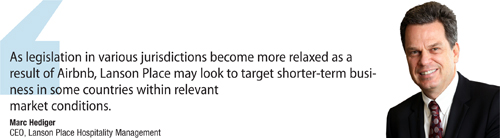
Businesses such as Airbnb allows us to constantly review our distribution channels (where potentially, units may be offered through this source). And as legislation in various jurisdictions become more relaxed as a result of Airbnb, Lanson Place may look to target shorter-term business in some countries within relevant market conditions, ensuring it would not affect our strength of achieving longer length of stay and engagement with our residents homes.
oct14_quote-marchediger

This article was first published in TTG Asia October 2016 issue. To read more, please view our digital edition or click here to subscribe.

Additional reporting by Xinyi Liang-Pholsena

Trade mourns with Thailand over King Bhumibol’s death

0

thailand-king-bhumibol-adulyadej-passing
An old woman looking at an image of Thailand’s King Bhumibol Adulyadej at Waroros Market in Chiang Mai on October 1, 2016

Thailand’s King Bhumibol Adulyadej, the world’s longest-reigning monarch, died on Thursday in Bangkok at the age of 88, after more than 70 years on the throne.

The Royal Palace stated that he passed away peacefully at Siriraj Hospital at 15.52 local time.

King Bhumibol, deeply loved by the Thais, was a unifying figure and symbol of nationhood since he ascended the throne in 1946. The nation now mourns his passing.

Here are the immediate reactions of travel industry leaders when TTG Asia asked how they felt about the King’s death and their hopes for tourism’s future.

Ittirit Kinglake, president, Tourism Council of Thailand
“All Thai people are in their deepest sorrow. Many might not expect this would happen. His Majesty had worked hard and has been a great role model. Under current circumstances, I seek cooperation from all parties to allow us time to pass through this sorrowful moment.

“The tourism sector will try to promote community tours to distribute income to local people in accordance with His Majesty’s wish to see Thai people love and help one another. The tourism council is also ready to fully cooperate with the government and take actions accordingly. The council is prepared to receive foreign delegates who will attend royal funeral rites as well. Details will be discussed further.”

Supawan Tanomkieatipume, president, Thai Hotels Association, Thailand
“I believe all Thai people are sharing the greatest sorrow for the loss of our King. For the time being, we would like everyone to behave properly in terms of dressing and activities. The association is ready to fully cooperate with the government. We have informed members that decisions on the organisation of events will depend on those who ordered them. If they like to postpone them, the hotel management will facilitate.

“For the New Year, I believe that most hotels have no plans for the celebration and foreign clients understand the present circumstance because the demise of His Majesty the King has been reported. The mourning is likely to continue for at least three months.”

Pornthip Hirunkate, managing director, Destination Asia, Thailand
“Thailand is crying. Although we are mourning his passing with unspeakable grief, His Majesty is now resting in peace. He devoted his entire life for the sake of the Thai people. Even though he’s a monarch, he was such a simple and down-to-earth man, and a great role model for all of us. He kept Thailand independent as we are today. We all love and respect him as a father of the nation.”

Luzi Matzig, chairman, Asian Trails, Thailand
“We all knew that King Bhumibol was in poor health for quite some time, but it nevertheless came as a great shock to all of us when the official announcement of his passing was made. Half of our staff in the office were crying so the shock to all Thais is really major and will affect outbound travel from Thailand for at least a year. As far as inbound tourism is concerned I do not see any big change. I personally feel very sorry that we lost a great King who did a lot for the good of our country. May he rest in peace.”

Soontarut Wattanahongsiri, general manager, Abercrombie & Kent Thailand
“As you can expect, there’s a melancholic mood at our office this morning. Yet despite the understandable sadness, our staff is still buoyed by the feeling of pride as well as sorrow, as countless well-wishing messages have arrived from contacts around the world paying their respects.

“The numerous messages of sympathy console us with the fact that our beloved King was not only revered by Thai people, he was deeply respected across the world. His leadership will be greatly missed. He was a father to all Thai people; a true People’s King. Despite his passing, we’re sure he will continue to inspire our nation for countless generations who will look back on his life and tireless contributions with awe and great respect.”

Bill Heinecke, chairman & CEO, The Minor Group, Thailand
“King Bhumibol was the greatest source of strength and inspiration to all Thais, to countless others around the world and to me and my family personally. His Majesty led by unparalleled example, vision and sacrifice to work for the prosperity of the nation and all Thai people. His humanity and gentle wisdom has touched us all in a way that we cannot express in words and will continue to inspire for many generations to come.

“At this sad time, it is important that we pull together to support each other and act for the greater good of the country. One of the King’s enduring aspirations is the sustainable development of Thailand and Thai people. I am proud of Minor for the part that we play in this and have no doubt that we will all continue to work closely together to honour the legacy and memory of King Bhumibol. In the meantime, and until further notice, Minor’s business will operate as usual.”

Mario Hardy, CEO, PATA, Thailand
“Today is a sad day for Thailand. His Majesty was a kind man with a great heart who loved his people and this was felt by all Thai people and those of us who are guests in this land of smiles. He was the light for us all and he will be greatly missed. Today I only want to offer my sincere condolences to the royal family and the people of Thailand.”

Ho Kwon Ping, executive chairman, Banyan Tree Holdings, Singapore
“I’m in Bangkok and I see how it affects all my colleagues so deeply; all Thais have a deep respect, reverence, and genuine affection for a King who was a father figure for as long as anyone can remember. His passing is of course deeply mourned, and there will certainly be a lot of uncertainties ahead without the King’s silent but steadying influence.

“But Thailand has been a united, independent nation for centuries, longer than any other ASEAN country, so the Thai people will simply go through the transition in their own way and start a new era. Tourism has gone through so many upheavals in Thailand in the past decade and always recovered quickly, so I don’t see any reasons why it should not continue to grow.”

Hamish Keith, group managing director, Exo Travel, Thailand
“Everyone at EXO Travel are extremely saddened by the passing of our beloved King. His Majesty has been the guiding light for everyone in Thailand and the driving force behind everything that is good in Thailand including our tourism industry.

“He was a great leader and for those of us who have been fortunate enough to live in Thailand during his reign have had the privileged opportunity to learn from his teachings and actions. The King of Thailand was the father of the nation and a shining example for everyone to follow and the greatest respect we can pay our King is to honour his legacy and do the best we can to follow his example as a leader. All of us at EXO share in the grief of the Thai nation and offer our deepest condolences to everyone in Thailand.”

Darren Ng, managing director, TTG Asia Media, Singapore
“My deepest condolences to our Thai partners and people of Thailand for the loss of their beloved King. His Majesty’s influence and aspirations for the country has a large part to play in the way the rest of the world has come to know and love of modern Thailand. I believe that his legacy will live on and that the Thai spirit of resilience, sincerity and hospitality will be testimony of this. Thailand, please know that your loss is felt beyond your borders, and that my colleagues and I across Singapore, Hong Kong and the rest of Asia-Pacific mourn along with you.”

Michael Chow, group publisher, TTG Travel Trade Publishing, Singapore
“His Majesty King Bhumibol Adulyadej will be remembered as a wise monarch and unifying figure who devoted his life to bettering the lives of his people. On behalf of TTG Asia Media and my TTG Travel Trade Publishing team across the region, I extend my deepest condolences to our Thai partners and the people of Thailand for their loss.”

An official one year period of mourning will come into effect from October 14. Visitors travelling to Thailand should exercise sensitivity and respect the loss of the Thai people. Across Thailand, entertainment venues, hotels and restaurants will remain open during the period of mourning but will be subdued. All planned festivities in Thailand will be cancelled over the next 30 days. The Royal Grand Palace in Bangkok will be temporarily closed for seven days.

New hotel openings: October 10 to 14, 2016

0

The latest hotel openings and announcements made this week

hanoi_novotel_suites

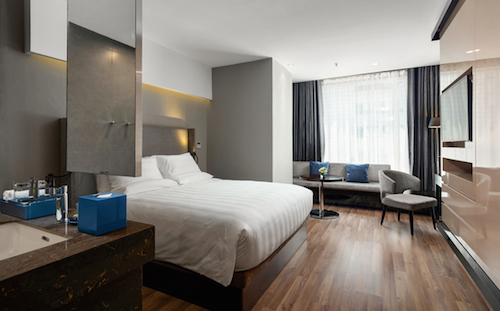
Novotel Suites Hanoi
AccorHotels has opened its first Novotel Suites in Asia-Pacific in Hanoi’s Cầu Giấy District. The debut property offers 87 studios and 64 one-, two- and three-bedroom apartments, ranging in size from 48m² to 104m². All suites come with fully-equipped kitchenettes, walk-in closets and a separate living room with an internet television. Facilities include all-day dining restaurant Food Exchange, a rooftop bar terrace, fitness centre, heated outdoor pool, kids’ playground and three meeting rooms.

north_hill_city_resort_chiang_mai

North Hill City Resort
Offering 42 rooms near Chiang Mai with views of Wat Phra That Doi Suthep temple is the boutique five-star North Hill City Resort. Rooms boast complimentary high speed Wi-Fi, a flatscreen TV, 500-threadcount linens, and large soaking tubs in the bathroom. Facilities include a fitness centre, an Italian-Thai restaurant, swimming pool, pool bar and an outdoor amphitheatre. For golfing enthusiasts, the new 18-hole North Hill Golf Course is located next door. The resort is currently offering 30 per cent off all room types until November 31. Prices start from 5,950 baht (US$169) for a deluxe room.

cosmo_hotel_kl-1

Cosmo Hotel Kuala Lumpur
Situated in Leboh Ampang, close to the Masjid Jamek Interchange Station and two stops away from KL Sentral is the 347-room Cosmo Hotel Kuala Lumpur, offering both guestrooms and family-style suites. There is an all-day dining restaurant and lobby lounge and several meeting spaces that can hold 110 pax theatre-style or 80 people banquet-style. Opening on December 1, the hotel’s introductory room rate starts at RM128 (US$30) per night in a standard non-window room.

hakone_kowaki-en_tenyu

Hakone Kowaki-en Tenyu
All 150 rooms at this upscale Japanese hot spring resort – located at the centre of Hakone’s Fuji-Hakone-Izu National Park – feature a private open-air hot spring bath. Resort facilities include a spa, more hot spring baths, a restaurant and a bar, while the resort complex has other dining and leisure facilities such as a soba noodle restaurant, Japanese steakhouse and Horaien Park, a botanical garden. The property, approximately a two-hour drive from Tokyo, is currently accepting reservations for April 2017 and beyond. Prices start at 33,000 yen (US$318) per guest, based on two guests, and includes breakfast and dinner.

lux_south_ari_atoll

LUX South Ari Atoll
LUX Resorts & Hotels has recently opened its latest five-star outpost on the island of Dhidhoofinolhu, Maldives. Perched on stilts above a lagoon are 193 pavilions and villas – of which 46 are Romantic Pool Villas with private 7m-long infinity pools, and three are adults-only Temptation Pool Water Villas with 14m-long pools. Facilities on the island include the Lux Me spa, a zen wellness pavilion, dive centre, eight restaurants, five bars and an outdoor cinema. The resort will also host workshops with leading practitioners throughout the year such as painting lessons with Jeannine Platz, and photography tutorials with travel shutterbug Michael Freeman.

Photo of the Day: Genting Dream ready for Guangzhou homeport

0

genting_dream_handover_signing_ceremony
Tan Sri Lim Kok Thay (left), chairman and CEO, Genting Hong Kong, and Bernard Meyer, managing partner of Meyer Werft, at the Genting Dream Handover Signing Ceremony

On Wednesday, Genting Hong Kong commemorated the official handover of Genting Dream, the first ship in its Dream Cruises fleet, from shipbuilder Meyer Werft. The cruise ship will voyage from the shipyard in Germany to her first homeport in Guangzhou (Nansha), with visits to India, Singapore, Vietnam and Hong Kong along the way.

Genting Dream will make her official debut on November 13 from Guangzhou and launch Vietnam and China itineraries as well as a weekend sails to Hong Kong.

Election-wary US millennials turn to travel for escape

0

donald-trump

New research from youth adventure tour operator Geckos Adventures Australia found a majority of American millennials are ready to bring forward plans for travel to escape this year’s election politics.

Four in 10 of 2,000 American millennials (18-30) surveyed in September said they would do a ‘Trump Jump’ if Donald Trump gets elected, while three in 10 plan a ‘Hillary Hop’ if Hillary Clinton becomes the next POTUS (president of the United States).

A ‘Trump Jump’ and ‘Hillary Hop’ were defined as “time abroad, travelling, taking a gap year or going overseas”.

Key findings of the survey include:

  • Nearly 58% agreed that they need at least a holiday or vacation to forget about the politics going on at the current moment
  • 63% of millennials surveyed believe Americans are more open to living abroad and travelling because of the current political situation
  • More than eight in 10 are utterly dismayed or frustrated with their choices for this year’s presidential elections, while just one in 10 expressed excitement and optimism about the election
  • 61% are worried about the election
  • 70% are planning to vote (13% are not, 17% are unsure)

One in three have become so dismayed with the political options on either side they are looking into moving abroad permanently.

Top regions cited for their re-ignited travel plans include Canada (47%), Europe (37%), Australia (15%), Asia (12%) and Mexico (12%).

The company said it commissioned the survey not only to learn more about millennials and their travel habits, but their desires and motivations – why they travel and where they want to go. The findings confirmed its “suspicions about an increased desire of American millennials to travel as the US election continues to be in the global spotlight”, said a spokesperson.

It also wanted to get American millennials excited about the prospect of travel and show the doors that travel can open up for this age group especially, she added.

Geckos, part of Intrepid Group, last month had repositioned itself as a tour company focusing on the under 30 crowd. In 2017, all of its trips will open only to travellers aged 18 to 29, down from a previous age cap of 39.

Along with the change, it introduced 20 new trips in 2017 that will cater to youths who are seeking grassroots cultural experiences and adventure. These include treks to Everest Base Camp and tours throughout North America, the Middle East, Asia and Africa.

Intrepid Group’s managing director James Thornton, 35, said: “This move is not about big bus tours and party trips in Europe; it’s about transforming Geckos into a brand that provides the next generation of travellers with a responsible small group alternative.

“While there are other travel brands with age limits, there is nobody offering a dedicated youth product to travellers who want an authentic experience that gives back to the places they visit and people they meet.”

According to the World Tourism Organization (UNWTO), youth travel is one of the fastest growing sectors in tourism, representing 23 per cent of more than one billion international tourists each year.

Millennials, along with Gen Z, who will soon age into the Geckos target market, are known for their socially-conscious, authentic and pragmatic approach to travel, giving experiences higher importance than material goods, said the company.

Agencies offering poor service unlikely to survive: ETOA

0

New competitors and disruptive technologies are more than happy to steal customers away from travel agents that fail to meet the needs of their clients, said industry experts at a summit organised by the European Tour Operators Association (ETOA) earlier this week.

Travel businesses that fail to listen to its customers or that deliver sub-standard services are liable to be taken out rapidly by a new company or piece of technology.

Besides traditional competitors, ETOA warned especially of Google, who “is progressively developing new technologies to give the consumer a better travel experience, with ever more relevant information and ultimately a path to making a booking via a partner company, from Expedia to Lufthansa”.

Itinerary planner Google Trips was launched just last month; Google Flight offers the same service travel metasearch engines do; and the Google Now app is able to offer users answers to questions that are immediately relevant to them. All these combine into a suite of services capable of challenging the traditional agent’s role.

ETOA pointed out that Philip Ries, Google’s industry leader for travel, said that Google would continually look to find travel experiences that it considered to be ‘broken’ and to offer the consumer a better solution.

In his view, the first place for this to happen is on a mobile device, as search and bookings are now more prevalent on mobile devices than they are on desktop devices. Mobile also offers the prospect of superior integration with payment solution services. He considers payment of hotel services currently ‘broken’ because it involves too much waiting time.

Andrew Aley, regional director of Viator, said that there is a huge opportunity in the tours and activities segment on mobile. It is valued at over US$70 billion; it is extremely fragmented and less than 10 per cent market share is online.

He believes the key to disrupting it will be to provide last-minute booking on a mobile device in order to cater to the growing number of mobile users who book at increasingly shorter lead times.

Concluded ETOA CEO Tom Jenkins: “We have no choice but to embrace innovation and market disruption. The travel industry will thrive when new, better services replace those that have passed their sell-by date and such progress is to be encouraged.”

Visitation to Tokyo Disneyland on the decline

0

tokyo-disneyland-daytime-paradeTokyo Disneyland’s daytime parade

Japan’s two largest theme parks, Universal Studios Japan and Tokyo Disneyland, have reported sharply differing visitor figures over the summer months with one seeing a sharp rise in visitorship while the other has seen numbers dwindle.

Universal Studios Japan, in Osaka, saw more than seven million visitors in the April-September period, up 500,000 from the same period last year and setting a new record for the second consecutive year.

Visitor numbers were boosted by a number of events to mark the theme park’s 15th anniversary, as well as the opening in March of the Flying Dinosaur, a new rollercoaster.

In contrast, visitors to Disneyland and DisneySea in Tokyo fell a combined 43,000 over a six-month period, according to owners Oriental Land Co.

The figure was the fourth-highest in the park’s history, but it was also the third consecutive first-half decline. And even a number of special events, including DisneySea’s 15th anniversary celebrations, were not enough of a lure.

Data suggests that the decline have been among domestic travellers.

“While these special event and shows were well received, the high number of rainy days and extreme weather conditions during this period were factors that resulted in the total combined attendance,” Oriental Land said in a statement.

In April, the company raised the admission fees for the parks, with an adult’s one-day ticket hiked from Y6,900 (US$66.50) to Y7,400.

“We do not believe the rate revision of tickets has had any influence on attendance,” a company spokesman told TTG Asia.

Oriental Land says it plans to introduce new attractions in the coming months to win back customers, including the Woodchuck Greeting Trail in November and Frozen Forever starting January 13.

Tui UK adds Vietnam in longhaul boost

0

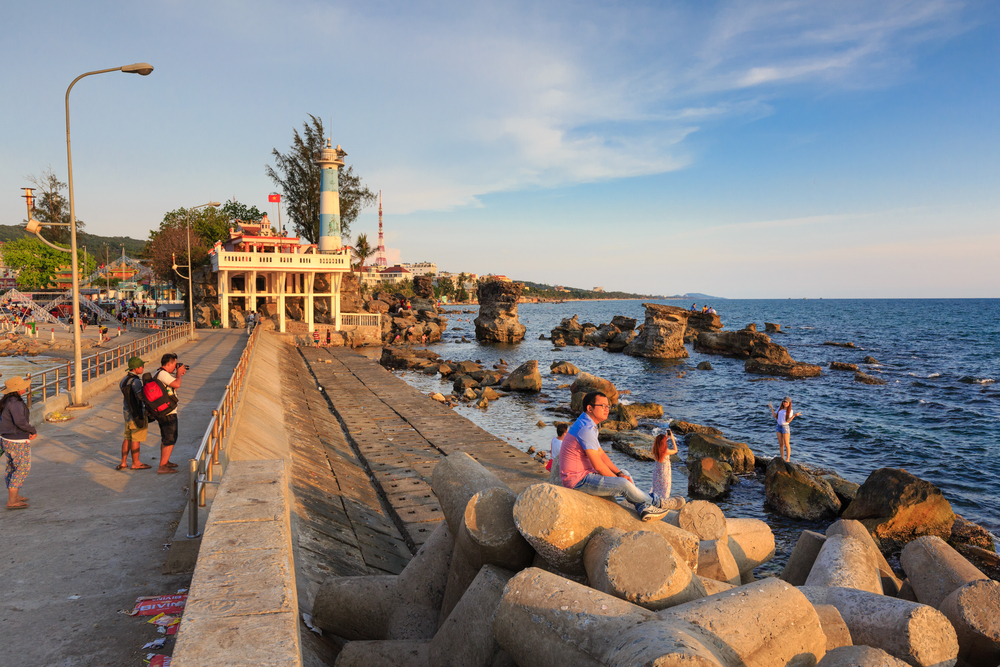
phu-quoc-vietnamPhu Quoc, Vietnam

Tui UK & Ireland has announced it will launch packages to Vietnam as part of its winter 2017-18 programme as well as an online itinerary planner for its upcoming range of longhaul multi-centre holidays.

The operator’s Thomson and First Choice brands will both offer 14-night all-inclusive stays to the country’s largest island, Phu Quoc, using the first direct flights to the destination from Gatwick Airport on its 787 Dreamliner aircraft.

Tui said it would further grow its longhaul product by offering its summer Caribbean destinations of St Lucia and Cayo Santa Maria in Cuba to its winter programme.

A new range of longhaul city breaks are also due to be introduced to the 2017-18 winter programme with destinations such as Las Vegas, New York, Miami, Bangkok, Hong Kong, Singapore and Kuala Lumpur bookable.

Read the rest of the article here.

By Tom Parry

Macau to host PATA Travel Mart 2017

0

macau

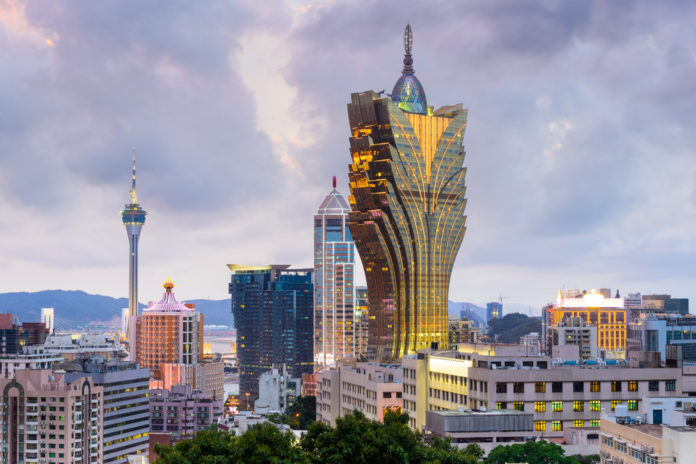
PATA Travel Mart 2017 (PTM 2017) will be held in Macau from September 13-15, 2017.

Hosted by the Macao Government Tourism Office (MGTO), next year’s event will mark the annual travel trade show’s 40th edition and the second time it is to be held in Macau.

“It is an exciting prospect to be returning to Macau for the 40th anniversary of PATA Travel Mart, having previously held a successful Mart there in 2010,” said PATA CEO Mario Hardy.

“MGTO has been a valuable member of PATA since 1958 and has sponsored the PATA Gold Awards for the past 21 years. Next year’s PTM provides us with the perfect opportunity to showcase that amazing relationship and highlight one of the most unique destinations in the Asia-Pacific region.”

Macau has undergone a transformation in recent years with the opening of more family-friendly attractions and hotels there while emphasising less on gaming, as had been the focus in the past.

Earlier this year, the Wynn Palace and the Parisian Macao opened. While still offering casino gaming facilities, more activities are being provided that caters to a broader range of leisure travellers, such as the Parisian Macao’s replica Eiffel Tower offering panoramic observation decks and Studio City Macau’s Batman Dark Flight 4D flight simulation ride.

“PATA Travel Mart mobilises a relevant contingent of travel trade stakeholders from the Asia-Pacific region and around the world and we are enthusiastic with the perspective of providing a first-hand update about the significant developments in our city since we last met in Macao for the PATA Travel Mart 2010 and in 2005 for the PATA Annual Conference,” said MGTO director Maria Helena de Senna Fernandes.

PTM 2016, held in BSD-Serpong, Indonesia attracted 1,358 delegates from 63 destinations, facilitating over 10,000 pre-matched appointments, face-to-face meetings, educational forums and networking functions.

Removal of minimum room rates in Colombo delayed

0

colombo-hotels

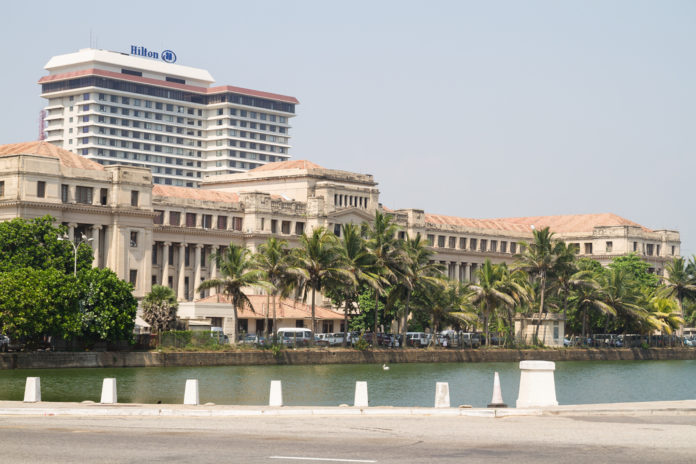
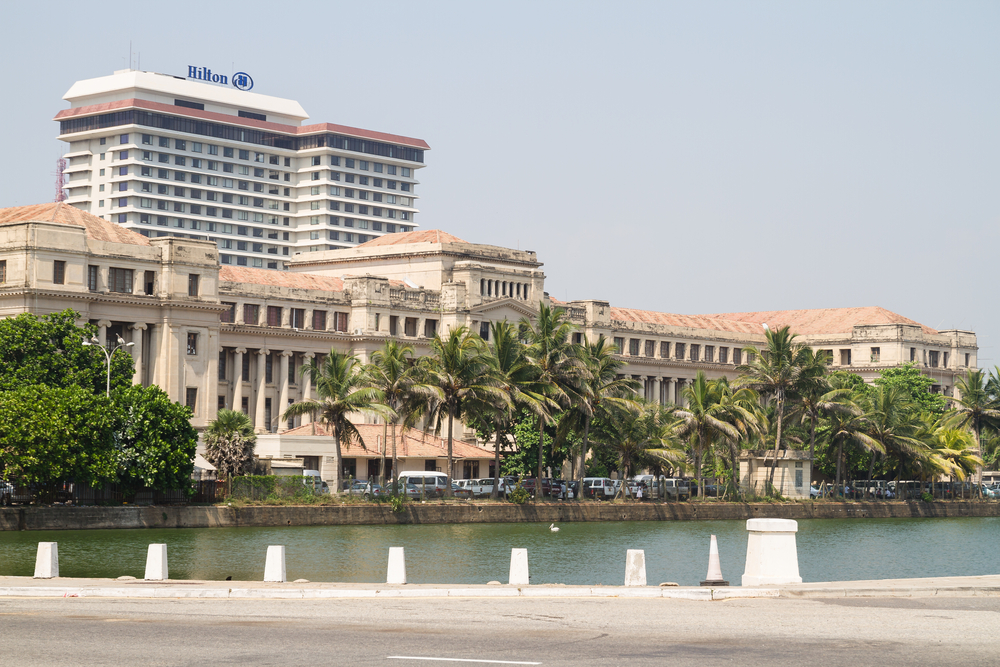
Sri Lanka is deferring a proposal to terminate the controversial minimum hotel room rates policy in Colombo, which was enforced some years ago to deter undercutting.

Earlier in July, Tourism minister John Amaratunga announced that the policy will be abolished by March 31, 2017. But earlier this week, he said that there has been a rethinking and that it may now only happen in two years’ time.

Hotels in Colombo have expressed mixed feelings over the development.

On Wednesday, president of Colombo City Hotels Association M. Shanthikumar told TTG Asia that most hotels in the capital were opposed to the removal. “We wrote to the minister urging him to keep the rates at least for another two years before making a call.”

Other hoteliers said any change in the minimum rate structure would severely impact the service charges for staff.

According to current rules, five-star hotels have to charge at minimum US$125 per night plus taxes, which works out to be US$185, while three-star rates have to be at minimum US$80 per night inclusive of taxes.

“If there is free pricing, small and medium scale hotels will suffer badly as five-star properties will start charging the same rates,” said a senior manager at a smaller hotel in Colombo, who declined to be named.

The scheme was first brought into force after the May 2009 end of the civil war, after smaller hotels complained of excessive price cuts by larger properties.