TTG Asia
Asia/Singapore Thursday, 2nd April 2026
Page 1316

PAL’s new Delhi-Manila service the ‘missing link’ to spur Indian arrivals

0

Philippine Airlines’ (PAL) return to India with four-times-weekly flights between Manila and Delhi starting April could be the “missing link” to stimulate arrivals from this growing source market.

The Philippine national carrier stopped flying Manila-Delhi with costly stopovers in Bangkok five years ago, and since then travel agents in both India and the Philippines have appealed repeatedly with airlines, including Cebu Pacific and AirAsia Philippines, to resume the connection.

Philippine trade players have for years been appealing to airlines to launch direct flights from India

Boris Travel and Tours general manager Irene Maliwanag hence viewed PAL’s Manila-Delhi service as a big win for the travel trade which consistently clamoured to restore the links between the two countries.

She expected PAL’s nonstop service to boost inbound further as current flight options linking both countries entail stopovers, including Cathay Pacific via Hong Kong preferred by her budget-conscious clients and the more expensive Singapore Airlines via the Lion City.

Welcoming the new direct flight, Simon Ang, managing director – operations at Celebrate Life TLC, pointed out that India has already surpassed Germany as the Philippines’ 12th biggest market. In January-October 2018, Indian arrivals grew 14.4 per cent year-on-year to 101,622.

PAL president and COO Jaime Bautista added that returning to India, and launching new routes to Hanoi and Phnom Penh, is meant to carry travellers to these countries from the US and Canada where it has 43 weekly flights to six destinations.

“We will leverage Manila’s geographical location as an ideal stopover point for people flying to South-east and South Asia from the East and West Coasts of North America,” Bautista explained.

But while the Delhi flight is expected to boost travel to the Philippines, PAL’s four-times weekly Manila-Hanoi flights starting March 31 and five-times weekly Manila-Phnom Penh flights beginning April are more likely to benefit outbound travel to these two new destinations.

Ang explained that Vietnam and Cambodia don’t have a huge travelling population but will have “surefire” benefits for Philippine outbound travel. In January-October 2018, inbound from Cambodia dropped 7.6 per cent to 3,470 while those from Vietnam fared a lot better with a 32.6 per cent growth to 44,143.

Agreeing, Great Sights Travel and Tours managing director Paul So said that the Philippines is also challenged in getting tour guides that speak Cambodian and Vietnamese to serve both feeder markets.

So underscored the need to make easier the visa requirements for Indians – a frequent request of travellers and travel agencies alike – and address the scarcity of three- and four-star accommodations for these travellers.

PAL’s new Delhi-Manila service the ‘missing link’ to spur Indian arrivals

0
Philippines' outbound prospects are suffering from a weak peso, rising fares, and inflation

Philippine Airlines’ (PAL) return to India with four-times-weekly flights between Manila and Delhi starting April could be the “missing link” to stimulate arrivals from this growing source market.

The Philippine national carrier stopped flying Manila-Delhi with costly stopovers in Bangkok five years ago, and since then travel agents in both India and the Philippines have appealed repeatedly with airlines, including Cebu Pacific and AirAsia Philippines, to resume the connection.

Philippine trade players have for years been appealing to airlines to launch direct flights from India

Boris Travel and Tours general manager Irene Maliwanag hence viewed PAL’s Manila-Delhi service as a big win for the travel trade which consistently clamoured to restore the links between the two countries.

She expected PAL’s nonstop service to boost inbound further as current flight options linking both countries entail stopovers, including Cathay Pacific via Hong Kong preferred by her budget-conscious clients and the more expensive Singapore Airlines via the Lion City.

Welcoming the new direct flight, Simon Ang, managing director – operations at Celebrate Life TLC, pointed out that India has already surpassed Germany as the Philippines’ 12th biggest market. In January-October 2018, Indian arrivals grew 14.4 per cent year-on-year to 101,622.

PAL president and COO Jaime Bautista added that returning to India, and launching new routes to Hanoi and Phnom Penh, is meant to carry travellers to these countries from the US and Canada where it has 43 weekly flights to six destinations.

“We will leverage Manila’s geographical location as an ideal stopover point for people flying to South-east and South Asia from the East and West Coasts of North America,” Bautista explained.

But while the Delhi flight is expected to boost travel to the Philippines, PAL’s four-times weekly Manila-Hanoi flights starting March 31 and five-times weekly Manila-Phnom Penh flights beginning April are more likely to benefit outbound travel to these two new destinations.

Ang explained that Vietnam and Cambodia don’t have a huge travelling population but will have “surefire” benefits for Philippine outbound travel. In January-October 2018, inbound from Cambodia dropped 7.6 per cent to 3,470 while those from Vietnam fared a lot better with a 32.6 per cent growth to 44,143.

Agreeing, Great Sights Travel and Tours managing director Paul So said that the Philippines is also challenged in getting tour guides that speak Cambodian and Vietnamese to serve both feeder markets.

So underscored the need to make easier the visa requirements for Indians – a frequent request of travellers and travel agencies alike – and address the scarcity of three- and four-star accommodations for these travellers.
World’s first Monopoly-themed attraction to open in Hong Kong’s Peak

0

The world’s first Monopoly Dreams themed attraction is set to open in Hong Kong come 3Q2019.

Opening at The Peak, the “king of property” in the Hong Kong edition of the popular board game, Monopoly Dreams will sprawl over 1,858m2 of indoor and outdoor space, and feature augmented reality, hologram and 4D interactive game technology.

This will be the world’s first Monopoly-themed attraction

Interactive attractions will be based on iconic Monopoly elements including the Bank, Water Supply, Jail, Title Deed cards, Chance cards and Community Chest cards.

“Our partnership with Monopoly Dreams allows Hasbro to further extend the reach of Monopoly to location-based entertainment sector and provide families and tourists with highly immersive entertainment experiences,” said Casey Collins, general manager and senior vice president, entertainment & licensing of Hasbro.

Gary Chan, COO of Monopoly Dreams, said that the company is targeting for the attraction to accommodate over 700,000 visitors.

Oceania Cruises orders two 1,200-pax ships for new Allura class

0
The new ships will have a similar capacity as the 1,250-guest Riviera

Oceania Cruises, the upper-premium subsidiary of Norwegian Cruise Line Holdings, has ordered two ships under its new Allura-Class, scheduled to be delivered in 2022 and 2025 respectively.

The contract price for each of the two vessels is approximately 575 million euros (US$664 million) per ship.

The new ships will have a similar capacity as the 1,250-guest Riviera

The two 67,000 gross ton ships will each accommodate about 1,200 guests. This new class of mid-size cruise vessels will retain the design elements and signature amenities of Oceania’s Marina and Riviera ships, while affording guests an additional level of comfort, convenience and luxury amenities, the cruise line said in a statement.

The expansion of Oceania Cruises’ fleet is expected to” meet the strong demand for upscale culinary- and destination-focused cruise vacations around the globe”, said Frank Del Rio, president and CEO of Norwegian Cruise Line Holdings.

Oceania Cruises currently has six ships, which carry 684 or 1,250 guests and call at more than 450 ports across Europe, Alaska, Asia, Africa, Australia, New Zealand, New England-Canada, Bermuda, the Caribbean, Panama Canal, Tahiti and the South Pacific.

APAC leads growth as global air travel rises 5.9% in 2018

0
Overall, global air travel grew by a very healthy 5.9% in 2018

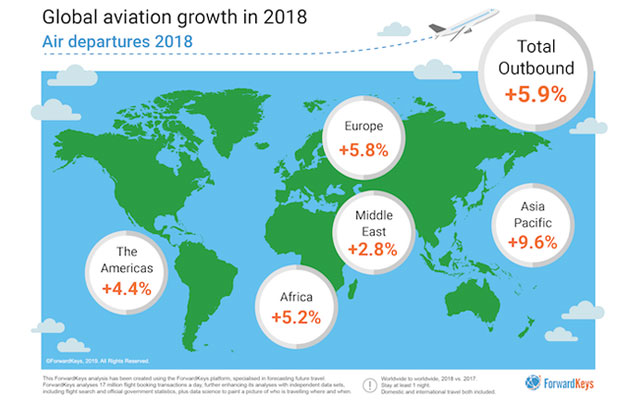
Global air travel grew by 5.9% in 2018, with Asia-Pacific seeing the strongest increase, according to data published by ForwardKeys.

While air travel grew in nearly every part of the world, there were substantial regional variations. Growth in Asia-Pacific, at 9.6%, was more than three times stronger than the weakest performer, the Middle East, where flight departures grew by 2.8%.

Overall, global air travel grew by a very healthy 5.9% in 2018

The second-best performing region was Europe, where air travel grew by 5.8%. Flight departures from Africa grew by 5.2% and from the Americas by 4.4%.

The growth in Asia-Pacific was driven primarily by increasing travel within the region. Domestic travel was up 14% and departures between Asia-Pacific countries were up 9.6%; whereas intercontinental departures were up 4.5%.

Olivier Ponti, ForwardKeys, vice president insights, said: “The growth in international air traffic within Asia-Pacific is a direct consequence of increasing disposable incomes, urbanisation and more dynamic lifestyles. As the middle classes of large urban centres – especially in China – have more money in their pockets and a growing appetite for travel, they fly more often, initially within their own continent, and then further afield. They have become a major driver of leisure and business travel worldwide.”

European air travel grew at virtually the same rate as the global average, but international travel within Europe, which was up 7%, grew faster than trips to other regions of the world, which was up 2.8% – a sign of the good shape of the European economy. The Middle East registered the highest growth of intercontinental departures from Europe, at 5.8%, helped by the easing of security concerns regarding Egypt.

ForwardKeys’ summary of aviation growth in 2018

By contrast, the trend in the Americas was in the opposite direction. There, the growth in travel to other continents, at 7.1%, outstripped the growth in domestic air travel, which grew by 4.0%, and the growth in travel between countries, which grew by 3.2%. Assisted by several new routes such as New York to Nairobi, Africa was the fastest-growing destination for travellers departing from the Americas, up 8.5%.

In Africa, growth in domestic air travel was negative, down by 0.9%, but growth in international air travel to other African countries was strong, up 6.6%, and growth in travel to other continents, where Africa’s main trading partners are located, was stronger still, up 7.8%. Highlights included departures from Africa to Europe (+9.3%), Asia-Pacific (+7.7%), and the Middle East (+6.9%).

Despite the ongoing blockade of Qatar, which started in June 2017 and continues to hamper regional international travel, the Middle East registered a 2.8% increase in air traffic. The decline of intra-regional travel was compensated by double-digit growth in domestic travel, up 10.9%, and a 2.5% increase in departures to other regions, with Europe benefitting the most from this trend, up 8.3%.

New hotels: La Seine Hotel by Burasari, Fairfield by Marriott Hotel Busan and more

0

La Seine Hotel by Burasari, Laos
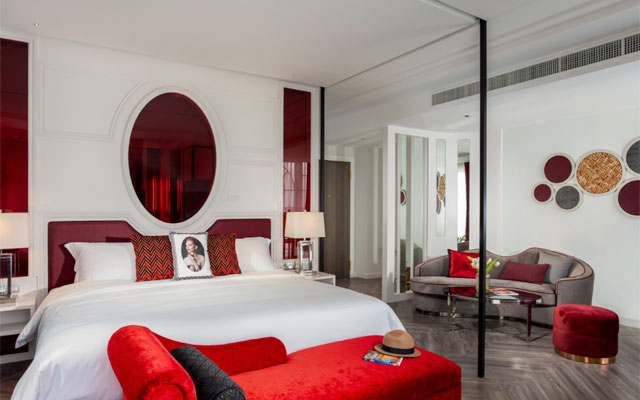
The five-star property has opened on the river promenade in Vientiane, Laos’ capital city. The boutique hotel offers 37 rooms and suites, and boasts bold colour palettes and Art Deco-inspired interiors. All rooms come with bath amenities and an in-room espresso machine. The hotel has two F&B options, a rooftop bar and The Red Rose Restaurant, and offers a happy hour special on selected wines.

Fairfield by Marriott Hotel Busan, South Korea
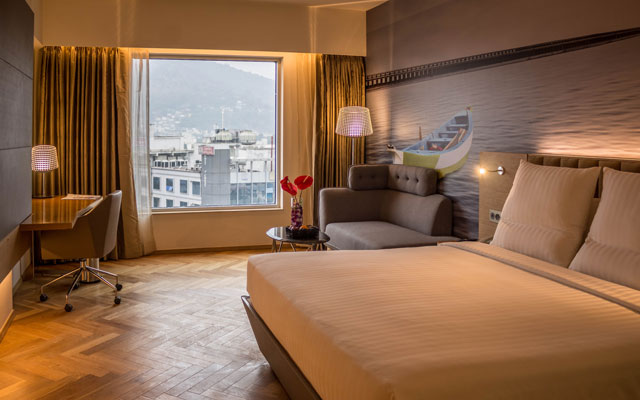
Marriott has opened a 225-room Fairfield by Marriott-branded property in Haeundae, a beach resort destination in eastern Busan. There are 224 guestrooms, one of which is a 45m2 family room that includes a separate living room. All guestrooms are furnished with 49-inch flatscreen TVs, ergonomic desks and chairs, minibars and safety deposit boxes. Facilities include a restaurant, fitness centre, and for business travellers, workspaces in the lobby, as well as a meeting room that can hold up to 30 people.

Novotel Vijayawada Varun, India
AccorHotels is the first international hotel brand to set up shop in Vijayawada, Andhra Pradesh’s commercial centre. The property has 194 rooms, 25 apartments and 12 suites, alongside recreational facilities such as a rooftop swimming pool, fitness centre, jogging track and a spa. There are also four dining options on-site ranging from the all-day dining restaurant to the Chinese kitchen, as well as a 930m2 banquet hall.

Hyatt Regency Bali, Indonesia
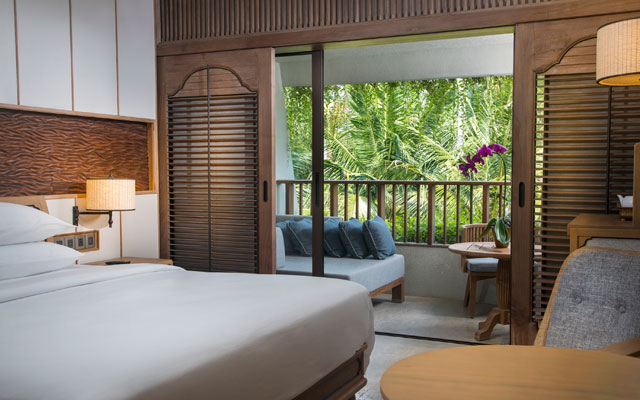
Previously known as the Bali Hyatt, the nine-hectare property has opened after five years of extensive renovations. It now features 363 keys, which includes 39 one-bedroom suites that come with a private balcony, separate living room, and an additional powder room with a shower. Guests who book suites are also offered access to the Regency Club Lounge.

Amenities on-site include three F&B venues, three swimming pools, a 24-hour fitness centre, and the Shankha Spa complete with 10 spa suites. Meanwhile, the hotel’s meeting facilities comprise a 468m2 ballroom that can accommodate up to 600 guests cocktail-style, an outdoor courtyard that can hold up to 120 attendees, and four multifunctional meeting spaces ranging from 92m2 to 324m2 in size.

DoubleTree by Hilton Shanghai Nanxiang, China
A 313-key DoubleTree by Hilton has risen in the up-and-coming CBD in Shanghai Jiading, the only international hotel in the town of Nanxiang. Aside from the four F&B options on-site, recreational facilities include an indoor swimming pool, sauna and steam rooms, spa and 24-hour fitness centre. Meeting planners will be able to avail the hotel’s 1,300m2 of event space across 12 function rooms, among which is a 750m2 grand ballroom which can accommodate up to 850.

Budget Car Rental returns to original GSA in Japan

0

Budget Car Rental has once again named Jeiba Corporation as its General Sales Agent (GSA) in Japan.

Jeiba was the company’s original GSA in Japan of 13 years, from 1996 to 2009.

As Budget Car Rental’s GSA, Jeiba Corporation will be responsible for delivering value through customer service, and promoting to general outbound travellers, including business customers, with the aim of being the go-to car rental company for Japanese travellers.

Mark Servodidio, president, international, Avis Budget Group, said: “Japan is an important market for Budget. We know Japanese customers enjoy self-drive road trips and authentic travel experiences, both domestically and when visiting other destinations including the US, Hawaii, Europe and closer to home in Asia.”

New GMs at Carlton hotels in Singapore, Bangkok

0
From left: Darren

The Carlton Group has appointed new general managers for its Singapore as well as upcoming Bangkok property.

From left: Darren Ware and Mark Bulmer

Darren Ware, previously general manager of Carlton City Hotel Singapore, is now heading Carlton Hotel Singapore in the same capacity.

Former general manager of Carlton Hotel Singapore, Mark Bulmer, has relocated to Thailand take up the new role of general manager at Carlton Hotel Bangkok Sukhumvit, set to open in late 2019 as the group’s first property outside of Singapore.

Agents up in arms over Garuda’s new commission model, minimum sales requirement

0
Agents will need to meet the minimum sales requirement of 50 million rupiah to receive their three per cent incentive

Garuda Indonesia’s plan to implement a new commission and incentive policy for agents starting January 21, which the airline says would “create a healthy business environment”, is met with strong pushback from travel agency and ticketing companies’ associations in the country.

The Indonesian national carrier has so far been giving agents three per cent commission on domestic ticket sales, according to Pauline Suharno, secretary general of The Indonesian Travel Agents Association (ASTINDO). With Garuda’s planned change, this commission will be replaced by an incentive, payable after the sector is flown.

Agents will need to meet the minimum sales requirement of 50 million rupiah to receive their three per cent incentive

The new policy also stipulates a minimum sales of 50 million rupiah (US$3,450) for the agent in order to receive a three per cent incentive, and none if the sales is below the amount.

In a letter the Association of the Indonesian Tours and Travel Agencies (ASITA) sent to president Joko Widodo requesting for the airline’s plans to be annulled, the move was described as “damaging (to) agencies and counter-productive to the development of tourism in the country”.

Negotiations between the associations and Garuda are ongoing. Agents are expecting a favourable outcome; otherwise, ASITA said its members were ready to stage a rally.

In a media briefing in Jakarta, Asnawi Bahar, chairman of ASITA, said: “Garuda has taken a unilateral action with (the planned policy). This will bring down the performance of travel agents, and threaten the livelihood of the small travel agencies’ businesses in the country, which comprise 70 per cent of travel companies in the country.”

ASTINDO’s Pauline added: “Let’s say if the booking is for next month, we will only receive the incentive by the end of next month. As we live out of the commission, how do we survive this month?”

Commenting on the minimum sales requirement, Pauline said: “That is too hard for small agents to achieve. We have members in the region with only five million rupiah in sales.”

She also pointed out that the new commission policy would affect agents handling government agencies. “Government agencies do not recognise service fee so if the zero commission is applied agents will not profit from selling Garuda tickets.

“Moreover, travel companies are not allowed to charge the merchant discount rate of credit card payment to customers, so the zero commission policy will cause travel companies to suffer more loss.”

In addition to the new incentives, Garuda will also introduce a top-up system whereby agents deposit a sum of money with the airline and receive up to eight per cent cash-back.

Asnawi remarked that only the bigger players are likely to benefit from this. To receive the cash-back, he said an agent needs to deposit five billion rupiah to receive a one per cent top-up incentive, and a company needs to deposit 400 billion rupiah to gain eight per cent cash-back. “How can an (average) agent afford to take part in this?”

Awan Aswinabawa, chairman of West Nusa Tenggara Chapter of ASTINDO, commented: “We are shocked to hear the news. It arrived at a time when we in Lombok are working hard to get back on our feet, still struggling to recover from the impact from the disaster last year.”

The cash-back incentive also applies to Garuda’s sister carriers Citilink and Sriwijaya Air, according to Awan, although the amounts vary. Citilink’s top-up policy, for example, stipulates a minimum of 50 million rupiah to gain one per cent cash back.

Explaining the new policy, Garuda’s vice president coordinator international sales, distribution & charter, Pikri Ilham Kurniansyah, told TTG Asia: “This is to create a new airline industry ecosystem whereby every component will get sufficient benefits to grow together. I don’t want to see agents dumping prices to get passengers but not the benefits.

“We want to encourage the agents to sell Garuda tickets in a profitable way for them. The agents will still receive the three per cent sales benefit just the same, the difference is that they have been receiving it up front, and now it will be paid at the end of the month.

“By giving the incentive after sales, we expect the agents to keep the three per cent commission on their benefit instead of throwing that to the customers by selling cheap tickets like (what we’re seeing) today.”

He added that setting the minimum sales at 50 million rupiah was reasonable.

“When you look at our prices, the amount will translate to only about 20 tickets, that’s very small for a month’s sales. Out of this amount, agents only receive 1.5 million rupiah… I believe a Garuda agent sells more than that and I want them to sell and prosper from Garuda more for their livelihood.”

Still, Pikri admitted that eventually not everyone could continue to be Garuda agents. He said: “Like with any other businesses, at the end of the day there will be a natural selection. The fit ones will stay.

“My responsibility is to turn over US$10 million a day. To reach that target I need those who can really support me, otherwise the airline will collapse and in turn, the agents will not survive either.”

Air NZ’s Singapore campaign takes off with Pete the kiwi

0
Pete the Kiwi

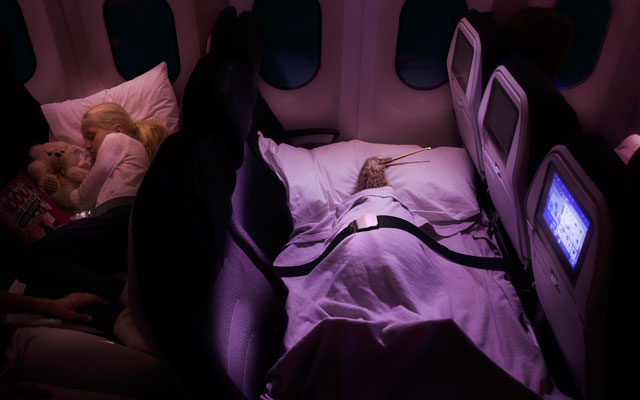
Air New Zealand today launched its first-ever global brand campaign in Singapore, with the help of Pete, a flightless bird native to New Zealand.

The airline’s new campaign is led by Pete the kiwi, which wants to travel but is hampered by his inability to fly. But the flightless bird has now been given the chance to explore the globe by taking flight with Air New Zealand, and hopes to take travellers on an experiential journey to show them the best of the carrier’s inflight offerings and classic Kiwi hospitality.

On why Singapore was chosen for the launch, Air New Zealand’s head of South & South East Asia, Jenni Martin, revealed: “Singapore is among the top 10 countries of visitor arrivals to New Zealand and one of our most important markets. As of October 2018, we recorded a seven per cent year-on-year increase in visitor arrivals from Singapore.”

But Singapore’s outbound market is not the only segment Air New Zealand is keen on.

Martin told TTG Asia: “Singapore also acts as a hub for travellers in the South-east Asia region into New Zealand. While we are very focused on growing Singapore traffic to New Zealand in its own right, we also recognise the growing interest in New Zealand from other South-east Asian markets, and India.”

“(In the South-east Asian region), Vietnam, Thailand, Indonesia, Malaysia and Singapore are our priority markets. These markets were identified as the biggest opportunity for (the Singapore Airlines (SIA)-Air New Zealand joint venture) based on the traffic numbers that were going into New Zealand when we first signed it. We will continue to focus our resources on these markets.”

Earlier in October 2018, SIA and Air New Zealand’s joint venture received renewed approval from the New Zealand Ministry of Transport, which enabled the two flag carriers to extend their alliance a further five years until March 2024, reinforcing the potential the South-east Asian region has to offer. This alliance has been a key part of Air New Zealand’s market strategy in this region, and both carriers together offer 25 flights per week.

To meet the “very high demand” from Singapore, capacity was increased on the Singapore-Auckland route in October last year, plus an upcoming seasonal service that will fly between Singapore and Christchurch five-times weekly beginning December 1, 2019 to February 22, 2020.

However, when asked if any more direct routes to major airports in South-east Asia such as Kuala Lumpur would be formed in the future, Martin stated: “At this point in time, the alliance with SIA is serving everything that we need for the market.”

Elsewhere in Asia, Air New Zealand started direct flights between Auckland and Taipei last November.