As the South Korean government relaxes its social distancing rules and implements the “everyday life quarantine” scheme, national cultural facilities across the country have reopened its doors to visitors, albeit with strict measures in place to prevent the spread of the coronavirus.
Under the “everyday life quarantine” scheme, people are allowed to engage in a certain level of economic and social activities while maintaining distance.
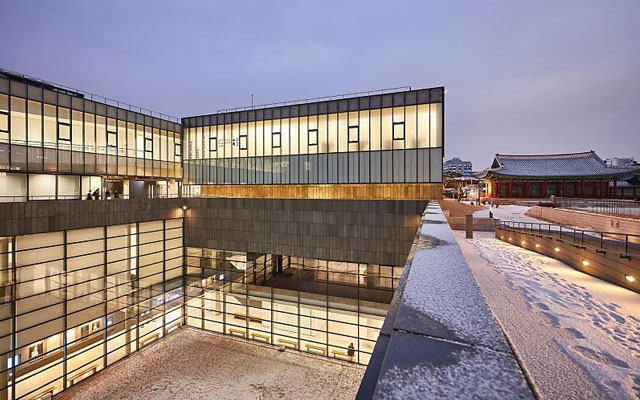
The National Museum of Modern and Contemporary Art reopens with strict preventive measures in place
At the National Museum of Modern and Contemporary Art (NMMC), group visits are banned and the museum has limited the number of visitors per hour to 50 people. Also, all visitors are required to wear masks, and are encouraged to make reservations beforehand, stating the specific time of visit and the exhibition that they want to view.
Bae Won-jung, one of the curators at the NMMC, said that the restrictions were in line with the government’s policy of distance keeping, adding that staff will be present in each exhibition room to ensure compliance.
It is still unclear if the new measure will become “the new normal” even after the pandemic blows over.
Major outdoor events like Goyang International Flower Festival has also been delayed and replaced with a drive-through flower market to help buoy flower farms suffering from the pandemic.
The new initiative, launched jointly by Gyeonggi-do Province, Gyeonggi agroFood Institute, Goyang City and the Goyang International Flower Foundation, took place from May 2-10.
Goyang International Flower Foundation Park CEO Dong-gil said: “This drive-through market was devised to make up for the postponement of the festival while preventing the spread of the virus. It is also a good opportunity for buyers to purchase high-quality flowers at low prices.”
This year’s 14th edition of the nation’s largest flower festival was originally to be held between late April to early May. It will now take place from September 25 to October 11 at Ilsan Lake Park.
The Philippines’ biggest carrier is fighting for survival as the Covid-19 pandemic leaves it with significant overheads, including costly maintenance for its fleet of grounded aircraft, but without revenue.
“Our biggest challenge has been financial”, Philippine Airlines (PAL) president and chief operating officer, Gilbert Santa Maria admitted, noting that from over one million passengers in January 2020, the airline has served “basically zero” travellers in April while paying for the maintenance of 100 aircraft.
PAL will rebuild traveller confidence by adopting international-standard health and safety measures
“We have been hammered” and “being big isn’t necessarily an advantage”, Santa Maria said in a webinar organised by Go Negosyo (Go Business) and the tourism sector.
With domestic and international travel still not allowed, PAL’s business is limited to chartered flights for stranded tourists and overseas Filipino workers of around 1,000 daily.
Although PAL earns from multiple daily cargo flights to the US, it is insufficient to compensate for the lost revenues from commercial flights.
While there is still a lot of unknowns about the pandemic, Santa Maria said PAL is not giving up.
“We’ve been around for 80 years….We will take everything day to day and we will survive,” he said.
He said the plan is for the carrier to return the demand for travel by building passenger confidence to fly again and ensure the safety of the aircraft.
“We are better prepared than most industries,” he opined, saying that the air quality onboard is similar to that in a medical operating room.
PAL will also adopt all international standards and measures that IATA will require of airlines.
While these new and additional measures may spike air fares, Santa Maria pointed out that there’s “no way we can increase prices” in this downturn and the Civil Aviation Board of the Philippines will not allow airlines to raise prices anyway.
What PAL will do is to work around the pricing framework for the different seat classes and promotions.
PAL has laid off a number of employees, and together with other Philippine airlines PAL had asked the government for some assistance, including a credit guarantee so that banks will facilitate loans.
Qatar Museums (QM) has rolled out several digital resources to allow virtual access to its collections and institutions, while its individual museums remain closed at present due to the the pandemic.
Netizens can explore the Mathaf: Arab Museum of Modern Art, showcasing modern and contemporary Arab art, via the Google Arts & Culture platform. Elsewhere, the Mathaf Encyclopedia of Modern Art and the Arab World provides free in-depth, peer-reviewed essays and biographies on modern and contemporary artists from North Africa, Asia and Middle East.
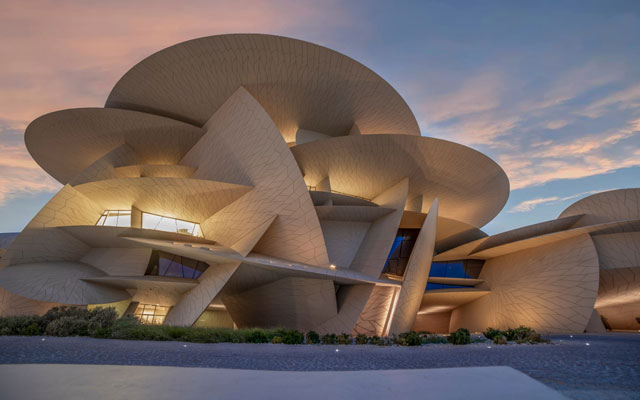
Virtual visitors can now drop by the Qatar National Museum and explore the country’s culture treasures
Also available is a 360-degree tour of the Museum of Islamic Art (MIA), housing a collection spanning some 1,400 years, accessible via Google Arts & Culture and on the MIA website. The museum also offers learning and engagement activities for children, families and adults on its social media platforms and website including MIA Storytime, games, puzzles, instructional art, video tours and DIY art projects.
Furthermore, M7 – QM’s new hub for fashion, design and technology startups – is offering a biweekly series of online coaching sessions by leaders in the fields of fashion and design, intended to guide and encourage aspiring Qatari designers. Although Covid-19 has delayed the full inauguration of M7, these online coaching sessions, which goes live every Thursday and Saturday on the M7 Instagram account (@M7.qatar) at 18.00 (GMT +3), will provide ongoing inspiration and support.
Through Google Arts & Culture, guests can also explore the collections of the Jean Nouvel-designed National Museum of Qatar, including an array of archaeological and heritage objects, such as the renowned Pearl Carpet of Baroda, embroidered with more than 1.5 million of the highest quality Gulf pearls and adorned with emeralds, diamonds, and sapphires.
Meanwhile, the Qatar Children’s Museum, currently under development by QM, is hosting daily workshops in English and Arabic on its Instagram account (@childrensmuseum.qa) that families can participate in using everyday materials found in their home. The sessions invite families to incorporate playing and learning into their daily routine, and engage with the museum’s staff who will be present to facilitate the sessions live.
Marriott International and the Marriott Thailand Business Council have joined forces with Scholars of Sustenance Foundation (SOS) to bake and deliver large batches of bread and cookies to underprivileged communities in Bangkok.
The trio converged at The Athenee Hotel, a Luxury Collection Hotel, Bangkok on May 12, 2020, to launch this initiative.
Launching the CSR project to feed needy families in the Thai capital were (from left) Century House Dairy’s Boonyakarn Saiphoklang, Bertagro’s Navit Tanglertpaibul, Betagro Agro Industry’s Jarunee Sangchawee, SOS’ Apinya Amnuayskul, Marriott International’s Jakob Helgen, The Athenee Hotel’s Chooleng Goh, Jakub Mares, and Ross Park
The hotel’s chefs will bake 300 loaves of raisin bread and 1,000 oatmeal banana cookies every day for 20 consecutive days, to be distributed by SOS. Upon the project’s completion, Marriott and SOS will have delivered a staggering 6,000 loaves of bread and 20,000 cookies.
Marriott usually sends surplus food from the group’s F&B outlets to families in need, via SOS. With most Bangkok hotels currently closed due to the Covid-19 pandemic, this initiative ensures that SOS beneficiaries do not miss out on their vital donations.
This CSR project was supported by the group’s local suppliers, including Centuryhouse Dairy and Premier Dairy Product, Laemthong Corporation Group, Betagro and The Saitarn Foundation, and Shrewsbury International School.
Other companies chipping in include JR F&B, Pacific Sugar Corporation, Asia Agro Intertrade, YSH Store, United Progress (Thailand), SW Foodtech, Dutch Mill, Puratos (Thailand), KCG Corporation, American-European Products, Charoen Pokphand Foods, and Schmidt Co.
Jakob Helgen, Area Vice President – Thailand, Vietnam, Cambodia & Myanmar, Marriott International, said: “During these challenging times, it is more critical than ever that we come together, support each other and give back to our community. Marriott International is a proud partner of SOS in Thailand; this innovative organisation does wonderful work, providing meals to the members of society who need it the most.”
Chooleng Goh, general manager, The Athenee Hotel, a Luxury Collection Hotel, Bangkok, added: “During the recent situation, we realised that we had plenty of resources that could be channelled towards charitable causes, so we spoke to our partners to see how we could help. Our sister properties have now teamed up with our own associates to take on this challenge.”
InterContinental Hotels Group (IHG) has launched its inaugural flagship store on Chinese OTA platform Ctrip, part of Trip.com Group.
The IHG Flagship Store will allow Ctrip members in Greater China to make bookings at more than 470 IHG hotels across the region, and register with the IHG Rewards Club, the hotel group’s loyalty programme, to gain access to exclusive membership offers, stay points and other member benefits.
IHG Greater China’s Jolyon Bulley inks deal with Trip.com Group’s Ray Chen for IHG to launch its flagship store on Ctrip
In addition, the two companies will also launch a membership-matching programme, whereby Ctrip Diamond (and higher-tier) members will receive an equivalent membership status for the IHG Rewards Club when joining through the IHG Flagship Store.
IHG Greater China CEO Jolyon Bulley said that the partnership “came as early signs of lodging demand return in China. We are looking forward to better leveraging the integrated resources of both sides, providing more IHG Rewards Club members with a richer range of benefits.”
Rendering of the Deck 2 Aft area, Finse Terrace, on-board the Viking Expedition ship
Viking Cruises has launched a series of trade training emails for agents to learn about Viking Expeditions, the cruise line’s new expedition voyages which debut in 2022.
Agents can register to receive seven weekly emails from May 18, 2020 to learn about Viking’s two purpose-built ships’ offerings to their clients, and how booking a Viking Expedition voyage benefits both agents and clients.
Rendering of the Finse Terrace on board the Viking Octantis and Viking Polaris ships
Set to sail in January 2022 is the 378-guest expedition ship, Viking Octantis, which will head to Antarctica and North America’s Great Lakes. A second expedition vessel, Viking Polaris, will debut in August 2022, sailing to Antarctica and the Arctic.
Viking Cruises said that the ships will boast “industry-first” features such as two complimentary underwater submersibles; an enclosed, in-ship marina called The Hangar that enables the launch of small excursion craft through the ship’s shell doors; and an onboard laboratory, where resident scientists will conduct research which guests can take part in, as part of Viking’s Cultural Curriculum.
Erin Kramer, trade marketing manager, Viking Cruises ANZ, said: “Our bespoke Viking Expeditions trade training email programme is perfect for agents who are looking for opportunities to upskill while spending more time at home.
“By boosting your expertise in this increasingly popular category, you maximise your opportunities to increase your commission too. And with departures in 2022 and 2023, all backed by our Risk-Free Guarantee, Viking offers your clients peace of mind to plan in advance.”
Agents can register to receive the email series here.
Many hotels have had to go into hibernation as a result of travel and movement restrictions. What is the state of Minor Hotels at the moment?
We have a mixed bag situation.
Our China operations are back in full operation, with full compliance with the restrictions that are still in place. Anantara Xishuangbanna Resort still has some limitations imposed by the authorities.
We are happy to report that our Vietnam resorts never had to completely close. Our hotels always had a small portion of domestic business and a lot of F&B take-outs by the local community. We were full at both the Anantara Mui Ne Resort and the Anantara Quy Nhon Villas over the long May 1 weekend.
In Thailand, our residences in Chiang Mai (Anantara Chiang Mai Serviced Suites) and Phuket (Layan Residences) remain in operation but elsewhere our hotels are closed. We are now awaiting approval from the local authorities to ease limits on inter-provincial travels. Once that happens, we will resume operations and focus on attracting the domestic market.
In the second phase, we expect regional traffic to return, but that is dependent on the lifting of travel restrictions as determined by respective country governments.
In phase three, which could come very late this year, a return in international travel.
Meier: resorts that operate with a high villa component will be popular, as they provide guests with a sense of safety and privacy as well as the option to stay indoors with access to their own facilities
WTTC has just laid out some health and safety protocols for the reopening of hospitality sectors. At the same time, WHO has said that the virus may never go away, and the world will just have to learn to come to terms with it. How do you see this impacting the concept of hospitality, which is all about human connection and runs counter to the guiding principal for many of these measures, which is to limit human contact?
We have pondered over this for weeks and weeks, and have discussed this with industry professionals and among ourselves.
We have created a committee with a WHO representative based in Thailand as well as representatives from EcoLab and Diversey to get us expert advice.
We have approached this by looking at key touch points with our guests, from emotional, experiential and physical angles. We have broken down the physical touch point into steps, to see how we, as a hotel operator, can provide assurance to the guest.
Six months ago, a guest coming to our hotel in Bangkok for a long weekend would most likely not have booked the hotel limousine because he is familiar with the destination and has access to Grab.
Now, we would strongly recommend that all our guests transfer with a designated hotel limousine upon arrival at the airport. They will be greeted by our staff who will assist them to our limousine. The driver will wear a mask and a pair of gloves, and has a Plexiglass screen between him and the guests; the driver doesn’t leave the car and our staff will help place the luggage in the boot.
At the hotel, the same approach is taken. We have Plexiglass screens at the reception, and we have discreet crosses on our beautiful marble floors to highlight distancing requirements. We will need some contact here and there to complete guest registration in some countries, like in Thailand where the guest needs to sign on a registration card. For this purpose, we will provide guests with UV-disinfected pens to use.
That approach will be replicated across the entire stay.
We are using only EPA-rated cleaning products – the same grade used in hospitals, and we have introduced a number of new cleaning procedures, such as UV sanitisation in rooms and electrostatic disinfectant treatment for hard surfaces.
I’m sure there is also a big question about hotel breakfast (laughs). There will be a buffet but the experience will be different. The guest will select his food from a menu at the table. Meal service will be direct to the table, which is easier for the guest.
We will keep a live kitchen concept and allow for some interactive stations that are completely protected by Plexiglass screens. Guests can still see the chefs at work and tell them how they want their eggs done.
We have tested this in Vietnam, and it has been successful. The common feedback in the first weekend was that guests wanted a bigger buffet and more breakfast choices. In the second weekend, most guests understood the concept and we foresee that they will be happy that we are implementing these steps.
In WTTC’s health and safety protocols, one of the suggestions is to remove extraneous items throughout the hotel. I take these extraneous items to mean soft furnishing. Will that mean a hotel stay in the future will be in rather bland surroundings?
Based on current cleaning methodology, there is no need for that. UV sanitisation lamps, for instance, will be able to disinfect the entire room, including soft furnishing.
Again, we are depending on experts to guide us in accordance to WHO standards.
What are the implications on operations and costs?
All these will obviously take more time to complete. A room attendant will probably get to clean two or three rooms less a day, which means it will take longer before we can resell a room.
In a restaurant operation, we can expect 30 to 40 per cent fewer guests being accommodated due to distancing measures. As such, we may need to have two restaurants for breakfast because nobody will be happy to be made to wait until 10.00 for a seat.
Operations have to adapt, and we will need more team members. As hotel operations return, we may need eight to 12 per cent more team members to cope with the new measures. Manpower needs will depend on government requirements and the type of property, say an island resort versus an urban meeting hotel.
Our hotel will need extra equipment to be compliant to new health and cleanliness standards. These are investments on our part. But the costs will not be the same across properties because in some resorts without meeting facilities, we will not need certain equipment.
Every hotel has 10 to 15 bottles of hand sanitisers, masks for guests, etc, which will raise our operating expenditure. These are expenses we will obviously cover to ensure the safety of our guests and team members.
How long do you suppose these measures will remain in place?
That is a crystal ball question, Karen. At this moment, we expect these measures to stay with us into the foreseeable future. I think we will see variations country to country, depending on the approach governments take on health and safety as well as tracing measures.
We expect to revisit some aspects of these measures whenever there are breakthroughs in cleaning methods or technology.
Will hotel design for your new openings in 2021 change based on the new health and safety considerations?
Our properties that are scheduled to open in 2021 are in an advanced planning stage, but there is certainly room for some tweaks. Our properties are developed with a lot of flexibility around F&B experiences, so as to be able to cope with different markets at different times of the year.
While we don’t foresee a lot of changes (needed as a result of the health and safety measures), we expect demand for private villas will spike because they offer guests their own space and access to their own facilities like the pool and lounge areas.
Our resorts that operate with a high villa component will be able to provide a sense of safety for the guest as well as the option for them to stay in the privacy of their villa.
Will this mean the end of recreational and wellness activities offered by the hotel? Some Anantara resorts offer sunrise yoga. What will happen to these activities?
We think the opposite is true. Guests can still do sunrise yoga while maintaining safe distancing of two metres between other guests.
Wellness and outdoor activities are expected to see far greater demand as travel resumes. We have requests for our resorts in the Maldives and Sri Lanka for November and December, and they come with specific interest in wellness programmes. We are selling Ayurvedic programmes for five, seven, nine days in Sri Lanka for January and February 2021.
Considering how the domestic market is expected to drive recovery, and most book direct, do you think this will change how Minor Hotels regards its travel trade partners?
Domestic business is pretty straight-forward. They book directly with the hotel and the airlines, although some have a preference for OTA apps.
Regional markets could return in 3Q2020, while our Vietnam properties are now in active discussion with Taiwan and South Korea for the first wave of business soon. We will continue to support our partners.
When longhaul markets return, it will be interesting to see what consumers prefer. Some may book direct (to access promotions offered by airlines) while others may want to rely on travel agents that offer assurance around cancellations.
The last couple of years we have a lot of longhaul markets that book multi-destination programmes through travel agents – four countries in three weeks, going through 20 different transportation, 10 different hotels, 25 different restaurants. We believe that kind of travel, which remains very much in the hands of travel agents, will take a longer time to rebound, as travellers need to regain confidence in all those countries.
Sojern has launched a new interactive dashboard providing real-time Covid-19 travel insights that will empower travel marketers to forecast travel demand and make informed decisions about market recovery.
The dashboard, updated daily at 10.30 (UTC), will provide market-level details on future searching and booking trends indexed to pre-Covid levels to provide visibility into timing for a recovery in specific destinations.
Sojern rolls out interactive dashboard providing real-time data on travel demand
Sojern collects and analyses travel intent data from thousands of airline and hotel partners from around the world to use as the foundation of its travel insights. This data provides an unparalleled view of travel demand by looking at online travellers’ path to purchase.
Travel providers can use these insights to help determine when to reopen or when to accelerate marketing to power recovery. Dashboard users will also be able to compare different regions to see when travel is likely to recover in each market.
Sojern director of travel insights Amber Kuo said: “Normally, weekly or even monthly data updates about how consumers are travelling would be acceptable to inform marketing campaigns. However, in Covid times, travel marketers are feeling stressed and uncertain about the future. Providing daily updates gives marketers more control because they can see how the situation is evolving, and when is the right time to act.”
This week’s insights on Covid-19’s travel impact in Asia-Pacific, which are based on data collected on May 4, 2020, showed signs of positive momentum in domestic travel, and revealed that destination markets can expect an uptick in travel in February 2021.
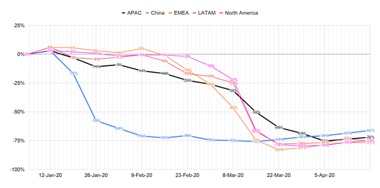
Following the WHO declaring that Covid-19 was officially a pandemic, from March 12 onwards, Asia-Pacific was seen to have a 40 per cent decrease in search volume. Following which, the individual countries within the region saw a further decrease in search intent as stricter travel restrictions came into play.
All Regions Year-To-Date Index in Searches
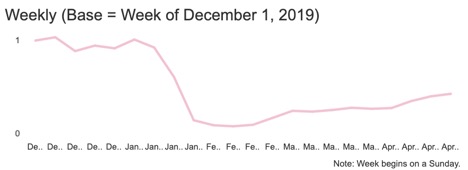
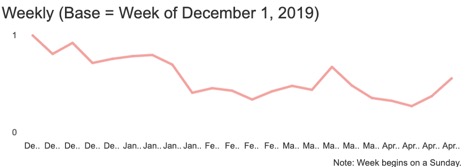
While Mainland China outbound travel started declining in December, it has since reached a plateau. Trends show that domestic travel took a sharp drop in mid-January when China imposed a lockdown, but continues to improve since mid-February, showing positive upticks.
This trend comes amid China’s prominence in the news, where a lengthy rebuttal of allegations was submitted over its handling of the Covid-19 outbreak, as well as the reopening of Shanghai Disneyland on May 11 to a reduced number of visitors, ending a three-month closure.
Source Market: China – Domestic Travel
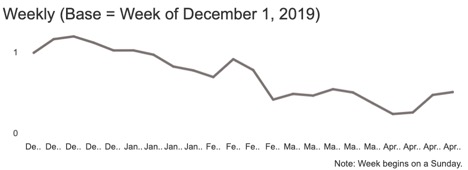
Hong Kong domestic travel was on a decline, but is showing clear signs of recovery since mid-February. Hong Kong outbound travel declined until the end of January, but has started to show signs of recovery at the end of April. Sojern noted that this uptick is coming from Hong Kong to China specifically. While Hong Kong has been celebrating progress of the containment of the virus, it remains to be seem if flash mobs that broke out over the Mother’s Day weekend will dent demand.
Source Market: Hong Kong – Domestic Travel
South Korean domestic and outbound travel has seen a general decline since mid-December, but Sojern’s data showed a slight improvement in April. Following positive news of containment of the virus, over the weekend, South Korea warned of a second wave of cases as a new cluster formed around a number of nightclubs. Since then, the capital Seoul has shut down all nightclubs, bars, and discos.
Source Market: South Korea – Domestic Travel
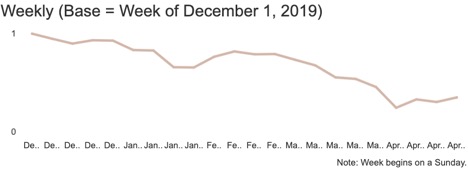
Taiwan domestic travel has a slower decline than average and showed signs of recovery in the second week of April. Additionally, Taiwan outbound has been on a decline since mid-January, but has reached a plateau. Taiwan reported over the weekend that they had no new cases of Covid-19, meaning the country has gone 28 days without reporting a single local transmission. This could reflect positively on travel trends in the near future, said Sojern.
Source Market: Taiwan – Domestic Travel
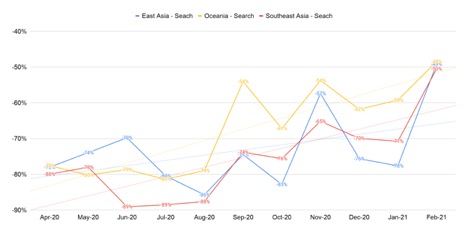
Looking at its flight data and the flight searches conducted across Asia in the last 28 days, Sojern noted that travellers are searching for potential destinations to visit during some specific months ahead. February 2021 has the highest search volume intent, presumably due to the Chinese Lunar New Year holidays. Additionally, Sojern also saw a high search volume for September and November this year, which could be due to the Mid-Autumn Festival in China.
Future Flight Departure Date Searches from East Asia, Oceania and South-east Asia
Hong Kong seems to have the highest search volume in November and this could be due to two anticipated events happening – The Airline Economic Growth and Fintech Conference. As for Singapore and Australia, February 2021 is the highest search month.
Even though the numbers are still lower than last year’s volume, it is a positive sign that travellers are “dreaming” of and planning their next trip, said Sojern.
Australia and New Zealand largely avoided high casualty cases by introducing strict nationwide stay-at-home orders and border closures, including travelling between states.
Positive signs coming out of Australia indicate that students of New South Wales and Queensland began returning to school this week on a limited basis, as the country’s rate of new infections continue to slow.
Future Flight Departure Date Searches to Australia, Hong Kong and Singapore
Having remained Covid-19-free thus far due to its stringent lockdown measures, Bohol is cautious about reopening and will have to ensure proper health and safety protocols to maintain its enviable reputation.
Speaking at a webinar run by Tourism Congress of the Philippines last Tuesday, Allen Christian Varquez, president, Bohol Association of Hotels, Resorts and Restaurants (BAHRR), observed that the locals fear that the virus might seep in when borders are opened, especially in high-risk Cebu.
Covid-free Bohol looks to implement strict measures on incoming tourists as it eyes reopening of borders; aerial view of Chocolate Hills Complex, a major tourist hub in Carmen, Bohol pictured
He added that “most accommodations are not keen on reopening mainly because they don’t expect to get the same volume of guests as before”, since tourists generally are still scared of travelling.
While metro Manila, Cebu City and Laguna remain under modified enhanced community quarantine until May 31 as these areas are categorised as high-risk, Bohol and other destinations have been placed on general community quarantine (a relaxed quarantine). Hotel openings and tourism activities are not allowed in all these areas until May 30.
Bohol governor Arthur Yap, who implemented a curfew, wearing of face masks and other measures as part of the extreme community quarantine for Bohol two months ago, said that authorities are looking to quell Covid-19 fears among locals and tourists through proper health, medical and safety protocols being developed with the industry.
Yap also highlighted the need to enforce Covid-19 testing on incoming visitors to prevent a virus breakout, adding that “there are critical border issues that we need to have an agreement on”.
Prior to the Philippines’ lockdown, Bohol was accessible through air services from various destinations as well as direct ferry services from Cebu, Dumaguete and Cagayan de Oro, among others.
Yvonne Villacorte, general manager, Best Western Plus The Ivy Wall Resort-Panglao, said the new guidelines for the hospitality industry being developed by the governor alongside BAHRR and other tourism-related associations will help assure locals and tourists that the province remains safe.
Villacorte added that since most locals don’t want to go out even in this month of festivals, normally a peak season in the province, there would be a better chance of reviving business if Cebu and Manila were reopened.
Lucas Nunag, president, Bohol Provincial Tourism Council, said that as the industry can write off 2020, tourism players in Bohol should use this downtime to prepare for tourism rebound.
Lourdes Sultan, president, Bohol Federation of Travel and Tour Operators, said that in preparation for reopening Bohol, the Department of Tourism should work on training and re-tooling tour guides, as well as providing financial assistance to travel players, especially freelance tour guides who were unable to access the wage subsidies.
CLIA has launched an online course for travel agents to sharpen their industry knowledge and help them combat common misperceptions around cruising by keeping them informed on existing regulations that govern cruise operations worldwide.
Called Cruise Champion, the new course is an interactive programme that deep dives into the workings of the global cruise sector and offers travel agent members the knowledge to become ambassadors for the industry.
CLIA releases online course for travel agents as it looks to dispel misconceptions around cruising
CLIA head of international training Peter Kollar said in a press release that the course would train cruise specialists on how to respond to their clients’ common queries.
He elaborated: “There are a lot of myths and misperceptions that circle the cruise industry and they can affect a travel agent’s ability to cater to their clients. This course is designed to help them respond confidently to some of the issues that customers may raise.”
Some of the topics covered by the course include regulations, safety, health, security, environmental protection, and CSR.
“By knowing more about cruise line practices and the strict regulations that govern cruise operations, agents will be able to join the growing network of voices who help advocate for cruising globally,” Kollar added.
Cruise Champion has been introduced within CLIA Australasia/Asia’s new Members Hub online learning platform, launched last week to provide an improved and streamlined education service for travel agents.
More education resources would be rolled out in the near future to help inform travel agents on the measures CLIA and cruise lines are developing in response to Covid-19, according to Kollar.
CLIA Asia travel agent members can access Cruise Champion via the new CLIA Member Hub here.