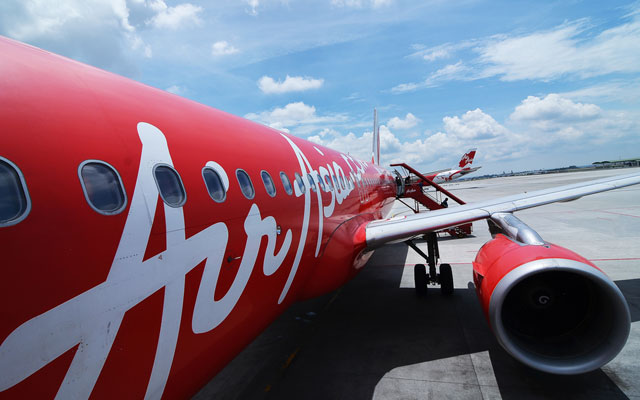
AirAsia sold a record-breaking 41,000 seats in a single day last Tuesday, in what is the airline’s highest post-hibernation sale day since restarting domestic flights in May, signifying a strong rebound in demand for air travel.
The LCC airline’s website experienced traffic growth of 170 per cent, according to a press release. Some of the most popular routes booked include Kota Kinabalu and Kuching to Kuala Lumpur for Malaysia, Bangkok to Chiang Mai and Hat Yai for Thailand, Manila to Puerto Princesa and Davao for the Philippines, Delhi to Srinagar and Bengaluru to Hyderabad for India, and Jakarta to Denpasar and Medan for Indonesia.
AirAsia registers its highest post-hibernation sale day with 41,000 seats sold
AirAsia Group’s CEO, Tony Fernandes, said in a statement that the airline is encouraged by this positive trend, foreseeing that it will continue in the coming weeks. He added: “We are aiming to increase our flight frequencies to around 50 per cent of our pre-Covid operations and we look forward to resuming all domestic routes in the coming weeks and months to cater to the increasing demand.”
Currently, AirAsia is operating 152 daily flights across the region. “We look forward to the reopening of international borders in recognition of the fact that air transport provides the connectivity that is essential for the resumption of economic activities and the global recovery efforts,” said Fernandes.
He added that the AirAsia Unlimited Pass, which was recently rolled out in Malaysia to stimulate domestic travel in the country, “sold out quickly” and that the pass will be launched in other markets soon.
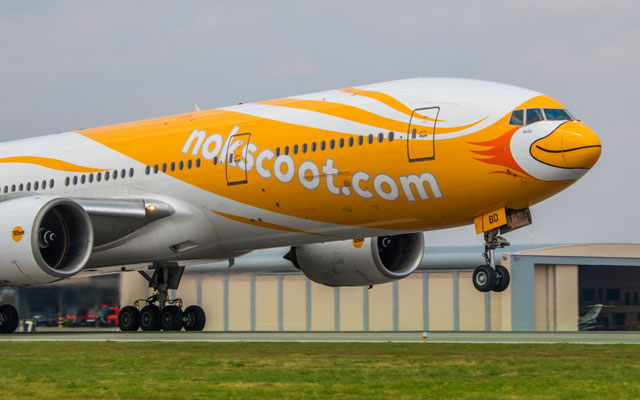
Thailand’s LCC NokScoot Airlines will enter liquidation as the crisis for the troubled airline deepened due to the coronavirus pandemic.
NokScoot, which is a joint venture between Singapore Airlines’ (SIA) Scoot and Thailand’s Nok Air, said that the difficulties it faced in growing the network coupled with the stiff competition left it unable to record a full-year profit since its inception in 2014. Challenges arising from the Covid-19 pandemic compounded the airline’s woes, it added.
Nokscoot becomes the latest airline casualty of the coronavirus outbreak
While weighing alternatives, Scoot said it offered to sell its 49 per cent stake in NokScoot to Nok Air for a nominal sum of one baht (US$0.032). However, it was not taken up.
NokScoot’s shareholders will hold a general meeting in about two weeks to discuss the dissolution, Scoot said in a media release.
Rumours were rife that the airline was terminating operations after it announced a massive layoff. NokScoot was among eight airlines in Thailand seeking 24 billion baht in soft loans from the government to tide through the coronavirus crisis, according to the Bangkok Post.
The carrier will return three aircraft from its five-jet fleet to SIA by month-end, said the report.
Some 13 attractions in Singapore will be allowed to progressively resume operations from July 1, as the city-state enters the second phase of post-Circuit Breaker lockdown.
They include some of the destination’s iconic tourist draws like the Singapore Zoo, Jurong Bird Park, Flower Dome at Gardens by the Bay, ArtScience Museum, Universal Studios Singapore, and the two casinos at Resorts World Sentosa (RWS) and Marina Bay Sands.
Universal Studios Singapore is among 13 local attractions that have been approved for reopening from July 1
Other attractions and domestic tour operators are welcome to apply with the Singapore Tourism Board (STB) for reopening permits by way of proposals that demonstrate effective implementation of safe management measures with customers and workers in mind. These measures must be tailored to reduce Covid-19 transmission risks. Operations may only resume after approvals are granted by the Ministry of Trade and Industry (MTI).
The 13 attractions to lead the resumption of attractions operations have been cleared for reopening by both MTI and STB.
As a further precautionary measure, most attractions will be restricted to no more than 25 per cent of their operating capacity at any one time, for a start. Access to casinos will be limited to existing casino members and annual levy holders.
Concurrently, STB will step up its efforts to ensure that more tourism businesses, including attractions, apply for the SG Clean national certification of excellence in sanitation and hygiene.
Detailing its safety and hygiene measures, RWS said in a statement that its operations are guided by three principals: Safe Entry, which is upheld by effective systems for guest screening and contact tracing; Safe Experience, which is upheld by a promise to ensure peace of mind for all visitors; and Safe Environment, which is upheld by the highest level of hygiene and sanitisation.
It will reopen its Universal Studios Singapore theme park and S.E.A Aquarium four days a week, with staggered operating hours in the initial phase. All guests will need to make online advanced reservation with specified date of visit.
Shows and street entertainment at Universal Studios Singapore will not be available during the initial phase of reopening.
Redefining ‘Clean Stays’ standards in meeting new travel norms
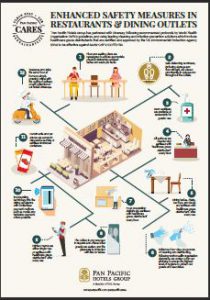
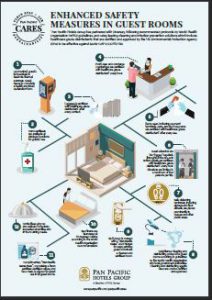
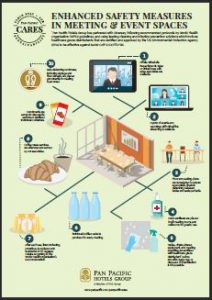
Pan Pacific Hotels Group (PPHG) has redefined guests’ stay experience with “Pan Pacific Cares”. The Group has partnered Diversey – hygiene and infection prevention solutions leader – in implementing protocols that adhere to World Health Organisation (WHO) guidelines.
Moving forward, properties will utilise cleaning and infection prevention solutions such as Oxivir and Virex II 256, which are healthcare grade disinfectants certified and approved by the US Environmental Protection Agency to be effective against Covid-19.
Electrostatic sprayers will be introduced to apply the Oxivir disinfectant, which uses active ingredients that break down into water and oxygen after use, an environmentally friendly solution subscribing to PPHG’s sustainable belief. The prescribed solution does not contain any respiratory irritants and is therefore, not expected to pose a health hazard.
Additional protocols such as increasing cleaning frequency by five folds, enhanced two-step cleaning and disinfecting processes, and laundering linens at 70 degree Celsius have been rolled out across all Group properties.
All properties will undergo stringent training by Diversey’s experts in ensuring they comply with the elevated processes and methodology.
Hotels will also use Ultronic UV torches to inspect all disinfected and sanitised guestrooms for further assurance.
Re-engineering processes to boost travel confidence
PPHG has been proactive in implementing recommended protocols such as safe distancing, thermal scanning, using safe entry codes for contact tracing, wearing of masks and provision of hand sanitisers, as the pandemic gained traction in complying further with WHO guidelines.
Properties will also be implementing contactless check-in and check-out, as well as advocating contactless payments and introduce new measures to its dining operations.
All PPHG guests will be given “Pan Pacific Care Packs” comprising hand sanitisers, surgical masks and disinfectant wipes upon check-in. A wellness channel will also be launching soon in guestrooms, featuring exercise routines such as pilates, barre and yoga, as well as self-pampering massage guides to unwind from travel stresses.
TTG Travel Awards, Asia-Pacific travel trade’s most celebrated event, returns for its 31st edition this year to honour the industry’s finest and brightest. Click here to vote for Pan Pacific Hotel Group, winner of “Best Regional Hotel Chain” for three consecutive years from 2017-2019.
Testing, contact tracing and health certificates may become the new norm
WTTC has laid out its new guidelines to ensure safe and seamless travel, including rapid testing and tracing, opening travel corridors, and implementing a risk assessment framework.
The guidelines will ensure that the travel sector is provided with an extensive framework to help governments and private business work in collaboration to create aligned testing and contact tracing programmes.
Testing, contact tracing and health certificates may become the new norm
The initiative is part of WTTC’s Safe and Seamless Traveller Journey, which aims to enable safe travels to rebuild global consumer confidence.
The council has outlined five critical calls to action for global governments to aid the sector’s recovery amid Covid-19. They are:
Support quick and reliable tests as a critical path to ensure public health and a rapid testing and contact tracing strategy to help contain the spread of the virus
Multilateral collaboration and adherence to internationally recognised guidelines to enable “approved travellers” to travel across to multiple destinations using a single process and risk assessment framework
Support “travel bubbles” or “tourism corridors” between low-risk Covid-19 areas/zones or countries based on recognised criteria on what constitutes low-, medium- and high-risk, so as to limit testing requirements for travellers and support the industry’s recovery
Remove blanket travel advisories and recommendations against non-essential international travel as this prevents insurance protection for travellers, as countries reopen
Support a global standard of traveller health insurance, or at least minimum requirements, defined with private sector insurance companies
WTTC said that the new guidelines were produced after extensive consultation with various stakeholders, including its members, health experts and government officials, and according to WHO and CDC guidance, and ICAO CART Take off guidance.
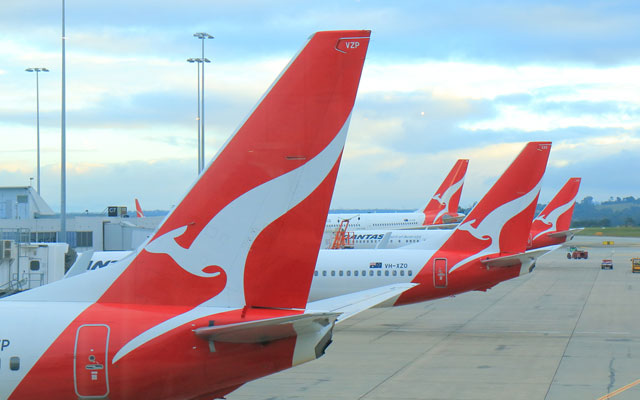
Qantas will ground 100 aircraft for up to a year, cut 6,000 jobs, and seek to raise A$1.9 billion (US$1.3 billion) in fresh equity, as part of a three-year post-Covid recovery plan.
The 6,000 roles made redundant will be across all parts of the business. In the meantime, the group will also continue the stand down for 15,000 employees, until flying returns.
Qantas slashes 6,000 jobs, puts 15,000 employees on extended furlough
The plan will also see the early retirement of the group’s six remaining 747s, and the grounding of up to 100 aircraft for up to 12 months or longer, including most of its international fleet. The majority are expected to ultimately go back in to service but some leased aircraft may be returned as they fall due, said the airline in a statement. As well, A321neo and 787-9 fleet deliveries for Qantas and Jetstar have been deferred.
In addition, the group will seek to raise up to A$1.9 billion, comprising of a fully underwritten institutional placement to raise approximately A$1,360 million and a non-underwritten share purchase plan for eligible existing shareholders to participate of up to A$500 million.
Proceeds will be used to strengthen the airline’s balance sheet and position it to capitalise on opportunities aligned with its strategy.
The plan targets benefits of A$15 billion over three years, in line with reduced flying activity including fuel consumption savings, and delivering A$1 billion per annum in ongoing cost savings from the 2023 financial year through productivity improvements across the group.
Qantas Group CEO Alan Joyce said: “The Qantas Group entered this crisis in a better position than most airlines and we have some of the best prospects for recovery, especially in the domestic market, but it will take years before international flying returns to what it was. We have to position ourselves for several years where revenue will be much lower. And that means becoming a smaller airline in the short-term.”
The Phuket Hotels Association (PHA) and global hospitality branding agency Quo have joined forces to launch a large-scale destination relaunch marketing campaign aimed at reviving travel to Phuket.
Entitled Imagine Phuket, the destination campaign – in English and Thai – focuses on the sights, sounds, feelings, tastes and emotions that Phuket evokes for an international traveller. A fresh logo and video have also been unveiled.
Imagine Phuket aims to boost domestic tourism by giving hotels in the region a coordinated marketing platform
The initiative also enables the island’s hotels to come together, where each property will be given the resources to personalise videos, images and logos with their own branding, creating their own version of the campaign’s message. Seventy-five hotels have signed up to participate.
“The Imagine Phuket video, and integrated social media campaign, are designed to drive emotion,” said Quo’s CEO David Keen. “We know that there is a massive desire to travel again, both locally and internationally. Our intent is to bring the story back to Phuket.”
PHA hopes that these efforts go towards helping to restore the island’s tourism industry and save jobs, as the destination has been one of the hardest-hit in Thailand.
In a press conference on June 10, Phuket Chamber of Commerce’s president Thanusak Phungdet told reporters that Covid-19 cost the island over 120 billion baht (US$3.9 million) in lost income, with losses expected by to reach 280 billion baht by the end of the year if the situation doesn’t improve.
But despite unemployment increasing by over 34 per cent year-on-year, according to local reports, island residents remain resilient.
Phuket welcomed over 10 million arrivals last year, and in the months after reopening, Phuket’s hotel industry aims to attract a sizeable chunk of Thailand’s 20 million domestic travellers. International travellers will have to wait, but the country has indicated it plans to reopen this summer.
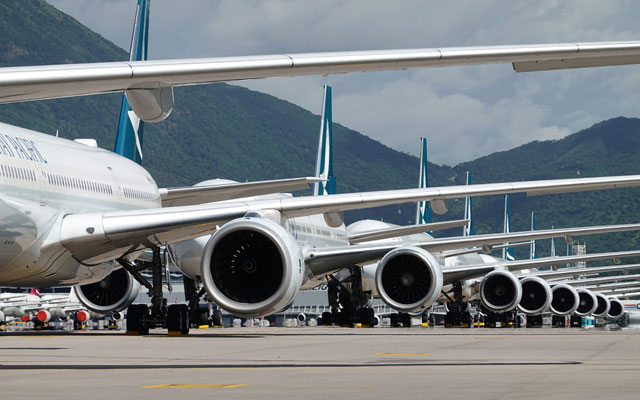
Due to the coronavirus, the aircraft of Cathay Pacific parked at the taxiway of Hong Kong International Airport
The Hong Kong government has thrown a HK$27.3 billion (US$3.5 billion) lifeline to the city’s flag carrier Cathay Pacific, as part of a HK$39 billion recapitalisation plan aimed at keeping the airline afloat amid the pandemic that has thrown global airlines into a tailspin.
The sum includes the issuance of HK$19.5 billion in preference shares with detachable warrants, a HK$11.7 billion rights issue, and a HK$7.8 billion bridge loan facility.
Cathay Pacific aircraft parked on the runway at Hong Kong International Airport due to the pandemic
Cathay Pacific began talks with the government to seek support for the aviation sector through an investment in the Cathay Group two months ago, according to a Legislative Council paper. The airline’s flights have been drastically cut by 97 per cent in recent months, as compared to pre-Covid-19 levels.
Both Cathay Pacific and Cathay Dragon only carried a total of 18,473 passengers last month. In the first five months of 2020, the number of passengers carried fell by 71.2 per cent, against a 59.5 per cent decrease in capacity as compared to the same period for 2019.
To the Hong Kong International Airport (HKIA), the failure of the Cathay Group to sustain its operations would mean an immediate loss of the network that it has established through the airline group over many decades. The network includes 49 passenger points and 14 all-cargo points served by Cathay Pacific exclusively pre-Covid-19.
Without the air connectivity, demand for the HKIA’s transit/transfer services, which contributed 29 per cent of the airport’s passengers in 2019, is expected to drop significantly.
In the absence of a well-established home-based flag carrier, reliance on non-local carriers will not be sustainable for the long-term development of HKIA, as the bases and foci of these carriers may not be in alignment with the best longer-term interests of Hong Kong.
Apart from refinancing, Cathay Pacific has confirmed that a submission has been made to the government’s US$10.3 billion Employment Subsidy Fund announced in March. This may benefit its 27,000 employees in Hong Kong and cover the maximum wage subsidy per employee at HK$9,000 per month for six months. During this period, employers cannot lay off staff.
Hailing the government’s bailout of Cathay Pacific, industry players called for the strengthening of the partnership between the airline and travel agents along the path to recovery.
Gray Line Tours managing director, Michael Wu, expressed hopes that the airline can provide travel agents with greater ticketing flexibility, as currently, if the group ticket fare quota is exceeded, agents have to pay the rest of the fare at FIT rate. He also urged the airline to sell tickets through agents rather than selling directly to consumers via its online platform.
“We’d like Cathay Pacific to treat us as business partners. The city needs more visitors and nobody can stand alone to fight for survival. We stakeholders should work together in this tough time,” he added.
Travel Industry Council’s chairman, Jason Wong, also urged Cathay Pacific to lend greater support to the travel trade, including traditional agents, noting that the use of public funds to bail out the airline means that there will be a greater expectation on the airline to fulfil its social responsibility.
The Society of IATA Passenger Agents’ chairman, Tommy Tam, opined that Cathay Pacific should mend its relationship with agents. “Before the pandemic, Cathay Pacific pushed NDC, direct marketing and loyalty programmes that were not favourable to agents’ business.”
He added that the airline should segment its products clearly, with Cathay Pacific serving the high-yield, longhaul market; while Cathay Dragon and HK Express, the low yield or tour package groups.
Japan is starting to see a rebound in domestic tourism following the government’s lifting of restrictions on inter-prefectural travel on June 19.
JR East has seen an uptick in passengers across stations in Tokyo, while hotels and attractions in rural areas have reported more arrivals by car from nearby areas.
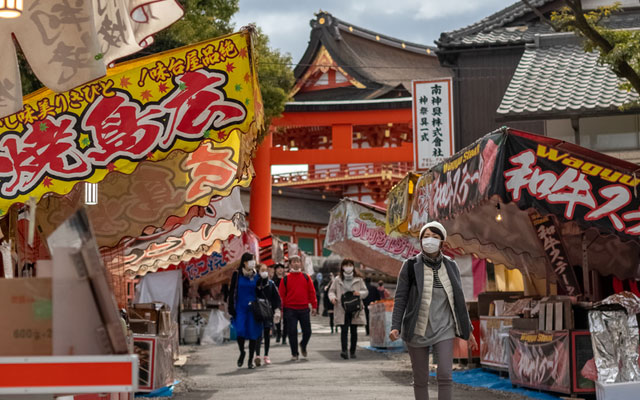
Domestic tourism in Japan rebounds on the back of government incentives; people strolling through a street market near the Fushimi Inari Shrine entrance during the pandemic pictured
The reopening of domestic travel coincides with the end of Japan’s last economic and social restrictions to contain Covid-19. Visitors are back at live music venues and popular attractions like Tokyo’s Ueno Zoo and Universal Studios Japan in Osaka.
Travellers are also making bookings, with hospitality tech company Agent Tripla reporting that reservations for 300 domestic hotels have bounced back to 70 per cent of pre-Covid levels.
The uptick is being partly attributed to the subsidies and other support that local governments are offering tourists.
For example, residents of Gunma and Ishikawa prefectures who stay in a hotel in their respective prefecture can have up to half of their accommodation cost covered. In Osaka, overnight visitors are awarded points worth about ¥2,500 (US$23) from the prefectural and city governments. Meanwhile, neighbouring Hyogo is offering shopping vouchers of up to ¥2,000 for visitors of the prefecture’s hot spring resorts.
The trade is also contributing to the rebound. Under a new programme in Amami City, Kagoshima Prefecture, tourism industry players are experiencing each other’s services and products using subsidies from the local government.
Domestic tourism is expected to get a further boost with the national government’s proposal of “workations” to reduce the number of office-based staff and encourage holiday-shy staff to take a break. Under the plan, staff will be encouraged to work remotely from holiday destinations.
In anticipation of growing domestic demand, All Nippon Airways and Japan Airlines are resuming more domestic flights. Japan Airlines expects its passenger numbers in the first half of July to recover to 40 per cent of last year’s over the same period, up from 30 per cent in June. LCC Peach resumed services on all 22 of its domestic routes on June 19, while Jetstar is set to restart services on all its domestic routes by late July.
As attractions across Indonesia prepare to welcome back domestic tourists, two local OTAs are looking to restore traveller confidence and stimulate demand by easing the process of Covid-19 compulsory testing and introducing a new clean and safety label for hotels.
Traveloka has launched a new service allowing its users to book a Covid-19 swab test and rapid test on its platform.
Tiket.com rolls out new Tiket Clean label to certify that hotels in Indonesia have implemented enhanced hygiene protocols
Since June 10, the service has enabled locals in 44 Indonesian cities and regencies to enjoy flexibility in booking the tests alongside arranging their transport and accommodation for their travels through the Traveloka Xperience feature on the OTA’s website and mobile app.
The testes will be conducted in partnership with clinical laboratory service providers Prodia, Klinik Pintar, and Biotest.
“We also provide information on required documents that people need to prepare for travel through in-apps communication that will pop up when users access a transport product page,” said Andhini Putri, head of marketing and transport of Traveloka.
Through Traveloka’s mobile app, users can find the nearest clinics of the three aforementioned providers and book an appointment. If the result is negative, they will receive a medical certificate in hard or softcopy, or both. If positive, they will be referred to a hospital for further examination.
Traveloka’s digital solution comes as the government stipulates that locals who are looking to travel within the country are required to take a rapid test or Covid-19 swab test prior to their travels.
Passengers travelling to Bali, Pangkal Pinang, Tanjung Pandang, and Balikpapan in East Kalimantan, are required to undergo a Covid-19 swab test, as the results from a rapid test will not be valid. In Bali, which plans to open its doors to domestic tourists in August, arriving passengers are expected to show their Covid-19 test results again upon arrival.
Elsewhere, Tiket.com has launched a new certificate label, Tiket Clean, to reassure guests that hotels with that label have complied with the government’s enhanced cleaning and hygiene protocols.
So far, 4,000 Tiket.com’s hotel partners have earned the Tiket Clean label, said Gaery Undarsa, its co-founder, during the recent virtual launch of Tiket Clean. Among them are Santika Hotel, phmhotels, Tauzia Hotels, Archipelago International, OYO, and RedDoorz.
In the new normal, travellers are not only concerned about hunting down the best deals, but also the safety and cleanliness of the hotels they stay in, Geary said, citing the results of a recent Tiket.com survey.