TTG Asia
Asia/Singapore Monday, 9th February 2026
Page 938

PATA offers free online tourism training

0

PATA has launched an e-learning platform for travel agents, tourism professionals, and destination marketers who want to refresh their knowledge, learn new skills and stay relevant.

The destination platform is developed and promoted within the OTT agent training platform, which is accessed by over 150,000 travel professionals worldwide.

The free online courses allow participants the opportunity to watch videos, complete assignments and earn a certificate while learning from travel professionals and experts. Current coursework is available for Palau, Kenya, the Marianas, Tahiti, Bangladesh, Guam, Kiribati and Macau, China.

PATA CEO Mario Hardy said: “The current pandemic has allowed many tourism professionals to take this opportunity to increase their knowledge and education, thus improving their careers and products. Furthermore, destinations are struggling during these unprecedented times to find meaningful avenues to engage with various stakeholders.

“Participating in the PATA eLearning Platform is the perfect opportunity for travel professionals to furthermore develop insights into various destinations, while destinations can effectively engage with travel professionals in a meaningful manner.”

As part of the launch, PATA government members have the opportunity to participate on the eLearning Platform by uploading free training courses onto the platform until March 2021. Courses can be up to 10 pages of informative insights for travel agents and tourism professionals. At the end of the course, participants will be asked to complete a short quiz to test their knowledge and receive a certificate of completion.

PATA government members who wish to keep their course on the training site after March 2021 can do so by paying an annual fee of £1,750 (US$2,240).

KidZania KL inks exclusive deal with Klook

0
Kidzania KL X Klook Signing Ceremony

KidZania Kuala Lumpur (KL) has signed an exclusive online travel agent (OTA) partnership with Klook to co-invest in initiatives to enhance and refresh the visitor experience at the indoor children’s theme park as well as curate marketing and promotional activities.

In support of KidZania KL’s mission to provide interactive and inspirational role-playing experiences for kids aged four to 14, Klook will also develop an interactive experience zone that would encourage kids to explore and be inspired by the journey of building a tech start-up.

From left: Tourism Malaysia’s Zurina Abd Samad, KidZania KL’s Shahrul Nizar Ahmad, Klook Malaysia’s Emily Tan, and KidZania KL’s Marco See at the signing of the exclusive partnership between KidZania KL and Klook

Shahrul Nizar Ahmad, mayor of Kidzania KL, said: “This partnership allows us to tap into Klook’s current user base in Malaysia, as well as its strengths in the inbound tourism market when international borders reopen.”

He added that more Malaysians are also booking their tickets online to reduce contact, and the company’s partnership with Klook “will result in a better customer experience overall by speeding up the entry process, especially with additional safety measures that we are taking such as temperature checking of every guest.”

Chuan Sheng Soong, general manager for Southeast Asia, Klook, shared that the partnership with KidZania KL will “help drive visitorship to the centre as well as enhance guests’ overall experience through Klook’s suite of merchant solutions”.

He added that both sides will be working together “to refresh and develop tech-centric experiences within the edutainment centre as well as curate marketing campaigns to meet joint business objectives and market needs”.

“Klook is also looking to work closely with government organisations such as Tourism Malaysia and open to teaming up with other industry partners to boost the recovery of the domestic tourism market,” he said.

Tourism Malaysia will lend its support to further promote this partnership via its marketing channels.

TTG Conversations: Five questions with Robert Hecker, Horwath HTL

0

With safety, hygiene and personalised care taking the front seat in the new normal, budget and mid-range hotel brands may find themselves in a more advantageous position. Horwath HTL’s Robert Hecker, managing director, Pacific Asia, asserts that the segment’s traditionally low-touch approach can now work in hotels’ favour.

In this new episode of TTG Conversations: Five questions video series, Hecker talks about how brands must now pay even closer attention to their messaging and identity, in order to grow confidence in consumers. This is especially pertinent in Asia, where a plethora of family-owned hotels and local brands are scrambling for survival.

A time for growth

0

What key technologies have gained momentum across the hospitality industry as a result of the pandemic?
Covid-19 has not created a new movement but greatly accelerated the digitalisation of the industry. For example, contactless and cashless payment systems have already been on the market for some time, but the need to reduce person-to-person contact has accelerated this transformation.

Similarly, online learning and development platforms for companies have been available since pre-Covid, and there was already a trend for companies to shift in-person training sessions to learning management systems and virtual training sessions, but Covid-19 also sped that up.

Other technologies that have seen swifter adoption include tools that enable internal and external collaboration, like Slack, Microsoft Teams and Zoom, as well as those that enable increased operational efficiencies, such as chat-bots.

How much more do you anticipate digital hospitality will grow from this point?
While many larger companies have already been investing in technologies to enable automation and other work efficiencies since pre-Covid, a large proportion of smaller companies still have not.

In Singapore, there are government grants such as the Productivity Solutions Grant that SMEs can tap into to fund their digitisation, which may cause a further acceleration in the adoption of certain technologies.

In addition, data will guide businesses in the hospitality industry, such as small restaurants, to take the guesswork out of their daily routine and base their decisions on data.

With tech solutions coming to the fore, and social distancing becoming the norm, what place does the human touch have in the Covid world?
Once again, this shows how Covid-19 is accelerating certain trends that were already in place. For example, the implementation of technologies such as kiosk check-ins and keyless entry will continue to proliferate especially in the economy and mid-tier segments, where human interaction is not expected and the hotel experience is much more transactional.

In the luxury domain, however, high-touch service will still be expected to create an elevated, immersive experience, combined with intentional and meaningful human touchpoints as well as technology to replace non-essential interactions. Social distancing and other measures that have been taken during the pandemic have only emphasised the need for human beings to connect and build relationships with others.

How do you predict Singapore’s S$320 million (US$236 million) credits might be channelled towards hotels and/or benefit the local hospitality industry?
With many companies in Singapore still having their employees work from home and hotels strongly pushing out staycation packages, we may start seeing a trend of Singaporeans choosing to take their staycations over the weekdays as well, rather than simply long weekends. The tourism credits will also encourage spending on local attractions, especially amongst families with children.

For Singaporeans – especially millennials – who are used to jetting off to Bali or Bangkok over the weekend, this extended period of stay in Singapore has also led to an increased appreciation of the nooks and crannies that may have been passed over before.

Rather than leaning heavily on the credits or the staycation demand to pull through, how should hotels relook their offerings to maintain a competitive product?
The tough economic reality would likely see Singaporeans curtailing their expenditure until clear signs of recovery appear, so hospitality brands truly need to return to the basics of ensuring excellent products, services and customer experiences to retain and grow a following, as well as to establish an efficient operating model.

While it may seem counter-intuitive to do so during a downturn, it is more important than ever to invest in ensuring a compelling brand story and double-down on training.

How can hotel players around the region rally and work together with each other, or with other travel suppliers, to stay afloat?
During this period, we have seen multiple stakeholders coming together to provide mutual support to each other and the industry, with initiatives coming both from public and private sectors.

An example of the former would be the Ministry of Manpower of Singapore hiring hotel employers who had been displaced due to the pandemic.

(On the private sector side,) EHL alumna Melissa Lou co-founded online marketplace Delegate, which helps users source event venues and vendors, and during this period companies are able to list for free.

Sky Hotel Management launches to provide owners with more asset management flexibility

0

Park Inn by Radisson sets foot in Jeddah

0

Radisson Hotel Group has established the first Park Inn by Radisson property in Jeddah, bringing its portfolio to over 45 hotels, resorts and serviced apartments in operation and under development across Saudi Arabia.

Yet another milestone for the company with this opening is the appointment of Maram Kokandi as the world’s first female Saudi general manager in the global hospitality industry.

Park Inn by Radisson Jeddah Madinah Road is fit for both leisure and business travellers

Park Inn by Radisson Jeddah Madinah Road consists of 84 contemporary rooms and suites, various casual dining spaces, spa and fitness facilities with separate areas for men and women, and three meeting rooms equipped with free high-speed Wi-Fi and audiovisual equipment.

Corporate event planners are supported by the brand’s Smart Meetings and Events promise, which offers attentive service from start to end.

A gateway to the holy city of Makkah, Jeddah attracts travellers from across the globe as a centre for international business and a canvas for public art. Located within close proximity of King Abdulaziz International Airport, the Park Inn by Radisson Jeddah Madinah Road is about 25km from the heart of the city, making it an ideal location for both business and leisure travellers.

InterContinental Singapore serves up stay-and-dine deals

0

Shangri-La’s Sentosa resort rolls out ‘daycation’ deal

0

Indonesia commits 100 billion rupiah to hotel quarantine programme

0

Indonesia’s Ministry of Tourism and Creative Economy (MOTACE), Ministry of Health, and the Indonesia Hotel and Restaurant Association (IHRA) are working together to qualify a list of three-star accommodation across the country to house Covid-19 patients who are asymptomatic or with mild symptoms as well as medical personnel.

The programme will be backed by a budget of 100 billion rupiah (US$6.7 million), revealed MOTACE minister Wishnutama Kusubandio, who added that Jakarta and Bali will see the first implementation, followed by North Sumatra, West Java and South Kalimantan.

Hotels in Jakarta (pictured) and Bali will be selected to be part of a government quarantine facility programme

Meals, laundry and support from medical personnel will be provided throughout the 14-day isolation programme, with MOTACE stepping in to provide medical staff to ensure compliance by hotels and residing patients.

To qualify for the programme, hotels must have suitable facilities and be able to comply with the requirements and protocols established by the Ministry of Health. The hotels are also not allowed to accept other guests during the programme.

To date, hotel brands Yello Hotels, Ibis, POP! Hotels, Mercure and Novotel in Jakarta and the surrounding areas are deemed to be ready, so are Ibis Kuta Bali and Novotel Banjarmasin Airport in South Kalimantan, according to Wishnutama.

Earlier this week, Terawan Agus Putranto, minister of health said the government would appoint 10 to 15 hotels of two- and three-star categories in Jakarta alone, providing 1,500 to 3,000 rooms in anticipation of hospital room shortage as the number of local infections continue to climb.

Haryadi Sukamdani, IHRA chairman said the move to use hotels for quarantine is not new, as many hotels have previously welcomed medical personnel and members of the public desiring self-isolation.

The fact that no new Covid-19 clusters were found in those hotels provided evidence that it was safe to transform hotels into quarantine centres, thanks to strict implementation of health protocols, Haryadi said.

Hotel groups with such experience include Aryaduta Hotels and Artotel Group, both of which partnered with medical institutions to provide necessary care.

The five-star Grand Sahid Jaya Hotel in Jakarta offers a self-isolation package, with prices ranging from 650,000 rupiah (US$44) to 900,000 rupiah per night for different room types. Besides laundry service and three meals a day, the guests can request for a rapid swab test. Medical attention is provided by doctors from Sahid Sahirman Medical Centre and Pelni Hospital.

Vivi Herlambang, director of business development, sales and marketing with Sahid Hotel & Resorts, told TTG Asia that the self-isolation package idea was birthed when the hotel was appointed by the government to accommodate medical staff during the country’s first large-scale social restriction a few months ago.

Medical personnel from Pelni Hospital had then asked if some patients could be accommodated at Grand Sahid Jaya Hotel while they waited for the results of their swab tests. The hotel agreed, and developed that capability further.

To ensure the safety of regular hotel guests, only patients with mild symptoms are allowed and both sets of customers are clearly separated.

Asymptomatic Covid-19 patients at the hotel are also under strict surveillance to prevent them from leaving their room.

IHRA Haryadi said the government’s latest decision to appoint specific quarantine hotels would not upset ongoing self-isolation programmes developed by hotels. Instead, people now have a wider choice of properties they can go to for quarantine.

Anantara Desaru Coast Resort & Villas reopens with offers

0

Anantara Desaru Coast Resort & Villas in Malaysia is welcoming guests once more, with a series of offers that will allow guests to stay, play and recharge across its varied leisure facilities.

From now until December 31, 2020, guests can enjoy resort credit of RM$150 (US$36) per room per stay or RM$250 per villa or residence per stay when they book the Best Flexible or Stay Longer rate at the property.

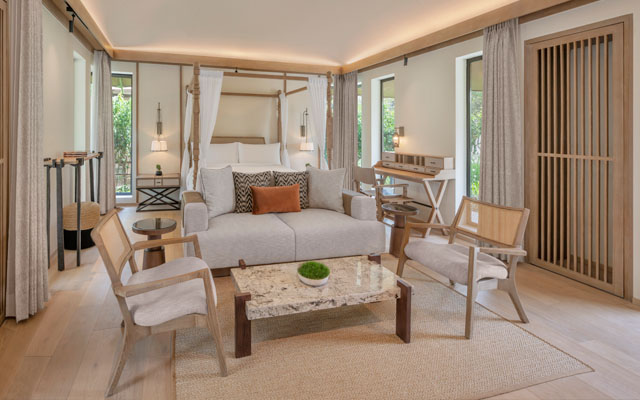
Enjoy luxury accommodation at Anantara Desaru Coast Resort & Villas

Golf enthusiasts can enjoy the Stay & Play package which comes with accommodation in a room or villa; daily breakfast for two at Turmeric Restaurant; and one-round of 18-hole golf course at either Ocean or Valley Course at The Els Club for two.

Perfect for family and friends, the Villas & Residences Retreat offer includes accommodation in a villa or residence; daily breakfast; complimentary daily lunch in villa or residence; one-time complimentary in-room minibar; and early check-in at 12:00 and late check out at 16:00, subject to availability.

Alternatively, the Splashing Fun offer will entice young families, where guests will receive a one-day pass to Adventure Waterpark for two adults and one child aged up to 12 years old, daily breakfast for two, and accommodation.