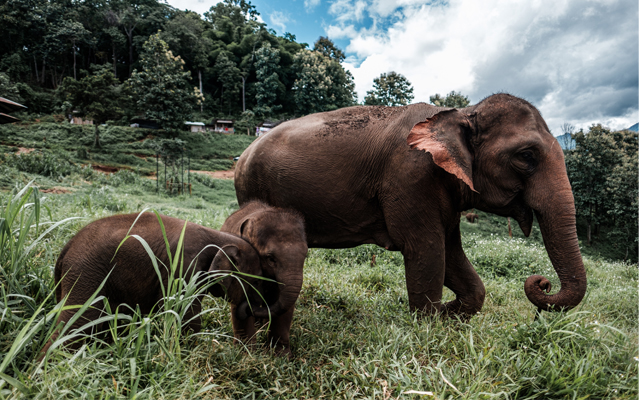
Elephant family in the elephant camp in northern Thailand
With global tourism remaining at a standstill, now’s an opportune time for tour operators who play an important role in shaping the future and vision of elephant tourism in South-east Asia, to rethink their approach to the industry, according to the founder of an elephant camp audit company.
Ingrid Suter, co-founder at Asian Captive Elephants Standards (ACES), which audits camps across Thailand, Laos, and Indonesia, said that there was enough scientific evidence to support the promotion of elephant tourism and that tour operators should educate themselves on the topic of captive elephant management with academic literature and resources.
Elephant camps have been deeply impacted by the Covid-19 crisis as tourism grinds to a halt; an elephant family in an elephant camp in northern Thailand pictured
She urged tour operators not to be intimidated by “emotional people warriors” who will condemn, attack and target supporters of elephant camps that does riding or bathing activities with its mammal residents. She said that critics of such camps “will simply not accept or probably won’t even read the academic papers (supporting elephant tourism).”
Speaking at a webinar organised by PATA, entitled Tour Operators for Elephants: Standards for the New Tourism, Suter said that elephant tourism was popular in South-east Asia before Covid-19, and she believes it will continue to be popular post-pandemic, thus, tour operators need to play their part to boost the industry’s sustainability.
She, however, warned tour operators against performing self-audits of non-accredited elephant camps and then recommending these camps to guests, as such reviews would likely be superficial, excluding back of house assessments to give a true picture of the goings-on at the camp.
Instead, they should team up with an elephant camp and recommend that the operators apply for an ACES evaluation. “We can tell them what they need to do to get their standards raised high enough to meet our strict requirements,” Suter said. Tour operators should “have confidence in our integrity and professionalism, and that we have examined all aspects of elephant welfare and management,” she added.
Tour operators who choose an ACES-accredited camp for their tour groups can be assured that those camps are doing good, and are assisting elephants, mahouts and local communities through tourism.
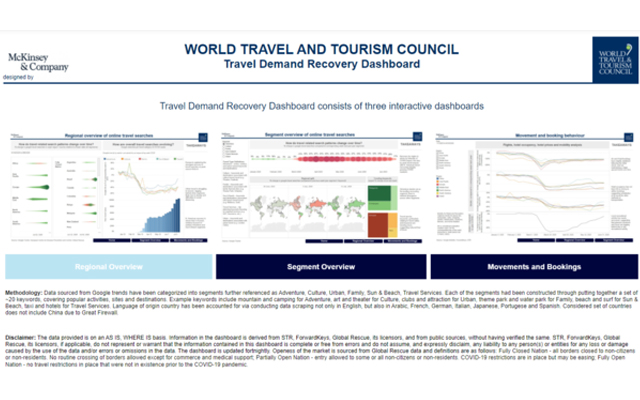
WTTC has launched an in-depth data dashboard highlighting the recovery of travel demand across flights and hotels, as well as revealing the shifting intentions of travellers through online travel searches, so as to help the travel and tourism sector map out its road to recovery.
Developed in partnership with consulting firm McKinsey & Company, the interactive Covid-19 Travel Demand Recovery Dashboard provides users with easy access to qualitative and quantitative travel data at the global and regional level as well as for 33 major countries around the world.
WTTC’s new dashboard offers unique insights into evolving travel demand
The tool tracks travel demand since the beginning of the year, and will be updated on a fortnightly basis. It offers a useful way to navigate through a sea of data reflecting changing travel demand around the world, as countries start to gradually ease travel restrictions and reopen borders.
Free to all WTTC members and non-members, the dashboard presents two distinct views based on Google trends and searches, and bookings via WTTC’s research partners in the project.
Gloria Guevara, WTTC president and CEO, said: “Our dashboard will enable decision makers to track the impact of public policies by monitoring the positive and negative fluctuations of flight and hotel bookings and also online travel searches, as well as consumer confidence.
“Data is essential for businesses, government and other organisations to make informed choices and drive the policy which will revive a sector that has suffered disproportionally due to the pandemic.”
The new data dashboard offers insights through two main avenues. The first is via Google Trends, where all the data sourced has been organised into holiday or trip segments: Adventure, Culture, Urban, Family, Sun & Beach, and Travel Services.
Each segmentation has been devised using a set of 20 keywords, covering popular activities, sites and destinations. The segments provide insights at both the regional level and for key travel and tourism countries, such as the UK, the US, France and Brazil.
The second comes via regional insights through bi-monthly updates on movements and bookings, with flight information from travel analytics company ForwardKeys, as well as hotel occupancy and average daily room rates from research firm STR and the Google Mobility Index, which shows local recreational activity.
In addition, Global Rescue, which offers medical, security, travel risk, and crisis management services, provides data showing the ‘openness’ of each country or key market, in the context of Covid-induced travel restrictions.
As an example, the dashboard shows that while travel search interest is still lower than last year, Europe is leading the recovery with searches now just 20 per cent down from last year. Adventure is the fastest recovering search segment globally, at just 10 per cent down from last year, versus 40 per cent for other segments such as urban, sun and beach, family, and culture. In a number of countries such as France and Germany, adventure travel searches are 50-70 per cent above 2019 levels.
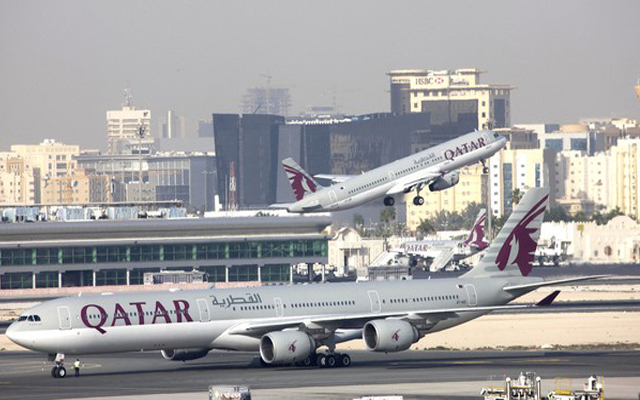
Qatar Airways continues to rebuild its network ravaged by the pandemic, now operating more than 550 weekly flights to over 85 destinations.
The airline has resumed flights to five destinations this month. They are: Adelaide (twice-weekly flights started August 16), Auckland (thrice-weekly flights via Brisbane started August 18), Kigali (thrice-weekly flights started August 3), London Gatwick (daily flights started August 20), and Nairobi (double daily flights started August 3).
Qatar Airways rebuilds network to more than 550 weekly flights to over 85 destinations
Come September, Qatar Airways will restart flights to a trio of destinations: Houston (thrice-weekly flights starting September 2, increasing to four-weekly from September 15), Philadelphia (thrice-weekly flights starting September 16), and Sialkot (thrice-weekly flights starting September 1).
In addition, the airline has increased frequencies to multiple destinations. They are: Cebu (increased to daily from August 12); Clark (increased to six-weekly from August 12); Islamabad, Karachi and Lahore (increased to double daily from August 10); Istanbul SAW (increased to 11 weekly from August 20, then thrice-daily from September 1); and New York JFK (increasing to double daily from September 1).
Upcoming adjustments to flight frequencies include: Ankara (increasing to daily from September 1), Dhaka (increasing to five-weekly from August 23), Kuala Lumpur and Jakarta (both increased to double daily from August 17), and Los Angeles (increased to daily from August 12).
Singapore Airlines (SIA) will commence customer service training for Patient Care Officers (PCO) at Khoo Teck Puat Hospital (KTPH) this September, with programmes tailored to the healthcare institution’s requirements and conducted by the flag carrier’s cabin crew trainers.
This is the first time that SIA is extending its training and development services outside the organisation. Cabin crew trainers will lead a three-day course, which forms part of a complete 20-day training curriculum for the PCOs, focusing on effective interpersonal communication and customer handling, and exemplifying values such as empathy, warmth and person-centred care.
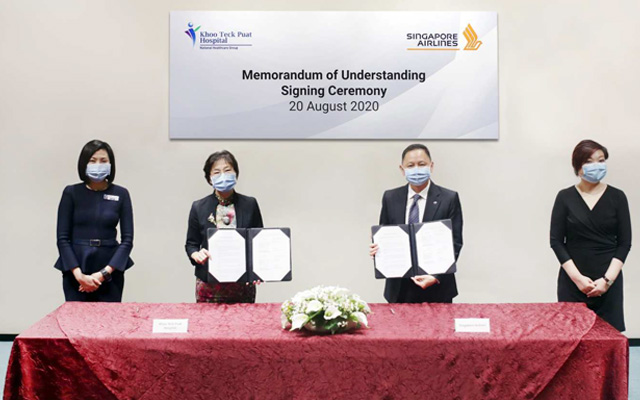
(From left) SIA’s Yen Tan, KTPH’s Chew Kwee Tiang, and SIA’s Goh Choon Phong and Shirlene Teo
The PCO is a new role created to support doctors, nurses and allied health staff in providing quality care service, caregiving and end-to-end care coordination for patients in the ward. It was inspired by the Care Ambassadors programme that KTPH and SIA jointly launched in this April. Care Ambassadors are staff from the SIA Group that have been been deployed to KTPH to support the care teams in the hospital. There are today 60 Care Ambassadors at work.
Yen Tan, COO, Khoo Teck Puat Hospital, said: “We have had a fruitful journey with SIA’s Care Ambassadors, who often put in the extra mile to work with our nurses, helping us to provide care good enough for our loved ones. After experiencing healthcare, many Care Ambassadors have expressed to us the joy of serving patients in healthcare.
“Their enthusiasm and dedication to service inspired us to create a new role – Patient Care Officer. This role will support the clinical work of the nurses and allows our hospitals to provide better end-to-end care for patients. This crisis showed us that there are people who want to serve in healthcare, but they are waiting for the right opportunity.”
Vanessa Ng, SIA’s senior vice president of human resources, added: “We may all be behind masks due to the pandemic, but our signature personal touch and intuitive care remain the key differentiator in the service industry. SIA can support companies and organisations with our experience and expertise in this area, and adapt our courses to meet their specific customer and industry requirements.”
SIA and KTPH are also exploring other potential areas of collaboration beyond the service sector.
This includes the possible application of SIA’s crew resource management practices – a wide range of skills that are used to enhance flight safety and reduce human error – to KTPH’s operations.
Days are starting to look brighter across the region’s tourism and hospitality industry, with more countries resuming economic activities and campaigning for a return of domestic travel.
More industry players are also restarting their engines and announcing fresh developments. Our newsdesk is once again welcoming announcements on new hotel openings and new signings, new tourism products in the marketplace, flights being resumed; and new partnerships being forged to bring companies and the industry forward.
However, the pandemic is still forcing governments into a dreaded cha-cha, where one step forward in returning to normalcy is followed by more steps back because of resurgence in community infections.
Sri Lanka has delayed the August 1 reopening of her international airport indefinitely due to new community cases. Hong Kong has held back the launch of her Spend-to-Redeem Free Local Tours programme for residents due to a spike in local infections.
Australia, which was among the few countries in the region to cope so well with the pandemic and was able to progress far into her reopening plans, is now fighting an outbreak in Melbourne and Sydney.
These days, conversations with industry peers lead us to ask: What will it take for travel and tourism to recover, without multiple frustrating stops and starts?
The easy answer is: a vaccine!
But our reality is a vaccine that is still out of reach.
Complete suppression of economic activities cannot be our solution while we wait for a reliable – and sufficiently lasting – cure to be accessible.
We have to restart. Many tourism and hospitality players are returning to business the right way, with limited capacity and advanced bookings to ensure safe distancing and tracing needs; with contactless technology and altered service processes to minimise risk of transmissions; with enhanced and audited sanitisation and disinfection measures that satisfy government’s requirements.
Equally critical for the sustainable success of our battle against the pandemic is improved public consciousness because the best of health and safety protocols adopted by organisations and governments are useless when people are complacent, careless and ready to leap back into crowds.
At the same time, paranoia over every single, new infection is also detrimental. We saw how a single reported infection in Thailand’s Rayong province in July resulted in domestic travellers retreating and causing hotels bookings there as well as in neighbouring Koh Samet to plunge 80-100 per cent.
The world has to be practical and learn to live sensibly with Covid-19. Only with this can the tourism and hospitality industry begin to recover in a more stable manner.
Karen Yue is group editor of TTG Asia Media. She sets the editorial direction for the company’s stable of travel trade titles and platforms, and produces content for them as well.
Beijing Capital International Airport (BCIA) has introduced a contactless experience for its passengers, in what SITA has called its most extensive biometric deployment to date.
BCIA joins the many airports around the world, including Singapore’s Changi Airport, which are undergoing digital makeovers to create touch-free experiences in a bid to reduce the risk of Covid-19 transmission.
Biometrics and contactless technologies means passengers can now glide through the Beijing Capital International airport in an entirely touch-free experience
As the busiest airport in China and the second busiest in the world, BCIA has completely automated the entire passenger journey using SITA technology – from check-in and bag drop to immigration, security, and boarding.
Passengers only need to enroll once during check-in, before enjoying a seamless, contactless journey through the airport enabled by facial recognition. Improved processing efficiency also means shorter queuing time and allowing for more social distancing among passengers.
SITA Smart Path can significantly speed up passenger processing at BCIA, processing over 400 passengers boarding an Airbus A380 in less than 20 minutes. As well, SITA Smart Path enables hands-free and touchless duty-free payment, enabling quicker processing by removing the need to retrieve and show a boarding pass at check-out.
The deployment included the implementation of over 600 biometric checkpoints through the airport including 250 lanes of automatic gates, 80 kiosks, and 30 self-bag drop stations which will process passengers from international flights.
The biometric technology is currently activated across multiple checkpoints at BCIA including manual check-in, self-service check-in, bag drop, restricted access, security, and boarding.
Battered by the coronavirus pandemic, hotels across Asia-Pacific continued to perform poorly in Q2, with a gradual U-shaped recovery likely, according to Colliers International’s Hotel Insights 3Q2020 report.
The report showed that overall room occupancy and average daily rate (ADR) for hotels in the region decreased to 33.9 per cent and US$60.32, respectively. Revenue per available room (RevPAR) for the region declined by some 69.9 per cent year-on-year.
The Covid-19 pandemic has adversely impacted the hotel sector in Asia-Pacific, with Japan among the region’s lowest performers in Q2; Tokyo cityscape against the backdrop of Mount Fuji in Japan pictured
In terms of room occupancy, most markets witnessed year-on-year declines in excess of 40.0 per cent, while Singapore only declined by 14.5 per cent. Japan, Thailand, Hong Kong and Vietnam led the field in being the top five lowest performers.
In local currency terms, Thailand and New Zealand are the only markets that witnessed year-on-year increases in ADR in excess of 2.0 per cent in Q2. Meanwhile, Singapore’s growth gaming revenue (GGR) is expected to drop between 65-75 per cent this year.
Govinda Singh, executive director and head of hotels & leisure for valuation & advisory services, Asia, commented: “The global economic outlook is expected to remain subdued in the near term given the ongoing uncertainty and risks of new waves of Covid-19. Therefore, the outlook for the hospitality industry in the region is expected to be dimmed in the near term.
“Nonetheless, we believe the hospitality industry will rebound when travel returns, given its legacy of resilience and agility. To prepare for hotels reopening, hoteliers will need to take a cross-disciplinary approach so that hotels are well-positioned to build public trust and offer compelling product and service offerings, enabling hotels to thrive in the new operating environment with an evolving customer mix and preferences.”
Domestic travel will return first while international travel, particularly if it involves air travel, will take a longer time to recover. The weekend leisure segment is expected to lead the recovery, driven by the pent-up demand for travel as international travel restrictions and quarantine measures remain largely in place globally.
Underpinned primarily by essential business travel, the corporate travel segment should be next to return, followed by the extended leisure segment, as consumers’ confidence increases over time alongside the lifting of international travel restrictions. Corporate and group segments will likely be last to recover given the high adoption of technology as an effective platform for business activities.
As markets start to recover, consumers will prioritise health, safety and hygiene when it comes to travel planning and decision making. Personal space will also be more important; instead of large tour groups, independent travel will take precedence and people will likely prefer bespoke holidays and seek out travel experiences with a purpose (such as health and wellness, eco-travel, etc.).
Technology will also take on a more critical role in the traveller ecosystem and be a key tool in the revival of travel. Robots, chatbots, automation, recognition technology, artificial intelligence, internet of things, and virtual reality will become increasingly commonplace.
The gradual lifting of restrictions and the implementation of the Chinese government’s stimulus plans, alongside the promotional initiatives to spur growth and consumption, have encouraged the return of domestic tourism in China. This was reflected in the tourism receipts generated from domestic tourism during the Labour Day holiday in May, which was RMB47.6 million (US$6.8 million), as compared to that of RMB8.3 million (US$1.2 million) during the Tomb Sweeping Day holiday in April.
In line with the improving trend of domestic tourism, the hotel industry in China saw an uptick in occupancy levels month-on-month after bottoming out in February. China has also been in discussions with several countries on the easing of borders for essential business travel.
The most liquid markets in Q2 were Japan and South Korea, while markets such as Hong Kong SAR, China and Taiwan saw little investment sales during the quarter. With international travel restrictions in place, domestic investors remain the dominant group in investment transactions.
In the coming months, investment activity is expected to gain pace as investors move to take advantage of any opportunities that will emerge, although cautious sentiment and stricter underwriting remain key given the evolving situation.
For value-add investors and those looking to create a presence in the region’s key city and resort markets, this may be the right time to explore. With access to mainstream financing likely to be limited in the near term, cashed-up investors who can transact quickly will be in prime position.
Singapore-based Millennium & Copthorne Hotels has let go of 159 employees in the city-state as it restructures its operations against the backdrop of a pandemic-induced tourism crisis.
The exercise impacts about 15 per cent of the firm’s Singapore-based workforce, of which 42 are foreigners, reported local newspapers.
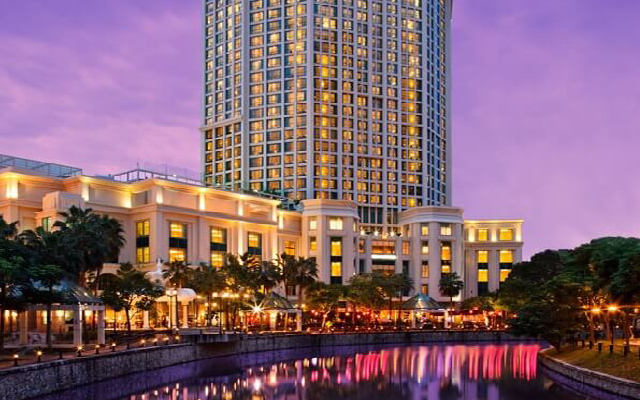
Millennium & Copthorne Hotels, which runs more than 100 hotels worldwide including the Grand Copthorne Waterfront Hotel (above), has retrenched 159 employees in Singapore amid the pandemic
This follows a February retrenchment, although group chief operating officer Kieran Twomey said then that the retrenchment exercise was unrelated to the pandemic.
The company has also tightened expenditure, including reducing salaries for senior management by up to 30 per cent.
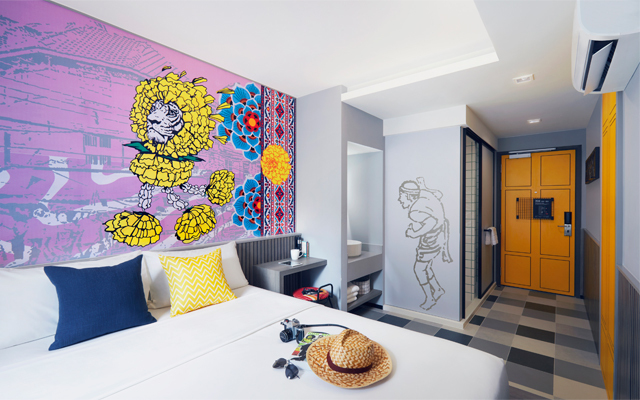
lyf Sukhumvit 8 Bangkok, Thailand
A stone’s throw from Nana BTS Skytrain station is the first lyf property in Thailand. Lyf Sukhumvit 8 Bangkok offers 196 studios, as well as creatively-designed, multifunctional social spaces. These include the Connect co-working and lounge zone, Bond social kitchen, a laundromat, an outdoor terrace and a rooftop fitness area. The property conducts weekly social programmes to build connections and inspire the exchange of new ideas.
InterContinental Chongqing Raffles City, China
Located in Chongqing’s Chao Tian Men Square, the luxury hotel offers 380 keys spread across the 44th to 65th floors in one of Raffles City complex’s eight towers. Facilities comprise a 25m-long infinity pool and fitness centre, while F&B options include Jing Dining Room & Bar serving a blend of Cantonese cuisine and Chonqing’s local specialities, as well as lounges The Maven, and Horizon. Also available are 2,000m2 of meetings and events spaces, including two pillarless ballrooms of 1,250m2 and 450m2.
Quest Palmerston North, New Zealand
Replacing the former Quest Apartment Hotel in Palmerston North, the brand-new, 40-apartment hotel is a joint venture between local iwi, Rangitāne o Manawatū and Wallace Development. Situated in the Palmerston North CBD, the hotel offers studios, one- and two-bedroom apartments. Each studio features a fully equipped kitchenette, while the one- and two-bedroom apartments boast full kitchens, laundry facilities and internet access on-demand. Guests will also enjoy access to local restaurant chargeback and the Quest Pantry Shopping service, which delivers groceries right to the guest’s door.
Holiday Inn Gurugram Sector 90, India
Located in the heart of New Gurugram, Holiday Inn Gurugram Sector 90 will be the first Holiday Inn hotel in the city and the third in the Delhi-NCR area. The 263-room hotel is part of the mixed-use development V3S Sapphire 90, which offers shopping, retail, multiplex, food court, and restaurants. Hotel facilities include an all-day dining restaurant, featuring a bar and lounge, serving Asian, Indian and Western cuisine with both buffet and à la carte offerings. Elsewhere, the Viva All Day Dining offers an interactive dining experience and an urban Aravali landscape view. The hotel also features banquet and meeting rooms spread across 510m2, a rooftop swimming pool, and a 24-hour fitness centre.
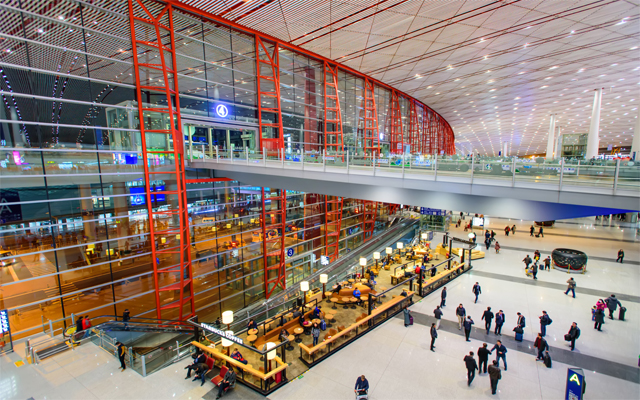
Interior view of Beijing capital international airport terminal No.3
Beijing Capital International Airport (BCIA) has introduced a contactless experience for its passengers, in what SITA has called its most extensive biometric deployment to date.
BCIA joins the many airports around the world, including Singapore’s Changi Airport, which are undergoing digital makeovers to create touch-free experiences in a bid to reduce the risk of Covid-19 transmission.
Biometrics and contactless technologies means passengers can now glide through the Beijing Capital International airport in an entirely touch-free experience
As the busiest airport in China and the second busiest in the world, BCIA has completely automated the entire passenger journey using SITA technology – from check-in and bag drop to immigration, security, and boarding.
Passengers only need to enroll once during check-in, before enjoying a seamless, contactless journey through the airport enabled by facial recognition. Improved processing efficiency also means shorter queuing time and allowing for more social distancing among passengers.
SITA Smart Path can significantly speed up passenger processing at BCIA, processing over 400 passengers boarding an Airbus A380 in less than 20 minutes. As well, SITA Smart Path enables hands-free and touchless duty-free payment, enabling quicker processing by removing the need to retrieve and show a boarding pass at check-out.
The deployment included the implementation of over 600 biometric checkpoints through the airport including 250 lanes of automatic gates, 80 kiosks, and 30 self-bag drop stations which will process passengers from international flights.
The biometric technology is currently activated across multiple checkpoints at BCIA including manual check-in, self-service check-in, bag drop, restricted access, security, and boarding.