


Hate matters: Anti-Asian Hate is influencing travel intentions

Shall we take a moment to talk about the Anti-Asian Hate movement that is raging in the US? On the surface, it seems to have a distant relation to travel and tourism since these hate crimes are mostly aimed at the resident Asian American and Pacific Islander (AAPI) community.
However, look just a little deeper and you will realise it has a significant effect on travel and tourism.

When I did a profile interview late last year with Olivier-Henry Biabaud, CEO of TCI Research, who founded the Resident Sentiment Index model to help destinations gauge and benchmark the level of tourism support they have in their community, he told me that residents are the face of a destination, and it only takes a minority of angry residents who lash out against tourists and tourism to establish a bad reputation for the destination, which will be long and pricey to repair.
Of course, Olivier was then commenting specifically about destination residents who are opposed to the concept of tourism in their backyard, and not racism-fuelled hate crimes. But for Asian consumers across the globe watching news about the US’s Anti-Asian Hate movement and taking in social media posts by AAPI citizens who are coming out with their own stories of abuse, there is little difference. Many would wonder if their skin would attract the same treatment should they go to the destination as tourists.
This consideration will resurface when they make their travel plans for the future.
That’s not just my imagination – a recent survey by Dragon Trail International on Chinese traveller sentiments found that friendliness towards Chinese travellers ranked first as a travel decision influencer by 65 per cent of respondents. That consideration outranks other critical factors such as zero confirmed Covid-19 cases, the absence of mandatory quarantines, flight resumption and personal access to a Covid-19 vaccine.
The same study, conducted from February 22 to March 3 this year, also found that more than 80 per cent of respondents rated the US as unsafe.
Unfriendliness to travellers can come in a wide spectrum, from a lack of understanding about their unique needs, such as dominant language and diet, to petty and deliberate negligence by service staff, and to severe and possibly fatal attacks.
Many people who have visited, studied or lived in the US as well as AAPI citizens have come forth with their own positive experiences of hospitality and friendship, in hopes of highlighting the presence of a welcoming majority.
Unfortunately, these messages are drowned out by bad news, which gather the most social media momentum.
With travel in a pandemic era, and even in the post-vaccination era, so much more tedious to arrange, how many consumers would risk ruining their rare leisure trip with a possible unfriendly experience? Unlike the AAPI community who has to live with and battle the problem at home, the Asian travelling community has a choice of where they want to holiday.
And they will likely pick somewhere safe, welcoming, and worth their time and money.
Karen Yue is group editor of TTG Asia Media. She sets the editorial direction for the company’s stable of travel trade titles and platforms, and produces content for them as well.
ATTA names new president

Veteran tour operator, Sisdivachr Cheewarattanaporn, has been elected as the new president of the Association of Thai Travel Agents (ATTA).
Sisdivachr, who previously served in the position from 2011-2014, had beat Mingkwan Metmowlee, president of ASEAN Tourism Association (ASEANTA), to win the election on Thursday (March 25).

In a speech after his win, Sisdivachr pledged to take urgent action to save Thailand’s tourism industry, with aims of reopening the country to international tourists by 3Q.
To that end, he will work with airlines to launch a digital Covid-19 vaccine passport to lure foreigners back to the country, as well as continue appealing to the government for financial aid to help tour operators impacted by the Covid-19 pandemic.
Additionally, he will work with the private sector to train the tourism workforce, create marketing tools, and develop new products and services for tourists.
Sisdivachr said: “My aim is to save Thailand’s tourism industry and reclaim the country’s position as top tourist destination on the global map.”
Phuket to welcome vaccinated foreigners from July 1

Foreign travellers who have been fully vaccinated will be allowed entry into Phuket without quarantine from July 1.
Deputy governor Pichet Panapong was quoted by the Bangkok Post as saying that the infectious diseases committee approved the proposal on Wednesday (March 24).

Noting that Phuket has recorded zero new Covid-19 cases for 89 days, Panapong said that the holiday island is in “urgent need for foreign tourists… to stimulate the economy and tourism sector”.
Before reopening, Phuket health authorities plan to acquire 930,000 doses of Covid-19 vaccine to inoculate 70 per cent of the local population in order to achieve herd immunity.
According to Thailand’s tourism minister Phiphat Ratchakitprakarn, a similar reopening scheme will also be rolled out in Pattaya, reported Nation Thailand. He added that the ministry plans to procure more vaccines with the aim of reopening more destinations across the country, including Chiang Mai, Krabi, Phang Nga and Surat Thani, by October 1.
Global airports to bleed US$94b in 2021: ACI World

Some 4.7 billion fewer passengers are projected to travel by this year-end, representing a decline of 47.5 per cent in global passenger traffic, according to a report by Airports Council International (ACI) World.
This is estimated to equate to a loss in revenue of more than US$94 billion this year, which is half of the projected baseline.
The analysis was published in the Advisory Bulletin: The impact of Covid-19 on the airport business and path to recovery.
As prospects for a recovery in 2021 begin to emerge, ACI World estimates that different regions of the world will recover at different rates. At country level, markets having significant domestic traffic are expected to recover in 2023 to pre-Covid-19 levels, while markets with a significant share of international traffic are unlikely to return to 2019 levels until 2024 or even 2025 in some cases.
ACI World has said an interoperable health data trust framework to facilitate safe border reopening and cross-border travel must be established to support this recovery. ACI added that it supports any system which will allow testing and vaccination data to be shared consistently, effectively, and in a way that protects the personal data of those that use it.
“The world is embarking on the biggest vaccination campaign in history, and we see positive indications in countries with high rates of vaccination and ACI World has discerned an escalation of these encouraging signs and prospects for recovery with a surge in travel in the second half of 2021 expected,” ACI World director general Luis Felipe de Oliveira said.
“Despite this, Covid-19 remains an existential crisis for airports, airlines and their commercial partners and we need support and sensible policy decisions from governments to ensure that aviation can fuel the global economic recovery.
“We hope an upsurge in confidence in air travel provided by vaccination and safety measures should result in the number of people travelling outside of their countries will start this spring and significantly increase by mid-year.
“Aviation recovery will not take-off, however, without a coordinated and globally-consistent approach to vaccination and testing, coupled with a safe and interoperable methods of sharing testing and vaccination information.”
With regards to economic impact, as a consequence of uncoordinated travel restrictions combined with small domestic markets, Europe is forecast to remain the most affected region in absolute terms with an estimated drop in revenues of more than US$37.5 billion for the full year 2021 compared to 2019.
In relative terms, the Middle East and Europe are forecast to suffer the biggest hits with decreases of 58.9 per cent and 58.1 per cent, respectively. Asia-Pacific is the region with comparatively the least impact, but it is still expected to experience a very significant decrease of 40.3 per cent against the projected baseline.
“Upsizing” could be one of the next major travel trends, says GlobalData

While the pandemic has upended the finances of many consumers, at the same time, there are those who have managed to bypass the financial squeeze and incidentally become efficient savers.
This trend should not be overlooked by tourism companies which need to realise that not all travellers will be wanting a budget-friendly option for their next holiday, said GlobalData.
With saved cash that has accumulated during the pandemic, many travellers may be planning to spend more than usual on their next trip.
According to GlobalData’s survey, when global respondents were asked if they were concerned about their personal financial situation, 13 per cent stated that they were ‘not concerned’. Although this is still significantly less than the 34 per cent that stated they are ‘extremely concerned’, it means that over one in ten of the global travel market could be financially unaffected by the pandemic and have even saved a considerable amount.
Ralph Hollister, travel and tourism analyst at GlobalData, commented: “Many of the travellers that make up this 13 per cent are likely to be white-collar workers that can work effectively at home. Due to spending the vast majority of their time being confined to their homes in the past year, the urge to travel would have built up. This urge, combined with a significant increase in savings, could mean that many of these travellers will have developed a ‘treat yourself’ mentality, to combat the impact of the pandemic which has increased boredom and frustration for many.
“This mentality could be present as these consumers start planning their next holiday, which could result in them spending more on room upgrades, business class flights and higher quality rental vehicles.”
Hollister added that many of these consumers who have been unaffected by the pandemic have saved not only on commuting, eating out and other recreational activities, but also, by not booking a holiday last year, or by having their cancelled trip refunded.
“This could mean that for their next trip, they will go bigger and better on more luxurious travel services and products. This trend could also be driven by a ‘now or never’ mentality, as when travellers have the opportunity to go on holiday, they will spend significantly more and stay for longer in case another situation like the Covid-19 pandemic reoccurs.”
Covid-19 robbed global tourism of US$4.5 trillion in 2020: WTTC

The global travel and tourism sector suffered a loss of almost US$4.5 trillion in 2020 due to the impact of Covid-19, revealed WTTC research.
The tourism body’s annual Economic Impact Report (EIR) showed the sector’s contribution to GDP dropped a staggering 49.1 per cent. In comparison, the overall global economy dropped by just 3.7 per cent last year.
Vast losses run up during 2020 paint the first full picture of a sector struggling to survive in the face of crippling travel restrictions and quarantines, which continue to threaten the recovery of the world economy.
Altogether, the sector’s contribution to global GDP plummeted to US$4.7 trillion in 2020 (5.5 per cent of the global economy), from nearly US$9.2 trillion the previous year (10.4 per cent).
In 2019, when global travel and tourism was thriving and generating one in four of all new jobs around the world, the sector contributed 10.6 per cent (334 million) jobs globally.
However last year, as the pandemic ripped through the heart of travel and tourism, more than 62 million jobs were lost, representing a drop of 18.5 per cent, leaving just 272 million employed across the industry globally.
These jobs losses were felt across the entire ecosystem of travel and tourism, with SMEs, which make up 80 per cent of all businesses in the sector, particularly affected. Furthermore, as one of the world’s most diverse sectors, the impact on women, youth and minorities was significant.
However, the threat persists as many of these jobs are currently supported by government retention schemes and reduced hours, which without a full recovery of travel and tourism could be lost, said WTTC.
The global tourism body fears governments cannot continue to prop up threatened jobs indefinitely and must instead turn to the sector to help its recovery, so it can power the global economic revival by saving businesses and creating much needed new jobs and saving the millions of livelihoods that depend on the sector.
The report also revealed a shocking loss in international travel spending, which was down 69.4 per cent on the previous year. Domestic travel spending fell by 45 per cent, a lower decline due to some internal travel in a number of countries.
Gloria Guevara, WTTC president & CEO, said: “With the sector’s contribution to GDP plunging by almost half, it’s more important than ever that travel and tourism is given the support needed so it can help power the economic recovery, which will be instrumental in enabling the world to revive from the effects of the pandemic.”
While 2020 and the winter of 2021 have been ruinous for travel and tourism, with millions around the world in lockdown, WTTC research showed that if international mobility and travel is resumed by June this year, it will significantly boost global and country level GDPs – and jobs.
According to the research, the sector’s contribution to global GDP could rise sharply this year, up 48.5 per cent year-on-year. The research also showed that its contribution could almost reach the same levels of 2019 in 2022, with a further year-on-year rise of 25.3 per cent.
WTTC also predicted that if the global vaccine rollout continues at pace, and travel restrictions are relaxed just before the busy summer season, the 62 million jobs lost in 2020 could return by 2022.
Regeneration rising

Move over, sustainable travel. The pandemic has birthed a call for a model of tourism that builds back better by going one step further than the motto of reaching net-zero. Regenerative tourism, the latest buzzword to enter the green scene, calls for a paradigm shift long overdue. Seen as a leap forward from simply developing tourism sustainably, regenerative tourism encourages travellers to leave a place better than they found it.
“Regenerative tourism gives back more than it takes. It should create measurable beneficial impacts for local community and ecosystems,” explained Jeffery Smith, vice president of sustainability for Six Senses Hotels Resorts Spa.
“The goal of sustainability is to minimise negative impacts in these areas to the point where that business is able to survive. Regenerative tourism seeks to maximise the positive impacts; it should thrive.”
As tourism slowly emerges from the shackles of Covid-19, more stakeholders are sounding the call for the industry to build back better. Last June, six NGOs including the Centre for Responsible Travel and Sustainable Travel International united as the Future of Tourism Coalition with the goal of placing destination needs at the centre of tourism’s new future.
Twenty-two industry stakeholders, including tour operators like G Adventures and The Travel Corporation, NTOs such as the Jordan Tourism Board, and NGOs like the World Wildlife Fund, have committed to the coalition’s 13 guiding principles. These include choosing quality over quantity, demanding fair income distribution, mitigating climate impacts, closing the loop on resources, and operating business responsibly.
Booking agency Regenerative Travel released a white paper in December 2020 exploring how travel and hospitality stakeholders can employ regenerative principles to benefit both their surrounding areas and the local communities, without causing further damage. Included are case studies from hotels like Six Senses and Gal Oya Lodge in Sri Lanka which may have been practicing regeneration, without explicitly using that terminology.
Five regenerative principles are detailed in the paper, including whole systems thinking which considers all stakeholders in every decision, as well as the ripple effect those choices have on both animate and inanimate systems; honouring sense of place which entails adopting a holistic understanding of places; as well as community inclusion and partnership.

Ramping up the regeneration focus
Some Asia-Pacific tourism stakeholders, long focused on a regenerative model, are making strides in progressing such efforts.
One such player is Asian Trails, which has always held regeneration close to its heart, but had tagged such actions as “responsible tourism” and “sustainable tourism”, shared its group sustainability coordinator, Ameer Virani.
“The move towards talking about regeneration came as a result of the launch of the regenerative travel movement in mid-2020 and growing awareness of the term and what it means. This helps us communicate more accurately what we are trying to do,” he added.
With a greater focus on regeneration, in July 2020, Asian Trails embarked on a rigorous evaluation process of all its day excursions, multi-day tours and animal experiences to identify its most responsible products, shared Virani.
Among other criteria, its evaluation guidelines consider direct support to small and social businesses, eco-friendly accommodation and transport, supporting community-based tourism, and financial or in-kind contributions to social or environmental causes.
Virani said these guidelines will also help its staff develop more regenerative products in future. “Our process is, of course, not an exact science but we really want to highlight those products that we believe have net positive outcomes on local people and places,” he added.
As well, the company launched a refillable water bottle initiative in early 2020, which has yet to be fully implemented due to the pandemic.
Virani explained that with the initiative, beyond the aim of reducing the use of single-use plastic bottles – an instance of sustainability – the company intends to also regenerate by donating US$1 from the sale of each refillable water bottle to a local drinking water or plastic reduction project to ensure wider community and environmental benefits.
Another DMC that also leveraged the pandemic pause to rethink its priorities is Discova. “We needed to reflect on the impact tourism has on our communities and the environment. This has allowed us to take things one step further than a mere sustainable tourism model, focusing instead on a regenerative model,” said Eileen Yee, regional general manager – Cambodia, Japan, Myanmar, Singapore and Education Travel, Discova.
In line with that new vision, Discova has undertaken a reforestation programme in Siem Reap to help regenerate the local environment, and started working with communities in Bali to grow organic vegetables, diversifying their crops in a mutually beneficial way.
Going down the regenerative route too is Six Senses, which has committed funding outside hotel operations designed to give back at the local level, on projects with clear objectives for local communities and ecosystems, shared Smith.
For instance, the group has installed free filters for local communities at Six Senses Yao Noi in Thailand, providing more than 105,000 people with access to clean drinking water.
Six Senses involves guests in its regenerative programming, said Smith. Since 2019, guests at Six Senses Con Dao in Vietnam has helped release endangered sea turtle hatchlings out to sea on the resort’s very own beach, via partnership with the national park.
As well, all Six Senses have an Earth Lab dedicated to schooling guests on its sustainability efforts through free workshops to learn tips like plastic reduction at home, crafty upcycling, and gardening. Guests also enjoy complimentary visits with community partner organisations and scientists to learn about regeneration projects outside the hotel.
Last August, Six Senses Yao Noi launched the Junior Eco Warrior programme for young guests to contribute in the preservation and regeneration of the island’s flora and fauna. Ways they can do so include sowing seeds, picking trash on the beach and DIY-ing them into treasure, as well as building nests from recycled timber for the resort’s resident hornbills.
A regenerative recovery
A post-vaccine return to travel has been predicted to be one that is greener and less crowded, driven by a new breed of more socially conscious travellers. Tourism stakeholders who invest in regenerative principles, therefore, are projected to gain favour with travellers who will be searching for more meaningful and purpose-driven experiences.
“The pandemic has led many to rethink, reflect on life, and contemplate the impact that we have on the things around us. This may mean that travellers will want to derive more from a holiday than just lazing on the beach and having fun,” said Yee.
“Thus, we believe purpose-driven experiences will gain a broader audience and become a bigger market for us – and regenerative tourism will be a way to satisfy this market.”
Having always placed sustainability at its core agenda, Discova intends to build on that firm foundation to further its green credentials. “Post-Covid, we will make available tour products that offer travellers more than just sightseeing, with rewarding experiences that give back to the communities, help the communities to grow, and hopefully, serve to regenerate their homes,” said Yee.
As tourism players ready for the rebound, Smith warned that those who lag behind the regenerative curve may ultimately find themselves on the losing end.
“Those (businesses) which do not responsibly mitigate negative impacts risk falling behind, and especially if – or when – the shift comes from inbound operators and OTAs. Similar to the abrupt shift we saw with elephant tourism in Thailand, some businesses may suddenly be left in the cold,” he said.
“The benefits for tourism players that shift to a regenerative model include reduced risk in the marketplace as well as increased support from local stakeholders and more reliable supply chains.”
Regenerative travel is a long-term endeavour, and once established, should reduce strategic risks, added Smith. “It is much easier to open a business that ignores externalities like public health or wildlife habitat, however, once those are eroded, that business will struggle to survive,” he said. “Going beyond risks, regenerative travel adds value to any tourism product through the fantastic authentic experiences it creates.”
As to how more tourism businesses can be encouraged to adopt regenerative practices, Virani said: “Consumers will be able to drive the regenerative travel trend, along with local governments who will hopefully play a more active and effective role in destination management in the future. A limited number of businesses will set the trend, but others will only follow if consumers and those managing destinations drive them in the right direction.”
He concluded: “Regenerative tourism is a no-brainer. It is in the best interests of our destinations and, as a result, our bottomline. Simply being sustainable is no longer good enough and never should have been considered that way.”
New platform helps travellers book ASQ stays in Thailand
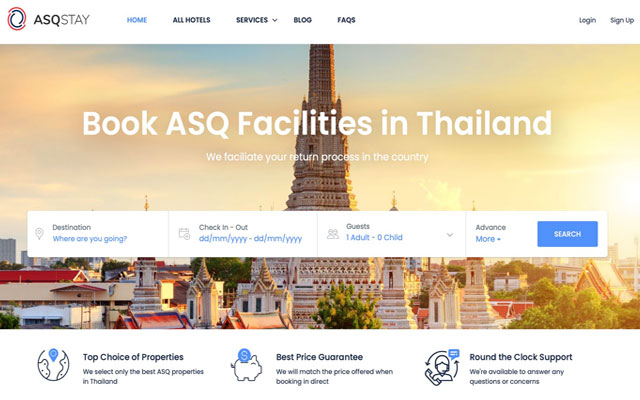
A new platform has been launched to help travellers book their alternative state quarantine (ASQ) stays in Thailand, uniting the country’s quarantine hotels on one platform.
Following its soft launch in December 2020 with 15 hotels, ASQ Stay presently has over 50 hotels on its site and has serviced over 200 travellers.
According to founder David Zilber, who comes from a travel start-up background, the idea was born when he was researching hotels to quarantine for himself on his way from France to Thailand.
“I looked up the process of getting into Thailand during Covid and the resources available to book a quarantine hotel. I felt the solutions existing in the market were not very elaborate. I had to call (the hotels) up one by one; there was no customer service and nobody to help in the process,” he explained.
After browsing Facebook groups and checking the feedback of other travellers to Thailand, he found many other confused travellers sharing similar experiences. “There were so many things they had to research themselves. Hotels were also new to the process so they didn’t really have the service or the teams. Hence, I felt there was a gap for a company to help you out – (a cross) between a concierge service and booking platform,” he shared.
On ASQ Stay, each hotel listing details what is included in each package. Travellers can also opt to rent or buy add-ons, such as treadmills, dumbbells and coffee machines, to enhance their quarantine experience.
“It’s really a one-stop shop to all the services; where we stand out is not just the booking process, but the customer support. Sometimes, clients have already checked into the hotel, and they’re not happy with the food. We’ve tried to fix that, for example, by having the hotel provide a microwave in the room,” Zilber elaborated.
ASQ Stay’s prices are the same as booking direct. “We receive a commission from the hotel, so we don’t have to upsell the room,” said Zilber.
He added that the platform is a pop-up product in response to the pandemic, but with more and more customer bookings everyday, ASQ Stay sees further potential in the market and is currently looking to expand to other destinations. “Now, we’re looking at Hong Kong as another destination to launch the platform, as a three-week quarantine is required (for incoming foreign travellers) and there is nothing similar (on the market),” Zilber concluded.
First signs of travel recovery in India emerges
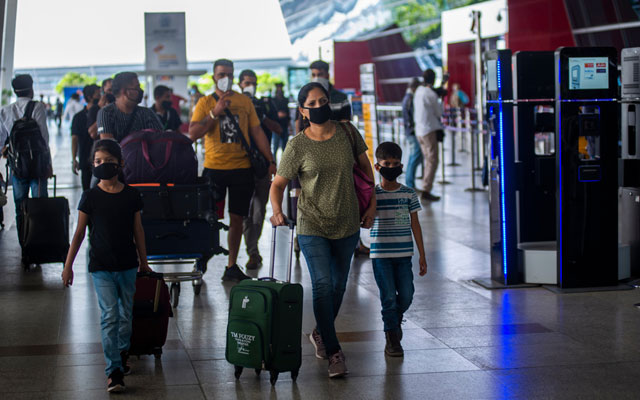
Domestic air travel in India has bounced back to 84 per cent of 2019 levels, while air bubble pacts have spurred the restoration of international seat capacity into the South Asian country, according to a ForwardKeys study.
Following the Indian government’s announcement that domestic flight operations could resume from May 25, 2020 through a calibrated approach, ForwardKeys’ air ticketing data reveals that domestic air travel has started, although the path to recovery has been bumpy.

The upward trajectory was disrupted from mid-June to mid-July, but quickly regained steam thereafter. In the first week of March 2021, domestic passengers had bounced back to 84 per cent of 2019 levels. Back in the lowest month of April 2020, domestic passengers were at 14 per cent of 2019 levels.
International commercial passenger flights have been suspended for over a year now – since March 23, 2020 when the national lockdown restrictions were imposed.
From Q3 last year, India began setting up air bubble agreements with various countries. Since October 22, 2020, it started permitting foreigners to enter India on all visas, except for tourist visas. As of March, India has formed travel bubble arrangements with 27 countries.

Spurred by India’s incremental expansion of air bubbles over the past eight months, international air travel seat capacity into India has clawed back steadily, from 10 per cent of the pre-pandemic level in June 2020 (June 2020 vs June 2019) to 34 per cent in February 2021 (February 2021 vs February 2020).
However, with leisure visas still under suspension and Covid-19 uncertainties looming like many other parts of the world, visitor arrivals into India remain expectedly low, with visitor arrivals recording 14 per cent of the pre-pandemic level in June 2020 (June 2020 vs June 2019) and 28 per cent in February 2021 (February 2021 vs February 2020).
Since June 2020, taking the lead from India’s air bubble developments and eyeing the leisure travel comeback in one of the biggest inbound tourism countries, airlines have been cautiously restoring international seat capacity into India and repositioning themselves to secure a head-start.
The upward trajectory in seat capacity has been sharper than the clawback in visitor arrivals. In the first two months of 2021, international seat capacity into India recorded 33 per cent of 2019 levels, while visitor arrivals lagged at just 26 per cent of 2019 levels.
The source markets mix has shifted for Destination India due to the pandemic. “Leading the preliminary recovery is the US (76 per cent of 2019 levels), followed by Canada (47 per cent), the UK (17 per cent), Europe excluding the UK (11 per cent), Australia and New Zealand (two per cent),” said Jameson Wong, APAC director at ForwardKeys.

Comparing April to September 2021 against the same six months in 2019, a significant shift in source markets is evident.

“The US, which used to account for 31 per cent of actual air tickets into India pre-Covid from April to September 2019, has doubled, up by 60 per cent for the next six months. Canada, which used to account for six per cent, now has grown to 10 per cent. Is India ready to welcome North American travellers?” asked Wong.
The UK, a traditional source market which used to constitute a sizeable 13 per cent, has shrunk by more than half to only six per cent. Europe, excluding the UK, has slid from 16 per cent to 12 per cent. Australia and New Zealand, combined, has dropped drastically from six per cent to one per cent.
Though not yet reflective of the true estimate of the leisure travel rebound as India still has leisure visas under suspension, such early signs of pandemic shifts in the traveller source markets to Destination India indicates the need for a change in planning and, exciting, new business opportunities, top-down. From government level to operator level.







Costa Cruises has made two leadership appointments in preparation for the resumption of its cruises and its long-term growth.
Mario Zanetti has been promoted to president of Costa Cruises, taking a role that had been temporarily filled by Michael Thamm, group CEO, Costa Group & Carnival Asia.
In his new position, Zanetti will oversee Costa as a unique brand across the world, including Asia, with the aim of guiding Costa to strengthen its leadership in Europe, South America and Asia, and ensure profitable and sustainable growth in the long-term.
Zanetti started his journey with Costa back in 1999 in the revenue management unit. In 2017, he was named president of Costa Asia; and since July 2020, he has been back in Genoa, as chief commercial officer (CCO) of Costa Cruises Europe.
Meanwhile, Roberto Alberti has been appointed CCO of Costa Cruises, a position previously held by Zanetti. Alberti will be responsible for the overall commercial operations, including sales, revenue management and marketing worldwide, reporting to Zanetti.
With a career in Costa Cruises spanning over 15 years, Alberti worked his way up through various positions in Italy and abroad. In 2016, he joined the CEO Office, reporting to Thamm. After the position of vice president strategic development, in 2019, he was appointed senior vice president and chief strategy officer of the Costa Group, contributing to the definition of a sustainable development plan, the global source market strategy and brand positioning.
Both Zanetti and Alberti will be based in Costa Cruises headquarters in Genoa.