

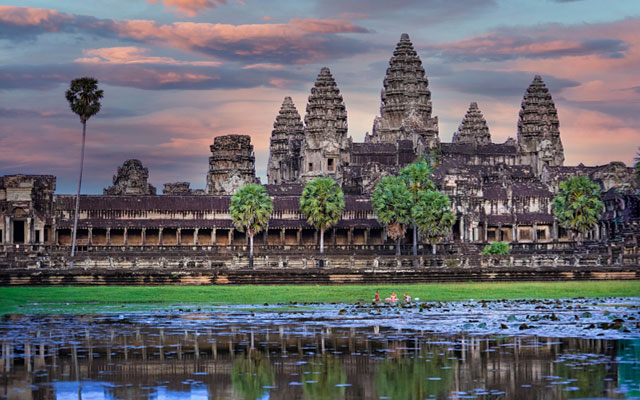
Cambodia’s tourism players are celebrating after a snap decision on Sunday (November 14) saw the nation become the first in South-east Asia to fully open to vaccinated travellers with no restrictions.
“Christmas has come early for the tourism and hospitality industry in Cambodia,” said Nick Ray, consultant for CamDMC, on the news that the country has fully opened to fully inoculated tourists.
Prime minister Hun Sen made the surprise announcement on Sunday that from the following day (November 15), fully vaccinated travellers from any destination are welcome without quarantine.
Inbound travellers must present a negative PCR test result taken 72 hours before departure and undergo a free rapid test on arrival. Once given the all-clear – an estimated 10- to 15-minute wait – arrivals are free to enter the country with no quarantine or restrictions on movement.
The requirement for health insurance has also been scrapped. While the visa-on-arrival service remains suspended, tourist e-visas can be applied online in advance of travel.
Virginie Kury, general manager at Asian Trails Cambodia, said: “This means we’re back to business and the economy will slowly be able to restart. Guides, hoteliers, restaurateurs and all staff in tourism businesses will be able to breathe again by earning a decent salary.”
The move also means Cambodia is the only South-east Asian country to fully reopen with very few restrictions, presenting an opportunity the industry is hoping to seize.
Jacques Guichandut, managing director of All Dreams Cambodia, said: “This means we are the sandbox for South-east Asia and can really be seen as one destination. It will encourage the tourism sector to reconsider Cambodia and change the image we had.”
The announcement supersedes previous plans to stagger Cambodia’s reopening. This was slated to start on November 30, with vaccinated arrivals spending five days at the coastal resort of Sihanoukville, Koh Rong island or the Dara Sakor area of Koh Kong.
The Cambodian premier said the full opening was due to Cambodia having vaccinated more than 88 per cent of the population. Third booster jabs are being rolled out countrywide.
In spite of the full opening, Guichandut predicts initial recovery will be slow, and will only start to pick up in 1Q2022. With Cambodia’s inbound international arrivals pre-Covid predominantly from Asia, he added predicting a full recovery is tough as quarantines continue to be widespread across the region.


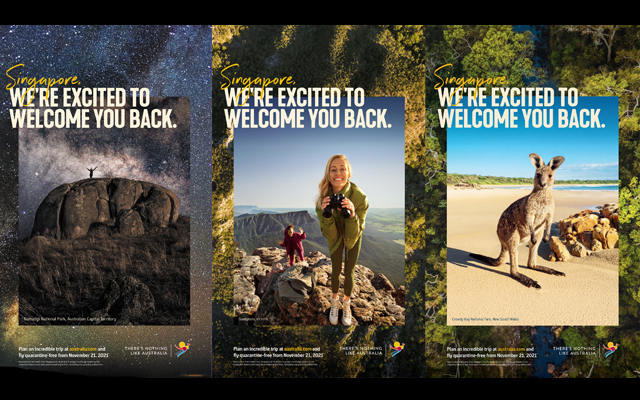










Tourism Australia has kicked off a campaign to welcome Singaporean citizens back to Australia, ahead of the opening up of quarantine-free travel for vaccinated citizens from Singapore to Australia on November 21.
The two-phase campaign, with the tagline We’re Excited to Welcome You Back, features destination imagery of the participating jurisdictions of New South Wales, Victoria and the Australian Capital Territory. It commenced on November 12, with the next phase to roll out on November 21.
“As one of our largest inbound markets, we have long held strong tourism ties with Singapore, so we are really excited to be welcoming this market back,” said Brent Anderson, Tourism Australia regional general manager South and South-east Asia.
He noted that Australia has long been a popular travel destination for Singaporeans, who spent A$1.53 billion (US$1.12 billion) on their travels here in 2019, and with more than 80 per cent repeat visitation.
“Australia’s relative isolation from the rest of the world, coupled with its sparsely populated land and natural wonders, have never been more precious and desirable, and we hope Singaporeans will jump on the opportunity to fall in love with Australia all over again,” said Anderson.
As part of the campaign, Tourism Australia is working with a range of key distribution partners to drive bookings and boost recovery for Australia’s hard-hit tourism economy, including Chan Brothers, UOB Travel, Dynasty Travel, CheapTickets.sg and Klook who will provide tactical offers aimed at stimulating travel to Australia from Singapore. Details of the available travel offers and packages are available on australia.com.
Tourism Australia is also partnering with Singapore Airlines and Qantas to support the recovery of the airline industry and recommence services into Australia in the coming months.