

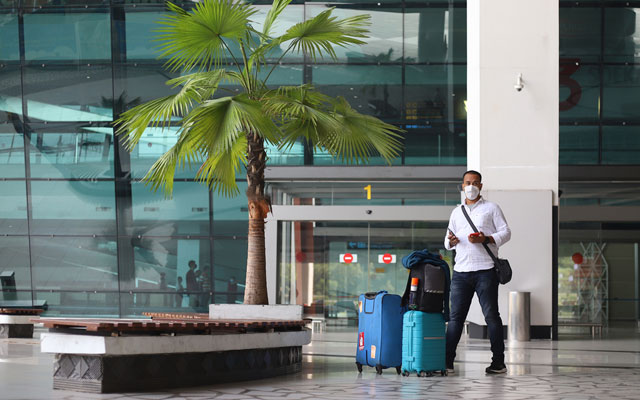
Foreign visitors who have not been vaccinated against Covid-19 will be barred from entering Indonesia from Tuesday (July 6), as authorities battle to contain an outbreak of the highly-infectious Delta variant.
In an announcement on Sunday, the government said that foreign nationals entering Indonesia will need to show a vaccination certificate and a negative PCR test result.
A vaccination certificate is also required for air travel within the country, both for international and domestic travellers.
The quarantine period for foreigners will also be increased from five to eight days, with a PCR test taken on Day 1 and another on Day 7, coordinating minister of maritime and investment Luhut Binsar Panjaitan, who spearheads the Emergency Public Activity Restrictions, said in a statement.
Unvaccinated Indonesian passport holders may enter the country by presenting a negative PCR test, and they will be vaccinated upon arrival.
Sandiaga Uno, minister of tourism and creative economy, expressed his support for the tightened border measures during a press conference on Monday.
“We are also calling (on industry stakeholders) to close all destinations and postpone all tourism and creative economic activities across the country,” he said, adding that activities such as the Work from Bali programme and vaccine tours have been put on hold for now.
“We understand that this is bitter for the industry, but Covid-19 data points to an emergency situation and we cannot take any more risks and must put the public’s health first,” Sandiaga said.
However, he added, preparations for the reopening of borders will go on. “The plan to reopen Bali, for example, must meet three pre-conditions: Around 70-80 per cent of the local population must be vaccinated, the end-to-end implementation of (cleanliness, health, safety and environment) CHSE protocols must be finalised, and the infection rate must be below 100. We have to keep our spirit and work hard to achieve those preconditions,” Sandiaga said.
He added that the government would speed up the rollout of the recently-announced 60 billion rupiah (US$4.2 million) incentive package to the tourism industry.

















Korean Air has finalised its post-merger integration (PMI) plan with Asiana Airlines after receiving approval from the state-run Korea Development Bank (KDB).
The PMI plan had been submitted to the KDB on March 17, five months after Korean Air signed a deal to acquire Asiana’s new shares and perpetual convertible bonds.
For three months, the KDB reviewed the PMI plan and made revisions in consultation with Korean Air, the Ministry of Land, Infrastructure and Transport, and other relevant agencies.
The finalised PMI plan includes integration plans for the airlines’ full-service carriers (FSCs) and low-cost carriers (LCCs), measures to resolve restrictions of holding companies stipulated in the Fair Trade Act, employment retention and succession of collective agreements, and plans to effectively reorganise relevant subsidiaries.
Once the PMI plan has been finalised, Korean Air will proceed to integrate with Asiana after receiving business combination approvals from relevant authorities.
The newly integrated global airline will increase operational efficiency of overlapping passenger and cargo routes, while diversifying its schedules and expanding opportunities for new routes, which will increase customer benefits and create integrated synergy by reducing costs, Korean Air said in a statement.
It added that the integrated FSCs and LCCs are expected to improve efficiency by achieving economies of scale, and will act as an opportunity for the growth of relevant contractors, partners and other companies in the aviation industry.