

Brought to you by Macao Government Tourism Office (MGTO)
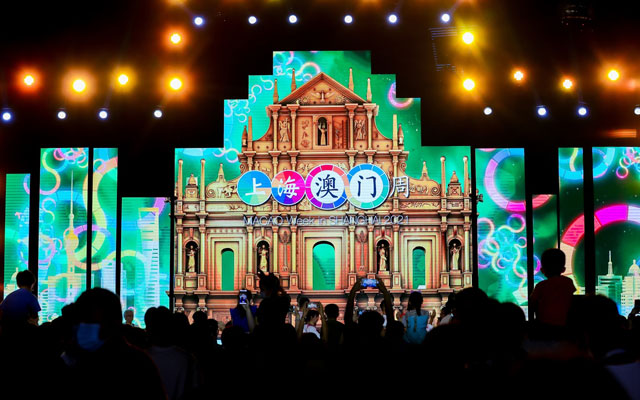
In a big show of all the exciting experiences Macao has to offer, the Macao Government Tourism Office (MGTO) threw a recent mega party along Yuanmingyuan Road Pedestrian Street at Waitanyuan, Huangpu District in Shanghai.
The Macao Week in Shanghai, held from June 3 to 7 this year, brought together 40 different enterprises and businesses to showcase the territory’s tourism, trade and commerce, culture and creativity, sports, entertainment and many more “tourism +” dimensions.
Some 300,000 visitors enjoyed 117 sessions of artistic and cultural performances, such as dragon and lion dances, Portuguese folk dances, and Wing Chun martial arts demonstrations performed by the Inventory of Intangible Cultural Heritage of Macao, as well as fun entertainment provided by the lovable Macao tourism mascot, MAK MAK, along with Macanese singers and music band Tuna Macanese.

Another stunning element in the line-up was a series of mapping shows that were projected on the façade of the Gothic-style Union Church, bringing sights of Macao right before the eyes of Shanghai residents.
To spur Shanghai residents into travel planning, some RMB110 million worth of special travel deals were offered in the form of air tickets, hotel accommodation, dining and other tourism products for sale at the roadshow and supporting platforms during the Macao Week in Shanghai.
Harnessing multiple channels
In support of Macao Week in Shanghai, MGTO utilised various online and offline channels across the mainland. Information was distributed through official accounts on WeChat, Weibo, Xiaohongshu and Douyin, as well as TV, newspapers, travel apps and more.
Sixteen KOLs specialising in travel, lifestyle, culture, gastronomy and other fields conducted 13 livestreams and posted content on the event on different platforms, such as Yizhibo and Trip.com. These livestreams garnered 44.36 million live views and playback throughout the event, while the hashtag #MacaoWeekinShanghai attracted over 40 million pageviews on Weibo.
The roadshow also earned extensive live coverage by Macao and mainland China media.
Multiple draws, one destination
Roadshow visitors were invited to explore Macao’s multifaceted draws through various zones: an overview of Macao and tourism events; Macao’s World Heritage, Intangible Cultural Heritage, Macao Good Shop; MAK MAK Shop; Macao’s sport events; trade, commerce and economy of Macao; and a showcase of Macao’s tourism industry presented by integrated tourism enterprises and airline company.

Visitors also enjoyed a literal taste of Macao through the elaborate Macao Week in Shanghai – Taste of Macao Food Promotion. The gastronomic presentation, created by MGTO, Bellagio by MGM Shanghai and MGM Macau, spotlighted Macao’s UNESCO Creative City of Gastronomy status. Through the deft hands of MGM Macau’s head chefs Tiago Reis and Lou Kam Meng, 12 Macanese and Portuguese delicacies were dished out at Café Bellagio, located within the hotel Bellagio by MGM Shanghai.
Chef Lou joined travel KOLs in an interactive live broadcast on June 4 to introduce Macanese and Portuguese dishes, earning even more eager eyeballs.

Alongside the roadshow, Macao’s business events prowess was played up through the Macao Tourism and MICE Presentation Seminar on June 4. Organised by MGTO and the Macao Trade and Investment Promotion Institute, the event connected some 150 delegates from Shanghai and Macao’s tourism and MICE industry.
The success of Macao Week in Shanghai is expected to carry through other major regions and cities in mainland China, with similar destination roadshows planned for Xiamen, Tianjin, Chongqing, Chengdu and Taiyuan.

Visions of Macao
Macao’s presence in the marketplace continues to shine through two major events that kicked off in July.
The 9th Macao International Travel (Industry) Expo took place on July 9 to 11 in a hybrid event format. Supported by the Ministry of Culture and Tourism of the People’s Republic of China, organised by MGTO and coordinated by the Macau Travel Agency Association, the Expo featured five major highlights and “tourism +” elements, and provided a platform for tourism and related business to deepen connections, conduct trade discourse, and identify opportunities for mutual collaboration and growth.
In his welcome address, secretary for economy and finance, Lei Wai Nong, expressed hopes that industry participants could ride on the Expo to explore cooperation opportunities and develop innovative travel products in preparation for the resumption of international travel.
Man Hongwei, secretary of the Bureau Party Committee and inspector at level 1 of the Bureau of International Exchanges and Cooperation of the Ministry of Culture and Tourism, also took the chance to spotlight Macao and Mainland China’s ongoing efforts to rebuild and revitalise tourism exchange.
The in-person component of the Expo was held at The Venetian Macao’s Cotai Expo, occupying 23,000m2 and featuring 708 booths held by 394 exhibitors. Besides 341 buyers from China and across the world, the Expo also welcomed members of the public.
Participants benefitted from a pre-scheduled appointment system across 14 days, a Cloud Contract-signing tool, Cloud Live Promotion interactive destination promotion resource, and Cloud Live Broadcast function that delivered live sale with influential streamers from the mainland and Macao on popular e-commerce platforms.
The Expo also marked the launch of MGTO’s Official Flagship Store on Ctrip App, during which an e-commerce workshop was conducted by Trip.com, as well as the debut of the Incubation Plan for Macao’s KOL in Tourism.

Meanwhile, between July and October, Macao will transform into a vibrant gallery and art garden, thanks to Art Macao: Macao International Art Biennale 2021. The international event brings government agencies, enterprises and artists from all over the world to create visual arts under the theme, To Create for Well-being, and to underline Macao’s reputation as a world heritage city. The show features several sections: Main Exhibition, Special Exhibition of Resorts and Hotels, Public Art Exhibition, Creative City Pavilion, Selected Works by Local Artists and Collateral Exhibition, and more.
For more travel updates and inspirations, follow Mak Mak Macao (on Instagram), Stopover Macao (on Facebook), and Macao Moments (on Twitter), or visit the Macao Government Tourism Office website.












One-third of travel industry experts in Asia-Pacific expect travel to resume to pre-pandemic levels by 2023, according to a new survey by Collinson.
While most travel experts (89 per cent) believe that it is safe to travel, they are pessimistic about the industry’s recovery – whether due to the policies being put in place, wider perceptions of safety, or both. The data highlights that 31 per cent of respondents in Asia-Pacific expect travel to return to pre-pandemic levels by 2023, closely followed by 2024 at 25 per cent, and late 2022 with 17 per cent.
The survey was carried out in April 2021 by Collinson in partnership with Centre for Aviation (CAPA), polling more than 330 C-Suite and senior managerial-level travel experts globally from leading travel industry brands.
Most travel experts in Asia-Pacific surveyed overwhelmingly believe that it is now safe to travel – with 11 per cent saying it is “extremely safe” and 30 per cent saying it is “quite safe”, with a further 48 per cent saying it is “extremely safe provided preventative solutions are adhered to”. However, over half (56 per cent) are “very concerned” at reports of fraudulent Covid-19 test results and vaccination passports.
Global herd immunity is a key driver of the return to normality; and yet, because of public resistance to the vaccine in certain locations, coupled with vaccine inequality – this will take a considerably long time.
When asked what they thought was the most plausible scenario by 2022, 30 per cent of experts in Asia-Pacific believed herd immunity would be reached in the US, the UK and a select few developed nations. By contrast, 27 per cent believed a handful of smaller nations would do so, with the rest of the world including the US and the UK failing to do so. Only 16 per cent believed that most countries in the developed world would achieve herd immunity by next year.
A high number of respondents believed that leisure travel would recover significantly faster than business travel, while in both categories, shorter-haul flights will make a faster comeback.
When asked to select the most plausible scenario in 2022 for the recovery of leisure travel, 27 per cent of respondents in Asia say they expect 41-60 per cent of 2019 levels next year.
Meanwhile, the outlook for business travel markets is weaker than leisure. For short-haul flights, 31 per cent expect to see 41-60 per cent of 2019 levels next year; while 35 per cent of respondents expect longhaul business travel in 2022 will be only 20-40 per cent of 2019 levels.
Most Asia-Pacific respondents (51 per cent) expect that robust testing protocols will remain key to reopening global borders until end of 2022. Almost one-third (32 per cent) of respondents believe robust testing protocols will remain key for the next three years, while just 13 per cent expect testing will be phased out in 2021 in line with the vaccine rollout.
As such, almost half (49 per cent) of Asia-Pacific respondents believe quarantine measures will be phased out by 2022, with a further 11 per cent expecting quarantine measures to be lifted by mid-2021. Yet, 30 per cent still believe quarantine measures will remain in place beyond 2021.
Most Asia-Pacific respondents (58 per cent) expect aviation market access arrangements by governments to evolve at different rates, depending on the region/market through 2021. Over a quarter (27 per cent) expect aviation market access arrangement by governments to “remain the same until at least 2022”, while only five per cent expect access arrangements to “substantially ease” or even just “start to ease” as we go through 2021.
It is, therefore, critical for governments and members of the travel ecosystem to come together and collaborate for the safe return of global travel.
Asia-Pacific respondents overwhelmingly (75 per cent) shared the view that vaccine passports were of “vital importance”, as governments won’t reopen borders without them. Meanwhile, only 18 per cent said they were “not important” as some governments will allow access regardless of digital health documents. A further seven per cent said they were “not relevant” compared to other issues, such as mutual recognition of vaccines.
Asia-Pacific respondents were also overwhelmingly (76 per cent) concerned by reports of fraudulent Covid-19 test results and vaccination passports surfacing, with only six per cent saying they were “not concerned”.
In light of this, Collinson is supporting the development of accredited testing solutions, along with Verifly, CommonPass and IATA, including the piloting of digital health passports aimed at reducing the chance of fraudulent activity – while expediting the safe return of global travel.
“The global travel recovery won’t be immediate, but we do have the unique opportunity to make things better than ever before by working together to evolve current practices,” said Todd Handcock, Asia Pacific president for Collinson.
“This joint research with CAPA has helped shine a light on the areas that require immediate, combined focus and effort from government bodies and private organisations – particularly those in the travel ecosystem – in order to remove remaining barriers and help achieve the safe, long-term return of global travel.”