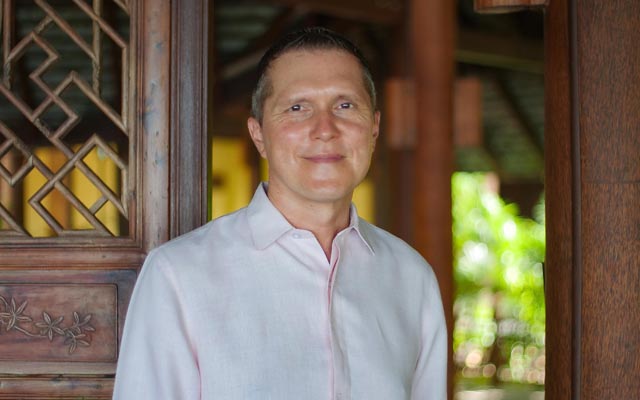
Pierre Lang, an industry veteran with over three decades of experience, has joined Kamalaya Koh Samui in Thailand as general manager.
The German has previously worked for international hotel brands including Alila Hotels & Resorts, Armani Hotels & Resorts, Park Hyatt, and Grand Hyatt, in countries such as Germany, Dubai, Singapore, Indonesia, and the Maldives.
Rezio, an online booking system in Asia for attractions, tours and activities, has rolled out its new brand tagline Empower Your Travel Business.
The new tagline reinforces the company’s positioning and purpose to empower tour and activity companies to digitalise their businesses, and be able to sell products through B2C, B2B, and OTAs.
Rezio adopts new brand tagline to emphasise its purpose to empower tour and activity companies to digitalise their businesses
Tour and activity company owners will be able to launch their own digital shopfront, enabling consumers to book their activities directly on their e-commerce platform. Business owners are also able to use the system to manage and control their inventory in real-time, scaling up their business with minimal manpower, which enables them to resell to the agents, corporates and other businesses without concerns about overbooking.
“We are now giving the empowerment back to the merchants, hence our new tagline refers to us giving the authority back to the merchants to make key decisions in their sales and distribution to aid them in their business recovery,” said Jasmine Lin, CEO of Rezio.
Currently, the company supports more than 1,200 merchants globally with more than 15,000 experiences in their portfolio. The travel SaaS company is expected to double that number in 2022 to aid more companies in digitalising their business in line with the travel recovery.
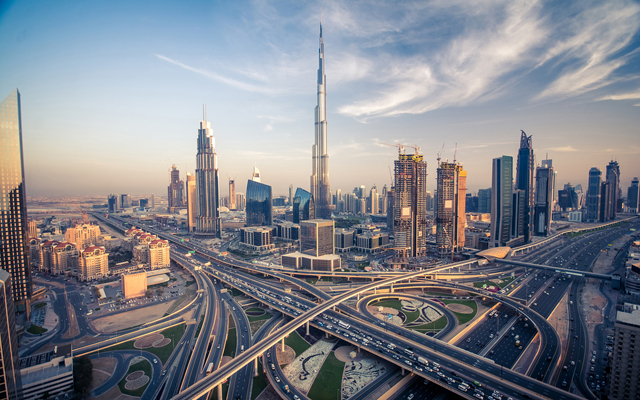
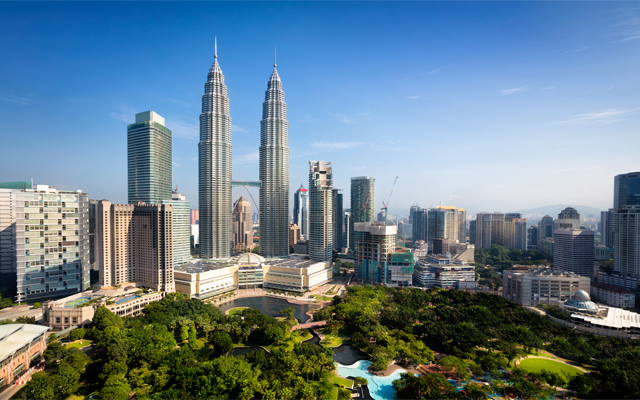
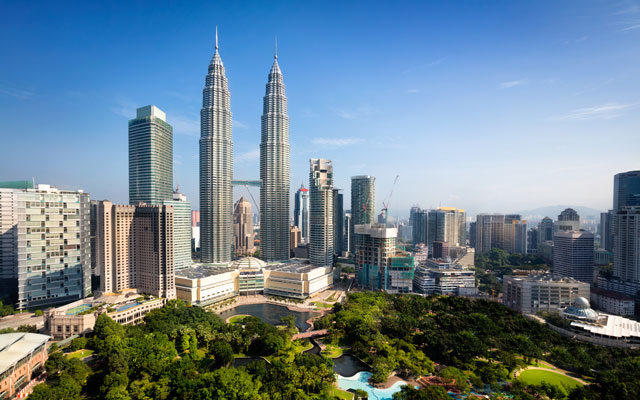
Destinations of the World, based in Dubai (pictured), will give WebBeds 5,600 unique direct hotel contracts
Visitors arriving in Dubai will no longer need to show a negative PCR test to enter the country as long as they present an approved vaccination certificate with a QR code.
Unvaccinated travellers are still required to show a negative PCR test conducted within 48 hours of departure or provide proof of a Covid-19 recovery within a month of the date of travel, complete with a QR code.
Vaccinated travellers no longer need to show a negative PCR test when visiting Dubai
Wearing of masks outdoors is now optional in Dubai and throughout the United Arab Emirates, though it remains mandatory across indoor public spaces.
The news comes as the UAE sees a significant decrease in Covid-19 cases combined with high vaccination and booster jab rates.
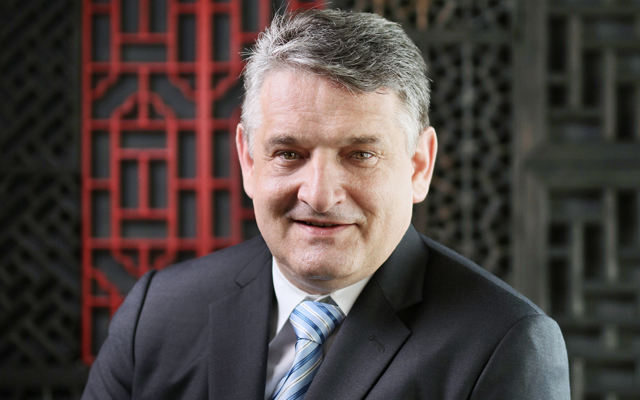
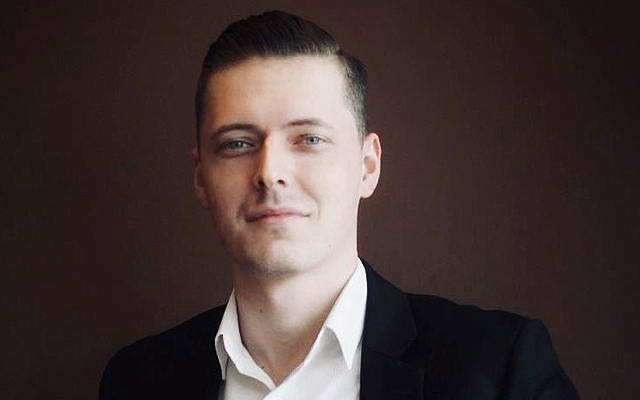
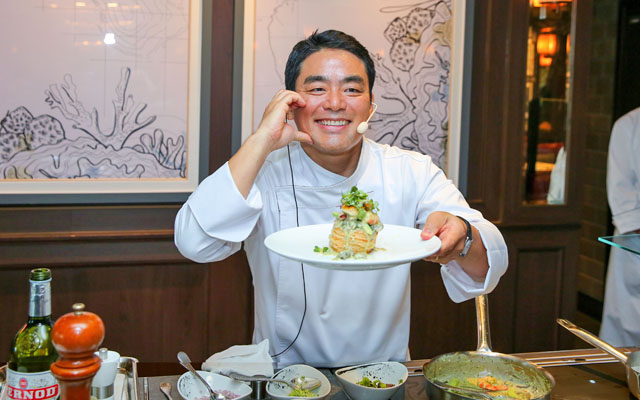
Wharf Hotels has promoted Thomas Salg to the role of president, from his current position as vice president operations.
Salg joined Marco Polo Hotels in 2013 as general manager, Marco Polo Shenzhen, and was promoted to area general manager of Marco Polo Hotels Hong Kong. He was made vice president operations in 2017.
He replaces president Jennifer Cronin who announced her resignation on March 1, 2022, and will leave her position on April 30.
Jennifer Cronin has resigned from her position as president of Wharf Hotels, effective April 30, to return to Australia.
Her role will be replaced by Thomas Salg who has served in the role of Wharf Hotels, vice president operations for four years.
Cronin’s last day of service as president of Wharf Hotels will be on April 30
During Cronin’s eight years with the group, starting as vice president sales & marketing, her remit was to strengthen the foundation of Marco Polo Hotels, and introduce an additional and luxury brand – Niccolo Hotels. Having completed this assignment, Wharf Hotels has now built a solid framework for future growth and is poised for expansion.
Cronin said: “I am honoured to have had the opportunity to work with so many inspiring and forward-thinking colleagues and associates, supported by a parent company that believes in its people and delivering on its promises.”
Cronin has spent more than 20 years working in Asia’s gateway cities.
On her successor, Cronin said: “Thomas has clearly demonstrated his commitment, leadership and professionalism since joining Marco Polo Hotels in 2013 as general manager, Marco Polo Shenzhen, followed by area general manager of Marco Polo Hotels Hong Kong, before becoming vice president operations in 2017.
“I am confident that Thomas will further strengthen the group’s solid foundation, as well as strategically drive new initiatives and developments for the hotel management company, while rebuilding the hotel’s priority business streams.”
Tourism players in Malaysia are calling on the authorities to be vigilant and proactive in taking action against illegal tour operators as the industry prepares for a tourism reset, as an imminent announcement on the reopening of borders will be made soon.
Malaysian Inbound Tourism Association (MITA) president, Uzaidi Udanis, shared that illegal tour operators have been in existence since he joined the tourism industry in 1985, but they have never been eradicated due to lack of enforcement.
Malaysian tourism players demand tougher actions against illegal tour operators
He called on the government to empower tourism associations such as MITA to assist in regulating the industry and weed out these illegal operators who compete with legal tour operators on pricing, and could inadvertently spoil Malaysia’s tourism reputation.
Inbound tour operator Zahira Tahir, founder and CEO, Universal Holidays Travel and Tourism, said such illegal tour operators spoilt the Arabic- and Indonesian-speaking markets in pre-pandemic times by offering tours at highly-reduced rates.
She said: “These illegal operators do not pay licensing fees, use their own vehicles, and double up as tour guides. The information they relay to tourists may also not be factually accurate, and if tourists have a bad experience, they will not revisit the country.”
As such, there’s no better time than now to take the steps to prevent the return of these unlicensed tour operators, Jimmy Leong, president and Johor chapter chairman of the Malaysia Tour Guides Association (MTGA), stressed.
He shared that MTGA has highlighted the issue to the Ministry of Tourism, Arts and Culture, as well as the transport ministry,on many different occasions but the problem has not been nipped in the bud.
From his experience, in pre-pandemic times, illegal tour operators who targeted the Singapore market were rampant.
“They mainly used private MPV and picked passengers up from their homes in Singapore, and took them on tours to Johor, Melaka, Kuala Lumpur and Perak,” Leong elaborated.
Although such activities have quietened down due to the current pandemic, Leong fears that such individuals and activities will resurface when borders eventually reopen due to the lack of enforcement.
Rouble devaluation, disrupted payments are hurting Russian travel appetite
SE-Asia unlikely to restrict Russian arrivals to protest Ukraine invasion
Large swaths of closed airspace may impact European longhaul to Asia
Russia’s shocking invasion of Ukraine puts to test the resilience of its outbound travellers who are prized for their long average length of stay and determination to travel come what may.
That resoluteness may end. Even before the crisis, the devaluation of the Russian rouble has crimped the spending power of Russian travellers. Now, following severe sanctions on Russia by the US and Western allies, the rouble has plunged by 30 per cent against the dollar.
Sanctions imposed to-date, particularly the removal of Russia’s central bank and some Russian banks from the SWIFT global payments system, are meant to disrupt payments for Russia’s energy and other exports, and cripple the economy. According to a BBC report, Russians are already waiting in long lines, worried their bank cards may stop working or that limits will be placed on the amount of cash they can withdraw.
Travel may be the last thing on their minds.
In 2019, Russians made 20 million trips abroad and continued globetrotting even during the height of the pandemic, as shown In 2020 when 12 million Russians travelled abroad, according to Sri Lanka Tourism. The country lifted international travel restrictions last October and saw Russia rise to become its top market.
But Sri Lanka and other popular Russian haunts in Asia, such as Thailand, are already seeing cancellations or a softening of the market.
Michal Zitek, area general manager of Angsana Laguna Phuket, said: “Our hotels in Laguna Phuket, Maldives and Corfu (an island in Greece) have not reported significant cancellations, however the pick-up pace may dwindle slightly.”
The market had seemed more “reserved” due to the currency devaluation, said Zitek.
Softer blow on Asia
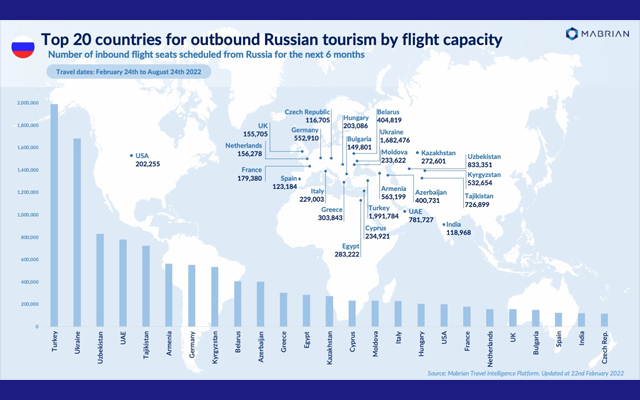
Asia is expected to be less impacted than Europe, if only because its share of the Russian market is smaller. Data from Mabrian Technologies, a Barcelona-based tourism intelligence platform, shows that the countries with the most number of scheduled flights and seats from Russia in the next six months are Turkey, the UAE, Germany, Greece, Egypt, Cyprus and Italy, among others.
Mabrian Technologies says countries with the most number of scheduled flights and seats from Russia will see greatest tourism impact
These countries would see their tourism sector affected if the crisis lengthens, said Mabrian.
“A new instability puts Europe’s tourism recovery at risk when it seemed that we had overcome the crisis caused by Covid-19,” said Carlos Cendra, Mabrian’s director of sales and marketing.
It’s difficult to estimate how far-reaching the impact will be at this stage.
“We don’t know all the sanctions, the reaction from Russian travellers in terms of appetite to travel as a result of this situation, how long this war might go on, if Russia itself might react by restricting outbound tourism, and so on,” said Cendra.
Kenneth Atkinson, founder and senior board adviser of Grant Thornton Vietnam, believes restrictions on Russian travellers by Western countries are likely. “As well, the banking and currency restrictions will make foreign travel difficult. In addition, I would think people will not want to leave Russia because of the fear of not being able to return,” he said.
Asia, with the exception of countries such as Japan and Singapore, is not expected to impose sanctions against Russia. “I don’t see any wholesale moves by South-east Asia to restrict movements because of the sensitivities with China, and because Russia is an important air corridor,” opined Atkinson.
Disrupted flights
Geography is set to play a huge role in reshaping air routes. This may unwittingly impact the European travel market to Asia, which is starting to perk up following reopening announcements by one Asian country after another.
Because of its vastness, Russia’s airspace is the popular overflight for EU flights en route to Asia. However, most of Europe have shut their airspace to Russian airlines and Russia has reciprocated with its own bans, causing airlines to fly circuitous intercontinental routes, Bloomberg reported on February 27.
The latest moves “wall off Russian carriers such as Aeroflot from the shortest routes west, forcing them to head south as far as Turkey to go around. European carriers going in the other direction face delays and higher fuel expense as well, after Russia, a key pathway to Asia, began blocking access in response”, said the report.
Finnair, which has staked its strategy on short routes to Asia, said such a move would likely halt those flights.
Thus, Asian destinations that hope Russia could help fill the gap left by Chinese travellers, face uncertainty not just over the Russian market, but the European market, which may prefer to stay closer to home than fly longer and pay higher fares due to rising fuel costs. Oil prices have surged above US$100 a barrel for the first time in seven years.
Vietnam, which is fully reopening on March 15, is one such. In 2019, Vietnam received 650,000 Russian travellers. Thailand, which now enables Russians to arrive under its Test & Go plan, unlike when the scheme was first launched, is another. In 2019, 1.5 million Russians visited the Kingdom.
Possible silver lining
However, some industry members believe Russian outbound will remain promising.
Victor Mogilev, group director of sales at Diethelm Travel, said: “Russian travellers, be they mass or luxury travellers, are known to be resilient. If there is a chance to travel, they will. Russian demand is always number one when destinations reopen — look at Maldives, Thailand and many others.
Mogilev: don’t mix politics with business
“I’d say continue to focus on the market, don’t mix politics with business, try to understand what the market needs/desires in the current situation, and find ways to offer solutions. This could be additional added value for families that might want to go out for few weeks longer, or tactical campaigns for people open to work remotely over the next few months.”
Angsana Laguna Phuket’s Zitek believes the crisis might even result in more extended stays, long stays or even “repatriation stays” depending on guest origin.
“Our market segments are diversified. Not all of our guests are from the Russian Federation itself. We also welcome many guests from Ukraine and the CIS, so the impact may be far-reaching, or it may be limited – too early to say,” said Zitek.
The Ukraine market travel cannot be compared with Russia in size but it is “usually quality tourists”, noted Diethelm’s Mogilev.
The biggest concern of Asian industry members is humanitarian in nature.
“My hope is the situation defaults to talking, not fighting and the consequence loss of life,” said Grant Thornton’s Atkinson.
Said Zitek: “The tourism industry will always recover. But not the loss of lives.”
EHL Hospitality Business School Campus (Singapore) has been working to improve gender parity in the workplace within the hospitality industry, through its Women in Leadership (WIL) initiative since 2018.
WIL promotes social changes at the group level as well as in the broader hospitality sector by addressing topics such as leadership, inclusion and belonging, entrepreneurship for women, networking and mentoring opportunities as well as family and work management.
Ang:women leaders can influence and create more empathetic workplaces in ways that homogeneous environments seldom do
In 2019, WIL launched the Sexual Harassment Prevention Initiative to educate and empower women on this sensitive topic.
Managing director Jenny Ang told TTG Asia: “This programme has educated more than 2,000 first-year students to date on preventing sexual harassment, one of the most damaging barriers to the career success and satisfaction for women.”
On campus, Ang attends WIL programmes to meet with students to discuss candidly about the importance of women in leadership and gender diversity. These events are often joined by industry experts and members from EHL’s alumni network.
She said: “While the glass ceiling is cracked, it has not been broken and more can be done to improve gender parity in the workplace.”
She believes it is important for organisations to have women leaders as it helps influence and create more empathetic workplaces in ways that homogeneous environments seldom do.
“It ensures more transparency and openness, allowing companies to build an inclusive foundation that is able to hire and retain the most qualified and skilled people. It also encourages people to share their thoughts and ideas, fuelling change and innovation that improves organisational performance,” she elaborated.
Almost 50 per cent of management positions at EHL are women, and EHL is set on increasing the percentage of women in positions and responsibilities.
“Gender parity is a huge issue. The work we started four years ago has barely skimmed the surface. While we are proud of what we have achieved so far, there is always more that needs to be done and so we look forward to continuing our WIL programme and expanding the initiative,” she concluded.
This story is part of an International Women’s Day series published by TTG Asia and TTGmice, where we highlight organisations in our industry that are committed to supporting gender parity in the workplace and beyond as well as uplifting the quality of life for womenfolk in the communities they interact with through their operations.
For better or worse, the “doing more with less” mantra has become a core skillset of today’s hotel revenue managers. It is imperative to be as efficient as possible with distribution and maximising booking profitability, while experimenting with new channels and pricing strategies that can further optimise revenues.
Optimal revenue management depends on mastering the “Five Rights” – selling the right room, to the right guest, at the right moment, at the right price, via the right distribution channel. However, with most hotels still understaffed, revenue managers have less time than ever to make those “rights” a reality.
When working in less than ideal conditions, the key is to use the data at your fingertips to optimise efficiencies and start experimenting. From there, you can embark on an impactful revenue strategy that focuses on playing smarter – not harder – despite a reduced staff headcount.
In our latest guide, we delve into the tactics that can help managers start maximising and optimising revenues despite lower staffing levels, from fully leveraging your technology and unearthing new segments to dynamic pricing.
If you’d like more information on ways to improve your hotel’s revenue management strategy, contact us today at info@cendyn.com. The path to smarter revenue management starts right here with Cendyn. Get started now.
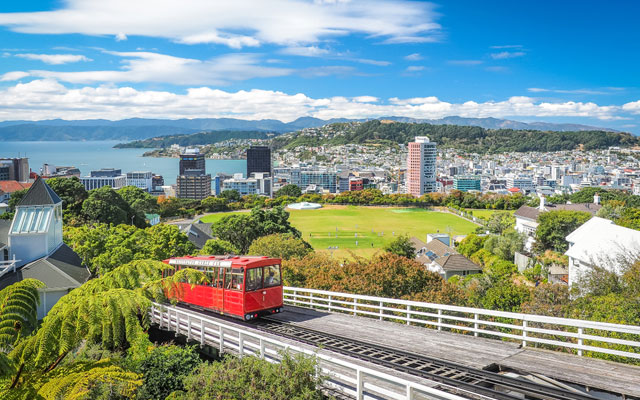
New Zealand will lift all self-isolation requirements for fully vaccinated citizens and eligible visa holders entering the country from Australia starting from 23.59 on March 2.
This will be extended to vaccinated New Zealanders and eligible travellers from anywhere else in the world from 23.59 on March 4. Entry settings for all other travellers will be reviewed in the coming months.
New Zealand to remove quarantine requirement for arriving travellers in phases
Travellers will still be required to produce a negative pre-departure test, and undertake two rapid antigen tests on arrival and on day 5/6. Travellers who return a positive result will be required to report it and isolate for the same period as a community case.
Managed isolation will remain for unvaccinated New Zealanders and some community cases.
Breaking the news on February 28, prime minister Jacinda Ardern recognised that the move was “a huge milestone for our tourism sector and regional economies”.













Salg joined Marco Polo Hotels in 2013 as general manager, Marco Polo Shenzhen, and was promoted to area general manager of Marco Polo Hotels Hong Kong. He was made vice president operations in 2017.
He replaces president Jennifer Cronin who announced her resignation on March 1, 2022, and will leave her position on April 30.