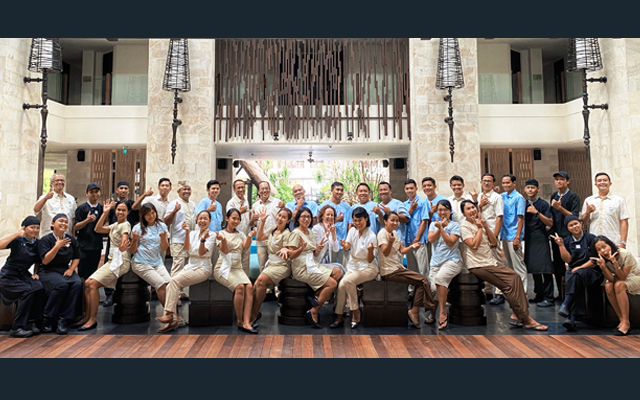

Shinta Mani Angkor and Bensley Collection Pool Villas
Cambodia’s reopening to international travellers, removal of domestic travel restrictions and the return of airlift were the signs Shinta Mani Angkor and Bensley Collection Pool Villas have been waiting for to rouse from its slumber – and now that the stars are aligned, the luxury property in the French Quarter of Siem Reap is ready to get back to business.
Anthony Lark, executive director at HMD Asia, the owning and management company of Shinta Mani Hotels, said: “Our maintenance staff have been working tirelessly the last couple of months to touch up the rooms and public areas, which are now looking fresh and new. We have also been re-activating relationships with our travel partners and past guests, who are already making bookings.”
By early March, the hotel has fully opened its 10 Bensley Collection Pool Villas, and is on track to reopening Shinta Mani Angkor, Kroya restaurant and the spa on April 1. A further 66 keys in the new Bayon Wing, named after the famous Temple, will open later in 2022.
Despite having to make the “hard choice” to close the property as the pandemic ravaged the world in 2020, not all came to a complete standstill, emphasised Lark. Attention was redirected to hotel staff and their families.
He detailed: “From the earliest days of the pandemic, we realised our staff and their families were going to find it incredibly hard. Our Shinta Mani Foundation went to work and we have been supporting them with regular care packages of food and other essentials, and of course, continued support for their medical needs.”
Now, as access returns to Cambodia, Lark and his team are happy to see that “great interest in Siem Reap” is back, and are eager to get busy with sales and marketing.
“Our travel partners, agents and DMCs are ready with new contacts and agreements so that they can sell our hotels. We are also focused on a digital marketing campaign to send positive messages that travel is quarantine-free, what the health formalities are at the airport, and how our staff are able to whisk guests through immigration. We have also been busy retraining the team members on service and food preparations as we launch new menus, etc,” he told TTG Asia.
Lark said this is now an opportune time to visit Siem Reap, as the destination has used the two years of travel disruption to make significant infrastructure improvements. The old French Quarter has also been restored in the past year.
“There has never been a better time to visit Siem Reap, especially with flights now operating directly from Singapore, Bangkok and other regional cities. The recent cancellation of the need to show a negative PCR test before arriving in Cambodia, elimination of a rapid test upon arrival, and availability of visa on arrival, Cambodia is leading the region in getting back to normal,” he remarked.

JEN Singapore Orchardgateway by Shangri-La
Once a hotel popular with tourists looking to take in the best of the shopping and lifestyle offerings in the heart of Singapore, JEN Singapore Orchardgateway had to shed that side of its hospitality role and transform into a government Stay-Home Notice (SHN) facility to accommodate guests on quarantine.
While functioning as a SHN facility ensured some income for the hotel and its staff during Singapore’s border lockdown, general manager Allen Khoo recalled that manpower had to be reconfigured to serve a different purpose.
“To safeguard our guests and colleagues’ well-being, our colleagues had to be split into two different teams to ensure no cross-contamination. While some departments could effectively work remotely, the operations team, including the F&B department, was still supporting the hotel with SHN food preparation,” he told TTG Asia.
Adding to Khoo’s challenge was a manpower crunch during the pandemic. The solution was to activate non-operational staff for operational duties. This included having administration personnel taking on housekeeping and culinary day-to-day duties.
“This ensured our hospitality shone through even though the hotel was predominantly serving guests on quarantine,” he said.
Meanwhile, to maximise revenue for the hotel throughout the business disruption, JEN Singapore Orchardgateway ventured into retail and F&B takeaways to allow customers to bring home the hotel experience.
After supporting the Singapore government’s SHN programme for two years, JEN Singapore Orchardgateway was given the green light to reopen to the public as a tourist hotel.
In the lead up to the hotel’s official reopening on February 8, the hotel team undertook thorough deep cleaning and sanitisation.
“The management also provided support and guidance to the team to pivot our operations back to a fully functional hotel,” Khoo added.
Today, the hotel is fully functional, with 50 per cent of guestroom inventory back online and the rest to reopen in the following days. Facilities such as the pool, gym and club lounge have started to welcome guests once more since February 8, albeit with Covid-safe measures in place.
As JEN Singapore Orchardgateway gets back to business, several programmes have been lined up to attract guests. They include fresh culinary concepts and thematic staycations. Setting an example of what’s to come, Khoo said the hotel recently hosted an F&B pop-up at BayWatch@JEN, the property’s popular rooftop infinity pool deck, where Manila’s hit Raging Bull Burgers came together with Shangri-La Singapore’s Origin Bar to dish out a potent mix of burgers and curated cocktails.
Holiday Inn Resort Bali Benoa
When it was clear that Holiday Inn Resort Bali Benoa in Indonesia could no longer stay open as international arrivals were shut out and local infections alongside intensifying movement restrictions strangled domestic travel possibilities, a decision was made to temporarily close the hotel on July 7, 2020.
According to Carol Waller, hotel general manager and area general manager of Holiday Inn Resorts Indonesia, the hardest part of that decision was breaking the news to the team.
“Many of our colleagues had to source for alternative income,” she recalled.
For the few who stayed, they were tasked with keeping the resort neat and clean. Waller was determined to keep the team “busy, motivated, and healthy” during those challenging times. Thus, she prescribed a range of activities.
“We had sharing sessions over lunch every Tuesday in our beachfront restaurant, where all team members talked about their daily life and business ideas. We made time for fun and games. Yoga every Thursday was hosted by one of our talented team members, and handicraft workshops were held by management to teach team members new skills,” shared Waller.
“You will be amazed at how our team members used this time to develop their entrepreneurial instinct as well; many of them started their own home business.”
Effort was made to support the local community and displaced staff through donations.
“Together we learnt to make the most out of the present moment and always try to see the bright side of this situation. It wasn’t easy but we made it!” she said.
By December 2021, a decision was made to work towards a reopening on April 1, 2022.
Waller said: “This decision was taken after observing and monitoring the progress of the pandemic situation globally. After seeing green signs, the ratio of vaccination, our neighbouring countries reopening again, we brainstormed with our stakeholders and we felt it was the right time.
“The preparation was pretty simple. We treated it as a brand-new hotel opening – recruitment, implementation of IHG Way of Clean, Covid-19 education, health and safety training for the team members, and trial stays. We also re-connected with all our missed guests, media friends and the local community.”
At press time, Holiday Inn Resort Bali Benoa is almost back to normal operations. One of the restaurants is now receiving diners, and a second will be put back to business as soon as demand surfaces.
“This is the time all of us have been waiting for, to be able to travel again, to be able to create memories with our loved ones again, to explore, and to experience new things,” said Waller excitedly, adding that efforts have been made to ensure the hotel is bookable and visible in all channels, including social media.
In addition, the hotel is strumming up its family-friendly draws, such as the sought-after family suite and Kids Stay and Eat Free programme, as well as health and safety assurances to win over guests.
The hotel’s reopening on April 1 coincides with its seventh anniversary, and for that guests can enjoy a buy-seven-nights-get-seven-nights-free offer.



 In 2020, the coronavirus pandemic took the global travel industry from all-time highs to a low of only five per cent of expected volumes overnight. Over the last two years, the industry has seen that the road to recovery is not linear. Border closures, vaccine shortages, new variants (Delta, Omicron) and now, Russia’s invasion of Ukraine all have immediate effects on travel. By the end of 2021, the global travel industry recovered more than 50 per cent of its gross activity, and if recovery continues along the same trajectory, 85 per cent of the travel industry’s gross activity could be regained by the end of 2022.