JLL Hotels & Hospitality Group has appointed Rathawat Kuvijitrsuwan as senior vice president, advisory & asset management, Thailand.
He will be responsible for advising both domestic and international clients through development advisory, feasibility assessment, investment strategies, operator selection and contract negotiation, and asset management.
He joins JLL from CBRE, where he was recently head of research and consulting, Thailand.
The Airports Council International (ACI) Asia-Pacific has appointed three new members into its board at its 34th Board Meeting in Muscat.
Joining the 27-member board are Lorie Argus from Australia, Muhammad Awaluddin from Indonesia and Chang Yi Wang from China.
The members during the 34th Board Meeting in Muscat
Argus currently serves as the CEO of Australia Pacific Airports Corporation (APAC), which manages and operates Melbourne and Launceston Airports.
Awaluddin serves as the president director of Angkasa Pura II, a state-owned enterprise under the Indonesian Department of Transport overseeing airports in Western Indonesia, while Wang serves as the chairman of Capital Airports Holding Limited & Beijing Capital International Airport Co.
Welcoming the new board members, Emmanuel Menanteau, president of ACI Asia-Pacific, said: “I am confident that new members will continue to be a strong advocate for our region, to aid travel recovery as the industry recovers. Their professional expertise is valuable as we work closely with our stakeholders to revive the industry.”
A total of six new airport operators, two affiliates and nine World Business Partners have joined ACI Asia-Pacific in 2022. ACI Asia-Pacific now has 127 airport members, managing and operating 618 airports across 46 countries and a strong line-up of 97 World Business Partners.
Themed Journey into the Future Together, Trip.com Group’s 2022 Global Partner Summit in Macau was attended by tourism boards, international airlines, hotel groups and industry representatives from across the travel industry.
The group and its partners provided insights on the industry’s growth and opportunities ahead, with leadership and experts sharing sector-specific knowledge via breakout sub-forums. It also continues to safeguard efforts toward global travel recovery by following its Local Focus, Global Vision blueprint.
Trip.com’s Jane Sun delivering her keynote presentation to partners at the Global Partner Summit
Jane Sun, CEO, Trip.com Group highlighted some of the group’s financial results, emphasising triple-digit growth in hotel bookings across key Asia-Pacific markets compared to the same period in 2019, with its global air ticket bookings increasing by 100 per cent year-over-year.
She said: “Although the road ahead is still uncertain, we want to explore more opportunities and use cooperation, technology, and service to promote the tourism industry together with our travel partners.
“The early recovery of global markets has given us confidence. We will continue looking for more possibilities to better serve our partners and users by building an improved travel ecosystem to meet users’ needs.”
Trip.com Group shared its plans to revitalise the tourism economy and reconnect with keen travellers by enhancing engagement between travellers and partners. Several upgrades and expansions to the existing content marketing offering were also announced during the summit, such as Ctrip Livestream, which will launch across more cities in mainland China to boost global distribution, and Trip.Best list to launch across all major sites.
In addition, new and existing partnerships, such as with Macao Government Tourism Office (MGTO) and Sands China, were inked to strengthen destination visibility and capture pent-up travel demand. Trip.com Group will collaborate with MGTO, Sands China and other partners in various industries, including accommodation, shopping, and gourmet, to enhance the vitality of Macau’s tourism market and build it as a world-class centre of tourism and leisure.
Hospitality 360 (H360) has partnered with Wyndham Hotels and Resorts to grow their portfolio of hotels, resorts, and serviced apartments across Malaysia.
Under the terms of the agreement, H360 will deliver at least 15 hotels signed as franchises under various Wyndham-owned brands over the course of the next six years.
The partnership will see the development of hotels, resorts, and serviced apartments across Malaysia
Construction of these hotels, totalling more than 2,000 rooms will commence in phases starting in 2023 and is expected to complete by 2027.
In the pipeline is Wyndham Grand TRX KL, which will feature over 190 rooms – construction is currently underway and slated to complete by 4Q2023.
In addition, the newly-built Ramada by Wyndham The Straits Johor Bahru will be operational by 1Q2023.
Other upcoming properties are Isola KLCC, Shahzan Kuantan in Pahang, Trinidad Suites Puteri Harbour in Johor, Lisbon Melaka, Trigo Kuala Lumpur, and Shahzan Frasers Hill – all are expected to sign to Wyndham’s Trademark Collection brand.
H360 hopes to achieve a portfolio of approximately 5,000 rooms all over Malaysia by 2027.
Indera Naresh Mohan, group CEO, H360 said: “The properties we will manage are targeted at different segments of the market, from leisure travellers and families to business travellers. We are looking forward to working with Wyndham to ensure all our guests get a full and holistic experience in our managed properties.”
Matt Holmes, vice president of development, South East Asia & Pacific for Wyndham, said: “This move will position Wyndham strongly to tap on the exponential rise in travel demand which has accelerated since early 2022 as borders reopen across key markets in Asia-Pacific.”
Cebu Pacific (CEB) has restored 92 per cent of its pre-Covid system-wide capacity following the continuous increase of its domestic and international routes.
The airline now flies an average of 355 flights a day, covering 34 domestic and 19 international destinations. This is equivalent to about 64,000 seats offered in a day.
Cebu Pacific has restored 92 per cent of its pre-Covid system-wide capacity
To date, CEB has fully restored its pre-pandemic domestic capacity, surpassing the airline’s December 2019 level.
CEB flew 13.3 million passengers from January to November 2022, up 493 per cent from the same period in 2021, as people rushed back to travel following the lifting of Covid-19 restrictions.
Xander Lao, chief commercial officer, Cebu Pacific said: “We’ve basically grown, in fact, much more than what we were doing pre-Covid in the domestic level. We are seeing green shoots of recovery.”
For December, CEB widened its international footprint as it added more flights to Brunei, Jakarta, Seoul, Taipei, and Hong Kong. From December 1, its Cebu hub was also boosted with additional flights.
As part of the airline’s sustainability efforts, aircraft deliveries will use blended Sustainable Aviation Fuel (SAF), with the aim of transitioning to an all-NEO fleet by 2028 and incorporate the use of SAF for its entire commercial network by 2030.
Philippine Airlines (PAL) will operate non-stop services between Manila and Perth starting from March 27, 2023, linking the Philippines and Western Australia with direct flights for the first time.
The three weekly PAL services will operate every Monday, Thursday and Saturday. The Manila-Perth service will depart 00.05 and arrive at 07.15; the Perth-Manila flight will depart at 08.30 and arrive at 15.50.
Philippine Airlines will fly direct to Perth from March 2023
Perth is PAL’s fourth Australian gateway, joining Sydney, Melbourne and Brisbane. The airline offers a total of 20 weekly direct flights to Perth, Sydney, Melbourne and Brisbane.
PAL’s service provides new connectivity via the airline’s Manila hub for Perth-bound passengers travelling from Los Angeles, Bangkok, Hong Kong and points in Japan, as well as from Cebu, Davao and other key Philippine destinations.
Oceania Cruises has announced a brand-new immersive Grand Voyage itinerary for 2023.
The Mediterranean Connection sailing on Marina will embark on a 33-day journey from Venice to Barcelona, immersing guests in the highlights of the Eastern Mediterranean and Holy Lands like never before.
Oceania Cruises’ Marina will call on 28 different ports during its 33-day journey
Departing on October 11, 2023, this Grand Voyage will call on 28 different ports, showcasing the history, culture, and cuisine of myriad destinations.
The 1,238-guest Marina will call on Italy, Croatia, Greece, Turkey, Malta, Israel, Egypt and more, with highlights like experiencing all that the Eastern Mediterranean has to offer in 10 countries, and an overnight in Istanbul for guests to explore the city.
For guests interested in shorter segments of the Mediterranean Connection Grand Voyage, Oceania Cruises is offering three segments for ease and convenience aboard the Marina, followed by three additional Grand Voyage itineraries ranging from 10 to 23 days.
Kyushu’s tourism stakeholders are adopting greater use of virtual reality (VR) and augmented reality (AR) at destinations in a bid to entice increasingly travel-savvy visitors in search of the hottest travel trends.
VR, a simulation of a three-dimensional environment that can be interacted with in a seemingly real way, and AR, which superimposes images on the user’s view of the real world, have been used by companies throughout Japan during the Covid-19 pandemic.
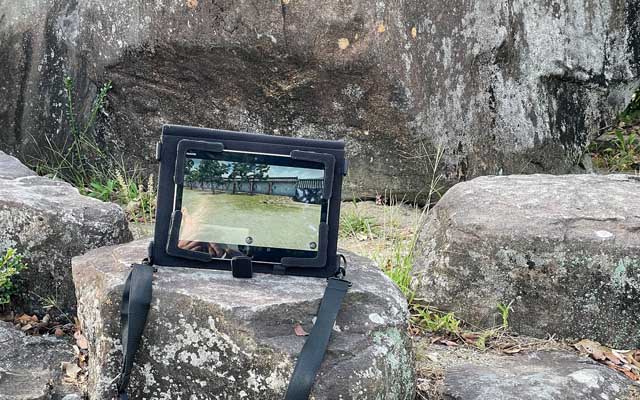
Travellers can see how Hara Castle, now in ruins, used to look like with the help of virtual reality
From offering tours of hotels and aircraft to attractions and even cities, the technologies have been used by travel-related companies, including JTB Corporation, Hankyu Travel and Japan Airlines, to recreate a piece of Japan for people stuck at home.
Now, Japanese organisations are using VR and AR to enhance products and services via a more immersive experience for in-person guests.
In Oita Prefecture’s Hita, where the renowned manga Attack on Titan was created, the city’s tourism association is promoting an AR-supported app. After downloading it, visitors can travel to sites from the manga that are located across the city, where they can superimpose themselves or other characters onto the screen.
“We launched the app in 2020 so international visitors haven’t really had a chance to try it yet,” said a spokesperson of Hita City Tourism Association. “We’ve had great feedback from the domestic market so we hope the inbound market loves the app too.”
In Nagasaki Prefecture, tablets on offer at Hara Castle, which is merely ruins, offer users the chance to see what the castle would have looked like in its heyday, thanks to VR.
Neighbouring Shimabara Castle, meanwhile, has created an AR headset that allows visitors to see and touch exhibits that appear to float in front of them.
A staff member at Shimabara Castle said further technology developments are underway, including VR walkthroughs of the castle in Japanese, English and Korean, to “bring its history to life”.
I tried out co-living for the first time recently. Yes, it’s true that what hotels are trying to do today – using technology to reduce operational costs, going local or being in the neighbourhood (even if they aren’t), getting strangers to socialise with one another – the co-living model has done it first, and done it well.
A key insight for me is that the best co-living players can make a stay seamless and efficient because technology is their DNA. Everything starts and ends with technology. For hotels, technology is often a capital expenditure to be carefully considered, not just because of the costs, but the risk and worries of de-personalising the guest experience.
Whether it was for business or leisure travel, I have stayed only in hotels. The chance to try out co-living arose during a Singapore visit recently and Hmlet, one of the largest co-living brands in the city, came to mind.
Hmlet’s technology was pervasive even before arrival. It starts with the user experience in searching for the right “home” on its revamped website and mobile app. The search was fuss-free, transparent and, actually, enjoyable. The most important details, such as availability and pricing, were shown upfront.
I found my place, Hmlet at Cantonment, and picked The Large, one of six room categories at the property. Hotels are never ever going to call their rooms The Small, The Medium, The Large, The X-Large, The 2-Bedroom and The 2-Bedroom with Kitchen, which are refreshingly simple and clear.
As I was travelling alone, The Large, 21-25m² with a queen-sized bed, small but fully-equipped kitchen, dining countertop for two and washer/dryer, was enough. Other in-room amenities were also spelled out clearly. A 3-D virtual tour done by Matterport left me with no doubt as to what I would be getting. When I arrived at my room, I felt I’d already been there.
Booking was easy and quick. I immediately received a confirmation with a link to update my credit card details. And on arrival, I picked up my key card and went to my room. I could even settle my outstanding balance and choose my departure time online so I wouldn’t have to go to the reception, unless I wanted to.
Guests who signed up on the Hmlet app can make seamless payments, set up self-renewal payment, in-app direct messaging among members, and access a help hotline, newsfeed and a marketplace featuring over 150 affiliate partners.
During the pandemic, in late 2020, Hmlet bolstered its tech function comprising product management, engineering, data, quality assurance and mobile development teams.
Living with technology
Hmlet Cantonment opened in mid-2019, a conversion of a three-storey building that was a former primary school and a police headquarters into a 150-room boutique apartment in two adjoining blocks.
My key card was used to access all indoor areas – reception/communal living room, wellness studio, common kitchen, as well as the laundry and ironing area. At no time during my stay did I feel unsafe or inconvenienced, as the key card always worked and the knowledge that you need it to enter all indoor areas was assuring for security.
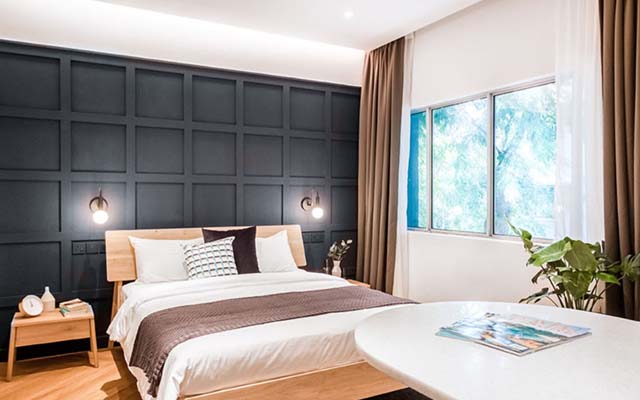
Hmlet Cantonment’s The Large was comfortably-sized with a full range of amenities
Living with technology cuts out a lot of waste. The smart TV in-room had no broadcast or cable channels, but I could link my device to it for Netflix and YouTube. When I needed help, my Whatsapp message to the Guest Experience Team was always answered, even at 21:00, when the dryer refused to dry my clothes. I worked mostly in-room as it was comfortable, with housekeeping done twice weekly by young and cheerful housekeepers. When I needed some company, I simply took my laptop with me to the living room and worked alongside other guests there.
Food was not an issue – the property’s location, in the colourful Tanjong Pagar area close to Chinatown and the Central Business District, is overflowing with local hawker centres and all kinds of restaurants.
Hmlet Cantonment didn’t try too hard to make guests go local. A fun map on its website was the just right pinch of cajoling for me. It shows where to go for something “historic and exciting” (Keong Saik district), for “tipples and nibbles” (Duxton Hill), and so on. Before I knew it, I was exploring the whole precinct on foot almost on a daily basis, snapping photos of rows of beautifully-designed shophouses in Everton Park or gawking at the temples in Keong Saik Road, among others. It made me realise that going local is an attitude, and that attempts by some hotels to go local or emphasise their “neighbourhoodness” are a sign they may be taking this consumer trend too seriously.
Co-living is quick, convenient and contact-free, ideal for a post-pandemic world. It also empowers guests and lets them choose whether or not to explore the neighbourhood and socialise with other guests.
Even those less inclined may be tempted by co-living’s cheaper pricing due to lower operating costs and higher efficiencies, yet another factor that makes it unlikely for co-living to be just a passing fad.
The impact of co-living on hotel room supply in Singapore is already being felt, although real data on the segment is absent. Even the taxi-driver who took me to Hmlet Cantonment asked me what co-living is all about, as he had driven foreign visitors to these accommodations.
In Singapore, co-living units are widespread and can be hard to track. They need not necessarily be in one leased building such as Hmlet Cantonment, but in private condominiums, residential apartments and even shophouses and other private homes. Their main regulation is by a minimum length of stay.
Data from the Urban Redevelopment Authority (URA), however, suggests the figure is not yet alarmingly high.
As of September 30, Singapore has about 6,000 units that URA has approved for use as serviced apartments, its spokesperson told TTG Asia. As to how many of these are actually in operation as serviced apartments or co-living units is anyone’s guess.
The Rwandan capital of Kigali will host the World Travel & Tourism Council’s (WTTC) Global Summit in 2023, marking the first time the event will visit Africa.
Rwanda, the home of the International Gorilla Conservation Programme, will showcase the power of sustainable tourism to protect biodiversity and create thriving communities.
The WTTC Global Summit in 2023 will be hosted by the Rwandan capital of Kigali
Julia Simpson, WTTC president & CEO said: “We are incredibly excited that Rwanda will host our next Global Summit in 2023. An amazing country famous for its conservation work, Rwanda is building its reputation as a must-see destination.”
More than 250 media delegates from around the world attended this year’s summit, with thousands globally watching remotely.
Under the theme Travel for a Better Future, the closing session in Riyadh, Saudi Arabia focused on the value of the sector, not only to the global economy, but to the planet and communities worldwide too.



 He joins JLL from CBRE, where he was recently head of research and consulting, Thailand.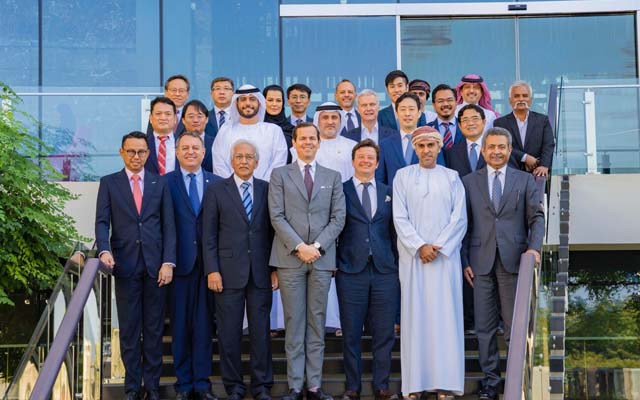






 I tried out co-living for the first time recently. Yes, it’s true that what hotels are trying to do today – using technology to reduce operational costs, going local or being in the neighbourhood (even if they aren’t), getting strangers to socialise with one another – the co-living model has done it first, and done it well.