 Location
This prime waterfront location is only a two-minute walk from MTR Fortress Hill Station. The well-covered footbridge links directly to the property, protecting guests from the sun and rain. Formerly occupied by Government Supplies Department, the site was redeveloped into a mixed-use development which includes both residential and hotel properties. The neighbourhood has lots to offer and is within walking distance to Oil Street Art Space, which is adjacent to the hotel, and the new East Coast Park Precinct.
Accommodation
Categorised by a playful selection of card suit names, the guestrooms can accommodate up to six people, making it ideal for couples, families, groups, long-stay guests and travellers.
With six room types to choose from, each floor features an average of 14-17 rooms, making it a short walk from the rooms to the hotel lifts. All rooms are equipped with individual ventilation systems, ensuring guests enjoy clean and fresh air.
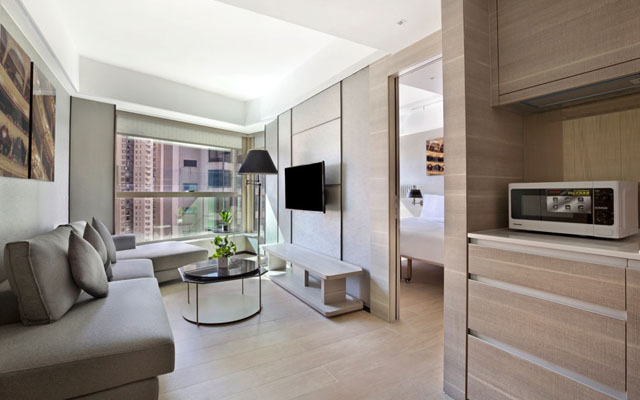
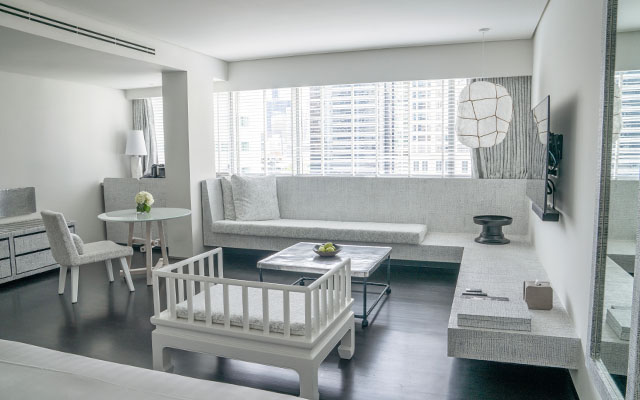
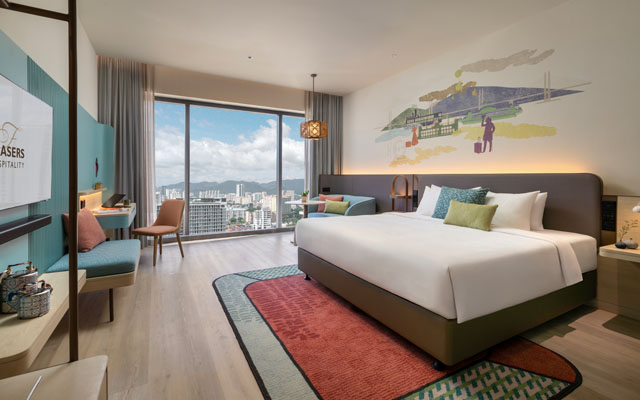
My 36m² Queen suite room on the 35th floor of the West Wing was spacious and modern, and had wood grained floor tiles instead of carpet. During the day, the room was well-lit thanks to the floor-to-ceiling windows – however the lighting in the living room needs to be better as it wasn’t conducive for reading.
The room’s double beds can also be converted into twin beds, providing some flexibility for the guests regarding sleeping arrangements.
While bathtubs are only available in the suites, all bathrooms come with wall-mounted body wash and shampoo dispensers.
F&B
Café A is the only dining outlet conveniently located on the hotel lobby level and serves up international cuisine and seasonal dishes. Apart from the semi-buffet breakfast and lunch, its afternoon tea set even offers a kid’s version. While I was there, the seasonal special was the Korean strawberry fantasy afternoon tea.
The Grand Ballroom adjacent to the café can be turned into a dining area for larger groups.
Also in the lobby is the brand-new Alice’s Corner which offers a range of grab-and-go items like sandwiches, cakes and coffee.
Despite limited dining options, guests can head out to explore the many eatery choices dotted along Fortress Hill and North Point neighbourhood, renowned for gourmet food.
Facilities
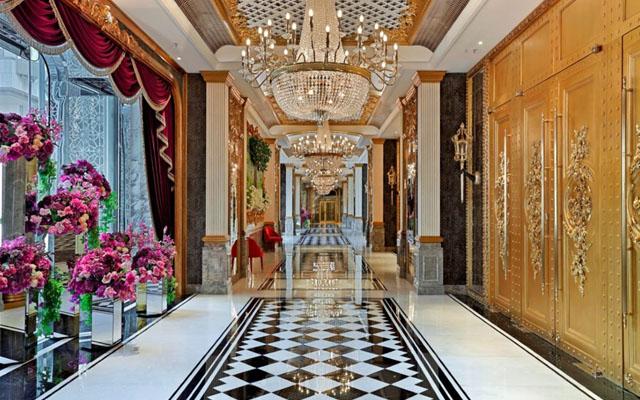
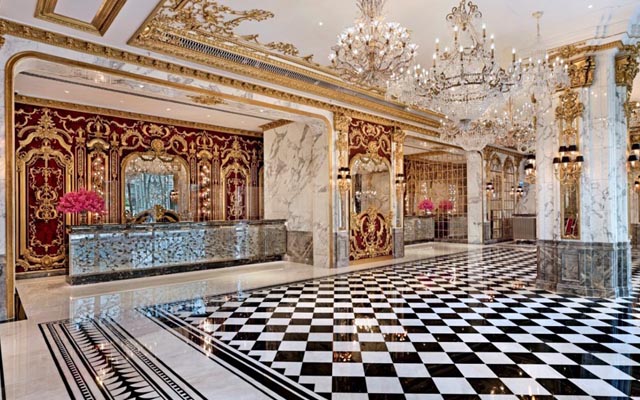
The hotel’s lobby and foyer are bright and uplifting, featuring grand chandeliers, floor-to-ceiling windows and doors, Victorian-tiled flooring and expansive mirrors – all perfect for that Instagram-worthy photo.
Meeting facilities include a 935m² Grand Ballroom for medium- to large-scale events, and five function spaces for more intimate gatherings.
Other facilities include a fitness centre, an outdoor swimming pool, and a kid’s playroom which goes by 45 minutes per session.
Service
As the lobby is a floor below the street level, I was greeted by a friendly security guard who guided me to the escalator leading to the lobby. Overall, staff were attentive and hands-on in responding to my queries. The hotel elevators may be smaller in size but are high-speed models.
Verdict
Nothing beats the location of the hotel, and its spacious interior makes it suitable for big groups. Plus, its seasonal food promotions are always something to look forward to.
Contact details
Tel: +852 3893 2888
Email: enquiry@hotelalexandrahk.com
Website: www.hotelalexandrahk.com






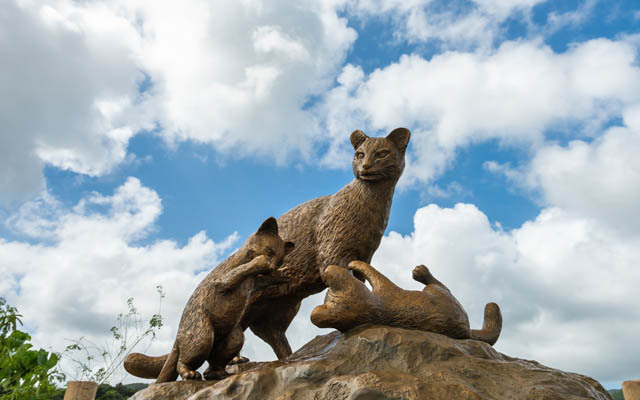






Iriomote island in Okinawa, Japan is imposing a cap on visitors in a bid to prevent overtourism as travel returns.
Starting from this month, only 1,200 visitors are permitted to enter the island daily, equating to 33,000 annually. The local government is concerned that a rebound of tourism to pre-pandemic levels would endanger the habit of its rare and indigenous Iriomote cat.
The subtropical destination is Okinawa’s second-largest island but its population of 2,400 is concentrated around its northern and eastern shores as much of the island is covered in subtropical forest.
Its popularity was on the rise pre-pandemic, with 290,000 visitors in 2019. However, the past decade of tourism growth brought a rise in traffic accidents involving Iriomote cats.
In 2020, when the island closed to tourists, no Iriomote cats were killed on the road.
As tourists returned to the island over 2021 to 2022, eight cats were killed and several more injured, according to local government data.
Since Iriomote became part of Japan’s newest UNESCO Natural World Heritage Site (covering Amami-Oshima, Tokunoshima, northern mainland Okinawa and Iriomote) in July 2021, support has been growing to protect the habit of the islands’ rare endemic species, including the Amami rabbit and Iriomote cat.
The cat is classified as “critically endangered” by the International Union for Conservation of Nature and is designated a natural monument by the Okinawa government. An estimated 100 adult cats inhabited the island as of 2007, predominantly in its subtropical forests, making Iriomote the smallest habitat of any wild cat species in the world.
The visitor cap is designed to “minimise the effects caused by tourists on nature and the local community,” according to the Okinawan department of environment affairs, which noted that the number of island sites open to guided tours will also be limited.
Although the restrictions are not compulsory, the Okinawan government is urging travel agents to comply with them.