


Hilton Singapore Orchard names new GM

Hilton has appointed Rupert Hallam as general manager for Hilton Singapore Orchard, Hilton’s largest hotel in Asia-Pacific.
With over three decades of hospitality experience, of which 21 years were spent with Hilton, Hallam will oversee day-to-day operations of the hotel, including guests services, culinary concepts, as well as business and wedding offerings in his new role.
 He previously served as the general manager of Hilton Adelaide for nearly five years.
Korean Air appoints Cambodia country manager

Korean Air has named Hoyeon (Chris) Chang as country manager for Cambodia.
 Having been with the SkyTeam Alliance carrier for 17 years, Chang will move to Phnom Penh for his new role. He was previously based at the airline’s headquarters in Seoul where he was in charge of marketing for Europe and South-east Asia.
Rajesh Chakraborty helms as GM of Taj Hotel and Convention Centre Agra

Taj Hotel and Convention Centre Agra has named Rajesh Chakraborty as its new general manager.
With over 26 years of dedicated service within the Indian Hotels Company Limited, Chakraborty has held pivotal positions across various hotels in India and internationally, with his most recent title as general manager of Vivanta By Taj Aurangabad Maharashtra.
 In his new role, he will leverage his extensive experience to further enhance guest experiences and elevate the hotel’s reputation.
Ascott makes key appointments to South-east Asia leadership team

The Ascott Limited has appointed David Cumming as regional general manager for Vietnam, Cambodia and Myanmar, and Kanit Sangmookda as country general manager for Thailand and Laos.
Cumming will oversee a portfolio of over 40 properties, where more than half are slated to open over the next three years. He joins Ascott with over two decades of global hospitality industry experience across the UK, Egypt, the UAE, Oman, and most recently Thailand.
 As for Sangmookda, he will manage a portfolio of over 30 properties where over a third are expected to open over the next three years. With over two decades of experience in Malaysia, Indonesia and Thailand, he brings with him strong operational and commercial expertise from the past management of large hotel portfolios under leading hotel chains such as Marriott International, Minor Hotels and the former Starwood Hotels & Resorts.
Langkawi defies decline, tourist arrivals soar

Amid news of declining tourist arrivals in September and October, compared against the same period last year, the Langkawi Development Authority (LADA) has come out to say that numbers for 2023 will still exceed last year’s record.
Langkawi, which is loved by local and international tourists for its picturesque islands, welcomed 2.57 million travellers in 2022. Between January and October this year, it had 2.2 million tourists, representing 69.9 per cent of the targetted 3.2 million tourists.

Azmil Munif Mohd Bukhari, manager of tourism division at LADA, told TTG Asia that a number of festivities and events in November were instrumental in boosting arrivals. These included the extended weekend of Deepavali last week, which coincided with the Langkawi Geopark International Enduro Mountain Biker challenge on November 12 and the Hari Mahsuri (Mahsuri Day) programme on November 18, which featuring a unique musical theatre and storytelling experience.
Furthermore, Langkawi International Half Marathon 2023 on December 2 is expected to draw more than 2,000 participants from 31 countries.
Azmil emphasised that December is projected to be a super peak season for Langkawi, mirroring trends observed in previous years.
However, he acknowledged the possibility that arrivals this year might slightly miss the targeted 3.2 million target.
He explained: “The arrival target for 2023 was set in late 2022. During that period, we anticipated a significant influx of Chinese outbound tourists, but regrettably, this expectation has not materialised. The presence of outbound travellers from China has been limited, not only in Langkawi but worldwide.
“Additionally, certain international carriers that were operating flights to Langkawi before the Covid-19 pandemic have reported a shortage of planes, preventing them from resuming flights to Langkawi post-lockdown.”
Azmil is confident that 2024 will mark the best post-lockdown year ever for Langkawi. To further enhance air connectivity, LADA has introduced a new incentive for scheduled airlines flying new routes to Langkawi effective January 1, 2024. It will provide a one-off US$10,000 to the airline.
Additionally, Langkawi is set to be the host destination for Routes Asia 2024, taking place from February 27 to 29. This event will serve as a platform for the region’s airlines, airports, tourism authorities, and aviation stakeholders to meet and share best practices.
He believes that hosting Routes Asia 2024 and providing senior-level airline executives with the opportunity to experience the island will lead to an increased number of international airlines initiating direct flights to Langkawi.
Air connectivity will see further improvement when flydubai initiates daily flights to Langkawi next February, and AirAsia commences direct flights from Kualanamu, Medan in Indonesia from March 2, 2024.
Itaka, one of Poland’s biggest tour operators, will also launch charter flights to Langkawi from winter 2024 for three consecutive years, shared Azmil.
IHG, Asset World Corp to lead two new hotels to Chiang Rai
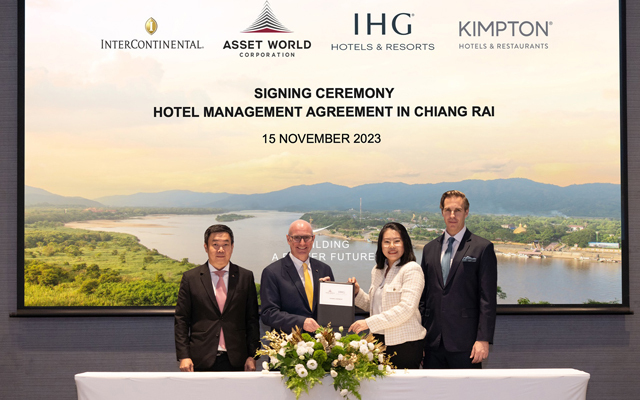
IHG Hotels & Resorts (IHG) and Asset World Corp Public Company (AWC) have signed an agreement to open two new luxury hotels in Chiang Rai, Thailand.
Opening in 2025, InterContinental Chiang Rai Golden Triangle Resort will offer 68 one- and two-bedroom pool and plunge pool villas. Kimpton Chiang Rai Golden Triangle, which currently operates as The Imperial Golden Triangle Resort, will undergo an extensive renovation and convert to the Kimpton brand with 68 suites, along with a range of facilities.
These luxury destination resorts will mark IHG’s entry into Thailand’s Golden Triangle, an area that is popular with travellers for its rich history, immersion into Lanna culture, and the scenic mountain and river landscape which borders Laos and Myanmar.
Rajit Sukumaran, managing director, South East Asia and Korea, IHG Hotels & Resorts, said the signing is “another milestone in IHG’s and AWC’s more than 10-year relationship”.
He added: “We remain on track to grow our luxury and lifestyle portfolio in Thailand by 50 per cent, and it’s fantastic to be expanding the InterContinental and Kimpton brands into new destinations.”
Wallapa Traisorat, CEO and president, AWC, said: “Chiang Rai is a unique destination in Thailand that showcases the beauty in nature and the arts as well as many beautiful temples, hill tribes and local villages, offering different organic and cultural sustainable experiences for travellers. This partnership with IHG will put this most northern province of Thailand top of mind for many local and global tourists. It aligns perfectly with our vision to transform Chiang Rai into a luxury ecotourism destination, with both hotels ideal for the cultural and natural explorer and for couples and families who seek wellness and a luxury lifestyle resort experience.”
Yotel signs first Malaysia hotel

Yotel, partnership with High Steet Holdings, will bring the 290-key Yotel Kuala Lumpur to the heart of the Malaysian capital’s central business district.
Projected to open in 2025, the hotel will be steps away from Petronas Towers, Kuala Lumpur City Centre, Kuala Lumpur Convention Centre, and shopping centre.
Plans for the hotel, which will be part of a mixed-use development, include a rooftop pool and bar offering views of the city skyline, as well as signature Yotel amenities, such as the multi-functional dining and co-working space, Komyuniti, a fitness centre, and Grab + Go snack station.
Daniel Yip, partner, High Street Holdings, said: “Yotel has proven that with its modern and sustainable smart design as well as creative use of technology, it is a very attractive brand for guests and real estate owners alike.”
Sojern publishes unique destination marketing report for travel industry players

Digital marketing platform Sojern has launched the State of Destination Marketing 2024 report for destination marketing organisations (DMOs). It is said to be the first-of-its-kind, produced through a partnership between Sojern and Digital Tourism Think Tank (DTTT), and supported by Brand USA, Destination Canada, and the European Travel Commission.
The new report sheds light on the latest industry trends and challenges, particularly related to the future of destination marketing, drawing insights from nearly 300 DMOs, government departments and affiliated tourism entities worldwide.

Sojern commissioned the report to ensure its global destination clients have access to the most comprehensive marketing insights.
The report found that economic uncertainty, inflation, and the cost of living are all having a significant impact on strategies, with more than 50 per cent of respondents considering these to be areas that require careful planning.
“As the travel industry undergoes rapid transformation, we remain committed to empowering destinations to navigate these changes effectively,” said Noreen Henry, chief revenue officer, Sojern.
“The insights uncovered in our report highlight destination marketers’ strategic priorities and overall approach to digital marketing, while also highlighting the significance of promoting sustainable and diverse tourism and meeting consumers’ increasing desire for unique experiences. Working with strategic technology-powered partners like Sojern ensures success in an increasingly dynamic and competitive environment.”
Some interesting observations made in the report include growing adoption of AI and the impact that has on destination marketing. According to the findings, DMOs anticipate that AI’s impact will be most pronounced in content creation, with nearly half (49%) foreseeing significant impact. A growing number of AI tools are transforming creative processes, from long-form content to social media posts.
In addition, 40% of DMOs see significant potential in AI for predictive analysis and forecasting, 38% for data analysis and interpretation, and 37% for marketing content personalisation. However, 71% are currently less confident and see little potential impact in AI’s ability to shape their teams’ web, app and platform creation, and 63% in conversational marketing.
The report also determined greater priority on digital paid media. Ninety-six per cent of DMOs are making significant investments in paid media as an essential component in achieving their marketing objectives. Notably, 58% take an always-on approach, investing year round, while 38% invest seasonally and only 21% invest when specific opportunities arise. Social media advertising maintains its prominence, as does Search Engine Marketing (SEM), with 96% and 95% of DMOs rating them as having a high or average importance, respectively.
Data use and privacy are also top of mind among respondents, with 54% saying that data provides the most value in marketing planning. Demographic data (88%) is used most frequently to guide decisions, followed by behavioural data (79%). However, increased reliance on data also brings its challenges – lack of data integration across channels (52%), the high cost of acquiring data (46%), and limited access to quality data (42%).
With Google’s deprecation of third-party cookies scheduled for mid-2024, 37% reported a significant impact, while 15% of respondents said that these changes have a small impact on their current strategies. DMOs are taking actions to mitigate the effects of these data privacy changes, with 60% planning to focus on social content and 58% prioritising obtaining more first-party data.
More findings and full survey methodology can be found in the full report, accessible here.
Airbnb searches in Thailand surge in lead up to festive period

Searches for Airbnb stays in Thailand among international travellers during Loy Krathong, which will be celebrated on November 27 and 28, have risen by 17 per cent.
Based on Airbnb booking data, Bangkok is the most visited destination in Thailand for the coming water festival that will segue into the year-end festivities, followed by Chiang Mai and Pattaya in the second and third position. The rest of the city ranking is made up of Phuket, Koh Samui, Hua Hin, Koh Pha-ngan and Krabi.

Airbnb has seen an approximately 88 per cent spike in searches by Chinese travellers for November to December. In fact, Thailand is the most searched destination for China guests on Airbnb ahead of the upcoming winter holidays, with Phuket and Bangkok getting the most attention.
Australians are also looking to escape the winter, and Thailand is on their radar as searches among Airbnb guests in Australia for travel to Thailand in the last two months of 2023 increased almost 16 per cent.
“Thailand’s international appeal remains strong with travellers from all around the world keen to experience the country’s world-famous hospitality, cuisine and cultural highlights,” said Amanpreet Bajaj, Airbnb’s general manager for Southeast Asia, India, Hong Kong and Taiwan. “Airbnb has seen a more than 30 per cent growth in nights booked in Thailand this year over last. (Based on) the volume of Airbnb guest searches for stays in Thailand during the end of 2023 holiday period, Thailand looks set for a bumper festive season.”








Planeterra’s work with the Kao Tep Pitak Community Restaurant has been recognised by the Tourism Authority of Thailand for its community-based tourism efforts.
Planeterra’s highly effective model of local regeneration empowers small communities around the world to take control of their lives and conserve their environment and traditions through sustainable tourism.
It helped Kao Tep Pitak Community Restaurant gain public awareness, which used to be elusive despite the villagers’ enthusiasm for travellers and warm hospitality. The few who came would stay only briefly, snapping a quick photo of the area’s main attraction – its elegant suspension bridge – before leaving..
By working with Planeterra to develop its tourism programme, Kao Tep Pitak Community Restaurant was able to incentivise locals by providing them with a reliable income while promoting local entrepreneurs and inculcating a sense of pride and self-esteem among participants.
Planeterra enabled the restaurant’s project to gain traction by providing food and hygiene training, guidance on how to improve the tourism experience, as well as vital funding to complete the construction of a community centre, which first began in 2016. The completed centre includes a communal area, kitchen, dining room, and guest bathrooms.
With Planeterra’s partner, G Adventures, the project has drawn thousands of visitors to the community to sample the Kao Tep Pitak way of life, discover local arts and crafts, sample the incredible cuisine and explore the local landscape.
“We are thrilled to congratulate our esteemed community partners, Kao Tep Pitak, on their well-deserved recognition at the Responsible Thailand Awards 2023,” said Tricia Schers, director, partnerships and development, Planeterra. “Their dedication to community-based tourism exemplifies the positive impact that responsible travel can have on Thailand’s nature, local communities, wildlife, and heritage.”