TTG Asia
Asia/Singapore Tuesday, 30th December 2025
Page 407

Space travel, inbound tourism push among Trip.com’s future commitments

0
  • Expected strong demand in China for space travel
  • Massive development opportunity in improving travel management content
  • Commitment to raising inbound tourism’s GDP contribution for China

Shanghai-based global travel company Trip.com Group’s vision for the future includes offering space travel on its platform, taking up the call by government to boost inbound tourism and optimising efficiency and convenience for corporate travellers.

These brush strokes paint some key aspects of the group’s vision for the future unveiled at its recent Envision.2023 – Navigate the Future of Travel Global Conference, attended by about 700 global industry partners at a venue not far from its headquarter campus in Changning District.
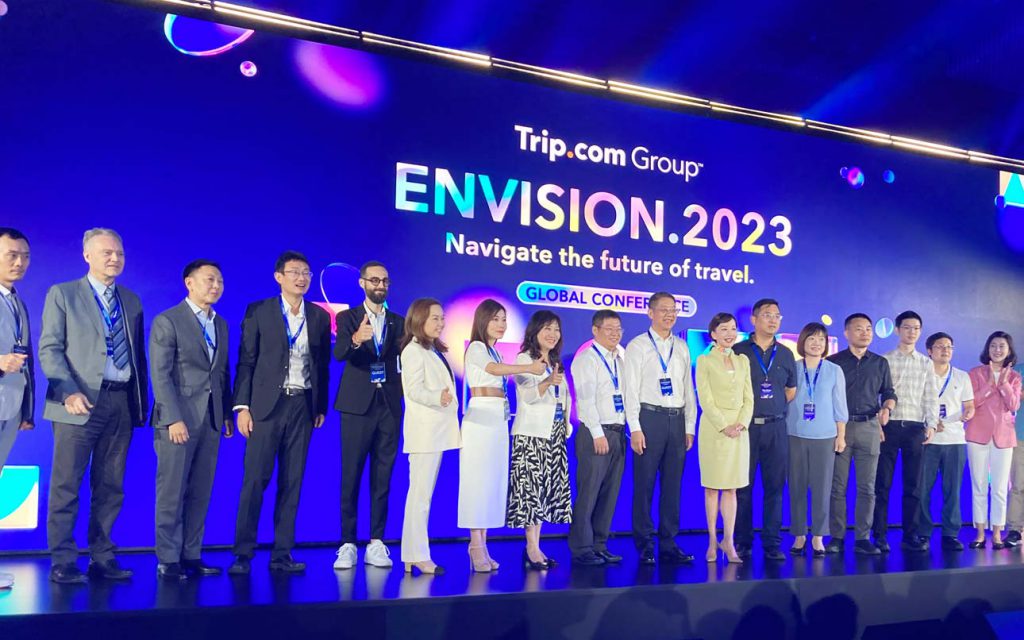
Trip.com Group lays out plans for the coming years at Envision.2023 – Navigate the Future of Travel Global Conference; CEO Jane Sun (in yellow) with partners

Arguing that travel promotes innovation, chairman James Liang in his video address cited man’s migration out of Africa leading to agriculture, the age of European exploration resulting in astronomy, geometry, evolution and scientific revolution, and space travel possibly leading to “limitless potential”.

Tribes travelling out of Africa helped humanity to survive by “risk diversification,” he continued, and so will “space travel and migration” and man being a “multi-planetary species”.

While the rapid development of metaverse technology could replace the desire to travel, Liang believes it will not because the real universe is “infinitely more complex, interesting and orderly”.

He said: “We love the travel industry because it is uniquely good. Psychologically it is a non-satiable high-level need. Economically, it is a long-term high-growth industry. Socially, it promotes understanding, integration and peace. Philosophically, it helps to achieve a higher purpose of humanity, that is the long-term prosperity of humanity because travel inspires innovation and space migration.

“We feel a sense of mission to help deliver the best travel experience, not in the metaverse universe, but in the real universe”.

Developing space travel and more
Elaborating on the company’s vision for space travel, CEO Jane Sun said it would be developed on the Trip.com platform and she would want to take the lead.

Sharing her optimism on demand for this new travel frontier, Sun said a US$200,000 programme on Trip.com was booked in 17 seconds.

In her Charting the Future of Travel Today address and on the topic of corporate travel, Sun noted there was a 100 per cent increase in successful partnerships and digital transformation in local sales and efficiency in optimising efficiency and convenience.

Trip.com also concluded some 1.5 million global hotel partnerships with international brands and by streamlining its travel management content improved efficiency for partners by 75 per cent, she added.

While it is number one in China, Trip.com also wants to address the business travel experience abroad and Sun sees “investment opportunities”.

She continued: “Our investment strategy is based on three principles. First, only travel-related businesses, second, it has to be the core competence and third we are only after the number one or two in the vertical.

“We are waiting for the right time when the market gives us a good opportunity, and we will invest with discipline like during the financial crisis.”

Promoting China inbound
In answering the call by Weng Huajian, vice mayor, Changning District, People’s Government of Shanghai to work with Trip.com to boost inbound during his welcome address, Sun acknowledged China’s inbound baseline and contribution to GDP was small compared to other Asian destinations.

She commented that inbound tourism represented 13 per cent of Thailand’s GDP and it was between five and seven per cent for Singapore and Japan.

“Inbound tourism is an area with great potential. It only represented 0.5 per cent of China’s GDP in 2019,” she said, adding it would be good for China as it would increase job opportunities for young people and create an initiative to bring prosperity to remote areas in the country.

“There’s a lot of work to do, like visas and the need to make applications more user-friendly like Saudi Arabia or Dubai, which offer online applications and visas-on-arrival.”

Sun observed the government was “making good improvement” like linking overseas credit cards to WeChat for payment, and suggested more bilingual signs as most visitors read English and to equip traffic police with technology.

“Trip.com is already working with partners, the government and like-minded in opening up China and welcoming inbound travellers,” she shared.

Meanwhile, to retain talent and to help pregnant employees, Sun said Trip.com provides free taxi transport.

According to Sun, it takes seven years to build the career of talented PhD women and Trip.com is looking at how it can support employees.

She said the company was setting aside a RMB1 billion (US$137,458,000) fund, and starting this year, RMB10,000 will be given for five years to support employees to have their first and second child.

“I hope other companies can support this initiative and that 10 per cent of businesses do,” she commented.
Adventure Travel World Summit concludes but adventure tourism development continues for Japan

0

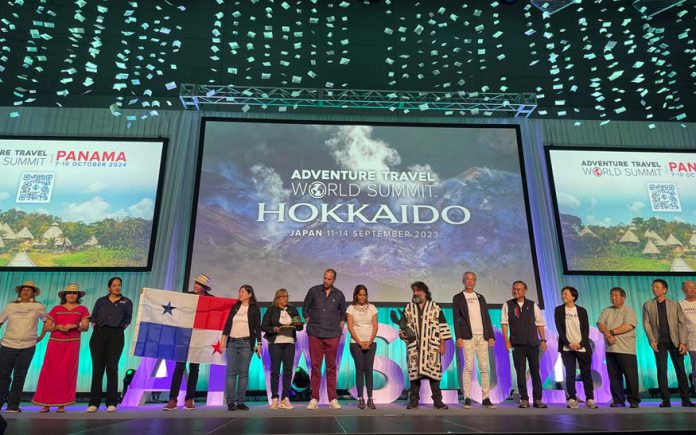
Industry excitement is growing for the future of Japan’s nascent adventure travel industry as the Adventure Travel World Summit (ATWS) wraps up at Sapporo Convention Center in Hokkaido and delegates embark on post-summit adventures on the island.

In closing the four-day event, Shannon Stowell, CEO of organiser Adventure Travel Trade Association (ATTA), said ongoing work, including education and promotion, is planned with members of the AWTS Executive Committee from Hokkaido to build on the success of the AWTS.

Panama takes over the baton for 2024 Adventure Travel World Summit

“We’re moving forward together,” he said, noting Hokkaido’s rich offering of the three important elements of adventure travel: culture, nature and experience.

The ATTA’s enthusiasm is mirrored by the growing interest in Japan among guides, tour operators and destinations to prepare infrastructure, skill up and forge relationships to improve the country’s adventure travel offering, added Hannah Pearson, regional director – APAC, of the ATTA.

“This summit is not the finish line; it’s about planting a flag, signalling to the community that this destination is ready to welcome adventure travellers,” she said. “Hokkaido and Japan are setting the bar very high for other destinations to follow and offering an inspiring model as adventure travel becomes more popular.”

ATWS Hokkaido Executive Committee representatives closed the event by exchanging cultural gifts with their counterparts in Panama, which will host the next AWTS over October 7 to 10 next year.

Delegates depart today on various four-day/three-night post-trip adventures in Hokkaido’s extreme north and south designed to showcase the areas’ natural habitats and their connection to the indigenous Ainu.

Tour contents include exploring the Kushiro Wetlands national park, Japan’s largest marshland; trekking around active volcano Atosanupuri and learning about Ainu culture at Lake Akan, home to marimo, a ball-shaped algae formed by wind and waves that Ainu call “lake monsters.” Due to their rarity, marimo are recognised as a National Special Natural Monument.

Rustic hideaway in Phuket offers sustainable dining draw

0

Phuket’s Jampa restaurant, which acquired a Michelin Green Star this year for its zero-waste, plant-based food, offers a unique and Instagrammable venue extension that is tucked away in a serene and scenic part of Pru Jampa organic farm.

Aptly named Hideaway at Jampa, the restaurant exudes a rustic vibe, occupying a wooden structure by a sparkling lake that is surrounded by greenery. Here, an open kitchen makes food preparation part of the dining experience.

Hideaway at Jampa, set in idyllic surroundings, presents sustainable dining in a stylish way

Hideaway at Jampa operates only on Saturdays for lunch, taking in no more than 20 pax each time and strictly by reservations. A sharing-style set menu, priced at 2,900 baht++ (US$81++) per pax, is served here. Dishes change with the day’s best harvest.

Hideaway at Jampa welcomes private gatherings, and the sustainability-focused team is happy to conduct insightful tours of the well-established Pru Jampa organic farm, which shares the land with main restaurant Jampa and Hideaway at Jampa. The farm supplies a wide range of fruits, vegetables, herbs and even chicken eggs to Jampa, sister restaurant and one-Michelin-star-holder Pru, and other dining outlets within the luxurious Trisara hotel. These establishments are all part of parent company, Montara Hospitality Group.

The farm tour can accommodate a maximum of three groups of 10 people each at the same time, and is a good prelude to the meal at Hideaway at Jampa.

Larger private events may choose to charter the venue, and a maximum of 50 guests can be accommodated. Such arrangements will require a rental fee of 300 baht per person.

The farm will host Local Roots by Jampa community market on November 4, during which sustainable produce from local farmers and hospitality providers will be showcased. Dining operations at Hideaway at Jampa will continue as usual then, allowing visitors to pair their sustainable shopping with a meaningful meal after.

High on adventures

0

Moving away from material purchases during the long years of Covid restrictions, affluent consumers are now prioritising spend on rare experiences, a trend that is rewarding operators of specialised expeditions to corners of the world.

Illustrating the transformation of demand among the truly well-travelled, Adam Radwanksi, managing director, Asia-Pacific for Silversea Cruises, said: “In the past, when you had a lot of money, you would escape the world by taking off in a private jet and go to a private island. You would pay money to build a wall between you and the world.

Silversea Cruises is always on the hunt for new landing sites on unchartered land

“The new luxury definition calls for immersion into authenticity, which could be a visit to an obscure, fifth generation-run smoked salmon stall deep in Niigata (Japan) or eating sardines out of a can on a Portuguese street like the locals. These are genuine experiences shared with regular folks going about their day-to-day life, but they are also a form of luxury because they are not easily known to foreigners.”

With Silversea’s clientele being those who have done it all, the quest for even more enriching and unusual experiences is intensifying – leading to a surge in demand and bookings for expedition cruises.

The ultra-luxury cruise line now has five expedition ships sailing exciting parts of the world. Expeditions to Arctic, Antarctica, and the Galapagos, in particular, are enjoying a surge in bookings from the Asian markets, shared Radwanski.

To keep expedition offerings always novel for guests, especially the “large proportion of repeat travellers” within Silversea’s “loyal community of Venetian Society members”, the cruise line invests in geographic scouting missions to identify new landing sites in remote regions like Antarctica, the South Pacific and the Arabian Peninsula. A recent 15-person Antarctica scouting and research mission led to the discovery of 42 new landing sites on uncharted land.

“As Antarctica landings are dependent on conditions, the more landing sites, the better the on-land experience for guests on Silver Endeavour, Silver Cloud and Silver Wind. This ensures that Silversea remains a cutting-edge polar leader,” stated Radwanski.

Expedition guests can also unlock new experiences through bespoke events. For example, on the Pole to Pole Grand Voyage, travellers were immersed, via events, in Oman’s geology, Cape Town’s Malay culture, Portugal’s Sintra, Ireland’s Wicklow Mountains, and the folklore and traditions of Greenland.

For polar adventure specialist, Quark Expeditions, bookings out of Asia-Pacific has been rising month on month for the past year, riding on improving airline capacity and traveller confidence in farther destinations.

Robert Halfpenny, regional sales director APAC & Japan, Quark Expeditions told TTG Asia that sales are now exceeding forecasted stretch targets, particularly over the last two quarters, and the pace “does not look like it will subside for the foreseeable future”.

While North America, Europe and Australia have been Quark’s core markets over the past 30 years, Asia is now seen as a growth star.

Halfpenny said: “Asia is very much part of Quark’s short to medium term development plan. Prior to Covid, China was a substantial sales territory for Quark, particularly for charters, and that has returned over the past six months post the reopening of its borders. We anticipate exceeding our pre-Covid sales over the next few years out of China.

“Singapore, India and Japan are also performing very well and we have just started investing into these markets this past year. We are already seeing exceptional sales returns with that investment since the beginning of this calendar year (2023). These three markets, as well as Malaysia and Thailand, will be regions that we will be ramping up our investment for the next few years.”

He observes a preference for longer and more premium polar expeditions like South Georgia 15-plus-day departures in Antarctica, in addition to the traditional Antarctica Peninsula which are nine- to 12-day adventures. Lesser-known destinations in the Arctic, like Greenland and the North West Passage, are also gaining favour.

“We are assuming this is due to the pent-up demand that occurred during the lockdowns and an appreciation for mystical destinations (when travel was once again possible),” opined Halfpenny.

Growing interest in adventures has led White Desert, an agency established by record-breaking polar explorer Patrick Woodhead and his wife in 2005 to bring travellers into the belly of Antarctica, to launch a 21-day journey that will take no more than 50 guests to 10 iconic destinations across seven continents, starting January 12, 2025.

Named 7 Continent Adventure, the tour will start in Mexico City and cover Colombia, Easter Island, Fiji, Borneo, India, Turkey, Namibia, and South Africa, before concluding with White Desert’s signature trip – into Antarctica. Guests will travel around the world in a unique Boeing 757-200 set up in a private configuration with 50 lie-flat seats.

While expeditions tend to fall under the luxury travel category due to their hefty price tags, White Desert CMO Mindy Roberts remarked that clients are not always high-net-worth individuals. “We absolutely do have guests that have planned these bucket list trips for years and joined our team for the adventure of a lifetime,” she said.

Rod Munro joins BWH Hotels as MD operations for Australasia

0

BWH Hotels has appointed Rod Munro to the role of managing director of operations for Australia and New Zealand.

Reporting to vice president, international operations for Asia Pacific, Olivier Berrivin, Munro will focus on expanding the brand’s presence in the region and lead a new era of growth and success for BWH Hotels.

Munro has a global career spanning over 20 years of hospitality operations experience. He recently served as vice president of operations – Australasia for Stamford Hotels & Resorts, where he oversaw seven properties.

Prior to this role, he spent over 15 years with Accor in a variety of operational management positions, including area general manager and chief operating officer of hospitality services for Pullman Bangkok Grande Sukhumvit; and area general manager and general manager for Novotel Bangkok Ploenchit.

Ala Andriuta joins DidaTravel as head of destination marketing

0

B2B travel distributor, DidaTravel, has appointed Ala Andriuta as head of destination marketing, reporting directly to Gareth Matthews.

This newly-created role was designed to power partnerships with National Tourism Organisations and Destination Marketing Organisations globally, by designing marketing and business development strategies aligned with visitor growth targets.

Prior to joining DidaTravel, Andriuta held a senior commercial role with Axel Springer. Her prior industry experience includes management roles in Tourico Holidays and Hotelbeds.

Discover Bill Bensley’s artistic genius in new Smiling Albino tour

0

Tour operator Smiling Albino has joined forces with Bill Bensley, a recognised hotel designer, architect, and uber conservationist to create the Bill Bensley Art Trail, an experience that combines luxury accommodation and art with sustainable travel practices.

With the first of the experiences to launch on November 28, the tour is a 12-day art and ecology odyssey exploring Bensley’s network of visually striking, sustainable and innovative hotels in Thailand, Laos, and Cambodia.

Shinta Mani Wild – A Bensley Collection

The tour begins at the new InterContinental Khao Yai Resort in Thailand, which uses restored old train carriages (some of which were salvaged from the surrounding jungle), creating charming and ecologically responsible spaces that are actual living pieces of history. There is plenty to do on the tour’s first leg, including art workshops run by Bensley himself, and joining the maestro on a conservation trek into the jungle.

The trail continues at the Rosewood Luang Prabang in Laos, where guests will discover the secrets behind ancient Laotian culture and traditions through inspiring talks and creative workshops.

The Cambodian leg of the tour is broken in two. The first is Shinta Mani Angkor and Bensley Collection Pool Villas in Siem Reap for some rest and relaxation, before striking out to Shinta Mani Wild – A Bensley Collection. Shinta Mani Wild is the jewel in the tour’s crown, a sustainable, all-inclusive luxury resort, under canvas and the canopy of the Cardoman Mountains, which was conceived to save the surrounding woodland from being chopped down.

The tour concludes back in Thailand at The Siam Hotel Bangkok, where an art-themed dinner is hosted at Bensley’s own home with the artist and his partner.

Resorts World Cruises commits to supporting Malaysian businesses, talents

0

Asia-based Resorts World Cruises is showcasing local talents and organisations in Malaysia onboard its ships as part of its new campaign, Sayang Lokal, which translates to ‘love local’ in English.

The campaign kicked off on September 14 with local music act, Alif Satar & The Locos, who launched their album and performed a mini showcase aboard Genting Dream at the 999-seated Zodiac Theatre.

Malaysian band, Alif Satar & The Locos, is the first local act to be presented onboard Genting Dream, as part of Resorts World Cruises’s Sayang Lokal campaign

Band members, representatives from Resorts World Cruises – vice president, sales (Malaysia), Cynthia Lee and Genting Dream captain Jukka Silvennoinen – as well as Warner Music Malaysia’s associate director, digital account & business development, Carter Ng, officiated the launch of Sayang Lokal.

Commenting on the initiative, Michael Goh, president of Resorts World Cruises, said: “It is our hope that through our Sayang Lokal campaign, we can further support, showcase and promote more local talents and products to elevate their presence and grow the local industry to new international heights.”

Genting Dream is homeported in Port Klang, Malaysia, and departs twice a week on round-trip cruises, offering the three-night Penang or Phuket- Singapore cruise and the four-night Singapore Discovery Cruise.

Get ready for China’s luxury travellers

0

As one of the last countries to remove pandemic-related restrictions, China’s outbound travel sentiments are closely watched. And today, with freedom returning, many affluent Chinese travellers are looking to spend more on travel in the year ahead, and to do so with a renewed need for escapism and exploration, according to ILTM’s new Buzz or Reality research, Decoding the Luxury Traveller Mindset: Spotlight China.

Decoding the Luxury Travellers Mindset: Spotlight China is produced in collaboration with affluent research specialist Altiant.

Having saved money over the past three years, most wealthy Chinese are looking to travel again in style and spend more on more extravagant and unique trips, with international travel set to accelerate in 2023.

Last year, domestic holidays were the most popular choice among wealthy Chinese travellers, many of whom were still concerned about the pandemic. However, there is now a clear shift in willingness to travel internationally. While many are still eager to remain close to China and visit Japan and Singapore, countries farther afield such as France, the US, Australia and Switzerland are cited as their ideal holiday destination for 2023.

There has also been a clear upturn in planned spending on holidays since July 2022. At that time, 55% of affluent Chinese individuals anticipated spending more on holidays than on pre-Covid trips. This figure has now risen to almost three-quarters (73%). Indeed, 26% say they plan to spend much more than before, underlining how travel has become even more important to these wealthy individuals.

Holiday types have also evolved. Multi-generational family trips should continue to show strong growth, with 46% planning to take one. Meanwhile, 41% of Chinese affluent travellers are planning to take a holiday which specifically improves their mental well-being. The pandemic has also meant that relaxing and slower holidays are now more popular than active ones (79% versus 7%) as people look to unwind and recuperate after two trying years.

Moving on, there is little change in priorities when it comes to affluent Chinese travellers’ travel bookings. Overall, the health, safety and hygiene of the destination is the most important factor for upcoming bookings (53%). The retail/food and drink offering and sustainability credentials are the other leading factors, both cited by just under half (49%) as being important for their next bookings.

Seclusion and privacy have also come to the fore, with 31% saying this is important to them and several respondents stating their desire to visit less-crowded destinations. The pandemic has also led many to search for new and unusual experiences, and the development of a more adventurous mindset, where 80% prefer new destinations and experiences. Similarly, 69% say that they prefer holidays where they explore the local area, versus only 17% who prefer trips where they mostly stay at the hotel or resort.

The pandemic appears to have impacted spontaneity when planning holidays. Two-thirds now say that they prefer to plan in advance, with many citing the additional safety and peace of mind which comes from doing so.

There is also a growing desire for longer holidays which last a week or more: 63% prefer these versus just 24% for shorter trips. Holidays are now sometimes also being appended to business trips: one-third of wealthy Chinese individuals took one of these trips last year. Similarly, almost half (52%) say that they prefer to fly less often and stay for longer rather than take whistle-stop, more superficial breaks (25%).

Climate change remains a vital and ever-growing issue globally, and in most luxury categories, consumers continue to be more environmentally aware. For example, 84% of wealthy Chinese travellers are planning to take more sustainable/eco-friendly holidays in the future.

The report also found out that travel advisors will remain integral, with 80% of Chinese affluent travellers saying that they are at least somewhat influential, with 58% planning to use them for half or more of their holiday bookings over the next year.

The projected upturn in the use of travel advisors is a boon for the industry, although this comes with new expectations and demands. Various factors such as monitoring government advice/Covid statuses, getting hygiene information, and taking care of insurance and cancellations are responsibilities that the majority of Chinese travellers now expect to at least be partially taken care of for them.

Overall, travel is the most popular category for affluent spending. A whopping 97% of affluent Chinese individuals spent on travel last year, and 11% spent more than a fifth of their total expenditure on holidays. More than three-quarters (78%) say that they have a bucket list of places and experiences that they are trying to complete.

The strong travel desire of the Chinese has translated to a keen attendance of Chinese buyers at ILTM Asia Pacific this year, when it took place in Singapore.

Alison Gilmore, portfolio director for ILTM Worldwide, RX Global, said: “Everyone wants the Chinese traveller, and I think that’s because they have the appetite to travel, and the money to spend.”

Complete findings from Decoding the Luxury Travellers Mindset: Spotlight China can be downloaded from the ILTM App and website.

Phuket Airport expansion raises environmental concerns

0

With news that the long-awaited Phuket Airport expansion has reached the design phase, Thailand’s new prime minister, Srettha Thavisin, is displaying his commitment to the Thai travel industry by preparing the country’s infrastructure with a beefed-up travel hub easily capable of handling the increase in arrivals during peak travel periods.

The work is slated for completion by 2027 and will enable the airport to process up to 18 million passengers per year.

Phuket Airport’s expansion will boost passengers handling capacity to 18 million per year

In comments to a group of entrepreneurs and business people last week, reported by the Bangkok Post, Srettha said: “I want everyone to know that the Pheu Thai government will propel the tourism sector in every dimension, including matters related to airlines, airports, security, visa exemption for some countries and extension of stays so that operators can prepare their business plans in advance.”

Ludovic Gallerne, vice president – global commerce of S Hotels & Resorts, believes the prime minister is on the right track.

Gallerne said: “This is absolutely good news to hear. The government plans to expand the airport in Phuket as flight capacity, especially in the high season, has almost reached its limits. Phuket has bounced back very well following Covid-19 and serves destinations like Khao Lak and Koh Phi Phi, as well as Phuket itself. The expansion will help to ensure a good continuation in our arrivals.”

However, Gallerne also has some concerns over the environmental impact of the expansion project. He told TTG Asia: “Phuket is already a world-famous destination where tons of tourists flock to every year. As long as the government plans with land and transport infrastructure organisations to enforce regulations to protect the environment, Phuket can see steady growth without a negative environmental effect.”

However, Bill Barnett, founder and managing director of C9 Hotel Works and a powerful voice for sustainable travel in Phuket, is not impressed with the project and believes more than expanding the existing airport is required to counter ongoing issues.

Barnett said: “The expansion plans are only a bandaid for the current tourism and economic recovery. Phuket has significant seasonal swings in arrivals, and handling peak period passenger traffic is a recurring issue, whether at immigration lines, on the tarmac, or overcrowding and a lack of seating in departures. These problems will be compounded by the steady return of Chinese tourists this year. This peak season is expected to be hectic.”

He cites a need for a second airport as a more long-term solution to the problem and believes a second runway cannot be accommodated on the present site.

Barnett added: ‘Phuket’s transportation infrastructure is a crumbling house of cards, and the sharp rise in residential projects, new hotels, and expansion of international schools has added to rising traffic woes.

“While the airport is one issue, the second is how to get anywhere once you arrive, and the peak season, this November, will likely bring the issues to a head. Bangkok’s central government can no longer continue to sit on the fence on these issues and must develop a sustainable transportation and infrastructure master plan.”