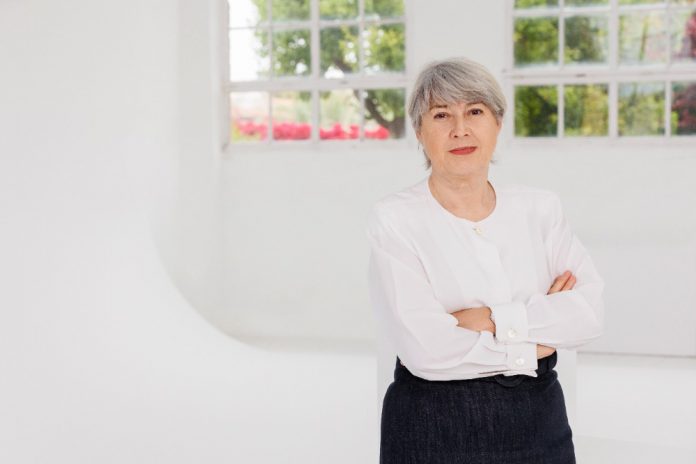
Carmen Riu will step down as CEO in summer 2024, leaving her brother Luis Riu as the company’s sole CEO
Riu Hotels and Resorts’ chief executive officer (CEO) Carmen Riu has announced that she will retire before the summer this year. She currently shares her position with her brother Luis Riu, who will now continue as the company’s sole CEO.
Carmen Riu will step down as CEO in summer 2024, leaving her brother Luis Riu as the company’s sole CEO
Riu began her career in 1977 as the manager of the hotel Riu Bali in Playa de Palma, Mallorca. Prior to that, she had worked in various hotel departments during her time as a trainee in the family business. In 1978, she took the reins of the human resources department, a responsibility that expanded to include administration and finance in 1981.
After the death of her father Luis Riu Bertrán, in 1998 she was appointed CEO alongside her brother Luis Riu Güell. Both have been responsible for the RIU Hotels & Resorts chain’s international growth and consolidation over the last 25 years.
From July 12, 2024, Gardens by the Bay Singapore debuts a fresh exhibition in a different style at its Flower Dome.
Visitors to Gardens by the Bay’s Flower Dome will get to experience a first-of-its-kind exhibition that seamlessly combines multi-sensory immersion and the beauty of nature with the Impressions of Monet exhibition.
Centred on the art, life and gardens of the master Impressionist painter, Claude Monet (1840 – 1926), visitors to the Flower Dome can experience two distinct but complementary aspects of the exhibition in one location: Impressions of Monet: The Garden and Impressions of Monet: The Experience.
An artist’s impression of a scene from Impressions of Monet: The Garden, where Monet’s iconic pink house and scenes from the garden will be recreated by horticulturists.
Impressions of Monet: The Garden is a floral display that recreates the landscapes of the renowned gardens of Monet’s home in Giverny in Normandy, France. Monet’s house is the second most visited tourist attraction in the region.
Inside the Flower Dome, visitors will encounter a recreation of Monet’s iconic pink house and the picturesque scenes of the adjoining garden, Clos Normand and Water Garden. Plants similiar to those in the original gardens, such as hydrangeas, weeping willows, digitalis, daisies, delphiniums and geraniums will be featured.
A highlight of the exhibit is the recreation of the unusual green arched Japanese footbridge that Monet was particularly proud of, and the water lilies that will be featured in the floral display for the first time. These beautiful flowering plants are the eponymous subject of one of his most renowned works, the Water Lilies series.
Complementing the floral extravaganza is Impressions of Monet: The Experience, a multi-sensory immersive experience that celebrates the works and life of Monet and his contemporaries.
As visitors cross into the front façade of Monet’s house, they are enveloped in the sights and sounds of 19th-century Europe as imagined by Monet and his Impressionist contemporaries.
Breathtaking paintings will be projected on an enormous scale, illuminating the bold brushstrokes of Monet, Camille Pissarro, Pierre-Auguste Renoir, Paul Cézanne, Edgar Degas and many more. In a rich, dynamic display of light, colour, sound and fragrance, the masterpieces of the Impressionists will come to life.
Visitors also have the chance to examine the Impressionists’ sources of inspiration via photographs and videos displayed alongside their works.
IATA is maintaining its projection of eight billion air travellers by 2040. Such massive travel volumes will push airport operations to their limits, but not all airports are able to expand their infrastructure to cope with future travel appetites, says Sumesh Patel, president for Asia-Pacific at SITA, the IT provider for the air transport industry.
In this episode of TTG Conversations: Five Questions video news series, Patel discusses what airports are doing to prepare for higher passenger volumes as well as mounting public expectations for sustainable aviation, emerging technologies that could aid traveller processing, and obstacles in adopting available technology, including biometric clearance. He also highlights notable airport developments and digitalisation efforts in Asia, and casts his eyes on how the future of air travel could look.
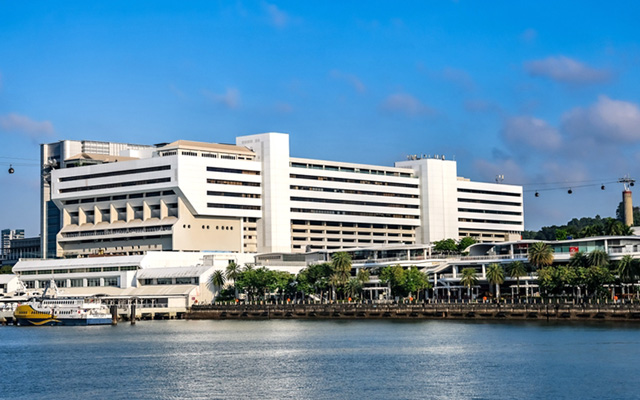
Singapore’s two cruise terminals will be consolidated in the coming years, with a move planned for the long-established Singapore Cruise Centre so as to make way for the Greater Southern Waterfront development.
Singapore’s other cruise terminal is the Marina Bay Cruise Centre, which opened in 2012 to service the new generation of larger and taller cruise ships.
Singapore Cruise Centre (pictured) in the HarbourFront district will move and be consolidated with the city-state’s other cruise terminal to form a single cruise hub
According to a report by national broadsheet, The Straits Times, with information from Urban Redevelopment Authority’s chief executive Lim Eng Hwee, the port move would come with “a lot of infrastructural work”, including land reclamation from the sea, and would result in a larger cruise hub.
Lim explained that the “small move” would allow urban development authorities to “stitch up the entire waterfront” which stretches from Labrador Nature Park through to the future Long Island project off the East Coast, cutting through Keppel-Tanjong Pagar and the Marina Bay areas.
The Long Island project is expected to create space for new homes, various amenities, and a new reservoir. The public has been encouraged to share use ideas for the project, which will take decades to come to fruition.
Destinations of the World, based in Dubai (pictured), will give WebBeds 5,600 unique direct hotel contracts
Middle Eastern travel and hospitality stakeholders expect Chinese outbound numbers to improve in 2024 and make a complete recovery by 2025.
Amanda Elder, chief commercial officer and member of the management board, Kempinski Hotels, told TTG Asia that while the number of Chinese guests at her Middle Eastern properties has been lower than that of sister properties in destinations like Bangkok, Bali, and Singapore, performance has increased noticeably this year.
Dubai is ranked most favoured Middle Eastern destination among outbound Chinese holidaymakers, according to HBX Group
“We anticipate that within the next 18 months, visitor numbers from China will return to their pre-Covid levels,” said Elder.
According to HBX Group, one of the leading B2B players in travel tech space, Chinese outbound to the Middle East grew by 10 per cent in the 2024 fiscal year (October 2023 to September 2024) when compared against the previous year. The most popular Middle Eastern destination among Chinese outbound travellers for 2024 fiscal year was Dubai, with Doha, Medina, and Kuwait making up the rest of the list.
Paul Anthony, digital commercialisation director of HBX Group, said: “Among Chinese outbound to destinations in the Middle East, around 30 per cent of arrivals stay between four and six nights while more than 20 per cent of them stay more than seven nights. The Chinese look for culture, shopping and luxury experiences while in the Middle East.”
DMCs in the region told TTG Asia that Chinese incentive travel movement has turned out stronger than leisure traffic.
Samir Mehta, chief operating officer, Desert Adventures Tourism, said enhanced air links between China and the Middle East are a factor.
“Recently, we managed a large group of nearly 1,400 Chinese incentive winners,” he shared.
Recognising that human capital is a crucial component of a successful tourism industry, Singapore has intensified its investments in capability development, with a compressed training and certification course for tourist guides to launch soon, a new leadership development programme to come later this year, and the creation of a training initiative focusing on sustainability, service experience excellence, and technology.
These programmes were announced at the Singapore Tourism Board-led Tourism Industry Conference on May 10.
STB’s Ong said Singapore’s new capability development programmes will cater to professionals across the leadership and operations segments of the industry
Addressing the audience in her opening speech, Singapore’s minister for sustainability and the environment and minister-in-charge of trade relations, Grace Fu, said “building our people” is a critical ingredient in Singapore tourism industry’s competitiveness.
Fu highlighted the Tourism Leadership Programme (TLP), set to launch in 4Q2024, as the way to equip industry leaders “with the necessary skillsets to navigate the present and the future”.
A programme under TLP is the Tourism Leadership Excellence & Advancement Programme (T-LEAP), which is designed for C-suite, high potential leaders, and business owners. Courses on technology and sustainability will take centre stage, and STB will work with training providers to build content.
T-LEAP will be piloted with Sentosa Development Corporation (SDC), where it will be offered to tourism companies on Sentosa, before being expanded to other industry partners.
STB Planning & Policy Group’s assistant chief executive and chief sustainability officer, Ong Heuy Hong told TTG Asia in an interview that the pilot duration would “depend on demand”.
“We hope to have one or two runs with SDC, with minimally 20 participants for each run. We will see how the take-up is before deciding whether to scale up the number of runs,” Ong said.
During the pilot, STB and training providers will monitor the practicality of the curriculum and benefits arising from new skills acquired through the courses.
While there is a cost for participation, STB will “work with training providers to provide ongoing support to make sure (courses are) affordable to companies”.
Graduates of T-LEAP will be inducted into the Tourism Leaders Network, a platform to encourage cross-collaboration and knowledge sharing.
While TLP and T-LEAP target industry professionals at the top, another capability development programme will ensure the “important majority of operational people” are not neglected.
Ong said: “For this, we are partnering with the National Trade Union Congress LearningHub (NTUC LHUB) for three years to co-develop and offer courses in key emerging areas such as sustainability, service experience excellence, and technology. These areas of focus were determined by the key outcomes of NTUC LHUB’s recent Industry Insights Report 2024 on Tourism.”
Courses will feature implementation-led training, which provides students with the opportunity to apply what they have learnt on real projects.
In an earlier interview with TTG Asia, Tay Ee Learn, chief sector skills officer at NTUC LHUB, emphasised that successful training adopts the 70-20-10 model, where 10 per cent of one’s learning comes from classroom-based training; 20 per cent of retention is through group sharing and experiential learning; and 70 per cent is from on-the-job training, subject to the culture and leadership of the line manager.
An implementation-led training method is, therefore, crucial for skills retention among students.
SDC will again be the pilot partner for STB’s training initiative with NTUC LHUB, as the wide range of businesses island partners are in will allow the courses to be tested out on a “good spread of tourism stakeholders”.
The third new capability development initiative to come is aimed at tourist guides and travel agents. In 2H2024, STB will roll out a more compact licensing course for aspiring tourist guides, in partnership with three approved training organisations – Tourism Management Institute of Singapore (TMIS), Singapore Chinese Chamber Institute of Business, and William Angliss Institute.
This streamlined approach to tourist guide licensing was a result of industry engagement, which alerted STB to hurdles discouraging keen individuals from taking up the profession.
“We want people from all walks of life and diverse background to join this profession, (but) people are telling us that 220 hours of training is very long. At the same time, people also want to know how the advent of technology is impacting this profession,” Ong recalled.
The solution was to revise the licensing course to a minimum of 120 hours, with the option for aspiring tourist guides to pad up their training with additional and relevant courses.
“While we are reducing the course hours, we are not compromising on quality. The course will cover minimal skillsets that are critical – ability to do storytelling, research skills, and decision-making agility,” she added.
Elaborating on the importance of having research skills, Ong said travellers no longer need tourist guides to lay out facts about a place, as these can easily be found on the Internet. Instead, tourist guides should be able and willing to “do their own research” and write a more interesting guiding narrative.
The ability to think on their feet is also valuable to tourist guides, she added, as they must know when is the right time to strike a “wow moment with their customers”.
According to Ong, each approved training organisation would offer its own supplement courses. Tourist guides could potentially sign up for additional courses on building personal branding and social media marketing.
TMIS spokesperson, Teo Puay Kim, director programmes and business operations, told TTG Asia that the additional courses are classified in two key areas: skill-based programmes such as digital marketing, self-branding, etc; and knowledge-based programmes such as nature, architecture, etc.
Teo said: “In the medium term, we are looking to provide professional development programmes on specific topics that can strengthen the depth of knowledge of the tourist guide, so that he/she can provide more specialised tours in return for better guiding fees.”
Additionally, tourist guides in Singapore can also take up the Professional Tour Leading programme, which will earn them an ability to conduct outbound tours. This skillset will boost their remuneration opportunities.
The revised approach to tourist guide qualification and support will also include compulsory networking opportunities that the three approved training organisations must conduct for their graduates and tour companies, according to Ong.
“We want to ensure business matching, so that whatever they have learnt can be brought to life in the real setting,” she explained.
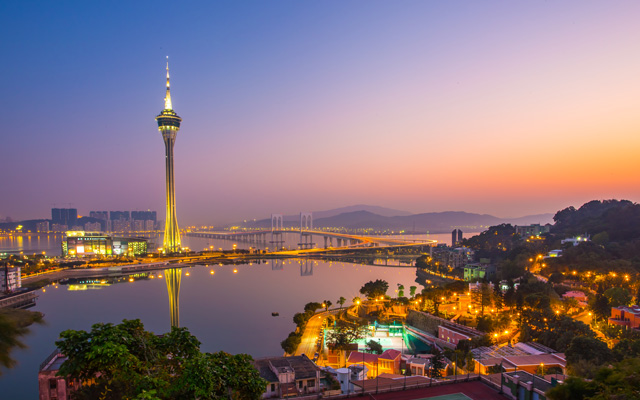
The three-day PATA Annual Summit 2024, set for Macau from May 15 to 17, will see the debut of the PATA-WTCF China Dialogue, supported by the World Tourism Cities Federation (WTCF) and sponsored by Dragon Trail International; the signing of two partnerships; and the launch of a social impact initiative.
The PATA-WTCF China Dialogue will explore the dynamic landscape of China Inbound Tourism, delving into the various challenges and opportunities.
Summit delegates will get to join the Offsite Educational Experience, which includes workshops on traditional dessert making and Portuguese blue tile Azulejo painting
Fresh MoUs between PATA and the Sarawak Tourism Board (STB), and between PATA and the East Asia Inter-Regional Tourism Federation (EATOF), will be signed during the Partnerships for Tomorrow session.
Furthermore, PATA will launch the PATA Kind Hearts initiative to underscore the association’s commitment to positively impacting local communities in the destinations where PATA events are hosted. This involves a donation of approximately 100 children’s books to Instituto Cultural de Macau (Macao Cultural Institute) to nurture a love of reading among the young.
PATA Annual Summit 2024 is hosted by the Macao Government Tourism Office (MGTO) and co-hosted by SJM Resorts, bearing the theme, Reimagining Tourism.
PATA CEO Noor Ahmad Hamid said: “While sustainability remains a focal point, this year’s summit will certainly delve into broader discussions, thought-provoking conversation, encompassing areas such as travel technology trends, marketing strategies, tourism policy, and cultural advancements. It will catalyse positive change transcending current norms across various dimensions of tourism.”
PATA said this year’s registration numbers have been the highest since the end of the pandemic.
“I am thrilled to see that when PATA members come together in full force at such a flagship event like the PATA Annual Summit, it will present an opportunity for the association to come into full form that can recalibrate the strength of what PATA is all about. We can only get stronger when we are together. Hence, it is our hope that members from across the world will seize this opportunity to find touch-points to collaborate with each other as the travel and tourism industry is recovering to its fullest potential,” added Noor Ahmad.
MGTO director, Maria Helena de Senna Fernandes, said, “It has been several years since our destination last staged a PATA flagship event, and it will be a great opportunity to provide delegates from across the Asia-Pacific region with a first-hand experience (of) the new dynamic development of Macau as a world centre of tourism and leisure.”
Summit attendees can expect to hear from a line-up of esteems industry professionals, such as SJM Resorts, managing director, Daisy Ho; Hong Kong Tourism Board, executive director, Dane Cheng; Ministry of Tourism, India, director general (tourism), Manisha Saxena; World Travel & Tourism Council, regional director Asia, Sarah Wang; OAG, head of Asia, Mayur Patel; and Sobie Aviation analyst, Brendan Sobie.
A gala celebration on May 2 marked Conrad Bali’s 20th anniversary, along with the launch of 20 curated guest experiences. The celebration, which had former executive committee members since the pre-opening of the resort, industry partners, and the media among its attendees, tracked the evolution of the property and its expectations of the future.
Kevin Girard, general manager of Conrad Bali, said: “Bali has changed dramatically over the past 20 years – and Conrad Bali is proud to have grown with it. We have seen the addition of one of the island’s most spectacular wedding venues, the Infinity Chapel; the completion of the Conrad Suites in a serene, secluded wing of the resort; and a major redesign of room interiors, among many other enhancements.
Conrad Bali celebrates its 20th milestone with meaningful experiences for hotel guests, such as traditional script workshops
“Despite these landmark changes, our resort’s position as a true icon of heartfelt Balinese hospitality is stronger than ever. As we look back on the past two decades, we are also celebrating the bonds forged, the milestones achieved, and the extraordinary moments shared”.
Resort guests can expect gastronomic journeys, cultural encounters, wellness escapes and more from Conrad Bali’s range of anniversary-special experiences.
One example is the weekly beach BBQ dinner, Savour the Source, which features a multi-course menu highlighting fresh local produce sourced from partners such as Plaga Farm, Jungle Gold Chocolate, Kusamba Salt, and Dewi Sri Arak.
A variety of cooking classes are offered, with additional opportunities to explore the resort’s rooftop herb gardens, master the art of salt panning, and learn about regenerative farming.
Art lovers can also look out for traditional Balinese script classes, sustainable craft workshops, and more.
Sensorial experiences, such as fragrance craft, as well as wellness programmes, such as meditation by the sea and sound healing, are available too.
These experiences are presented by exclusive stay packages that are available for booking now and valid for stays from May 1 to December 24, 2024.
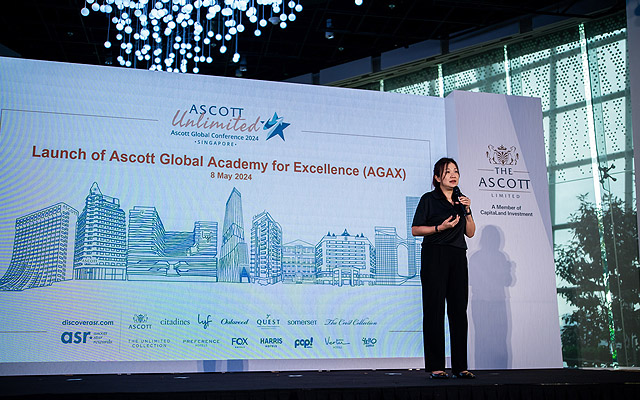
Wong Kar Ling, chief strategy officer and managing director, Southeast Asia for Ascott announces the launch of Ascott Global Academy for Excellence, which will train Ascott associates worldwide
Singapore-based hospitality firm, Ascott has launched its global learning facility, Ascott Global Academy for Excellence (AGAX) as part of its year-long Ascott Unlimited campaign to mark its 40th year of hospitality service.
Wong Kar Ling, chief strategy officer and managing director, Southeast Asia for Ascott announces the launch of Ascott Global Academy for Excellence, which will train Ascott associates worldwide
AGAX is an extension of Ascott Centre for Excellence (ACE), a hospitality training centre in Singapore that provides training courses to the wider industry. It will be established in collaboration with accredited learning partners to train Ascott associates from all over the world.
AGAX will serve as a platform with a comprehensive range of offerings for learning and development, based on a systematised and outcome-based learning track.
From apprenticeship programmes to hospitality and service training courses, all programmes will be designed to equip Ascott associates with the skills and knowledge essential for success in the ever-evolving hospitality landscape. Plans are underway for targeted training resources and support to facilitate associates’ adaptation to technology and embrace technological advancements.
There will also be personal development programmes to equip associates with the technical know-how and best practices for the hospitality industry.
Wong Kar Ling, chief strategy officer and managing director, Southeast Asia for Ascott, said: “As we continue to build on a highly resilient flex-hybrid accommodation model and ride on the upswing of travel recovery, we need a robust and holistic talent management strategy to ensure Ascott maintains an ever-ready pool of talent.
“The Ascott Global Academy for Excellence is a significant milestone in our ongoing efforts to elevate employee engagement, drive operational excellence, and deliver unparalleled guest experiences. By prioritising continuous learning and development, Ascott aims to nurture a workforce that is not only adept at meeting current challenges but also poised to capitalise on future opportunities in the dynamic hospitality industry.”
Beat the heat with the biggest water park bubble festival at Adventure Cove Waterpark, Resorts World Sentosa from June 1 to August 11, 2024.
Visitors of all ages can explore the eight immersive zones spread across the expansive water park and participate in a range of games and activities.
Head to Resorts World Sentosa’s Adventure Cove Waterpark for a splashing good time at the Bubble Fiesta from June 1 to August 11
The Grotto is where the young and young at heart can step and dance on the tiles of the Dazzle Dance Floor, or break out dance moves at Bubble Boogie. Nearby, the Bubble Bounce lets visitors move about in giant inflatable bubbles.
At Bubble Blizzard, visitors can dodge, hit or catch inflatable bubbles as they swirl around, while at Colour-Me Cottage, children can give the cottage a new splash of colours. More bubble fun awaits at Bluwater Bay’s Bubble Rave. Furthermore, in collaboration with DJ Dispensary, kids can try their hand at being a DJ every Friday to Sunday and on June 17, from 11.00 to 15.00.
Bubble Playhouse features a ball pit with giant bubbles for children, while at Bubble Rumble, they can dash and bash their way across a maze of giant inflatable bubbles as giant bubble potions blast bubbles around them.
Adventure Cove Waterpark will also launch a new retail merchandise collection, The Nostalgic Adventure, that reflects the water park’s journey over the last 12 years.
Tickets start from S$40 (US$29.50) per adult and S$33 per child and include admission to Adventure Cove Waterpark, the eight immersive zones of bubble-themed activities, and a complimentary Bubble Rainbow Twirler.


















The three-day PATA Annual Summit 2024, set for Macau from May 15 to 17, will see the debut of the PATA-WTCF China Dialogue, supported by the World Tourism Cities Federation (WTCF) and sponsored by Dragon Trail International; the signing of two partnerships; and the launch of a social impact initiative.
The PATA-WTCF China Dialogue will explore the dynamic landscape of China Inbound Tourism, delving into the various challenges and opportunities.
Fresh MoUs between PATA and the Sarawak Tourism Board (STB), and between PATA and the East Asia Inter-Regional Tourism Federation (EATOF), will be signed during the Partnerships for Tomorrow session.
Furthermore, PATA will launch the PATA Kind Hearts initiative to underscore the association’s commitment to positively impacting local communities in the destinations where PATA events are hosted. This involves a donation of approximately 100 children’s books to Instituto Cultural de Macau (Macao Cultural Institute) to nurture a love of reading among the young.
PATA Annual Summit 2024 is hosted by the Macao Government Tourism Office (MGTO) and co-hosted by SJM Resorts, bearing the theme, Reimagining Tourism.
PATA CEO Noor Ahmad Hamid said: “While sustainability remains a focal point, this year’s summit will certainly delve into broader discussions, thought-provoking conversation, encompassing areas such as travel technology trends, marketing strategies, tourism policy, and cultural advancements. It will catalyse positive change transcending current norms across various dimensions of tourism.”
PATA said this year’s registration numbers have been the highest since the end of the pandemic.
“I am thrilled to see that when PATA members come together in full force at such a flagship event like the PATA Annual Summit, it will present an opportunity for the association to come into full form that can recalibrate the strength of what PATA is all about. We can only get stronger when we are together. Hence, it is our hope that members from across the world will seize this opportunity to find touch-points to collaborate with each other as the travel and tourism industry is recovering to its fullest potential,” added Noor Ahmad.
MGTO director, Maria Helena de Senna Fernandes, said, “It has been several years since our destination last staged a PATA flagship event, and it will be a great opportunity to provide delegates from across the Asia-Pacific region with a first-hand experience (of) the new dynamic development of Macau as a world centre of tourism and leisure.”
Summit attendees can expect to hear from a line-up of esteems industry professionals, such as SJM Resorts, managing director, Daisy Ho; Hong Kong Tourism Board, executive director, Dane Cheng; Ministry of Tourism, India, director general (tourism), Manisha Saxena; World Travel & Tourism Council, regional director Asia, Sarah Wang; OAG, head of Asia, Mayur Patel; and Sobie Aviation analyst, Brendan Sobie.