TTG Asia
Asia/Singapore Saturday, 20th December 2025
Page 2515

Pumping up capacity in Asia

0

Buoyed by steady growth, it’s full steam ahead for cruise lines operating in the region
2012nov16cruised1
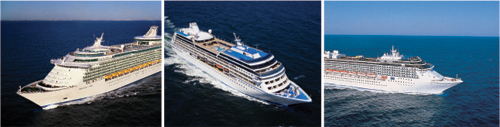
Mariner of the Seas; Azamara Journey; Costa Altantica

nov16-5-1
Kelvin Tan
Regional director, Asia Pacific
Royal Caribbean Cruises 

Homeporting, deployment plans in Asia
The 3,807-pax Mariner of the Seas will kick off her maiden Asian season in Singapore in June 2013 with cruises to Malaysia, Vietnam, Hong Kong, Japan and China. She will be deployed to China for summer and autumn, joined by the 3,840-pax Voyager of the Seas, before returning in November to offer a series of South-east Asian cruises. The 2,076-pax Legend of the Seas will complete her Asian deployment next April.

The 2,158-pax Celebrity Millennium will embark on her maiden Asian season this December for winter/spring 2012/13, featuring cruises from Singapore and Hong Kong with overnight stays in ports like Bangkok, Ho Chi Minh City, Halong Bay and Hong Kong.

The 694-pax Azamara Journey will sail in Asia for the first time for winter/spring 2012/13, offering voyages from Singapore, Hong Kong and Tianjin with overnight calls at destinations such as Bangkok, Hong Kong, Shanghai and Kobe.

Asia as a source market
We average 30-40 per cent year-on-year growth. Our fastest-growing markets are China, Singapore and Indonesia due to the emerging middle class, growing awareness of cruising and our brands, and our regular deployments to homeports such as China and Singapore.

Asian consumers tend to have later booking patterns, but over the years we are seeing more bookings coming in earlier, for instance, eight to nine months before the sailing dates.

For our Asian markets like Indonesia and Thailand, MICE business is also growing from year to year and makes up almost 50 per cent of our total sales, and we expect this to grow further. Incentive travel is a popular trend for companies in these markets. With the recent opening of the new cruise terminal in Singapore, we are also able to deploy larger ships here such as the Voyager of the Seas and Mariner of the Seas, which have more MICE facilities.

Investment on marketing and training
Training is one of our key focuses in our Asian business, to familiarise travel consultants with our cruise products. We are spending significant resources in travel consultant training, such as seminars, workshops, ship tours and cruise previews.

We have identified some markets in Asia, such as China, Singapore and Japan, where our cruise products are very well received. We will continue to invest in these markets by participating in tradeshows and events.

Greatest challenges 
As we deploy bigger ships with better hardware to the region in response to market demand, the port infrastructure in Asia, especially South-east Asia, needs to be upgraded urgently, in order to accommodate these bigger ships and passenger load.

nov16-5-2
Michael Goh
Senior vice president, sales
Star Cruises

Homeporting, deployment plans in Asia
SuperStar Gemini, which was formerly known as Norwegian Dream, will commence service in 2013. Currently undergoing a major US$50 million refurbishment, she will have a passenger capacity of 1,532 pax. She will start her deployments in Penang in January, Sanya in February and March, and then be homeported in Shanghai from April, calling at North Asian destinations. In addition, SuperStar Aquarius will return to Sanya for a second seasonal deployment, calling at Halong Bay and Danang. After that, she will be based in Taipei, calling at destinations such as Ishigaki and Naha.

Asia as a source market
The source markets for our current homeport cities (Hong Kong, Singapore, Penang, Taipei and Sanya) are Greater China, South-east Asia, India, Japan, South Korea and Australia. Among these markets, we are seeing particularly encouraging growth from India as we understand their holiday preferences, especially in F&B, entertainment and shopping. China also represents a good source with the growing spending power of the middle class and easier application process for travelling on cruises. We entered China in 1994, and have cultivated an intimate understanding of what Chinese passengers expect.

Investment on marketing and training
In 2013, Star Cruises will celebrate its 20th anniversary with a series of celebrations across our fleet. This will be supported by advertising & sales promotion campaigns. In addition, we will also celebrate the launch of SuperStar Gemini in Penang, Sanya and Shanghai with on-ground activities as well as publicity campaigns.

Since the announcement of SuperStar Aquarius’ second deployment to Sanya, we have conducted more than 30 cruise seminars and training sessions for travel agencies in major cities in China. Topics include how to promote cruises to individual travellers and MICE groups.

Greatest challenges 
To further develop cruise markets, local tourism bureaus have to develop an in-depth understanding of the cruise industry in order to help promote cruising as a holiday option in their regions. In addition, governments should provide cruise-friendly policies to make it more attractive for cruise lines to deploy vessels in their markets and grow their local cruise economies.

nov16-5-3
Buhdy Bok
Vice president
Pacific Asia & China, Costa Cruises

Homeporting, deployment plans in Asia
This year we replaced Costa Classica with the 2,394-pax Costa Victoria, boosting passenger capacity by 40 per cent. We will have the 2,680-pax Costa Atlantica in addition to Costa Victoria in 2013. This will boast a combined daily passenger capacity of 5,074 pax – more than double the capacity in Asia from 2012. Costa Atlantica has 1,057 cabins, including 54 suites and 620 cabins with private balcony.

Asia as a source market
Demand continues to grow at double digits, which coming off a relatively small base and penetration rate is achievable for the foreseeable future. Our major source markets continue to be Singapore, Indonesia, China, Hong Kong and other South and North Asian countries, depending on the programme and embarkation ports. Asia is expected to continue to grow at a rate that is faster than our other markets.

Investment on marketing and training
We look to differentiate our product through an ‘Italy at Sea’ theme, while uniquely positioning a European experience to the Asian market. Advertising campaigns and cooperation with our preferred sales agents remain crucial. We also look to enhance our products regularly, through special Italian themes. Training for travel consultants and staff also plays a key role. We encourage interaction and seek feedback.

Greatest challenges
In Asia, we believe that the cruise market, despite registering strong growth, is still relatively underpenetrated. The goal of cruise liners is still to actively promote the benefits of a cruise holiday. However, on top of marketing efforts, cruise operators should work hand in hand to develop attractive itineraries, ports and destinations to bring out the uniqueness of a cruise vacation.

nov16-5-4
Jan Swartz
Executive vice president
Sales, marketing & customer service, Princess Cruises

Homeporting, deployment plans in Asia 
In March, Carnival Japan was set up to sell Carnival Corporation brands, with a large focus on promoting the new Princess voyages. In 2013, we are launching the first short season of round-trip cruises from Japan. From April to July, the 2,022-pax Sun Princess will sail from Yokohama and Kobe, calling at ports in South Korea, Taiwan and Russia; many of these cruises are designed around festivals or onsens that are of interest to Japanese and other Asians that fly to Japan.

We also have usual Princess itineraries and deployments in the region, such as the classic Diamond Princess sailing between Beijing to Bangkok. Ocean Princess will make some calls in Asia in April and October, while Dawn Princess will offer some Asian cruises from Fremantle, Western Australia in May and June.

Asia as a source market
Asia has grown quite considerably over the last few years. We don’t share statistics about exactly how many passengers we are sourcing, but there has been a large growth for us, and that’s true not just for a single country in Asia but across the region. There are many Asian countries where consumers are increasingly interested in cruising as a way to see the world.

Investment on marketing and training
We spend considerable amounts to build awareness of our cruises and promote our brand in Asia through our GSAs. We do that in the form of creating local market brochures, local market cooperatives and marketing investment at times with travel agency partners who spend their own money to promote our brand.

We recently launched the Polar Online booking engine in Japanese and simplified Chinese, so there are increasingly opportunities for us to use (existing) tools in other markets and help travel agencies learn more about cruises they can offer their clients.

Greatest challenges 
The big challenge is port infrastructure: besides homeports, ports of call should have sufficient room to deliver a great passenger experience. Some ports may not know how to configure their facilities to handle the required volume of people, so that’s why we need to partner together to build the setting so that many ships can be accommodated – often on the same day – and consumers will be given an experience that they enjoy so much that they will want to cruise with us again.

nov16-5-5
Ann Sherry
CEO, Carnival
Australia 

Homeporting, deployment plans in Asia 
Besides Princess Cruises’ sailings to Asia, we are looking at deployments into Asia in 2014 for P&O ships, partly because we see many Australians flying into (South-east Asia), so obviously one of the ways to build your market is to follow the people who already know your brand. Carnival Australia represents international cruise brands operating in the local market namely P&O Cruises, P&O Cruises World Cruising, Princess Cruises, Cunard, Holland America Line, Seabourn and Carnival Cruise Lines.

Asia as a source market
Asia is a growing source market because there are a lot of flights coming into Australia from the region. We are seeing groups incorporating cruises as part of their holidays in Australia and New Zealand. The growth is very visible now, from almost none to quite big groups of 200 pax on some cruises, so it would be double digit over the past two years, particularly in the last 12 months, when we saw the arrival of several Asian airlines. The strongest growths are from Singapore, Malaysia and Indonesia.

Investment on marketing and training
Once we publish our 2014 itineraries, we will be embarking on a much bigger marketing campaign. We are looking at (investing in) South-east Asia as this part of the Asian market has a lot of air access, expats and Australian-educated Singaporeans, so we already have a connection that works, rather than go into a market where we have to start from scratch. We are looking at a market we already have some understanding of, as that makes it easier to get growth.

Greatest challenges 
The greatest challenges in Asia for us are probably where to go and how to start growing local as well as Australian demand. It’s really getting the balance right between offering a product that Australians already know versus a product that also works for the Asian market. We are watching what all the other brands are doing in terms of what changes are needed to made to the product, how do you work your onboard dynamics and what works for the market.

Additional reporting from Linda Haden

Entering the nerve centre of travel

0

Gracia Chiang gets a behind-the-scenes peek at the Amadeus Data Centre in Germany, which powers over a billion transactions a day 

2012-nov4
The Amadeus Data Centre in Erding; infrastructure manager, Matthias Koll, explaining how every corner of the facility is closely monitored

Dubbed the ‘brain behind travel’, the Pentagon-like global data processing centre in Erding offers an interesting insight into what happens when a travel consultant in Bangkok, Sydney or anywhere else in the world attempts to make a booking for his client through the Amadeus platform.

Stepping into the 24-year-old facility, which sits close to the Munich airport, one is immediately struck by how security and safety are the cornerstones of the highly resilient structure. For instance, its exterior walls and roof are made of 1m-thick steel reinforced concrete with no windows, its external doors are 50cm-thick solid steel, and there is round-the-clock staffed security, with video cameras both inside and outside the premises.

“There is redundancy in all critical areas and no single point of failure”, said Eberhard Haag, executive vice president, global operations, Amadeus, explaining that a back-up component will kick in when one temporarily fails.

We are told that Erding is an area with no risk of floods, tornadoes, hurricanes or similar calamities. However, Haag revealed that there was a disaster centre sited nearby, where quarterly rehearsals are conducted as part of contingency plans.

The lengths taken to ensure continued service delivery is not surprising considering that the centre handles as many as  17,000 transactions per second at its peak, out of which around 2,000 are from Asia-Pacific. Among the technology provider’s clients are over 700 airlines, 110,000 hotel properties and 207 tour operators spanning more than 195 countries. It is not just travel bookings that are processed here; the data centre also delivers mission-critical services such as departure control and flight management for airlines who use Amadeus’ IT systems.

Our group of eight was ushered into one of six server rooms, where we were shown how efforts were taken to ensure optimal temperatures all day long, by use of room configurations that faciliate hot/cold air flows and cooling floor vents.

The building is separated into three individual data centres with three independent technical zones, served by nine diesel power generators in four locations and four uninterrupted power supply systems. To support growth in its IT solutions business, Amadeus also recently announced the opening of a new ‘energy annexe’, roughly doubling the data centre’s overall power and cooling capability.

When asked if there have been occasions when the centre has been stressed, Haag admitted that the “storm of transactions” that occur when airlines run promotions is “highly dangerous”, but he said that there was enough buffer for every airline. “If the promotions are not coming at the same moment, we can easily cover six times more traffic than usual.”

Said Haag: “We are extremely scalable…year by year our capacity growth is 30 per cent. It’s not just coming from pure bookings, it’s coming from transactions: the number of customer inputs and requests are driving our capacity load.”

This is due in part to how Amadeus’ role has evolved. In the past, when its services were mainly delivered to traditional travel agencies, there would be around five transactions before one booking; now that Amadeus is also rolling out its products to websites, there can be some 2,500 transactions to one booking, noted Haag.

As for his 2020 prediction, Haag said he saw Amadeus having multiple data centres – one in Europe, one in Asia-Pacific and one in North America – to mitigate risks. This may not be far off, considering that there are already teams sitting outside of Europe who manage the data centre remotely during their respective time zones in a follow-the-sun concept. A typical operations day starts in Erding, and by 16.00, handovers to colleagues in Miami are carried out, who work until day breaks in Sydney, where the final shift kicks in.

Data processing is hardly sexy, but this was honestly a fun excursion into the heart of travel IT. Plus, visiting the hometown of one of German’s best breweries had its perks. Erdinger for lunch, anyone?

Web channels taking flight

0

GDSs and travel consultants watch out. Full-fledged airlines are finding more direct routes to Internet-savvy travellers

2012-nov16-3
From left: Lawrence Chai, Vice president, commercial systems, Malaysia Airlines; Gerry Oh, Vice president, Asia-Pacific, Jet Airways; Tom Nishihata, Vice president, web sales & marketing, Japan Airlines

Full-service airlines in Asia-Pacific are cruising towards more direct distribution, following in the jet streams of their low-cost counterparts.

At the recent Web in Travel conference in Singapore, Malaysia Airlines, Jet Airways and Japan Airlines representatives said they were targeting for web sales to account for about half of all ticket revenue in a few years, up from an average of between 20-30 per cent now.

Malaysia Airlines (MAS), vice president, commercial systems, Lawrence Chai, for example, said the airline was in the midst of enhancing its Internet booking engine to encourage customers to book direct. Besides boasting a higher performance, the platform will eventually allow MAS to increase its ancillary income from items such as excess baggage and meal selections.

Gerry Oh, vice president Asia-Pacific, Jet Airways, revealed that the Indian carrier’s web sales out of Singapore was as high as 60 per cent of total revenue.

“In Singapore, where we were once held hostage by some (travel consultants), we told them sorry and asked them to go fly a kite,” he quipped, explaining that he refused to let them stop him from selling tickets online.

However, Oh said the situation in India was slightly different, due to the strong lobbying power of agencies there, explaining that the airline has had to “take it slow and easy”.

In the case of Japan Airlines (JAL), vice president, web sales & marketing, Tom Nishihata, said the proportion of tickets purchased through the web by its domestic passengers was higher (about 50 per cent) compared to international ones (over 20 per cent).

He added that mobile transactions were on the rise, with more than a tenth of JAL’s web sales coming from mobile. Within this year alone, the airline launched 10 apps covering the entire travel cycle from booking to boarding.

Not all were convinced about mobile as a transaction platform though, with Jet Airways’ Oh questioning the ROI on apps. He said his mobile sales were insignificant, and that while an app was “nice to have”, the cost of investment had to be weighed against how well it could actually translate into sales.

Similarly, MAS’ Chai said only a small volume of business currently comes from mobile.

Despite efforts to go direct, all three airlines acknowledged that trade relationships would continue to be vital.

“We have to be realistic. Being a full-service carrier, a large percentage of our distribution still comes from our GDS and travel trade partners,” Chai pointed out.

Oh concurred. “You can’t dismiss all the (travel agencies). Many of them sell multiple segments and groups,” he said, adding that the web was more suitable for sales of FIT, point-to-point tickets due to the limitations posed by legacy systems.

IATA, which has come out to say that the age-old GDSs that travel consultants rely on to book tickets do not enable enough product differentiation, is currently developing new industry-wide distribution standards. These will be open standards that can be used by any party, including GDSs, resulting in increased competition in the distribution space.

However, this has ruffled the feathers of some travel consultants, who feel that their position as the largest single airline distribution channel will be shaken.

It remains to see how the controversial IATA’s New Distribution Capability initiative will play out, but the airline industry body has said it will actively engage the trade in the formation of the new standards, which is supposed to offer travel agencies greater access to ancillary products and a simplified booking process, among other benefits.

Wholesome wholesale

0

An expansion of B2B players in Asia is making the wholesale market more wholesome, providing OTAs and brick-and-mortars greater service, product, availability and pricing than ever before. Raini Hamdi and Gracia Chiang take a look at the competitive strategies of four such players

2012-nov16-travel-distribution1-1

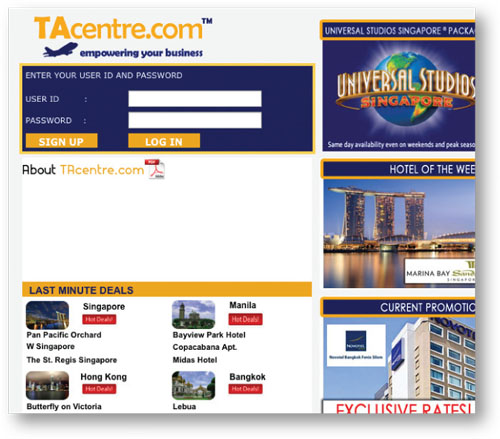
TAcentre
WHO Owned by Asiatravel.com Holdings Singapore, a pioneer in B2C in Asia and the only public-listed travel agency on the Singapore Stock Exchange.

PLANS Launched recently in Singapore, the Philippines and Hong Kong, TAcentre will be rolled out to Malaysia, Indonesia and China next. Plans are afoot to offer local language versions in-market and to offer agencies white-label marketing later on.

USP/INVENTORY TAcentre bills itself as Asia’s first online wholesale system that offers not just hotels but FHTs (flight/hotel/tours) that can be booked with instant confirmation. TAcentre banks on “best rates” and “widest inventory”, thanks to 17 years of local presence throughout Asia that helps it seal “real” relationships with suppliers, said vice president marketing Fred Seow. The inventory now comprises 100,000 products (including packages, hotels, flights and tours) and the aim is to boost this to one million products by 2013. There are 44 FHT packages for Singapore to Hong Kong alone. Consultants can also buy tickets to popular theme parks in Asia directly on TAcentre, with the barcoded vouchers serving as tickets.

THUMBS UP Agencies see the instant confirmation promise as its greatest advantage. They also give the inventory,  convenience, service and flexibility the thumbs up. Plus, it’s free to use.

FEEDBACK Some agencies were concerned about clients’ data confidentiality. As well, “instant confirmation” still depends on availability, they pointed out. Addressing the former concern, Seow said: “Transactions and communication on TAcentre.com are between the travel agency and TAcentre.com strictly. E-tickets and vouchers are emailed to the travel agency and not their customers…protecting the integrity of the wholesale system is of utmost importance, or else TAcentre will not be sustainable in the marketplace.”

2012-nov16travel-distribution1-2

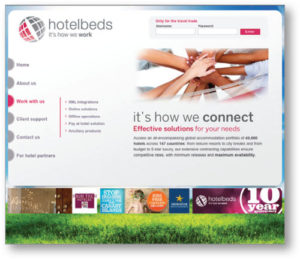
Hotelbeds
WHO Part of the Accommodation & Destinations Sector of TUI Travel, Hotelbeds is now in its 10th year of operations as accommodation provider.

PLANS The Middle East and Asia-Pacific (MEAPAC) region is where it is betting its dollars on next, having established a firm footing in Europe and the Americas.It has set a target of 40 per cent growth for MEAPAC by 2015, compared with 20 per cent growth for the Americas by 2015.

It aims to increase its workforce in MEAPAC by 25 per cent by 2015, from 750 employees and 21 offices throughout the region now.

It also aims to double the hotel portfolio in the next five years, with particular focus on Singapore, Thailand, Indonesia, Malaysia, Hong Kong and Japan, and develop its distribution coverage and further expand source markets across the region, particularly in Singapore, South Korea, Japan, Saudi Arabia, Malaysia, Indonesia, Thailand, China and the Philippines.

USP/INVENTORY An online accommodation database of over 45,000 hotels from over 1,500 hotel chains and independent hotels in 147 countries.

“We invest in people, IT platforms and distribution channels. This is why we have been able to outperform the market with double-digit growths every year since the last 10 years.

“There may be more competition now in the region, but our core strengths and our continued investment will ensure we achieve our targeted growth of 40 per cent by 2015. With 21 offices now, you can imagine how this gives us more opportunities to have preferential rates and treatment with key partners,” said Pablo Aycart, MEAPAC managing director.

He also revealed that Hotelbeds was starting to develop special services such as ticketing and excursions for Real Madrid and Barcelona team matches. In Europe, the trade can already buy such inventory with Hotelbeds, and Aycart expects that within 12 months, agencies worldwide would also be able to do so.

2012-nov16travel-distribution1-3

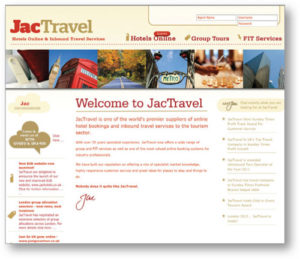
JacTravel
WHO An independent, privately-owned company based in the UK specialising in providing hotels online and inbound services to the travel trade.

JacTravel has local operations in London, Edinburgh, Vancouver, Dubai, Barcelona, Paris, Prague, Rome and Sao Paulo. Last year, it claims to have handled operations for more than 3,000 groups and 1.5 million FIT passengers on behalf of its trade partners.

PLANS With a growing client base in Asia and the growth potential of Asia, JacTravel aims to open an office in the region by the end of the year, employing people with local knowledge. It recently appointed a head of sales for South-east Asia, Ali Jones. She will be selling JacTravel’s B2B booking system and XML links to its hotel inventory, which the trade can access on a net rate basis.

Since expanding to Asia in 2009, sales in the region have increased 319 per cent to £8.3 million (US$13.3 million), with over 20 new clients. Inventory has grown to over 350 directly contracted hotels in Asia in the past three years.

USP/INVENTORY It “handpicks” its own hotels rather contracting all hotels. Said CEO Mario Bodini: “These are boutique, independent hotels in a wide range of categories and styles, with large allocations on short releases and the best deals.  JacTravel’s API/XML system is one of the best in the industry, being fast and reliable.”

Its inventory includes over 10,000 properties in more than 550 cities.

Aside from zeroing in on boutique, independent hotels, Bodini said excellent customer service, and rigorous health and safety criteria for its hotels, were “potent differentiators” in the B2B market.

“The strategy is listening to clients and trying to ensure we have all the hotels that they require with great availability and at great prices.

“The market is tough – with lots of barriers for new players such as having the technology, working capital and the correct product range,” said Bodini.

2012-nov16travel-distribution1-4

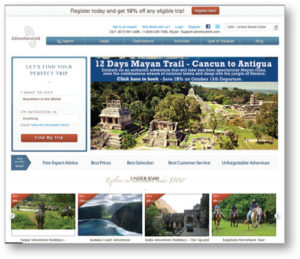
AdventureLink
WHO US-based adventure travel aggregator AdventureLink was established in 2006. Ninety per cent of its business is from B2B partners, which includes OTAs, leisure travel agencies and even consumer publications that want to feature adventure travel products. The company recently established a partnership with Orbitz and is in talks with Travelport to distribute its content.

PLANS Wants to enter the Asian market with a new agent interface that will be launched in the region next year, offering access to around 12,000 trips across 130 countries. It is seeking distribution partners who will allow it to gain access to the agency community in Asia, with markets of interest being Thailand, Singapore and Japan.

USP/INVENTORY Calling it the “largest system in the world for booking adventure travel”, founder and CEO, Kelly Tompkins, said his “well-rounded” inventory consists of land packages ranging from African safaris to cycling wine tours in France, contracted with major tour operators such as G Adventures and Intrepid Travel, as well as family-run boutique outfits. Air content will also be available soon, with at least one airline already onboard.

Tompkins said: “The adventure travel market is estimated to be growing at 17 per cent a year by the Adventure Travel Trade Association. That’s higher growth than most other travel products.

“This is a US$89 billion market, and it’s being fuelled by ageing baby boomers who are looking for these types of experiential travel opportunities. However, (the market is) very fragmented…so we’re trying to put all the information into one place.”

THUMBS UP Dangling commissions of 10-15 per cent, Tompkins said: “It’s the largest commission opportunity available today. Our average booking is US$5,000…We’re proponents of (travel consultants), and we’re giving them the tool set to become specialists in adventure travel.”

Additional reporting from Gracia Chiang

Balancing, juggling

0

Globally, only two females head international hotel chains as CEO – Trudy Rautio of Carlson and Kathleen Taylor of Four Seasons Hotels & Resorts. Raini Hamdi speaks to Rautio, the new CEO of Carlson, about smashing the glass ceiling and how she intends to make Carlson a smashing company

2012-nov16-top1


“I feel I have some fingerprints on the strategy, the people, the structure.” 

Trudy Rautio
President & CEO
Carlson


How do you feel being in a club of capable, but virtually all men?
I’m old enough to have been a pioneer of that in my entire career. I got an undergraduate degree in accounting – only 10 per cent in the graduating class were women and I kind of had to make my way through that profession as the only woman. Now it is more than 50 per cent graduates in accounting that are women.

But the hospitality industry is particularly difficult for women and I consider it one of my goals to work on that. In an entry level capacity, we bring in equal numbers of women and men, but the industry is difficult for women because there is a lot of shift work and mobility requirements. So when women want to start a family, it becomes a difficult career to stay in. We have to figure out more creative ways to make it possible for women to stay in the industry and to advance because women are naturally hospitable. It’s a perfect industry for them.

What do you hope to do?
The American Hotel & Lodging Association is headed this year by Nancy Johnson, who is an EVP at Carlson. She has created a forum for younger women leaders and is doing a lot with the industry on that and we are both going to continue to work on this together. We are of about the same age and we really believe strongly in this.

You are two months into the CEO role, while Kurt Ritter is retiring at year-end as Rezidor president & CEO. These are big changes.
Yes. In some ways, it is an enormous change to step into the CEO role but having been the CFO of the organisation and worked closely with both of the last two CEOs through their tenures, I feel I have some fingerprints on the strategy, the people and the structure. Our organisation as a global one is diverse and has a lot of relationships, whether JVs or partnerships, and at least I have a familiarity with them. That’s also helpful.

With Kurt stepping down – he’s an icon in the industry and built the business from nothing (Editor’s note: Rezidor covers EMEA exclusively) – that’s a loss to Rezidor, but it’s been well-planned with Wolfgang (Neumann, currently Rezidor COO) succeeding. He will stay on in advisory capacity for the first quarter to ensure the relationship with the owners are effectively transferred. I’m also pleased he’s staying on in advisory capacity to me: one of the things Simon Barlow (Carlson Rezidor Hotel Group president Asia-Pacific) and I talked about is having Kurt come out to emerging markets and provide us with his insights and his relationship-building skills, so we’ll be able to utilise him going forward and he won’t be totally losing the family.

From you, what can we expect?
It’s a balance, like everything in life. One is to make sure we attract, retain and develop the right people, so we continue to deliver what we at Carlson say is the ‘service heart’ in whatever it is that we do, whether it is restaurants, hotels or Carlson Wagonlit Travel (CWT). We need to make sure each of the businesses (Carlson Rezidor, CWT and TGI Friday’s) has its strategy around that.

As a private company, we don’t have quarterly earnings expectations, but we still have to perform. And as a private company, we can’t go to the capital market and get more funds, so we need to make sure we invest in the right project at the right time, so we can deliver the returns and reinvest in the business. So that’s the balance – women are used to balancing, right?

So balance is a strength of yours?
Yes, balance, not in the personal life though (laughs). But I’m good at juggling.

How do you motivate your leaders?
You have to set ambitious goals for people. We just recently set long-range plans for our businesses. The restaurant group (TGI Friday’s), for instance, is so aligned around its goals that we’ve actually created a long-term incentive plan for it that has cliff vesting  (i.e. benefits will be gained only if the goals were fully achieved at the end of the plan’s period).

People come to work everyday wanting to achieve. You have to provide the resources they need, from the HQ perspective and also in-market. Then give them the freedom to execute those goals to some extent. It’s pretty classic.

We’ve seen a rash of global players expanding in Asia. What advice would you give Asian owners on how they should choose their brands or chains to work with?
I don’t think I have to advise Asian owners of this, but I think if they utilise the normal tendency to think long term, they would pick the right chain.

It’s a long-term relationship you’re signing up for. Yes, you can switch brands, but you really want to be with the company that you can be with and grow with for a long time, so pick a company that has the right values system, right people and right capability, then grow together.

Most hotel chains profess these same things.
I think Carlson has unique values. Our credo was given to us by our founder. We’re an organisation that has unique capability when it comes to people and relationships. The relationships we form are very long-term. Look at London – we formed our relationship with the Edwardian Group in 1991, we still have that relationship today and they are still growing with us with a new development in London. Very few have those kinds of relationship, in my mind.

India is another great example. We signed our first strategic partnership (with financial investment) in India with Bestech (in April), a company we’ve hotels with. We think there’s a great demand, not just in India but in a lot of the emerging markets, for midscale properties, so we invest together. We believe having a local partner is important, as they know the local customs, have access to real estate, are able to develop the properties more effectively than we could coming in. So we’re looking at developing 49 hotels with them. That’s the way we look to grow in other parts of the world.

We have the right brands, upper upscale and midscale, for growth in this region – Radisson Blu, Radisson and Park Inn. Our Country Inns & Suites also has a strong presence in India, so we’re analysing if it has further use in Asia.

What about luxury – why does Regent keep coming back to you?*
(Laughs) We love that brand. In the downturn we felt we could not support it to the extent that it needed. So we sold that to Formosa, which wanted to bring it back to its Asian roots, and they are happy with it from my understanding.

Now they are saying that in order to grow, just like we’re doing in Asia-Pacific, perhaps it will be better off with an operator and management company in Europe. So he (Steven Pan, Formosa and Regent’s chairman, TTG Asia e-Daily, May 6, 2011) went back to Kurt Ritter. Now we can grow and develop Regent without having the capital investment in the leases and so on. I was asked by our general managers if  that means we can have it for Asia. Well, he’s not willing to give it up for Asia, he still believes he can handle his own in Asia.

But it’s an example of how these relationships come back. This was not an antagonistic sale in anyway. We supported each other as we did the transition and now we have the opportunity to continue with the brand. It does help us in building our portfolio in Europe because there are certain cities where that luxury brand will be effective.

*In September, Regent signed an alliance with Rezidor to develop new Regent hotels exclusively in Russia/CIS, Baltics, Middle East & Africa and jointly with Regent in the rest of Europe.

Read also Carlson in talks to bring Hotel Missoni to Asia.

The Residence Maldives dangles 25% discount

0

FIVE-STAR The Residence Maldives is marking its first anniversary with a 25 per cent discount on early bird bookings.

Available until December 31, the Early Bird Special is valid for advance reservations 60 days ahead of stays of at least three nights, on the island of Falhumaafushi on Gaafu Alifu Atoll.

Guests will also receive US$100 credit per person for F&B and/or spa spending, along with early check in and late check out allowing for domestic flight schedules. Other amenities include free ironing of two items per guest and free in-villa Wi-Fi.

New OTA taps Myanmar inbound and outbound

0

LAUNCHED last month, Oway.com.mm has broken new ground for Myanmar’s tourism industry, touting itself as the first major website allowing secure online credit card purchases in the otherwise cash-only economy.

Riding on the double-digit growths of tourists to Myanmar, Oway offers accommodation options for more than 40 per cent of hotels in Myanmar, as well as travel products such as airfares, car rentals and dining options.

Traditionally, travel to Myanmar had to be booked through travel consultants on the ground.

Oway is also looking for business partners in other Asian countries, such as Singapore, Thailand, Malaysia, Cambodia, Vietnam, Nepal and Indonesia, who can supply products including hotels, serviced apartments and car rentals.

Currently, more than 1,500 merchants in Myanmar and around the world are represented.

Myanmar consumers who do not have credit cards can purchase holidays online through prepaid Oway cards sold by retailers across the country. There are no additional surcharges or commission fees.

Said Oway’s founder, Nay Aung: “I always believe in the power of technology to break barriers and provide a level playing field, so that end users get access to better pricing and small businesses can directly participate in the marketplace.”

Major brands bring five-star hotels to Goa

0

INDIA’S beach destination Goa will see a doubling of its supply of five-star rooms by 2014, with major hotel groups adding 12 new properties, six each in north and south Goa.

InterContinental Hotels Group will build a hotel with a convention centre in Baga and a Marriott is under construction in Khobravado. DoubleTree by Hilton has also just opened in Arpora.

Meanwhile, Ronil Beach Resort Goa in Baga is being upgraded to a five-star property, while work in Cavelossim on three new hotels are also to begin immediately. Saipem near Candolim will get one hotel and two have been slated for Calangute, all by local hotel groups.

Goa currently has 25 five-star properties, totalling 3,465 rooms, though a number of luxury resorts and boutique properties have yet to receive a five-star rating from the authorities.

Arun Varma, managing director, Allways Marketing & Travel Services, said: “Goa needs this boost of high-end hospitality products to bring in the luxury clientele that has diminished in recent years. The new five-star hotels will reclaim Goa’s position as an exclusive year-round upscale resort destination.”

Ralph de Souza, spokesperson, Travel and Tourism Association of Goa, said in a statement to the media: “There is a need for rooms in the luxury segment in Goa, and efforts are being made to tap the luxury segments in key international tourism markets.”

Tussle for luxury trade show ILTM Asia

0

JAPAN is overtly courting Reed Travel Exhibitions, organiser of International Luxury Travel Market (ILTM) Asia, to move the annual show from Shanghai, which has hosted the event since it started seven years ago, to Kyoto.

Though Japan tourism authorities have managed to persuade Reed to launch an ILTM Japan edition next year in Kyoto from March 11-13, it is ILTM Asia they are after.

“Our final goal is for Reed to move ILTM Asia to Kyoto,” Yoshikazu Kuki, director, Kyoto City Tourism & MICE Office, told TTG Asia e-Daily, adding that Singapore is understood to have also expressed interest to Reed to host ILTM Asia.

Added Kyoto Convention Bureau (KCB) managing director conventions & tourism, Shubei Akahoshi: “We know it’ll be difficult to switch from Shanghai to Kyoto, as the show is established in Shanghai and it is perhaps more costly to hold it in Kyoto than Shanghai – but we’ll keep trying.”

Akahoshi was advisor to Japan tourism authorities for two years before joining KCB recently. “For two years, we had been trying to get ILTM Asia to Japan, and now Reed has decided to do a Japan version, which is a start,” he said.

A target of 50 luxury travel buyers and 50 luxury travel sellers has been set, according to Akahoshi. ILTM Japan will be held at the Kyoto International Conference Center, and Kyoto will be sponsoring the opening reception on March 11.

However, a spokesperson for ILTM Asia said “while it is true that ILTM Asia could be moved, Reed Travel Exhibitions has no plans to move it at this stage”.

In announcing ILTM Japan recently, ILTM exhibition director Alison Gilmore had said: “Whereas ILTM Asia has a seven-year proven track record in providing access to a range of buyers from over 20 countries across the burgeoning and diverse Asia-Pacific, ILTM Japan will venture further, providing a direct opportunity for a selection of the world’s elite travel products and experiences to reach the most discerning of Japanese luxury travel buyers and specialists.”

James Kent, KCB’s director international marketing, said KCB was putting all its support behind the show as it was eager to show that Kyoto could host such events. It is equally eager to show off the city to luxury travel buyers and sellers.

“When it comes to luxury in Japan, Kyoto is the destination. In fact, Japan overall is synonymous with luxury like no other. People say, just being in Japan is a luxury experience,” said Kent. “Though it may appear more expensive for the show to be held in Japan, the quality you get in return makes it a real value and we’re keen for Japan to show how high luxury levels can reach.”

Asked about the impact of Japan’s contracted economy on its luxury outbound market, Kent said: “The market is still very much alive. Japan’s economy has been contracting and expanding; it’s not large movements either way and ultimately nothing has changed. The fact that Four Seasons and Ritz-Carlton hotels are opening in Kyoto (in 2014) further proves the market is still growing as these hotels serve not just their global customers but domestic customers as well.”

China-Russia Tourism Year whips up Chinese interest

0

THE China-Russia Tourism Year, which was launched in March, has yielded positive results for Chinese inbound, according to Russian inbound tour operators attending CITM 2012.

Speaking at a product presentation, Olesya Aliferenko, advisor, international department, Russia’s Federal Agency for Tourism, revealed that Chinese tourist arrivals to Russia climbed 43 per cent to reach 113,000 in the first half of this year.

Svetlana Pyatikhatka, general director of World Without Borders (WWB), an association of Russian inbound tour operators appointed to organise Russian tourism tradeshows overseas, said: “This year sees the largest contingent of Russian operators represented at CITM, with 300 exhibitors across 24 regions of the country.

“To keep up the momentum, we will organise roadshows in Beijing, Shanghai and Guangzhou, in addition to participating in major tradeshows like GITF (Guangzhou International Travel Fair), BITE (Beijing International Travel Expo) and CITM.”

Meanwhile, long-standing relations between the two giants continue to keep Russian interest high among Chinese outbound tourists, according to Jiang Yanyan, manager of Soyuz Intour K’s Beijing office, which handled 70 per cent more business from China since the start of the year.

She said: “Our tours are particularly popular among Chinese aged above 50 who are more familiar with Russia’s history and culture, plus this segment also has more money and time at their disposal.”

Furthermore, Chinese tourists are now more inclined to visit destinations beyond Moscow and Saint Petersburg, noted several Russian tourism players.

Nina Kiseik, incoming department chief of Rus Tour, which recorded a 20 per cent increase in Chinese tourists, said: “We are offering new destinations such as Kazan, an old city with iconic mosques in Tatarstan, and the Baltic Republic.”

Encouraged by the 200 per cent surge in business from China since 2010, Oksana Trofimova-Nidentae, CEO of VisitUral.com, has partnered local tourism authorities to organise more fam trips to Ural for Chinese tour operators and media next year.