AIR India’s restarting of direct flights between New Delhi and Moscow last month are expected to boost the Russian inbound market, even as the airline is understood to be considering flights to other Russian destinations.
The national carrier started flying four times a week to Moscow on Boeing 787 Dreamliner aircraft on the heels of a meeting between prime minister Narendra Modi and Russian president Vladimir Putin at the BRICS Summit in Brazil. The service was initially scheduled for commencement in March.
Rohit Nandan, chairman and managing director of Air India, commented: “Presently, around 10,000 people travel between the two countries every month, and there are over 1,000 Indian students in Russia who will benefit from this service.”
Besides Air India, Aeroflot is the only airline connecting New Delhi and Moscow, a route which Air India had previously codeshared on.
SUNWAY International Hotels & Resorts has appointed Lucia Franziska as general manager of Banjaran Hotsprings Retreat Ipoh, effective immediately.
Reporting to Mandy Chew, CEO of Sunway International Hotels & Resorts, Franziska brings with her over 30 years of experience in a range of positions and institutions within the hospitality industry.
Franziska managed the Le Planteur Restaurant in Yangon alongside her Michelin-starred chef husband, Felix Eppisser, before her appointment to Banjaran.
Eppisser has been appointed culinary director at Banjaran Hotsprings Retreat Ipoh.
THE owning company of The Mira Hong Kong and Mira Moon Hotel, Miramar Group, is set to launch its third boutique hotel on January 1, 2015.
The 50-key Mira Cube is situated in the heart of Knutsford Terrace in Tsim Sha Tsui close to The Mira Hong Kong.
Gerhard Aicher, general manager of The Mira Hong Kong, who is tasked with running the group’s maiden Mira Cube, said: “Designed with well-travelled and tech-savvy individuals in mind, Mira Cube’s features and services are streamlined to the convenient minimum that defines 21st century urban lifestyle hotel experience.
“Mira Cube customers will also enjoy unique offerings and privileges at The Mira Hong Kong’s six award-winning outlets, the MiraSpa which includes our infinity pool and 24-hour gym, as well as access to a fleet of guest service specialists for meeting, catering and events facilities.”
For promotional opening rates at Mira Cube, visit www.miracubehote.com for more information.
Raini Hamdi visits The Chedi Andermatt and discovers a thrilling story of a real purpose behind an unreal world of jaw-dropping luxury
Every once in a while, an astonishing development comes along and makes a statement for a destination. The Guggenheim Museum did it for Bilbao in Spain, Marina Bay Sands for Singapore, The Burj Al Arab for Dubai. And now I dare say The Chedi Andermatt can be counted in this elite group, its opening last December not only reviving a forgotten valley but changing the style of resort vacationing in the Swiss Alps.
I did not expect it to be this significant. After all, how much would it take for an international, modern Chedi to create a difference in a conservative Swiss mountain village where flowers-laden, sun-blackened wooden hotels or others covered with shingles are the norm? So as my partner drove me to Andermatt, I was not filled with anticipation – the Chedi had done its job for Andermatt long before I arrived – but I was eager to see Andermatt itself while Kurt was already sentimental about revisiting the valley which helped form him as a man. Andermatt was the centre of the Swiss Army in the Alps and in his military days my Kurt was there as a chef in charge of cooking for a company of 150 men. Andermatt instilled in him a love for the mountains and taught him how to walk up and down them like a Gemse, come rain or snow.
Andermatt, the largest village in the Urseren Valley
An-der-matt. It is not Zermatt, St Moritz, Arosa or Gstaad, mountain resort destinations which need no introduction as playgrounds for the rich to hobnob with one another. Andermatt, on the other hand, requires quite some explanation and, even though it has riveting rags to riches stories to tell, no one had bothered to listen. Until now.
The largest settlement in the long and lusciously green Urseren Valley, Andermatt actually has a long history of hospitality. The opening of the Gotthard Road in 1830 brought a wave of travellers passing through the valley in summer and winter, and with it, the opening of the first hotel in Andermatt, Hotel St Gotthard, in 1854, and its first luxury property, Hotel Bellevue, in 1872. The health of the hotel industry became rosy; alas this lasted only a decade because the village was bypassed when the railway tunnel through the Gotthard opened in 1882. In the early 1900s, Andermatt took off again as a ski resort destination, catering to lots of British guests who pioneered winter holidays in the Alps. But the second World War decimated the image of Andermatt as a luxury destination and in the years that followed, it became synonymous as a military base, with the valley and its mountains being the grounds for army training until 1998.
Chedi’s Gemsstock Suite
Andermatt was in an economic black hole when the army moved out, as the military provided lots of jobs to the village. The knight in shining armour came in the form of an Egyptian entrepreneur, Samih Sawiris of the Orascom empire, whose main businesses are telecommunications and construction. He was welcomed with open arms by the local population who voted to let him build, over time, six hotels with some 3,000 beds, 42 apartment blocks, 20-30 villas, an indoor swimming pool, an 18-hole golf course and a new ski resort – the largest in central Switzerland – linking the Andermatt and Sedrun ski areas. The total investment is reportedly more than 1.8 billion Swiss francs (US$2 billion) if these projects all materialise.
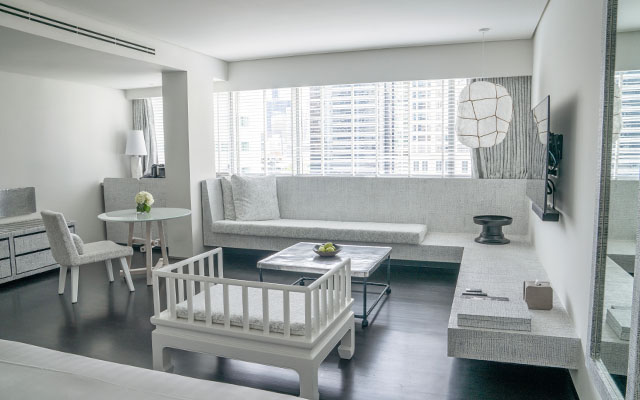
The Chedi Andermatt, with 105 rooms and suites, along with the golf course, is the first of these to open, and if Sawiris had intended the hotel’s opening to strike awe among those who behold it, that aim is a bullseye. There is nothing like it in Swiss Alps and it is nothing like any Chedi I know, not even the grander ones in Oman or Vietnam. It is by no means a Frank Gehry or a Moshi Safdie eye-popping starscrapper; in fact, the building is rather nondescript. Like a Steinbock perched on a mountain, it stealthily blends into the village, its exterior reminding me of a church organ made of wood.
But what’s inside is magnificent – the lobby scales a height, width and length that feel monumental and every facility be it the pool or the suite looks larger than life, everything glitters although nothing is gold. It employs the best technology and the best quality at every turn. The design has Jean-Michel Gathy’s Chedi hallmarks of contemporary elegance and minimalist style but without doubt this is the ultimate Chedi.
This must be how it was when the Badrut Palace in Moritz, or the Tschuggen Grand Hotel in Arosa, opened years before, jaw-dropping pieces of their time that draw the rich and famous till today. Dining in the main restaurant of the Chedi, which twinkles with no fewer than 480 lightbulbs from a dozen modern chandeliers hanging on the ceiling, the young and old wealthy are here to see and to be seen.
Spa & fitness-hydrothermal area
Discombobulated by the scale of luxury, my mind went into defence mode with a barrage of questions: Does this thing fit in a small and modest community like Andermatt? Shouldn’t it have more Swiss ‘sense of place’? Is it a good idea to have a largely young, international crew who further perpetuates the absence of a homely, ‘Swiss-ly’ hospitality one would normally experience in the Alps?
But like all icons, I realised the Chedi sets its own rules. It tells you what luxury is and, before long, you will surrender, just as those before us had to at each of the grand hotels that had opened in the Alps throughout its long history of tourism.
Befittingly, the Chedi Andermatt sits on the site of the former Hotel Bellevue, setting the new foundation for the an old valley. I’m thrilled for the region. The Urseren Valley has lots to offer to international tourists. James Bond movie buffs could relive a scene from Goldfinger by driving through the bends on Furka Pass, while those who love to walk or hike will be spoilt by both gentle and more strenuous trails amid some of the most breathtaking mountain sceneries in Switzerland. And the Swiss Army left one gem of an attraction within reach of Andermatt, Sasso da Pigna, a mountain that hid men and artillery during World War II, which was kept a secret until 2001. Today, the public could walk its 2.5km tunnels, see the dormitories, the cannons and combat positions – now I not only have hiked up, down and on a mountain, but inside it. In just the few days I was in Andermatt, I left richer from the experience.
Andermatt is the new holiday address in Switzerland. For me it is everything Switzerland is: small – yet resilient, lucky and hard to be sidelined or forgotten.
HOSPITALITY investments rose to a five-year record high in 2013 for the Asia-Pacific region, according to global real estate consultancy Cushman & Wakefield. While China, Singapore and Japan led the charge, emerging markets will have a bigger role to play in the near future.
Cushman & Wakefield reported that hotel investments grew 30 per cent from 2012 for a total of US$12.8 billion.
China accounted for the largest share of total investment volume at 20.5 per cent or US$2.636 billion. Singapore took second place at US$2.63 billion, followed by Japan with US$2.61 billion, and Australia with US$2.27 billion.
Investment last year was spread over a wider range of countries including emerging and non-core markets such as Cambodia, Macau and the Maldives.
Akshay Kulkarni, regional director, hospitality services for South Asia and South-east Asia, Cushman & Wakefield, said: “Hospitality investment volume in 2013 more than doubled since 2008 and can be attributed to the excess liquidity, the low borrowing costs, and the region’s favourable tourism growth and outlook.”
Investment volumes for 1H2014 totalled US$5.2 billion, a 9.5 per cent year-on-year increase, though full-year figures are expected to come in at US$9-10.5 billion.
Asia-Pacific’s strongest hotel markets Japan, China, Singapore and Australia are still the most traded and make up 68.8 per cent of investment volume, but emerging markets like the Philippines, Malaysia, Sri Lanka, and Indonesia have seen more action as compared to the same period last year.
China has seen investments of more than US$1.5 billion in 1H2014, but the Cushman & Wakefield report expects this to taper in the second half of the year.
On the other hand, India, Thailand, Indonesia, the Philippines and Sri Lanka stand to gain with major transactions to be closed. Myanmar and Cambodia have witnessed renewed interest in their hotel markets and “could become viable investment destinations”, said Kulkarni.
Kulkarni explained: “We expect the balance of 2014 to equal or come close last year’s level in terms of transactional activity. Japan has already seen significant investment volume and will undoubtedly improve further and lead the pack, due to strong corporate demand and greater investor optimism arising from (Japanese prime minister Shinzo) Abe’s economic reforms. Lower hotel transaction volume is expected for Singapore this year compared to last year, at least in the organised institutional side. However with the change in norms on the shophouses, those that have approved hotel licences will see high guest demand.”
VALADOO is bringing its e-commerce expertise and Burufly its social travel community into a merger that will take on the market of young Indonesian travellers.
The joint entity will retain the Valadoo brand while integrating Burufly’s social network that allows photo- and experience-sharing into the website.
Aimed at Indonesian travellers between 18 and 35 years old, the new Valadoo.com will include travel ideas and packages created by Indonesian travel experts and tailored to young travellers’ social and budget expectations; focus on Indonesian and international destinations popular with this demographic; and a Popular Events Calendar with travel packages created around key events, among others.
Pete Goldsworthy has been appointed chairman of Valadoo, while Jake Wiradisuria, CEO and co-founder of Valadoo, continues in the role of CEO of the merged company.
Said Goldsworthy: “The Valadoo and Burufly brands both resonate particularly strongly with younger, trend-setting, social-media savvy Indonesian travellers.
“Joining forces enables us to offer Valadoo’s superb range of travel and lifestyle e-commerce offerings across Burufly’s social traveller network and to allow travellers a channel to share their travel experiences with the community.”
Wiradisuria commented: “I’m particularly pleased by the depth of talent and complementary strengths of the Valadoo and Burufly teams who combined are really an Indonesian online travel dream team.
“With this team I’m looking forward to revolutionising the way young Indonesians learn about new destinations, shop for travel and then share their experiences online.”
INDIAN Railways last Friday introduced a stored value card, the Go-India card, as well as a number of IT-related improvements to encourage tourists to travel by rail.
The Go-India card is sold at all authorised agents and rail ticket sellers throughout India.
Meanwhile, other software platforms including a train enquiry and train-tracking mobile app were launched on www.irctc.co.in and www.indianrail.gov.in, with pilot testing now effective for Mumbai, New Delhi and Kolkata.
The new implements were developed by the Centre for Railway Information Systems.
Jyoti Kapur, president of the Association of Domestic Tour Operators of India, said: “With one of the largest railway networks in the world and expensive flight tickets, seamless and user-friendly systems for railway passengers will help develop tourism to more remote destinations and increase footfalls to untapped geographies in India.”
“The imminent introduction to high-speed trains will be a boon,” he added.
SWISS luxury hotel group Kempinski Hotels will open its first hotel in Myanmar this November, aiming to cater to international NGO and government delegates besides leisure travellers.
Located in the National Guest House Compound in Hotel Zone 1 in the Myanmar capital, close to the convention hall where the 25th ASEAN Summit will take place from November 9-11, the hotel places a high emphasis on security.
Franck Droin, general manager of Kempinski Hotel Nay Pyi Taw, commented: “The hotel invested about US$1.2 million only for fire safety. The Royal Suite with bulletproof glass is for high-profile delegations that require higher security standards.”
Droin declined to confirm speculation that US president Barack Obama will stay at Kempinski Hotel Nay Pyi Taw during said summit.
The hotel is 50-50 owned by KBZ Group of Companies and Jewellery Luck Company, and is managed by Kempinski. This makes it the second international hotel chain in Naypyidaw after Pan Pacific Hotels Group, which launched Parkroyal Nay Pyi Taw earlier this month.
Its 106 rooms and 35 suites range from Standards rooms (US$220 per night) to the Royal Suite (US$4,000). Other facilities available include a fitness centre, Kempinski the Spa, an outdoor swimming pool, a tennis court, kids’ club, Rangoon Kitchen, two bars, two executive lounges, a business centre with private meeting rooms, ballroom, five conference rooms and banquet rooms.
Said Droin: “Of course we are interested in other projects in Myanmar, but we need to make sure that we have healthy, sustainable growth. We are into long-term strategy and investing in people management.”
SPICEJET is tapping an underserved segment with its new Kolkata-Bagdogra-Kathmandu flights launched last week.
The thrice-weekly service, operated with a Boeing 737 Next Generation aircraft, will serve West Bengal, where West Bengal Tourism has been carrying out major resort and entertainment development projects that will offer golfing and adventure tourism options, due to be completed in 2017.
With no other airports in the region, Bagdogra acts as gateway to popular destinations like Darjeeling, Kalimpong, Kurseong, Dooars, Sikkim, and Phuntsholing in Bhutan.
Debjit Dutta, director, Impression Tourism Services Kolkata, said: “The mountains-to-mangroves tourist trail leads to Bagdogra airport as the entry point, and (the new flight) opens up the mountain resorts in the Darjeeling hills and neighbouring areas for tea tourism.
“Close by, Jaldapara National park offers wildlife tourism, and Sikkim offers birding and adventure tourism. Flights connecting Bagdogra with Kolkata and Kathmandu will exponentially increase inbound tourism from Nepal not only for Nepalese nationals but also international tourists.”
SpiceJet currently flies from New Delhi to Kathmandu 11 times weekly, and will add new international services from Kolkata to Hong Kong, Guangzhou, and Dhaka by 4Q2014.
NEW hotels are sprouting up in the vicinity of the newly opened Dongdaemun Design Plaza (DDP) while old ones have embarked on renovation in anticipation of a surge in MICE visitors, mostly from China.
Located in the Dongdaemun shopping district, Dongdaemun Design Plaza commenced operations in March as part of the Seoul metropolitan government’s MICE Master Plan initiated in 2013 (TTGmice e-Weekly, November 8, 2013).
Exuding futuristic, eco-friendly vibes, DDP is located at Seoul’s fashion core of Dongdaemun. The 8,500m2 DDP encompasses recreational functions and flexible MICE spaces including a museum, a learning centre, and a conference and exhibition centre.
DDP’s establishment has attracted fashion and design-related conferences and exhibitions to Dongdaemun, and also bolstered the hospitality sector.
JW Marriott Dongdaemun Square Seoul commenced operations last December; The Shilla Seoul completed its renovation last August; and Grand Ambassador Seoul Associated Pullman Hotel’s renovation is due to complete in three years’ time.
The main drive for hotels in DDP’s vicinity to increase their capacities is understood to have stemmed from the China market, for whom Dongdaemun is a must-visit area in Seoul.
Last year, 4.3 million visitors from China travelled to Seoul. Seoul’s tourism authority estimates Chinese arrivals will exceed five million in 2014 and 10 million in subsequent years.
Targeted at the China market, DDP’s film and drama serial exhibitions such as Transformers and My Love from the Star reflects the China market’s impact on Seoul’s tourist attractions.
The influence of the China market is akin to the Japanese market’s previous impact on Seoul, observe industry players, and the rapid growth of the China market has propelled Seoul’s economic development and fuelled alterations to the city’s landscape.