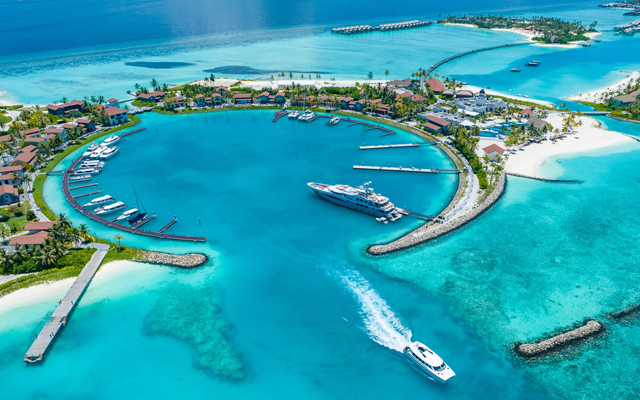
KOH Samui’s tourism sector has managed to shield itself from the worst effects of 2014, despite year-on-year slides in overall arrivals and hotel performance.
Total passenger arrivals through Samui International Airport last year dropped 0.5 per cent from 2013 to 958,987, while occupancy contracted six percentage points, room rate fell by six per cent and RevPAR tumbled 14 per cent, the Samui 2014 Hotel Market Update from C9 Hotelworks found.
The declines were a direct result of Thailand’s political crisis, including the May coup d’etat, said the consultancy’s managing director, Bill Barnett, who pointed out that the timing of the crisis coincided with the lead-up to Koh Samui’s traditional high season.
While total arrivals were down last year, international passenger arrivals increased four per cent to 125,275, helping stabilise performance by year-end. Thailand, Russia, Germany, the UK and Australia were the top five source markets, with the latter down 17 per cent year-on-year. The strongest growth came from Eastern Europe, up 35 per cent on 2013.
“Airlift remains the most profound bellwether for Koh Samui and new flights to the gateways of Singapore and Kuala Lumpur have spurred fly-through traffic from regional and longhaul markets,” Barnett stated in the report. “More importantly, the upgrading of the island’s daily flight ceiling has for the moment put the long-term airport conundrum on the back bench.”
The Department of Civil Aviation recently granted permission for the airport to increase daily flights from 36 to 50, which is expected to drive demand.
However, due to the scarcity of land on the island, hotel development will take place at a relatively slow pace. The 208-room Ozo Chaweng was the sole opening in 2014.
This year, the Imperial Samui Resort will rebrand as a Sheraton, marking the only new opening with the addition of 75 keys to the island’s capacity of 17,986 rooms. Another six new properties are in the pipeline over the next three years.
A NEW hotel brand, First & Foremost Family Hotels, backed by South African golf legend Ernie Els, has been launched.
An offshoot of First & Foremost Hotels & Resorts, a company based out of the UK and Dubai owned by its managing director, Mike Scully, the new brand aims to provide a point of difference in the family hospitality sector. The first hotel is expected to open in Dubai in 2017 and it eyes development across Europe and Asia depending upon investors.
“To achieve double-digit returns, hotels need to have their point of difference. This can be location, hospitality, entertainment and/or leisure,” said Scully.
“First & Foremost Family Hotels will incorporate all of the above. Combined with the Leading Family Hotels ‘edutainment’ offer – specialising in kids (up to five years old) – this makes us unique. We’re not reliant on school holidays and we can focus on achieving the highest room rates and occupancy levels all year round.”
The hotels will be autism friendly thanks to input from Ernie Els and his foundation Els for Autism. Expertise and the latest systems from The Els Center of Excellence will be utilised to produce highly trained staff.
A “complete family holiday experience” will be a priority at First & Foremost, according to Els. “In addition, we are going to ensure a safe environment for families on the spectrum and also create substantial employment opportunities for adults with autism. Hopefully our lead will encourage other organisations to follow suit.”
Leading Family Hotels is not affiliated to Leading Hotels of the World.
Technology has disrupted the global travel landscape like a tsunami force, but how can industry players retool their organisations to compete in the next-generation marketplace?
TECHNOLOGY, once the exclusive domain of geeks and occupying just a small section of newspapers, is now so deeply embedded in the modern world that it has left no industry untouched in its relentless march forward.
Needless to say the travel sector has not been spared the all-pervasive influences – both beneficial and detrimental – of the technology cudgel. First came OTAs, then metasearch, and now, the tide of peer-to-peer consumption is drawing the attention of a younger generation of travellers that are seeing a lesser need for travel agencies.
With the maturation of mobile, social media, big data and cloud, it is also clear that technological changes will take place faster and more profoundly than before.
For instance, Apple’s Bluetooth low-energy wireless technology iBeacon, which received an upgrade alongside the release of the iPhone 6, paves the way for time-sensitive information prompts such as flight status changes at airports or location-based deals.
Or the Internet of Things which can be more accurately described as Things Linked to the Internet, which left tech pundits to predict that 2015 could be the year for it to take off. The ability to send and receive data from everyday devices and objects will have the most immediate impact on hotels – think rooms you can heat or cool before you return, baths you could fill, etc.
In an email interview, Gerry Samuels, CEO of MTT, which has worked with Jetstar Asia and Abacus Singapore and is currently collaborating with Singapore Airlines on smartphone apps, said travel companies already know they need to be on mobile and expects the roll-out of more payment options such as Apple Pay to further mobile bookings growth in future.
“The industry will also see a rise in ‘data snacking’ as a key mobile trend whereby quick, actionable and personalised mobile notifications are presented to travellers in a timely and relevant manner.”
“There is also a greater focus on intelligence, where mobile systems are aggregating data from a multitude of sources to create true end-to-end smartphone apps to cover the entire travel experience,” he said.
“Many airlines primarily focus on the in-airport experience, but the majority of travellers now want apps that help them navigate throughout their entire journey from when they depart their home to get to the airport, in the airport itself, to the hotel and beyond.”
Gfk’s Destination Digital report stated: “The traditional travel (consultants) cannot ignore digital. In order to survive they have to mirror their offline strengths – such as friendly and personalised customer service, reliability, attention to detail and the ability to negotiate great deals – in the digital environment. They need to grow and monetise their loyal user bases, finding innovative ways online to inform, serve, entertain, reward and retain customers.”
Over 50 per cent of travel consumers do research online, making digital presence as important as word of mouth when reaching customers. Thus, it is important that travel companies ensure they are visible from the start of the travel cycle and that their online presence must be “mobile-friendly, user-friendly and adapted to every new platform and every screen size”, given that more than 65 per cent of travel consumers now use three devices when researching and booking flights.
It makes good sense then that travel agencies are keen to find out what the next wave of technological disruption will bring to remain relevant today.
This was the main theme at the 3rd PATAcademy-HCD, held in Bangkok last December, where a lineup of speakers from the travel and technology sectors spoke on possible technologies that could come into play in the travel industry in the next few years, from wearables to artificial intelligence.
When enquired if keyless entry and mobile concierges were something Amritanjali Sakya, executive director of KGH Hotels, would like to implement at her properties in Nepal, she said: “Even if we did, people wouldn’t know how to use them or what it’s about. People (in Nepal) aren’t ready yet.”
Nguyen Truong Quan, CEO of Orient Horizon, a travel agency in Ho Chi Minh City, is considering whether he should change the company’s digital approach.
“We have a website to show we are alive, but now we have to think about where we have to go,” he said. “As a B2B company, do we lose our partners by going B2C? Or how can we engage our existing partners?”
Venkat Chandramoleshwar, head of product marketing, APAC travel, Google, Singapore, a speaker at PATAcademy-HCD, advised: “There’s a lot of cooler things that are happening, the cutting-edge stuff. (But) it makes a lot of sense for smaller businesses to get those that work for you, and for the rest you wait for the dust to settle, because you can’t invest in everything. But there are a lot of things on Google, Facebook, TripAdvisor that you can do for digital relevance 101.”
Words that now are almost prophetic in light of news that Google has stopped selling Google Glass in its current form, which had, following its launch, excited the travel industry with new possibilities for customer service such that Virgin Atlantic launched Google Glass trials at London’s Heathrow airport.
Chandramoleshwar emphasised that there were still immediate steps to be taken: “Do you have your Google business listing? Is your phone number there, is it updated? Do you have those basics taken care of? Many don’t, but the core thing to focus on are the basics. Respond to your reviews.”
Fellow speaker Bronwyn White, co-founder of MyTravelResearch.com, stressed the nitty gritty: “You need to have a clear brand position – it’s useless to be all things to all people anymore, like marketing to honeymooners one day and families the next.
“Do your research, get your marketing in place and have a clear brand position. Link all your social media to one URL. You may have your Facebook account, Google Plus, Instagram, make sure it’s the same URL across all of them. URL is going to be telling the search engine whether your social media is active. Make sure your posts are geo-coded so people going around can see it. It’s important to get your basics right.”
In attendance at the seminar were a pool of hotel, airline, NTO and travel agency professionals, largely from Asia, united by their desire to know what they can do to ride the tech wave and emerge safely the other side. However, when asked if the participants had ever used Airbnb, only six out of the 30 travel professionals replied in the affirmative. Interestingly, they were all female.
But is such a straw poll a measure of how ready travel industry players in Asia-Pacific are in embracing disruption and travel technology? And what technology to adopt? Will keyless entry and augmented reality make that much of a difference?
However, one thing is clear – the technological tide waits for no one.
Said PATA CEO Mario Hardy pointedly: “Disrupt, or be disrupted.”
This article was first published in TTG Asia, February 13, 2015 issue, on page 07. To read more, please view our digital edition or click here to subscribe
Cruise operators are embracing South-east Asia as a market as well as a destination but are travellers from around the region reciprocating their affections?
Voyager of the Seas in Port Klang
Sea-based explorations of South-east Asia are experiencing a surge in demand from within and outside the region, and cruise lines have been quick to expand their reach here with new homeportings and itineraries in recent years.
Intra-ASEAN cruising remains the dominant choice, report cruise lines and travel consultants.
A growing middle class lure more ships
ASEAN travellers are taking up regional itineraries over international itineraries 70:30, according to Royal Caribbean Cruises’ managing director, Singapore and South-east Asia, Jennifer Yap, who attributed this to closer proximity and better flight availability.
“The number of guests from ASEAN taking up regional cruises has also grown 50 per cent year-on-year, especially with…the arrival of the new Quantum of the Seas (in Singapore this) June,” said Yap.
Royal Caribbean International’s Mariner of the Seas is plying 29 sailings for the current Singapore season until March 2015. Itineraries range from three to five nights, cruising to Malaysia and/or Thailand.
Carnival Asia has also doubled its regional market share in the past two years as well. Farriek Tawfik, director of South-east Asia of Carnival’s Princess Cruises, credited this to the region’s booming consumer market and rising purchasing power of the middle class. “We expect double-digit growth in passenger traffic and 30 per cent growth in sales for regional cruise packages in (2015).”
First-time cruisers and large family groups from the region tend to take three- to five-day cruises, opt for larger ships and also prefer more affordable itineraries within South-east Asia since it is nearer to home.
Farriek commented that Princess Cruises is seeing an “increase in first-time cruisers and young Asians”. Based on Carnival Asia’s research, a larger proportion of 18- to 30-year-olds in Singapore aspire to go on a cruise holiday than the over-65 age group.
Given such a forecast, it is unsurprising that Princess Cruises entered a strategic partnership with Changi Airport Group and Singapore Tourism Board to promote fly-cruises out of Singapore last year.
Markets ripe for plucking for the Singapore-centred fly-cruise segment are the Philippines and Indonesia.
Jenica Ferrer, sales and operations officer at Travel People Philippines, Costa Cruises’ preferred sales agent and groundhandler in the Philippines, said about half of Costa’s Filipino clients sail around ASEAN.
Ferrer attributes “strong bookings” to the lower cost of cruising compared with other means of travel, especially competitive fly-cruises in the region due to the proliferation of LCCs.
Filipinos like flying into Singapore and sailing to Thailand and Malaysia, though some also venture farther to Shanghai, Japan and South Korea.
Dining on board Crystal Symphony
Elsewhere in the region, travel consultants are also reporting a continued preference for ASEAN cruises. Anthony Chan, group managing director and CEO, Chan Brothers Travel Singapore, said: “We have seen a 30 per cent year-on-year increase in demand for regional cruises from Singapore.”
Passengers range from busy professionals to multi-generation families and groups of friends with a budget, he said.
“Since international cruise liners began deploying ships in South-east Asia, they have been promoting heavily in Indonesia, collaborating with travel companies and offering promotional fares,” said WITA Tour Indonesia’s director of sales, Rudiana, who said demand for ASEAN cruising has been increasing.
Meanwhile Buhdy Bok, senior vice president Pacific Asia and China, Costa Cruises, noted China’s growing appetite for intra-ASEAN cruises, such that the Costa Serena will be deployed year-round in Shanghai starting April 2015.
On the other hand, local markets have also been a mainstay for Star Cruises. “Star Cruises’ three key ASEAN markets are Singapore, Malaysia and Indonesia,” said Michael Goh, vice president sales. “Both our two- and three-night destination-centric cruises (in Asia) are very popular with ASEAN travellers.”
“We’ve seen year-on-year growth in the family segment for SuperStar Libra mainly due to its affordable pricing. The fact that it is homeported in Penang, which has good access out of our main customer base Kuala Lumpur, also helps,” Goh said.
Enter the Muslim, incentive markets
The lucrative Muslim market is also taking to cruising, in the meantime.
Rakyat Travel Kuala Lumpur’s CEO, Adam Kamal, told TTG Asia: “We’ve seen a 20 per cent increase in year-on-year bookings for family travel on SuperStar Libra, mainly due to the availability of halal food on board. This is very important to entice the Muslim market, which is our main customer base.”
Sunflower Holidays Kuala Lumpur’s managing director, Mint Leong, said the company is promoting the idea of cruising as an incentive, which is still a novel idea in Malaysia. “In 2014 we started to market SuperStar Libra’s 4D3N cruise from Penang to local corporates looking for new incentive ideas.”
Negotiations with two multi-level marketing companies for incentive cruises are also underway at the moment, she revealed.
“We have seen demand growing in the last two years from both FITs and corporate incentives for South-east Asian cruises. They take 4D3N or 5D4N packages, boarding in Singapore and cruising to Malaysia and Thailand,” said Edhi Sutadharma, general manager of Golden Rama Tours and Travel Indonesia.
Far-flung destinations keep appeal
On the other hand, cruise travellers with deeper pockets in South-east Asia tend to gravitate towards far-flung destinations.
Paul Garcia, director of public relations at Crystal Cruises, said that while demand for cruises from Asia-based clients remains strong, especially from Hong Kong, Singapore and Taiwan, most travellers are opting to go beyond South-east Asia. Mediterranean and Baltic itineraries remain firm favourites.
He explained: “The ultra-luxury cruise guest is much more adventurous than the regular cruiser and therefore is seeking destinations much farther afield, though they sometimes book a regional sailing at the very last minute if they opt for a last-minute holiday.”
Likewise, cruise specialists in Thailand say demand for intra-regional trips remains weak. Supanee Bencharit, managing director of SEA Tours Thailand, said Crystal Cruises and Oceania Cruises remain the leading choices for local clients, who range from 40 to 80 years old and comprise both FIT and group travel.
Star Cruises’ Goh added: “Our affluent guests are eager to experience longhaul cruises to worldwide destinations especially with our ships, Norwegian Breakaway and Norwegian Getaway.” Popular destinations include Alaska, the Mediterranean and Caribbean, or Hawaii, he shared.
This article was first published in TTG Asia, February 13, 2015 issue, on page 12. To read more, please view our digital edition or click here to subscribe.
Additional reporting from S Puvaneswary, Paige Lee Pei Qi, Greg Lowe, Rosa Ocampo
SALA Hospitality Group has appointed Nicolas Reschke as group director of business development.
Joining the company with more than 10 years of experience in luxury hotel sales, Reschke will be responsible for overseeing the entire sales and marketing division of Sala Hospitality Group in this new role.
Most recently, he spent two years as group director of sales and marketing at the Sutera Harbour Resort in Malaysia. Prior to that, he was with Marriott International for 15 years in Bali. No stranger to Thailand, Reschke previously worked three years in destinations like Hua Hin and Phuket.
CRUISE operator P&O Cruises is aiming to boost its corporate bookings by almost three-fold with the launch of a conferences division.
P&O Cruises director of sales, Ryan Taibel, said the move to set up a dedicated conference team comes as it prepares to expand its fleet from three to five ships, with the addition of Pacific Aria and Pacific Eden in November this year.
The cruise line saw a surge in meeting bookings in 2015, particularly from the retail and pharmaceutical sectors and associations, he commented.
While bookings to date from corporates stand at 4,000, Taibel said P&O is targeting 12,000 meeting delegates in 2016, with meetings of 100-200 delegates as its prime target.
Forty per cent of the overall ship itineraries offer short breaks of two to five nights, he shared, adding: “This shows that we are serious about having meetings or incentives on board our ships because we know that duration is one of the key considerations for this group of people.
“The current trend in MICE is that incentive groups will reward their top achievers with seven-night cruises, but generally for conferencing on cruises, meeting planners go for three to four nights.”
Taibel said the expanded fleet would also enable P&O to offer cruises from Australian ports including Sydney, Brisbane, Melbourne, Adelaide, Fremantle and Cairns, as well as regional ones like Singapore and Auckland.
Highlighting that cruises are more affordable than land tours, Taibel said a price comparison between a three-night meeting on land including all group extras would cost an estimated minimum of A$1,059 (US$822) per delegate compared with A$906 for a cruise.
P&O cruises has produced a conference brochure highlighting the features of its meetings at sea and the facilities on its ships, the new Pacific Eden and Pacific Aria.
MOBILE apps are becoming increasingly critical to large events and conferences but meeting planners have not learnt how to maximise the full potential of such technology for better communication, according to a report on the subject.
American Express (AMEX) Meetings & Events’ report Great Expectations: The Evolving Landscape of Technology in Meetings, communication and scheduling ranked among the most important features within a meeting app for approximately 80 per cent of meeting planners and attendees.
Sharing the findings of the report, Danielle Puceta, director, AMEX Meetings and Events, said: “Everyone is in the mobile app game now and it is more about what needs to be included in the app and how to make it work, rather than whether you have it or not.”
However, Puceta pointed out that event planners have yet to fully utilise the ability of mobile apps. Citing an example, she said: “Let’s just say if there is a sudden change in the conference schedule, it would be so easy for planners to simply shoot a message out via the app but they are not at that stage yet.
“Mobile apps are still in its early days. There is so much potential that planners can tap on but now there is still a lot of discussion on what needs to be included in an app and what is not necessary.”
As it “takes two hands to clap”, delegates also have to be motivated to download the app.
Puceta said the study showed that instant mobile access to the event schedule is the “killer app” feature that will ensure delegates download the meeting app.
However, she cautioned that planners must ensure ample Wi-Fi access for attendees or the app can backfire and lead to dissatisfaction.
SOUTH-EAST Asia’s travel appetite is only getting bigger as its economies boom, and the UK is trailing behind other European destinations in chasing this market, said Kuoni Group.
In a statement released last week, Kuoni said the company met with prime minister David Cameron to discuss the importance of inbound tourism and regional development.
The UK currently falls behind France, Italy, Switzerland and Germany when it comes to popular European destinations for group travellers from South-east Asia.
The UK has only a five per cent share of group travel from the region, as compared with France’s 22 per cent.
Group travel is a popular travel option in Asia as it removes the hassle and obstacles of overcoming language barriers, planning itineraries, and booking transport and accommodation.
Some 600 million people live in South-east Asia, with a combined GDP of US$2.1 trillion, reported HSBC. With the upcoming ASEAN Economic Community taking root end-2015, regional trade is expected to soar.
Kuoni’s vice president of inbound UK, Rob Andrew, said in the release: “Upgraded infrastructure coupled with political and legislative commitment will help drive trade links, both within the ASEAN region but also with the rest of the world in coming years. This will in turn drive the growth of potentially millions of middle-class consumers with a greater desire and ability to travel.
“VisitBritain’s GREAT campaign has been and remains a success story that it should rightly be proud of. Unfortunately, at present, the agency can only afford to focus its efforts on Indonesia, Malaysia and Singapore as ‘nurture’ markets and showcases its destinations in none of the other seven (ASEAN) countries.”
VIETNAM Helicopter Corporation has launched chopper tours in Danang, and the service is expected to reach full swing in March.
Targeting both the domestic and international markets, the company has bought a US$3 million luxury EC130 T2 Airbus helicopter from France.
“We are now looking at a marketing programme to be launched after Lunar New Year,” commerce manager Tran Dinh Nam told TTG Asia e-Daily last week. “This is our first project for Vietnam, and we are preparing to follow up in other tourist areas such as Halong Bay and Phu Quoc.”
Several packages have been rolled out and scheduled tours include a 15-minute flight over the city, and a 25-minute flight around Son Tra Peninsula and the spectacular Hai Van Pass.
Seating six passengers, the helicopter is also available for private charter.
“I believe this new service will be great for high-end tourism and perhaps MICE delegates,” commented Events Travel Asia Bangkok’s group managing director, Max Jantasuwan.
“Danang is becoming one of the top popular destinations for both our European and Asia-Pacific clients. We are planning a high-end programme into Danang in September and will definitely look into this service for our clients.”
“Helicopter flights are a good selling point for the high-end FIT market, especially for side trips to tourist attractions such as island resorts,” said general manager Allan Chew of Poloair Holidays Shanghai. “However, the travel trade needs to be made aware of the product and the services/packages offered.”
ISRAEL is courting Chinese visitors more aggressively this year and stands to benefit from Hainan Airlines’ thrice-weekly Beijing-Tel Aviv connection starting in September.
Amir Halevi, director general, Israel Ministry of Tourism, said: “We have been traditionally investing in North American and European markets. Emerging markets like China are also a focus for us now.
“We opened a office in Beijing around two years back and now, with Hainan Airlines planning to operate flights to Tel Aviv, we expect significant growth from the Chinese market.”
Israel has set a lofty 100,000 arrivals target over the next two years, compared to the 35,000 Chinese tourists it received in 2014. Leisure and MICE segments are key areas of focus.
To increase Chinese arrivals, the ministry has recommended that Chinese tourists are granted visas on arrival (VoA). “In the past we started VoA for Russia, which helped us to grow tourist arrivals from that market. So, we have proposed the government to extend this facility to emerging markets like China and India,” said Halevi.
Online marketing, tradeshow participation, organising seminars and fam trips also form part of Israel’s efforts in China.
“We are also looking to increase our marketing budget for the Chinese market, which at present is about US$600,000 and we expect it to grow to US$2-3 million in three to four years,” said Oren Drori, deputy director general and head of marketing administration, Israel Ministry of Tourism.
“Chinese tourists are mainly from the business segment, though there are some leisure tourists who visit places like the Dead Sea and Jerusalem. We are seeing an increase in demand from Chinese incentive groups as well,” said Ronit Ezra, incoming sales manager, Mamilla Hotel Jerusalem.