TTG Asia
Asia/Singapore Thursday, 23rd April 2026
Page 1985

Switzerland sees mixed performance from Asian source markets

0

SWITZERLAND has elicited mixed performances from its Asian source markets this year, despite its active promotions there following the slowdown in its traditional European markets.

Hong Kong and China are the fastest growing, India is revving up following a slow increase last year while South-east Asia’s emerging markets are rising from a low base.

Casey Liu, Switzerland Tourism’s chief representative in Hong Kong and China, said overnight stays from Hong Kong has increased by 12 per cent so far this year from 2014, posting a “remarkable growth for a mature market”.

China, meanwhile, has grown more than 20 per cent so far this year, topping France as Switzerland’s fifth biggest market.

India grew 26 per cent in overnight stays in 1Q2015 after logging marginal growth of two to five per cent in the past few years.

“This is a really big step,” said Claudio Zemp, Switzerland Tourism’s director of India, adding that a majority of Indian travellers to the country are FITs.

Ivan Breiter, director of South-east Asia at Switzerland Tourism, said Singapore and Malaysia are “a bit slow” but are expected to post a 15 per cent gain within two years.

This year, Breiter expects Indonesia to post a 43.2 per cent growth, Thailand 31.1 per cent and the Philippines 24.3 per cent for a total of over half a million room nights from the region.

Myanmar Tourism Federation sets up rep office in Tokyo

0

THE Myanmar Tourism Federation (MTF) last week opened its second overseas representative office in Tokyo, following the launch of the first one in the US earlier this year.

“MTF now has a mutual agreement with the Japanese Public Diplomacy Association (PDA) with an aim to encourage the growth of Japanese travellers to Myanmar,” said Sai Kyaw Ohn, deputy minister at the Ministry of Hotels and Tourism Myanmar.

Phyoe Wai Yar Zar, joint secretary general at MTF and chairman of Myanmar Tourism Marketing, added: “By opening this office in Tokyo, we will promote destination Myanmar through PDA’s services.”

The move to attract more Japanese tourists to Myanmar is derived from MTF’s goal to support sustainable, long-term growth by attracting high-value, low-impact travellers.

“Japanese tourist arrivals are currently at 58,527 with a growth rate of 12 per cent so far this year. This means approximately US$1.8 billion of direct tourism income,” said Sai Kyaw Ohn.

According to MTF figures, international tourist arrivals from January to August this year reached nearly three million, a 50 per cent growth over the same period last year.

CVBs must safeguard interest of event owners: Grimmer

0

CVBs need to start seeing themselves as customer representatives instead of being “official mouthpieces” lest they start losing their credibility, said Gary Grimmer, CEO of convention industry consultancy GainingEdge.

Speaking to TTGmice e-Weekly on the sidelines of the ASEAN MICE Forum on Monday, Grimmer who is the former chairman of the board of the International Association of Convention & Visitors Bureau and former chairman of the Business Events Council of Australia, said: “I think a key (credibility) issue is that most CVBs are structured to be a representative (of their destination and suppliers). When CVBs represent the suppliers, they will always be protecting the supplier’s reputation regardless of the quality of service delivery.”

Providing an example of how CVBs can embrace the role of a customer representative, Grimmer said: “If I were representing a bureau, I would encourage people to visit my website and critique the supplier’s service level. It is only then will CVBs be seen as being more transparent and credible.”

He added: “Suppliers are going to get angry when they receive bad reviews but that is the only way to force them to improve their services, or risk going out of business.”

Hugo Slimbrouck, director of strategic partnerships with Ovation Global DMC, also lamented that CVBs were “not working sufficiently together” with the DMC community which he said were the real experts on the ground.

Sharing this opinion during the opening panel session of the ASEAN MICE Forum, Slimbrouck said: “Very often CVBs would have the whole event plan drawn up on their own, then approach the DMC for sponsorship or to be part of the programme.

“But I do not wait for the CVBs (to come to me); I do the opposite. I would organise the event and then go to the CVB and tell them to do something with what I have.”

Nevertheless, Grimmer underlined the importance of CVBs, saying that “they are vital as they are our hope to developing government support”.

Citing Singapore as an example of a country with a strong CVB, he added: “I like Singapore because it is an example of a modern nation with barely any natural resources. Singapore more than anybody else understands how vitally important it is to have conventions and exhibitions (contributing to its) economy.

“Singapore in general has a reputation for great service and (the Singapore Tourism Board) can continue to encourage radical transparency and move towards engaging communication with consumers beyond providing services to meeting planners.”

Additional reporting by Mimi Hudoyo

Malaysia stands to lose Indian events with MAS’ service cuts

0

MALAYSIA Airlines’ decision to halve frequencies of air services between Kuala Lumpur and Delhi to daily flights since September 1 had resulted in a loss of MICE business to Malaysia, said agents interviewed.

Suneet Goenka, group managing director of Red Apple Travel in Kuala Lumpur, declared the reduced frequencies “a disaster”.

He elaborated: “It is going to be very difficult to get MICE business from northern India where companies place great value on connectivity and pricing. Many Indian companies book last minute – three to four weeks in advance – and a hybrid carrier like Malindo Air will not give airfares in advance for large groups.”

Goenka revealed that some Indian companies had already removed Malaysia from their list of preferred destinations.

He also warned that reduced capacity on scheduled airlines would lead to higher airfares on the India-Malaysia sector.

Also impacted by Malaysia Airlines’ service reduction is Hidden Asia Travel & Tours in Kuala Lumpur. Its managing director, Nanda Kumar, said: “Many corporate companies in India want their staff to arrive on the same day. Due to this requirement which cannot be fulfilled through reduced frequency, we have lost a number of potential MICE businesses to other destinations.”

However, an agent from Delhi, Rajendra Dhumma, director of Classic Travels & Tours, has downplayed the effect, saying that the weakened ringgit is enough to keep Indian clients interested in Malaysia.

He said that “Malaysia (is) an even more attractive destination” due to the currency exchange in India’s favour.

“(Moreover) many companies in India have also cut spending and will opt to send employees on (cheaper) airlines like Malindo Air,” he added.

Amit Singla, managing director of Scotch & Water Innovations, Bangalore, disagreed. “Organisers who can pay for scheduled carriers will want a direct connection for their groups. The distance from Delhi to Kuala Lumpur is too short for one stop. The suspension of the morning departures from Delhi to Kuala Lumpur will also affect onward connections from Kuala Lumpur for business travellers from India.”

Dilip Masrani, managing director of Favourite Tours & Forex Gujarat, remarked: “Malaysia will lose out to other destinations once Twentieth Century Fox World Malaysia opens in 2016. This will be a very big attraction for the Indian market and will appeal to Indian business event delegates who often travel with their spouses.

“If organisers fail to secure enough seats to Malaysia for their groups, they will simply choose another destination that can offer better connectivity and airfares.”

Japanese Nobel laureates to help attract MICE business

0

JAPAN is aiming to take advantage of its traditional strengths in technology, sciences and medicine to attract more MICE events and particularly hopes to win more business from Europe and North America.

“We have many Nobel Prize winners in these areas and we feel that the opportunity to meet and learn from them will attract participants from all over the world,” said Katsuaki Suzuki, executive director of the Japan Convention Bureau.

“We are (telling) potential delegates from abroad that they will be able to meet with Japanese scientists and researchers,” he added.

Leveraging the appeal of these experts, the Japan National Tourism Organization (JNTO) has introduced the use of these experts as conference ambassadors to promote the country to foreign markets.

“At the moment, we have 21 university professors who serve as ambassadors and the scheme has had some success,” said Suzuki.

However, he admitted that some issues must be overcome before Japan’s MICE sector can fully take advantage of its unique position.

“Firstly, there is not enough support – financial and human resource – for organisers of conferences and events,” he said. “(The human resource limitation) is partly due to a lack of people with the necessary English language skills.”

Now that solutions are being devised to overcome these challenges, Suzuki believes the sector holds potential for Japanese companies.

“Incentive travel, particularly from markets in South-east Asia, has huge potential for us,” he said. “Those economies are developing rapidly and the JNTO is strengthening its marketing in those areas, such as through the opening of our Jakarta office last year.”

Ultimately, markets further afield are his prime targets. “We would like to attract more MICE business from Europe and North America as we have relatively little business from those areas and those events tend to be high-quality and, as a result, bring in a lot of money,” he added.

Anantara pursues brand refresh with new logo, digital focus

0

ANANTARA Hotels, Resorts & Spas is marking its 15th year in the business with a rebranding exercise, introducing a new brand philosophy, move towards greater digital and social strategies, and a redesigned logo.

Changes to the brand philosophy come on the back of shifting global growth strategies, resulting in a new Life is a journey slogan that is meant to reflect on the brand’s core value of natural luxury and guest-centric focus, it said in a statement.

The move towards greater use of social and digital platforms will involve the creation of a new website and blog, as well as a mobile strategy push to offer guests greater conveniences.

Anantara’s logo will also be redesigned, its iconic water jar and cushions remaining intact, while adding a new golden colour palette.

“Fifteen years later, the way in which people travel and experience the world has changed, and Anantara’s brand refresh has taken shape to meet the expectations, inspire the passions and delight the tastes of new explorers in city and resort destinations,” explained William E Heinecke, CEO and chairman of Minor International.

Minor Hotel Group, CEO, Dillip Rajakarier, added: “The development of the Anantara brand marks the start of the dynamic new journey, both in terms of strategic international footprint and enhancements to the guest experience.”

Absolute to bring Travelodge hotels to Thailand

0

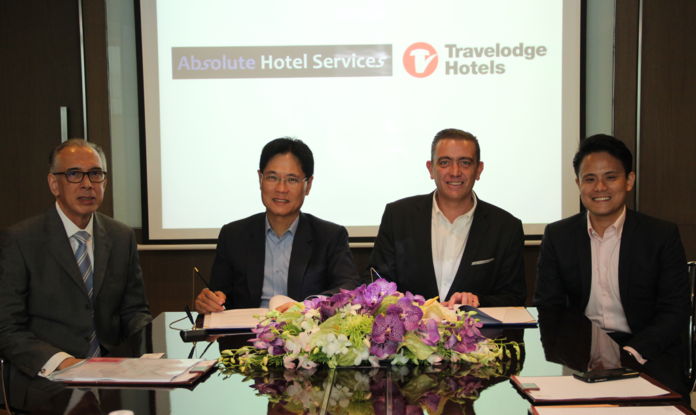
absolute-to-bring-travelodge-hotels-to-thailand(From left) Bernardo Godinez, director of Absolute Hotel Services, Aw Cheok Huat, chairman of Travelodge Hotels Asia, Jonathan Wigley, CEO of Absolute Hotel Services and Marcus Aw, vice president of Travelodge Hotels Asia.

TRAVELODGE Hotels Asia has entered into an agreement with Thailand’s Absolute Hotel Services Group (AHS) to form Travelodge Thailand, a joint venture to bring the Travelodge brands into the Land of Smiles.

Four brands will be entering the Thai market, namely Nano by Travelodge, One by Travelodge and Skye by Travelodge, alongside the main Travelodge brand. They range from lower to upper midscale properties with various design concepts.

Explaining the introduction of Travelodge into the Thai market, Jonathan Wigley, CEO of AHG, said: “Thailand continues to be one of Asia’s most popular holiday and business destinations. Travel and tourism is a key contributor to the Thai economy and the country’s GDP.

“Specifically, the midscale hotel segment that Travelodge and its three sub-brands operate in is expected to fit in well with the travel demographics of Thailand. We are excited to bring in a new international brand to Thailand and we target over 4000 keys in Thailand for Travelodge by 2020.”

There are currently close to 1000 Travelodge-branded hotels worldwide.

AHS also owns the Eastin Grand Hotels, Eastin Hotels & Residences, Eastin Easy and U Hotels & Resorts brands in Thailand, Vietnam, India, Middle East, Indonesia and Europe.

M&C woos tour operators to home of The Beatles

0

mc-woos-tour-operators-to-home-of-the-beatles
M&C’s Aloysius Lee (center back) and John Lennon’s sister Julia Baird (left) joining the choir at Hard Days Night Hotel.

MILLENNIUM & Copthorne (M&C), which has completed its acquisition of the world’s only Beatles-inspired hotel, Hard Days Night Hotel, in Liverpool, is now hard at work persuading Asian tour operators to launch London-Liverpool itineraries.

Aloysius Lee, CEO of M&C, is starting talks with Asian operators to combine London and Liverpool. The drive between the two cities is a long three hours, but the pain can be lessened for Asian clients especially with a stop at the Bicester Designer Outlet Village located halfway through the journey, he said.

Currently, coaches already operate from Millennium Gloucester Hotel London Kensington in London to Bicester. Lee figured operators could combine a few nights in London with a few nights in Liverpool, a city which has regenerated itself since 2008 when it was conferred the European Capital of Culture status.

Some 600,000 people each year visit Liverpool to retrace the footsteps of The Beatles. Attractions include Beatles Story, the world’s largest permanent exhibition, a psychedelic tour bus that stops at world-famous Beatles sites from Penny Lane to Strawberry Field, the Cavern Club where The Beatles had played nearly 300 times and the International Beatleweek Festival, the biggest Come Together in the world featuring over 200 bands from across the globe. The Hard Days Night Hotel has become part of this pilgrimage for some.

Fundamentally, the property is neither a theme hotel nor a museum hotel, but a stylish design hotel that pays homage to a legend in subtle and creative ways. It looks brand new, has the wherewithals to please the modern leisure and business traveller, and rests easily in the ‘lifestyle’ category – the current rage of hotel chains which are scared to lose out on the New Gen.

The hotel is profitable, Lee said. It’s a question of improving its performance and that’s why he needs the international market to fill the hotel during weekdays, when occupancy languishes, while weekends are a full house thanks to the domestic market.

General manager Michael Dewey said on average the hotel does an occupancy of 78 per cent and an ARR of £89.

“We compete with other brands such as Hilton and Crowne Plaza and outperformed them on all three measures, not that often on occupancies but always on rates and RevPAR. And we did that as an independent, i.e., without M&C, and without affiliations or alliances, but because of brand Beatles,” said Dewey.

“My market is everywhere, as everywhere in the world there are Beatles fans. But as an independent, we don’t have loads of money. And that’s why M&C suddenly gives us an international platform. I can’t see us doing anything but grow from strength to strength. We will be the busiest hotel, and there will be an increase in international customers.”

The hotel teamed up with John Lennon’s sister Julia Baird and a duo of Liverpool choirs to show its love for its new owners last week, singing All You Need is Love on the staircase of its grand entrance and handing out red roses to the public.

– I Want to Hold Your Hand – read the full analysis in TTG Asia, October 16, 2015

Asia’s first cosplay cruise to set sail on Mariner of the Seas

0

cosplay-festTaiwanese celebrity cosplayer, Neneko (left), and cosplayers from the Singapore Cosplay Club (right).

THE Singapore Cosplay Club will be organising a cosplay festival aboard Royal Caribbean’s Mariner of the Seas as part of the club’s 15th anniversary celebrations. The cruise is set to depart Singapore’s shores on January 8, 2016, arriving at Malaysia’s Port Klang three days later.

Named Cosfest Sea: The Rising Tide, the three-night weekend cruise’s biggest draw is the Asia Cosplay Meet Championship, where top regional cosplayers from Japan, South Korea, China and more, battle it out for the top prize. This will be open for public viewing for all the guests onboard to view the action.

Taiwanese celebrity cosplayer, Neneko, will also be making an appearance on the cruise, offering photo opportunities and autograph signing sessions.

Other highlights of the festival include a cosplay parade on the ship’s promenade, costume dressing sessions for children, and a Cosplay Café, where guests get served by staff dressed in popular anime characters.

Tickets are available on Singapore Cosplay Club’s website, with Interior Stateroom packages going at S$460 (US$321) and Balcony Stateroom packages going at S$633. Besides use of usual cruise amenities, ticket holders also get special souvenirs, allocated seating at the Cosplay Café and access to events such as a private photoshoot and a singing party.

Political jitters make China, South Korea a hard-sell for Japanese travellers

0

THE ongoing geopolitical tensions between Tokyo and two of its nearest neighbours have made selling China and South Korea “very difficult”, according to a spokesman for the Japan Association of Travel Agents (JATA).

Speaking to TTG Asia e-Daily at the JATA Tourism Expo Japan in Tokyo last week, Yuzo Murakami of the association’s World Campaign Promotions Office, said the situation has become so dire that many outbound companies have “basically given up on those markets”.

The association’s most recent figures reinforces the claim, with 2.7 million Japanese visiting China in 2014, an enormous slump from 2012’s 3.5 million high. A similar picture is painted for South Korea, which recorded 2.3 million Japanese visitors in 2014 versus 3.5 million in 2012.

“With China, it has mainly been a problem over political issues,” said Murakami, pointing to territorial disputes and differing interpretations of history between the two governments. “Also, big cities such as Beijing and Shanghai have an image of being badly polluted,” he said.

South Korea also has political disagreements with Japan, but the bigger push factor for Japanese tourists was the end of the boom in K-pop imports, explained Murakami.

The losses experienced by China and South Korea, however, are other destinations’ gains.

“We are seeing strong interest in South-east Asia now, particularly to Taiwan, which is very cheap, close to Japan and where the people have an image of being kind,” Murakami said.

Thailand, Vietnam, Malaysia and Hong Kong are also increasing in popularity, he added.

“These destinations are popular with groups of women in their 20s to 40s, as well as older couples in their 60s, because they are friendly, easy to get to and cheap.”