CARLSON Wagonlit Travel (CWT) has reported an increase in new business sales and firm financial results despite a decline in travel spend from its energy portfolio.
New business sales rose to US$1.7 billion while transactions held steady at US$61.4 million. Overall sales volume reached US$24.2 billion, reflecting the significant curtailment in travel expenses by energy customers.
By region, Asia-Pacific transactions showed neutral growth while north American volumes were up 1.1 per cent. Meanwhile, transactions in Europe, Middle East and Africa dropped 1.2 per cent and in Latin America, volumes plunged 7.8 per cent.
Douglas Anderson, president and CEO, CWT, said: “2015 was a challenging year for the industry overall given the continued sharp fall in energy prices and oil in particular. We nevertheless delivered solid results.
“We continued to focus on enhancing our technology offering, with the deployment of mobile hotel booking on CWT To Go and the global launch of CWT AnalytIQs, a powerful tool to report and manage travel data.”
Anderson added: “Our solid results demonstrate our ongoing commitment to help our clients run cost effective travel programmes and our travellers to safely reach their destination.”
Andrew Kam, managing director, Hong Kong Disneyland, says fiscal 2015 was a challenging year for the entire tourism sector.
IMPACTED by the challenging tourism landscape last year, Hong Kong Disneyland (HKDL) generated a net loss of HK$148 million (US$19 million) for the fiscal period ending early October 2015 with total revenue amounting to HK$5.1 billion.
HKDL had operated at a loss since its 2005 opening and only turned a profit in 2012.
“While fiscal 2015 was a challenging year in the entire tourism sector, we are committed to continuously contributing to the growth of the tourism industry in Hong Kong,” said HKDL managing director Andrew Kam.
“We are making significant investments in the guest experience at Hong Kong Disneyland, including new entertainment just launched as part of our 10th Anniversary celebration, the opening of the Iron Man Experience in 2016 and the construction of a new (750-room) resort hotel, Disney Explorers Lodge, which will welcome its first guests in 2017.”
Total attendance at the theme park dropped 9.3 per cent year-on-year to 6.8 million, with locals accounting for 39 per cent of total attendance, while mainland and international visitation made up 41 per cent and 20 per cent respectively. Lower visitation from mainland China and the region largely contributed to the lesser footfalls, according to HKDL in a statement.
With Shanghai Disney Resort set to open its doors to guests come June 16, visitations from mainland Chinese guests are expected to decline further.
INDONESIA wants China to be its top source market with a target of 2.1 million arrivals from there this year, comprising 1.7 million from mainland China, 275,000 from Taiwan and 125,000 from Hong Kong.
Traditionally, Singapore and Malaysia have been Indonesia’s biggest source of arrivals.
Speaking to the media in Jakarta this week, I Gde Pitana, deputy minister, International Tourism Marketing Development, said: “This is the first time we are targeting China arrivals to be higher than Singapore (with a target of 1.8 million) and Malaysia (at two million).”
In 2015, China contributed 1.4 million arrivals to Indonesia, while Singapore added 1.5 million and Malaysia 1.2 million.
Bali is the main destination of travellers from China with a growing number of chartered flights from secondary cities in China landing on the island.
Pitana said: “In February alone, a total of 200 chartered flights will land in Bali, with passengers expected to reach more than 50,000, the majority of which had arrived during the Chinese New Year week.”
Apart from the visa-free facilitation, the Indonesian Ministry of Tourism is investing in branding, advertising and selling in China this year.
“Travellers from China seek information from the Internet. (Despite) a negative perception of Indonesia as an anti-China country on social media, we are going to invest on positive information on Baidu, which holds 80 per cent of the travel market share there,” added Pitana.
Other efforts to boost tourist footfall from China include increasing direct flights from secondary cities, introducing to them lesser-known destinations in Indonesia and boosting the number of Mandarin-speaking guides.
CATHAY Pacific and its subsidiary Dragonair has renewed its partnership with Travelport and is now available in rich format on the GDS.
Known as Rich Content and Branding, it allows the two carriers to market and retail their products better by being able to display fares, ancillaries and brand propositions to travel agencies in a visually appealing format akin to those available on web browsers.
“Cathay Pacific operates an extensive international network, while Dragonair concentrates on regional routes with unrivalled coverage of destinations in China. Both airlines see the benefit of communicating our value propositions in a clearer and more visual manner, helping to differentiate ourselves from our competitors within our market segments,” said Toby Smith, general manager sales and distribution, Cathay Pacific.
“Rich Content and Branding is a strategic tool that will help us achieve that objective. This solution also brings the distribution of our content towards the direction of IATA’s New Distribution Capability (NDC) initiative.”
As part of the agreement, Cathay Pacific is also implementing Travelport Rapid Reprice – a solution that helps agents automate ticket re-pricing and re-issue processes.
WYNDHAM Hotel Group is set to open the 455 million ringgit (US$109 million) Ramada Resort Lumut in Malaysia in 2018, which comprises 170 guestrooms, 269 residential and serviced apartments, as well as seven forest villas complete with plunge pools.
Located on the west coast of Malaysia between Kuala Lumpur and Penang, the forest and sea-themed resort features a spa settled under a spring pool, a four-storey podium offering multi-functional meeting spaces, a banquet hall for up to 350 people and an infinity pool.
The resort will be accessible via the international airport in Ipoh and the West Coast Expressway, which is soon to be completed.
Barry Robinson, president and managing director of Wyndham Hotel Group South-east Asia and Pacific Rim, said the resort will cater to both business and leisure travellers looking for world-class accommodation and events facilities.
(From left) Jonathan Umali, director asset management, ARCH Capital Management, MontAzure; Pichet Nithivasin, shareholder, MontAzure; Proudputh Liptapanlop, executive director, Proud Real Estate; Richard Yue, CEO and CIO, ARCH Capital Management, MontAzure; H.E. Suwat Liptapanlop, former deputy prime minister of Thailand; Jan Smith, CEO Asia Middle East and Africa, IHG; Pasu Liptapanlop, executive director, Proud Real Estate; and Allan Watts, COO Asia Middle East and Africa, IHG.
THE InterContinental Hotels Group (IHG) is set to enter Phuket with the signing of a management contract with Proud Resort Phuket to develop the InterContinental Phuket Resort.
Scheduled to open in 2019, the luxury property will be sited on the island’s west coast on Kamala Beach, between Millionaire’s Mile and the Amanpuri headland. It is also part of a luxury community project, MontAzure, a 15 billion baht (US$414 million) mixed-use development.
“The number of rooms probably varies between 200 and the mid-200s with a combination of villas and hotel rooms,” said Pasu Liptapanlop, executive director of Proud Real Estate.
Facilities include four beach clubs, 13 private hillside estate villas, 75 beachfront condos, a spa, pool, fitness centre, Kid’s Club, meeting venues and a lifestyle mall, all surrounded by a protected 32-hectare nature reserve.
Alan Watts, CEO, Asia, Middle East and Africa, IHG, said: “We are very selective of where the luxury traveller is going to. Though there are other destinations in Thailand that we would be willing to bring the brand to, it depends on whether we think the hotel or resort in question is a good match to the InterContinental brand and is going to complement other InterContinental resorts in the portfolio.”
RECENT research released by C9 Hotelworks shows that more and more travellers to South-east Asia are choosing luxury tented accommodation, or glamping, as opposed to more traditional forms of lodging.
Data from C9’s Tented Accommodation Market 2016 report shows there are currently 29 properties consisting 533 tents in the region offering international standard products. Thailand and Indonesia are leaders with 12 and eight properties respectively offering glamping services in their own markets.
“If you trace back the roots of most of Asia’s resort and cultural destinations, backpackers were the earliest first movers into these locations. Today we have key travel disruptors such as low-cost airlines, flashpackers, millennials and a rising tide of tourists looking for authentic and local experiences that go beyond the four walls,” said Bill Barnett, managing director, C9 Hotelworks.
The report further states that most glamping properties are located in secluded areas, such as forest and beaches, and offer products with eco-friendly designs and activities relating to the destination. This high product differentiation has spurred a rebirth of tent accommodations and is why travellers are interested, it adds.
Price wise, the average tent in South-east Asia costs US$270 a night, while in Thailand, which holds almost 40 per cent of the region’s tent inventory, the average rack rate goes up to US$340 a night.
“We are seeing a broader range of traditional investors coming on-stream in newer destinations. Favorable development cost, short build times and ultimately, a drive led by customers who are looking for more authentic holidays are key motivating factors (for the trend),” explained Barnett.
Singapore transport minister Khaw Boon Wan with youth aviation ambassadors from tertiary institutions
AS more people and airlines take to the skies, governments need to play a firm regulatory role to ensure that safety is not compromised, said Singapore’s transport minister Khaw Boon Wan during the opening address at the Singapore Airshow Aviation Leadership Summit yesterday.
According to Khaw, air travel in ASEAN member countries is expected to grow at 6.5 per cent over the next 20 years, surpassing the global average of 4.9 per cent, which could challenge existing infrastructure and air navigation service providers (ANSPs).
He said: “The liberalisation of the air services regime within ASEAN, which led to a proliferation of low cost carriers, has allowed many of our people to fly for the first time. The number of air passengers within ASEAN has tripled in the last decade, while the number of routes has grown by almost 40 per cent to more than 1,500 city pairs.”
He said: “Air traffic volumes are rising, especially on the back of the growing middle class in emerging economies. However, airport capacity cannot increase overnight, and the volume of airspace for aircraft to operate is finite.”
Explaining the current situation, Khaw said: “At present, many of our ANSPs manage traffic solely in the confines of the airspace assigned to them. This is manageable with current traffic volumes, but as traffic increases, ANSPs should have sight of upstream traffic and coordinate with upstream ANSPs in order to optimise the overall flow of traffic.
“We need our airspaces to be better integrated so that air traffic can overall be more efficiently managed, and more importantly, safety can be enhanced even as our skies become more crowded,” he added.
Khaw emphasised that governments have a key role to play in this area and cited the example of the collaborative air traffic management system that will be implemented soon between major cities like Singapore, Bangkok and Hong Kong.
“We have taken some steps in this direction but clearly we can do more together. We must have resolve to make the hard decisions in the interest of aviation safety first and foremost,” stated Khaw.
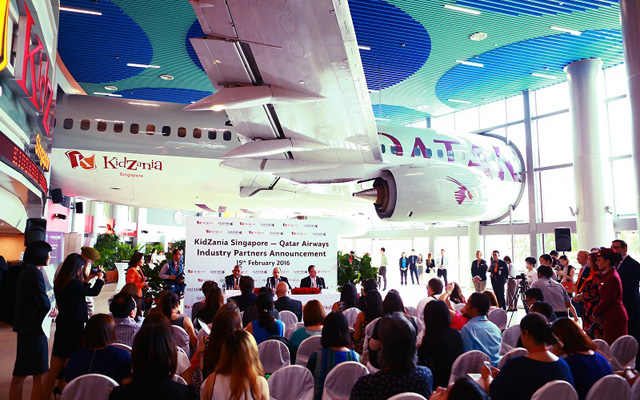
KIDZANIA Singapore, an interactive indoor edutainment centre built around realistic role-playing activities, is scheduled to open this April at Palawan Beach on Sentosa Island.
In a press conference yesterday, Qatar Airways, KidZania’s latest industry partner, revealed its life-size decommissioned Boeing 737 measuring over 25 metres in length with a wingspan of 28 metres.
Qatar plane at the entrance of Kidzania Singapore
Qatar Airways group CEO, Akbar Al Bakar, said: “We are delighted to be here, to showcase our brand and be part of the growth of the vision of our kids. We are here to help KidZania educate children, especially in the field of aviation. The brand of Qatar present in the backyard of Singapore Airlines is also very important for us.”
He added: “Aviation is where the future lies, and it is a very important tool in developing tourism. Singapore’s economy is dependent on tourism and on business, and aviation is a contributor. We want to educate children to think about a future in aviation.”
This is Qatar Airways’ second KidZania partnership and there are plans afoot to announce a third KidZania partnership in the very near future.
Visitors entering KidZania Singapore will be greeted at the Qatar Airways-branded airport terminal, complete with check-in desks and personnel dressed in the carrier’s uniforms.
Aspiring pilots at KidZania Singapore can experience flying two of Qatar Airways’ aircraft – the 787 Dreamliner and the A380 superjumbo – with the help of state-of-the-art flight simulators. Kids can also roleplay as cabin crew and learn how to ensure the safety and comfort of their passengers onboard.
On how different KidZania Singapore is compared to the other 22 KidZanias around the world, William Edwards, CEO of Attractions – Themed Attractions Resorts & Hotels, said: “This particular plane that we have at the airport entrance to KidZania Singapore is the first full-wing fuselage plane that is featured (in a KidZania facility).”
But it’s not just for kids. Tunku Dato’ Ahmad Burhanuddin, group managing director and CEO of Themed Attractions Resorts & Hotels, said: “Parents will be allowed into the flight simulator area as well, and be able to experience it as a passenger.”
When asked why Qatar Airways was chosen as a partner instead of Singapore’s flag carrier Singapore Airlines, Leong Yue Weng, general manager of KidZania Singapore, said: “As Singapore is an international air hub, KidZania Singapore sought to approach various airlines, including the local carriers, to explore possible partnership opportunities during the discussion stage.
“It reached a mutual agreement with Qatar Airways and is looking forward to jointly presenting an edutainment aviation experience for children when KidZania Singapore opens.”
DATA from IATA has revealed that there were more commercial jet accidents in 2015 compared to the year before, but resulted in far fewer passenger fatalities.
The global jet accident rate (measured in hull losses per 1 million flights) stood at 0.32, which equates to one major accident for every 3.1 million flights, a rise from 2014’s rate of 0.27, or approximately one major accident for every 4 million flights.
However, while 2014 saw a staggering 641 passenger fatalities, the number dropped to 136 last year, if only taking accidents into account. If including the tragic loss of Germanwings 9525 and Metrojet 9268, which were caused by deliberate pilot suicide and a suspected act of terror respectively, the number of passenger deaths last year stands at 510.
In total, there were four fatal aircraft accidents in 2015 versus 12 in 2014.
Sorted by operator regions, only north America saw a decline in safety performance last year when compared to the respective five-year rates between 2010 and 2014, with 0.32 accidents versus 0.13.
North Asia experienced zero accidents in 2015, while Asia-Pacific saw 0.21 incidents last year compared to its five-year rate of 0.56.