TTG Asia
Asia/Singapore Saturday, 25th April 2026
Page 1904

Arrivals in APAC led by intra-regional travel

0

15131357_ml

FOREIGN arrivals in Asia-Pacific averaged a year-on-year growth of 5.2 per cent in 2015 to reach a total of more than 455 million travellers, according to preliminary data collected by PATA.

Regionally, arrivals grew most in South Asia (8.2 per cent), followed by South-east Asia (6.7 per cent) and North-east Asia (3.5 per cent), with overall growth in Asia reaching 4.5 per cent in 2015 compared to the year before.

At the destination level, Japan had an especially strong year, growing by over 47 per cent year-on-year and setting a new record with more than 19.7 million foreign arrivals.

Also remarkable were arrivals to Thailand and Sri Lanka, which grew by 21 and 18 per cent to almost 30 million and 1.8 million respectively.

The gains were supported by the continued expansion of scheduled air seat capacity, with an 8.7 per cent annual growth in 2015 for the Asia-Pacific compared to the global average of 6.7 per cent.

According to PATA’s forecast, growth rate up to 2020 is expected to be around 3.4 per cent for North-east Asia, around 6.8 per cent for South-east Asia and 7.6 per cent for South Asia to collectively reach 650 million total arrivals.

Overall, Asia is predicted to see its foreign arrivals count increase by an average of 4.5 per cent per annum between 2015 and 2020.

In terms of source markets, the Pacific enlarged substantially in 2015 with annual growth of over seven percent to reach almost 27 million people. The Americas – which excludes the US – also grew significantly by nine percent to almost more than 54 million arrivals.

Origin markets within Asia will generate the largest volume of arrivals into Asia-Pacific heading into 2020. From a proportionate volume of 66 percent in 2015, Asia will increase its relative share of arrivals to more than 68 percent by 2020. Asian source markets are expected to generate close to 400 million arrivals annually into the Asia-Pacific region by then.

At the destination level, unsurprisingly, China will lead as the largest generator of foreign arrivals. It is expected to create over 60 million arrivals to non-mainland China destinations in Asia-Pacific in 2020.

Emirates not bailing out SriLankan Airlines

0

emirates-aircraft

EMIRATES has stated that it is no longer interested in investing or managing another airline again, citing an unsuccessful partnership with SriLankan Airlines that concluded in 2008.

Since the 10-year management contract with Emirates ran out, SriLankan Airlines has accumulated losses totalling 145 billion Sri Lankan rupees (US$1billion).

But the national carrier is once again on the lookout for a partner. Quashing Emirates as a possible option, Matt Raos, vice president corporate sales at Emirates, said: “We don’t intend to go back down that road (either by investing in or managing other airlines).”

SriLankan Airlines, like many global aviation players, is faced with an increasingly difficult operating environment as competition rises and margins tighten. Recently, it announced plans to stop flying to Rome from May.

Japanese DMC Zenses targets luxury market

0

open-air-bath-for-men1

Photo credit: The Ryokan Collection

JAPAN’s H.I.S. and R Project have joined forces to form a new luxury DMC named Zenses: Japan Ultimate Experience, targeting upscale, sophisticated travellers from around the world.

H.I.S. is one of the largest integrated travel agencies in Japan with 514 sales offices worldwide, while R Project specialises in luxury travel marketing and operates high-end Japanese inn consortium The Ryokan Collection.

The combined Zenses will feature tailor-made itineraries; specialised guides; luxury transportation services; private admission to famous temples, shrines and gardens; dinners and parties at heritage sites; private meetings with noteworthy artists and craftsmen; as well as admission to special galleries.

Shuichi Tezuka, general manager new business promotion at H.I.S., said: “I think the business potential of this market is huge. By utilising the know-how, manpower and marketing strength of H.I.S., combined with The Ryokan Collection’s domestic expertise, we aim to quickly establish the most exclusive DMC service in Japan.”

Concurring, Hiroki Fukunaga, founder and CEO, The Ryokan Collection, said: “This kind of DMC service – focusing on exclusivity, specialising in individuals, and with the ability to satisfy discerning travellers – is not so common in Japan yet. Our partnership with H.I.S. creates a travel agency with a high sense of value.”

Editor’s Picks from TTG Asia, March 4, 2016

0

The latest issue of TTG Asia has many features and insights you won’t want to miss. Here are three picks from the print for your weekend reading.

Rocking and rolling in Asia
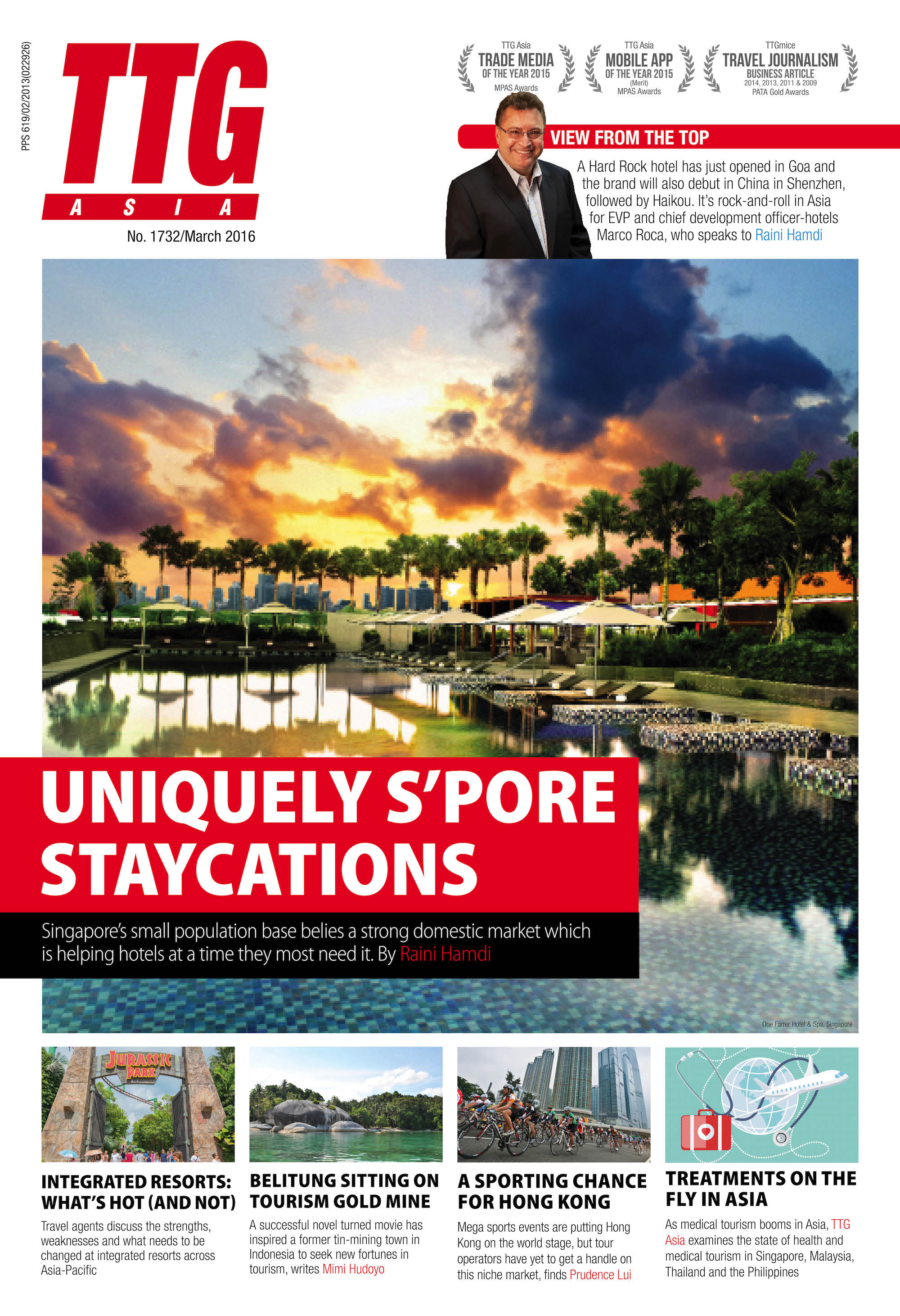
A Hard Rock hotel has just opened in Goa and the brand will also debut in China in Shenzhen, followed by Haikou. It’s rock-and-roll in Asia for EVP and chief development officer-hotels Marco Roca, who speaks to Raini Hamdi.

Uniquely Singapore staycations
Singapore’s small population base belies a strong domestic demand which is helping hotels at a time they most need it. By Raini Hamdi.

Playing tourist close to home
A second look is also what NTOs should give to domestic travellers, says Xinyi Liang-Pholsena. Countries with a strong domestic tourism are generally better equipped to withstand fluctuations in the international demand.

UN to hold sustainable tourism conference in Beijing

0

40666813_l

THE United Nations World Tourism Organization (UNWTO) and the government of China will be organising the First World Conference on Tourism for Development, with a view to advance tourism towards UN Sustainable Development Goals (SDG).

Meetings will be held in Beijing from May 18 to 21 under the theme ‘Tourism for Peace and Development’. The programme includes three main forums on May 19 – Summit on Sustainable Development through Tourism, Tourism for Poverty Reduction and Tourism for Peace – as well as a ministerial meeting on May 20.

The high-level segment will bring key decision-makers together to discuss how countries can align their national development strategies with the SDGs and the role of public and private partnerships in the 2030 Sustainable Development Agenda.

Explaining tourism’s potential to contribute to development, UNWTO secretary-general, Taleb Rifai, said: “Tourism is one of the most dynamic economic sectors, with significant global reach, and as such can make an important contribution to the achievement of the SDGs, particularly in the areas of job creation, sustainable consumption and production and the preservation of natural resources.”

The decision to hold the conference in Beijing came after Chinese officials decided to promote rural tourism as an effective means to fight poverty.

China also launched a nationwide tourism development plan to lift 17 per cent of the country’s impoverished population out of poverty by 2020.

TripConnexion links travellers and agencies with global site

0

screen-shot-2016-03-03-at-11_57_40-am

FRANCE-based TripConnexion has unveiled the English language version of its travel search engine, allowing agencies to sell directly to travellers worldwide via the portal www.en.tripconnexion.com.

Travellers can search for specific tours, packages and agencies on the site and book directly from any of TripConnexion’s inventory of 150 local guides and agency partners via the platform.

“We are not a travel agency,” said Bruno Lapeyre, co-founder of TripConnexion in a press statement. “We take no commission on trips sold through the platform.”

He adds: “Instead, local travel agencies become our partners, and pay a monthly subscription to ensure they are visible on our website.”

The company has also recently raised 260,000 euros (US$282,464) to be used to improve its websites, increase number of agency partnerships and to create a mobile app.

TripConnexion was first launched in France in November 2013.

Sheraton Pattaya rebranded Intercon

0

intercontinental_pattaya_drone

OWNER of the Sheraton Pattaya Resort, Sunny Bajag of Amburaya Hotels & Resorts, has signed up InterContinental Hotels Group (IHG) to manage the resort, which will be rebranded InterContinental Pattaya Resort, effective April.

Amburaya still retains Starwood for its resort in Samui, a W hotel.

The 156-key beachfront resort is located south of Pattaya Bay and a short walk away from the Pattaya Exhibition and Convention Center.

Facilities include an all-day-dining and signature restaurant, three lagoon swimming pools, a fitness centre and a spa.

There are plans for a Club InterContinental lounge and Planet Trekkers, a dedicated space for young guests. Guest rooms will also be renovated, including the addition of Club InterContinental rooms on a dedicated floor.

IHG currently operates the Holiday Inn Pattaya as well.

Best Shots Today: Malaysia names tourism ambassador for China

0

shila-amzah

Malaysian singer-songwriter, actress and record producer Nur Shahila Amir Amzah (right), or more popularly known as Shila Amzah, has been appointed as Malaysia’s tourism ambassador for China. She rose to fame in China, Hong Kong and Taiwan after becoming the champion of Asian Wave, a Chinese reality singing talent show. She also participated in I Am a Singer Season 2, the most popular television programme in China, emerging as the top few contestants.

Luxury travellers in Japan on the rise

0

46892814_l1

THE luxury outbound segment in Japan is strong and growing, with this profile of travellers expecting a greater degree of personalisation than ever before.

Speaking at the recent International Luxury Travel Mart (ILTM) Japan 2016, Jesper Koll, CEO of WisdomTree Japan, said: “Japan has a stable government who is pro-business, banks are healthy and lending, companies are focused and highly innovative and Japan is seeing the rise of new middle class.”

Japan’s high-end travellers do come from this emerging middle class, but also from wealthy retirees, said Koll, adding that 70 per cent of high income household’s net financial assets are held by them.

The fact that 45 per cent of Japanese above 20 years of age hold no debt was another reason why there is a buoyant luxury outbound market, he said.

A recent American Express survey also showed that in 2015, 90 per cent of its premium card members and 60 per cent of millennial travellers were craving for meaningful experiences when they travel.

Yashimi Nakajima, vice president proprietary card services, Japan, AMEX International, said: “Being expensive, high quality and comfortable is no longer enough. They want their trips to be handled by professionals and to be a point of contact they can trust.”

She added that 85 per cent of travellers want personalised itineraries and 80 per cent of them want authentic interactions with locals in the destinations they visit.

Park in rebranding, asset enhancement exercise

0

allen-law

Law: Visitors are staying longer despite uncertain economy

AS it enters new markets such as Indonesia and Australia and seeks to expand deeper in Asia-Pacific, Park Hotel Group (PHG) is embarking on a drive to strengthen its brand and product.

CEO Allen Law and executive director Shin Hui Tan envisioned “a big year” for PHG this year as they embark on a rebranding exercise, and asset and product enhancements.

RFPs have been called for the rebranding exercise, which they hope to finish by the third quarter. Another major undertaking is the renovation of Grand Park City Hall, the oldest hotel in the group, while product enhancements are being planned for Park Hotel Clarke Quay. Law and Tan declined to reveal more details on the projects.

PHG has already been making product enhancements over the last year, including providing free Handy smartphones for guests at Grand Park Orchard Singapore and soon, all its hotels in Singapore and Hong Kong. By April all its hotels will also offer free Wi-Fi. As well, PHG has fielded several new F&B concepts and, at the back of the house, implemented new technologies such as RFID-based laundry counting and tracking to boost productivity.

On the rebranding exercise, Tan said: “We’ve been progressive with our product development, but we do need to review if our brand messaging and proposition are also progressive.

“It might not mean that our Loving Hospitality messaging was no longer relevant. It might be just a question of conveying it well to today’s guests. And we now have to consider the brand look and feel in different markets, compared to one or two before. Today we are operating in six different countries and are targeting 10 different countries in the next one to two years,” she said.

tan-shin-hui

Tan: Keeping brand messaging progressive

As part of the exercise, PHG would also look at whether its current two-tier Grand Park and Park brands are in line with its growth aspiration and if another tier is required.

PHG opened its first resort, Park Hotel Nusa Dua, Bali, last December and will break ground for the construction of the first Park Hotel in Australia in Adelaide, which is expected to be completed in 2018. CEO Allen Law said he was evaluating more opportunities in Indonesia, Australia and other Asian markets new to Park such as Malaysia and South Korea.

From a small Hong Kong hotel group, PHG, now Singapore-based, has grown into a regional chain with plans for a wider footprint in Asia-Pacific. Apart from the new resort in Bali, it operates four hotels in Singapore and another to open end of this year; three in China and one each in Hong Kong and Japan.

one_bedroom_pool_villa

Park Hotel Nusa Dua, Bali

Law said he was looking for more properties in Singapore when asked if the chain was over-exposed in the city. He was not overly concerned with the decline in tourism revenue of seven per cent and a marginal increase of 0.9 per cent in arrivals last year, over 2014, with more challenges anticipated this year including more supply and weak economies.

“Actually, 2015 was not as bad as the general public think it is. A lot of people focus on arrivals which were on par last year (with 2014). But they don’t focus on room demand, i.e., the number of rooms sold, which grew over five per cent. This indicates that visitors are staying longer, which is a positive sign.

“I do agree that with economies not doing so well, this may affect the budgets of leisure and corporates, but we still expect a 10-15 per cent increment from last year despite the volatility and uncertainties,” said Law.

He added that having four-star hotels in the portfolio was helpful. “Our Bali resort for instance is trading quite well. When the economy is not so good, travellers are still able to enjoy a good holiday in a good four-star resort with nice rooms, great pool, etc, at a fraction of the cost. Most of the new supply in Bali are in the luxury market,” he said.

PHG is looking to grow both through ownership and management. New hotel partners are paying attention – its latest Singapore hotel, Park Alexandra Singapore, the Bali resort and Park Hotel Adelaide are all management contracts with new owners.

Law said adding value, coming up with new concepts and taking risks were key. Most of all, being owners, PHG thinks like one.

“Other owners know we manage their hotel like it’s ours,” he said.