TTG Asia
Asia/Singapore Tuesday, 3rd February 2026
Page 1805

SLH expands APAC leadership team

0

SMALL Luxury Hotels of the World (SLH) has appointed Mark Wong as vice president, Asia-Pacific and Victor Wong as vice president development, Asia-Pacific.

Mark’s position is a newly-created role and he will be in charge of driving SLH’s growth plans in the region following a recent restructure and 12 million pound (US$17.3 million) investment into the brand by the management company.

slh-expands-apac-leadership-team
Mark Wong, vice president Asia-Pacific, SLH

Based in the Singapore office, he takes overall responsibility for the group’s strategic direction across operations, distribution, product development, sales and marketing for Asia-Pacific, as well as maintenance and strengthening of hotelier relationships.

Victor, who has been with SLH for four years, will work closely with Mark in his newly appointed post, which will see him take full responsibility in expanding relationships with new hotels to the brand.

Anthony Quin to head Mövenpick Hotel Enshi

0

OPERATORS Mövenpick Hotels & Resorts has appointed Anthony Quin as general manager of Mövenpick Hotel Enshi, located in Hubei province, China.

The Australian national was most recently general manager of Mövenpick Hotel Hanoi, in Vietnam, and before that, was a general manager with Hilton Hotels & Resorts. His first general manager assignment was with Warwick Hotels & Resorts, back in 2008.

anthony-quin-to-head-movenpick-hotel-enshi

Quin first started his hospitality career with Intercontinental Hotels Group where he remained with the company for eight years in various positions.

Photo of the Day: ‘What’s next for airlines’ panel discussion at Travelport LIVE 2016

0

tp_macau_image_2(From left) Damian Hickey, vice president Asia-Pacific & global sales strategy, air commerce, Travelport; Conrad Clifford, regional VP Asia-Pacific, IATA; Jay Westbury, chairman, World Travel Agents Association Alliance; Jacob Jiang, assistant president, Hong Kong Express; and David Orszaczky, head of slaes, Qantas Airways

Travelport recently hosted its annual Asia-Pacific customer conference – Travelport LIVE 2016 – at Studio City in Macau. This was one of the many discussions that took place over the two-day conference, which saw a record showing of 360 attendees from 23 countries.

Indian agents welcome test-run of Australian multiple-entry visas

0

australian-visa

AUSTRALIA will begin testing three-year multiple-entry visas for visitors from India, Thailand, Vietnam and Chile by July.

The trial, announced as part of the Australian government’s 2016-2017 federal budget unveiled last month, will allow entry into Australia multiple times, with each stay valid for up to three months.

In response, the Indian travel trade has given the thumbs up saying the new visa will lead to growth in repeat visitations to Australia.

“It is a forward-looking strategy and will effectively serve to catalyse demand for Australia, a destination that is already seeing strong uptake from Indians for leisure, in addition to bleisure and VFR travel,” said Rajeev D. Kale, president & country head – leisure travel, MICE, Thomas Cook India.

The sheer diversity of destination Australia calls for repeat visits, something the three-year visa enables. Moreover, its per-visit validity goes a long way to incentivise longer stays, Kale added.

Said Uniglobe Swiftravel chairman Rajji Rai: “India is already among the top ten tourism markets for Australia with both leisure and business travellers frequenting the destination. Many Indian students stay in Australia and this move will also benefit parents of such students who visit their children often.”

Australia issued about 233,000 visas to Indian visitors in 2015.

New US$300 million cultural precinct for Australia’s Gold Coast

0

gold_coast_cultural_precinct_amphitheatre_

Artist impression of the precinct’s amphitheatre

DEMOLITION works will commence on the Gold Coast’s council chambers building next week to make way for the 17ha Gold Coast Cultural Precinct, which will serve as the live site for the Commonwealth Games in 2018.

The design of the precinct, which is already home to the Arts Centre Gold Coast, was awarded to Melbourne-based ARM Architecture and will be developed over the next 10-15 years.

Stage one of the A$400 million (US$298 million) project, described as an “enduring cultural, artistic and civic heart for the city”, will result in an outdoor amphitheatre for cultural performances and functions for 850-5000 guests; a riverside hub, which will transform the existing building into a transitional gallery exhibition space; and an ‘Artscape’ outdoor garden.

Valued at A$37 million, the first stage will also include the detailed design of a pedestrian and cycle bridge connecting the precinct to Surfers Paradise and Chevron Island.

Anna Carroll, director of the Cultural Precinct Project, Arts Centre Gold Coast, said that while the Commonwealth Games has spurred on the project, this had been a long-term vision for the city.

“Our cultural institutions have been outgrown,” she said.

“We’re trying to build a space that’s versatile so it can be used for formal performances, but when it’s not in use there will be spaces for the community to access. The architects are really taking on that challenge and stage one is very much on track for 2018.”

Thailand contends for sports tourism heavyweight title

0

thailand-travel-mart-plus

Thai minister of tourism and sports Kobkarn Wattanavrangkul making a speech during Thailand Travel Mart Plus 2016

SPORTS tourism is thrust into the limelight at Thailand Travel Mart Plus (TTM+) 2016, with Thai minister of tourism and sports Kobkarn Wattanavrangkul proposing a marketing budget of 100 million baht (US$2.8 million) from the cabinet to grow the burgeoning sector.

“Thailand is entering the sports tourism era,” declared Kobkarn during her sports tourism presentation at TTM+, as she sees great potential in leveraging the country’s existing sporting infrastructure and events to make the kingdom the “dream sports destination” for international sports visitors.

Efforts in this arena include the implementation of 648km of bike lanes across the country and the introduction of Tour de Andaman, a three-day cycling event taking place in Krabi, Phang Nga and Phuket, to the Thai sporting calendar this year.

And despite the lack of an iconic sporting event like Singapore F1, Kobkarn believes major events like Thailand Golf Championship and FIVB Volleyball Grand Prix and rising sports champions the likes of Ratchanok Intanon (badminton) and Ariya Jutanugarn (golf) will aid the kingdom’s image as a sports destination on the world stage.

As well, the increasing popularity of marathons, triathlons and cycling events that is developing in tandem with the rising wave of health consciousness will further stoke interest in Thailand as a sports tourism destination, she added.

Seeing potential in Thailand’s sporting tourism market is Lars Vinterberg, partner and product manager from Denmark’s Live Travel, who opines that cycling most appeals to his clients as the Danish hail from a country steeped in the bike culture. “We are already working a lot with SpiceRoads for cycling trips in Bangkok and Chiang Mai.”

However, for cycling tourism to properly take off in Thailand, Vinterberg urges the Thai authorities to improve road safety levels in the country.

Ovation of the Seas to homeport in Singapore in 2017

0

ovation-of-the-seas

ROYAL Caribbean International’s newest ship, the Ovation of the Seas, will be homeporting in Singapore for a season next year, with sales channels officially opened today.

Over ten itineraries will take place from March to April 2017 that includes three- to five-night sailings to Penang, Phuket, and Bangkok (Laem Chabang), as well as a one-way cruise to Tianjin with calls at Ho Chi Minh City (Phu My), Hue/Danang (Chan May), Hong Kong and Seoul (Incheon).

Some 42,000 guests are expected to set sail through Singapore during this period.

The announcement was made during the Quantum Class smartship’s maiden call in Singapore yesterday at the Marina Bay Cruise Centre, bringing more than 4000 passengers with it to the city-state.

The ship is bound for a sold-out three-night sailing from Singapore to Phuket today, before going on a 12-night one-way trip to Tianjin on Sunday.

During the inaugural event, Sean Treacy, managing director Southeast Asia, Royal Caribbean Cruises, expressed his excitement for the warm reception and gratitude to travel agents here for making this a success.

He added: “With Ovation returning next year, Mariner coming for a full winter season, and also the return of Voyager, we’re looking at about 30 per cent capacity growth next year in Singapore.”

Treacy further revealed that at current, roughly 60 per cent of passenger load from Singapore are fly-cruise guests and the rest local, with weekend sailings tending to have more domestic holidaymakers compared to longer four-night or more itineraries.

“In the long-term, fly-cruise is extremely important for us here. Singapore is a great market and our travel agencies really support us, but at the end of the day, the opportunity lies outside. What’s great about Singapore is its position. It is a short flight for people from India, China, Indonesia and Malaysia, but fly-cruise is the future,” he said.

While the leisure segment remains Royal Caribbean’s core customer base, opportunities are also opening up in the MICE segment as in accordance with the broader cruising industry.

For them, at least 90 per cent or more guests are still leisure customers, said Treacy, but MICE sales are showing increasing traction.

“We’ve seen some good groups. We just had a charter from Nu Skin for the whole ship out of Southampton earlier this year, so there’s definitely growth in that area,” he said.

Newsmaker: New startup bridges tourism suppliers to Chinese travellers

0
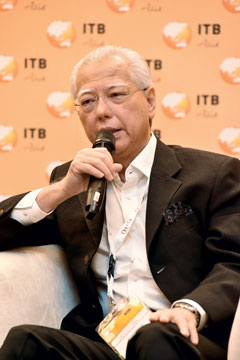
Wong Toon King

NEW startup WEGOGO sees huge opportunity to connect tourism suppliers outside China, particularly small and medium-sized enterprises, to sophisticated Chinese tourists via WeChat, the dominant social networking platform in China with 633 million users.

The venture is backed by a group of Singapore private investors led by Farsight Capital’s managing director Wong Toon King, a Massachusetts Institute of Technology graduate who has a track record with startups.

Raini Hamdi talks to Wong, chairman of WEGOGO, about the ‘social discovery AI travel platform’.

Wong Toon King

What’s the big idea?
The big idea is there is a huge number of Chinese travellers, over 100 million now and projected to grow to 200 million by 2020. Many of them, in particular the millennials, don’t even do group tours, but leapfrog straight to FIT and are very adventurous.

So we’ve built this platform to match travel suppliers to the new Chinese travellers (WEGOGO was launched to suppliers in Singapore recently). Most suppliers have caught on to the idea of a digital platform to attract clients, but they have not caught on to the need to serve Chinese travellers in their own way. In China, people use WeChat, not Facebook. Yet, suppliers are not even on WeChat. So the first step is to quickly get them (suppliers) on WeChat, then evolve to match suppliers and Chinese tourists effectively through a learning system based on AI technology.

(Editor’s Note: The latest Hurun Report shows WeChat as the top mobile phone function – 79 per cent – for Chinese millennial travellers.)

How quickly and easily can suppliers get a presence in China?
We’ve built the platform such that in less than two hours, you’ll have your own mobile website and presence in China. You’ll have the details of your company, product, pricing, promotions on a microsite and you can start selling as there’s payment gateway. (There is free language translation up to a certain number of words.)

We don’t repurpose your content or present your product. The platform enables you to be directly linked to the consumer. We’re the enabler.

wegogo-wechat-microsites

How are you going to attract the Chinese travellers?
In Q3, we will do a major launch to the Chinese audience, and we will activate media and other online channels to be our partners.

We will do a lot of video campaigns. We put the videos on WeChat; Chinese travellers can ‘like’ it, comment on it, so we are creating aspirational demand. It does not have to be expensive places. The first, Island Fever!, has just kicked off and showcases the laid-back nature and lifestyle of the Gili Islands in Indonesia. There are five videos of Gili, experiencing Beaches, Diving, Swimming with Turtles, Island-hopping and Underwater World, each with a local person.

We focus on people – the local hosts, the guides, etc – who make the experience possible. We are attracting the Chinese travellers with transformative stories. Today, they want more than just bragging rights to a destination. Travel is life-changing and self-learning for them.

What is the bigger goal you think WEGOGO can achieve?
Chinese travellers, in such huge numbers, are really going to transform the way we organise travel to suit them. But in return, as they learn about the world, they are going to be transformed. So we’re hoping that what we do will help them realise that, even for China, there are many things they need to preserve, sustain, by seeing what others are doing.

That’s why we want our hosts to share tips with them on how to care for the environment and how they would like travellers to interact with them, so we become a bridge that links and empowers both sides.

How many suppliers are you targeting?
We want to get our positioning right, so it’s not so much the number of suppliers but the quality. It’s about the creation of a community that can provide transformational experiences. The suppliers can be an activity provider, a certified home-dining experience, an accommodation provider, etc, and certain categories may jump if they have been under-served. If we have to put a number to it, probably 15,000 in three years’ time.

Do you verify them?
Yes, we have partners and groups of people who will verify, while the user-generated content will provide instant feedback to travellers.

How do you make your money?
Through a booking transaction fee.

Tell me about the AI part of WEGOGO.
AI is the next big trend in every sector. Everyone is trying to make sure their system is intelligent and learning. You can build an intelligent system initially by coding, but it stays somewhat static. AI enables the system to continue to learn over time. And it is possible to learn now because of the deluge of information – what you post, what you are doing are captured and these bits of information start to build a pattern for each person.

In the end, we are teaching this AI system to understand a person’s aspiration. Does he travel to escape, get inspired, be stress-free, to have time to bond with his family? And we’re focused only on the Chinese travellers as their mindset is different and it is a big enough market to apply the technology in the domain of travel.

Why did you decide to back WEGOGO?
Any venture is about people. We (the people in the startup) go back a long way. I believe in the team. Secondly, we’re talking about the entire China travel market; that’s huge. Thirdly, it’s an area I was trained in.

(Editor’s Note: The people in the startup include founder/CEO Mak Chee Wah, former CEO of Melioris International and CFO of SilkRoute Holdings which Wong set up; Richard Tan Boon Piew, co-founder/COO, who has 23 years experience in the IT industry; Yue Yew Hoong, co-founder/CFO, who was also with Melioris and SilkRoute; and Reene Ho, managing director of BrandStory Inc, who is strategic advisor of WEGOGO.)

Do you think with platforms such as yours, which connect travellers directly to suppliers, travel agents will die?
The whole industry is transforming. But I don’t see ourselves as a disruptor. Travel is so complex, so there must be intermediaries, that’s the lay of the land. Will there be more direct (sell), yes, but will there be others who need guidance? Absolutely.

In the case of Chinese millennials, they want more direct (buying), because they are so used to technology.

Phuket Hotel Association seeks unified branding, voice

0

anthony-lark

Anthony Lark, managing director and general manager of Trisara, is PHA’s president

PROMINENT leaders in Phuket’s hospitality sector have rallied together to establish the Phuket Hotel Association (PHA) to develop a unified voice and brand identify for the island.

The formation of PHA was spearheaded by Bill Barnett, managing director of C9 Hotelworks, who enlisted the assistance of veteran hotelier Wichit Na-Ranong as founding advisor.

Heading the Phuket Hotel Association as president is Anthony Lark, managing director and general manager of Trisara, while Mark Simmons, vice president sales & marketing, Asia-Pacific at Outriggers Resorts, and David Keen, chief executive of Quo, have been appointed as strategic advisors, among other prominent hotel owners.

Speaking to TTG Asia e-Daily, Simmons said: “The idea of the association is for hotels to collaborate together to focus on ‘Brand Phuket’, to give one voice to Phuket’s hotel industry. Covering hotels from north to south of the island, the association will collaborate on tourism marketing strategies to promote Phuket as a leading resort destination in Asia.”

Creating synergies out of the collective reach of the non-profit, strategic initiative is a principal goal. “We want to be a strong part of the local economy to lobby the government to improve the infrastructure, for example, as Phuket gets a new airport terminal and attracts major events like Laguna Phuket International Marathon,” added Simmons.

PHA will also be a platform to “groom the next generation of talent in the hospitality sector” and lead in charitable works, he informed.

Comprising general managers and owners to ensure that decisions are made at the executive level, the newly-launched association currently boasts 40 chain and independent properties, and targets to reach 70 hotels by this year-end.

Global third-party companies like STR are also supporting the association, revealed Simmons.

Easier ride for MICE delegates in South East Queensland

0

gold-coast-tram
Tram plying Gold Coast’s G:Link network

SOUTH East Queensland is trialling Australia’s first public transport travel card tailored to the MICE market.

The go access Corporate Events card, an initiative of Translink in Queensland’s Department of Transport, costs A$12 (US$8.95) for three days of unlimited travel on buses, trains and ferries throughout the South East, as well as on the Gold Coast’s G:Link tram network.

Speaking to TTGmice at the This is Gold Coast Business Exchange last week, Translink’s senior advisor new business and product development, George Chemali, said: “What we found from surveys over 18 months was that (the card) was something the industry was crying out for.”

Chemali added: “It means that a delegate can get on at any mode of transport and travel anywhere in South East Queensland and not have to worry about a deposit, topping up or understanding zones.

“We’ve had (representatives) from other states (in Australia) say they wish their transport authority would take a leaf out of our book.”

Shannon Thwaites, manager, Gold Coast Business Events, said the card provided a seamless public transport mode for delegates with significant savings.

“The card has also enabled delegates to choose from a wider selection of accommodation venues, with so many conveniently located in close proximity to the light rail corridor,” she said.

The go access Corporate Events can only be purchased for events with 50 delegates or more.