In a region where air travel is booming, how are Asia-Pacific’s legacy and budget airlines keeping pace with passenger demand and industry competition? TTG Asia examines the latest developments in the sector.
Philippines
By Rosa Ocampo
Philippine Airlines
For Philippine Airlines (PAL), 2016 was a year defined by fleet modernisation, addition of longhaul routes and increased operations outside Manila.
Marking its 75th year in 2016, the Philippine national carrier took delivery of two Boeing 777 and five A321s, enabling it to expand its international routes. In 2017, eight A330s with mono-class seats ordered by the previous PAL adminsitration will be reconfigured with business, premium economy and economy class seats for flights to Australia and Honolulu.
PAL also made clear its intentions to penetrate deeper into the US, having commenced Cebu-Los Angeles and Manila-New York services last year. President and COO Jaime Bautista disclosed plans to increase flights to Los Angeles and San Francisco, and luanch new services to Chicago and Texas when the airline takes delivery of A350 in 2018.
For China, more frequencies to Beijing and Shanghai can be expected in the near future, as well as a new Chengdu connection and more chartered services linking to other Philippine destinations.
Europe, meanwhile, is not yet on PAL’s expansion radar apart from the existing Manila-Heathrow service, Bautista said.
PAL also began longhaul routes from its secondary hub of Cebu due to congestion at Ninoy Aquino International Airport.
 Cebu Pacific
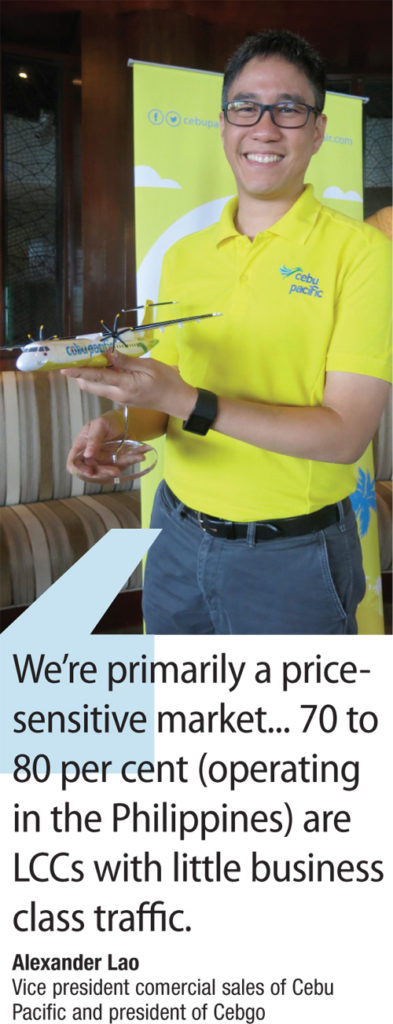
Twenty-sixteen saw Cebu Pacific (CEB) lay down massive expansion plans and reinforcing its position as a LCC.
“We’re primarily a leisure and price-sensitive market… 70 to 80 per cent (operating in the Philippines are LCCs with little business class traffic,” said Alexander Lao, CEB vice president commercial sales and president of Cebgo.
The LCC counts 30 international destinations, including the 2016 launch of Manila-Guam and Kalibo (Boracay)-Incheon routes It is considering mounting services to Honolulu, Delhi, Perth and Hokkaido.
Capacity constraints at Manila’s Ninoy Aquino International Airport limits CEB’s expansion, which the airline overcomes by using its five other hubs of Clark Freeport Zone, Davao, Cebu, Kalibo and Iloilo.
At home, CEB and subsidiary Cebgo serve more than 60 domestic routes with over 2,700 weekly fights. In 2016, it introduced new flights from Cebu to Calbayog, Ormoc and Roxas City in the Visayas.
Cebgo is hoping its order of 16 ATR 72-600s turboprop aircraft, of which two were already delivered, will enable it to serve more offbeat Philippine destinations like Marinduque and Masbate.
Industry watcher Shukor Yusuf, founder of Endau Analytics, opined that CEB’s “vibrancy and bubbliness” will put it in good stead to attract younger travellers and remain one of the “best performing airlines in the region”.
Thailand
By Michael Sanderson
Thai Airways International
Fleet renewal and a revived focus on European routes are reasons credited for Thai Airways International’s (THAI) ability to weather the turbulence of recent years.
THAI president Charamporn Jotikasthira said notable points in the airline’s “strength building phase” include the launch of the first of its 12 new Airbus A350s, resuming Bangkok-Moscow flights and a return to Frankfurt. There are also talks of reviving non-stop flights to the US in 2017.
Welcoming the changes, Diethelm Travel Thailand general manager Victor Mogilev, said:“THAI gives a very strong sign towards growth and development by bringing back more routes… The US market is an area where we see a lot of potential for tourism in Thailand.”
On THAI’s improved Skytrax ranking from 19 to 13, making it the most improved airline of 2016, Endau Analytics aviation analyst Shukor Yusof said: “This was largely due to improved products on board, introducing new routes and more importantly, streamlining its fleet which had different types of aircraft hence costing a lot in maintainence.”
Shukor maintained that while the new A350 fleet could help THAI in the long run in their likely deployment for Europe and select Asia-Pacific destinations like Singapore, Melbourne and Sydney, the carrier “remains stuck with six A380s that will continue eroding revenue”.
Nok Air
In a year marred by a pilot strike and flight cancellations, CEO Patee Sarasin acknowledged that 2016 had been a difficult year for Nok Air although he pointed to the launch of the Value Alliance and the introduction of the Smiling Across Asia slogan as highlights.
Notably, the airline also suffered financial losses due to a planned expansion into China coinciding with the Thai government’s crackdown on zero-dollar tours.
“While we didn’t meet the original goal (of second-half profit) due to unforeseen factors such as the crackdown and the king’s passing, we are on the right track and are looking forward to a very positive year,” Patee said.
Despite the disruptions to its China ambitions, Patee said regular charter flights between China and Bangkok continued to thrive. It also planned a “trade-fair style campaign” with affiliate NokScoot and the Thai Ministry of Tourism and Sports to attract high-end Chinese tourists.
However, Endau Analytics’ Shukor thinks the LCC’s problems in China were more a case of bad management than bad luck. “Nok never really was well managed to begin with, hence the years of losses,” he said. “It needs a new breed of managers to run the airline and ensure profitability.”
Singapore
By Paige Lee Pei Qi
Singapore Airlines
As it looks to claim a bigger share of Asia’s growing low-cost travel market, Singapore Airlines (SIA) established the Budget Aviation Holdings in May 2016 to house and manage its budget carriers, Scoot and Tigerair, with the planned adoption of a single brand and operating licence for both LCCs in 2017.
For SIA CEO and Budget Aviation Holdings chairman, Goh Choon Phong, merging the brands is “the logical next step” after the integration brought about “commercial and operational synergies that are providing growth opportunities for both airlines”.
For example, SIA and regional wing SilkAir connect to only 12 destinations in China, but with Scoot and Tigerair in the mix, the group will reach 24.
While lauding the greater flexibility and destination network that SIA and its subsidiary airlines bring, Alicia Seah, marketing communications director, Dynasty Travel Singapore, said: “For business travellers however, budget airlines are still not their priority (choice) if there are other alternatives.”
Jetstar
Jetstar is clearly pushing into the corporate market with the introduction of the FlexiBiz bundle last September, an add-on product which provides business travellers greater flexibility and ease of booking.
Paul Rombeek, head of sales, commercial, Jetstar Group, said this is a “major strategic move” by the LCC to enter into the business travel space after its prior focus on the leisure market.
For instance, the FlexiBiz upgrade allows business travellers to move their flight earlier or later for free on the same day of travel, take extra carry-on baggage (7kg) and select an upfront seat at no extra charge. Those who cancel their flights will also be entitled to a credit voucher refund that is valid for a new booking within six months of issue.
Rombeek said: “Convenience is the hallmark of business travel. We are not targeting the premium business traveller as we know they have different needs. We are looking at the business traveller who considers airline schedule and direct flights as top priorities.”
However, Jetstar’s new offering has some trade players wondering if it was just another way to boost its ancillary revenues. Said Chan Brothers Travel’s head of marketing communications, Jane Chang: “FlexiBiz is just another configuration of their existing (ancillary) offering.”
She remarked: “While attractive, ultimately travellers will do their own math on whether it’s worth selecting a budget carrier over a (full-service) carrier, as various ancillary offerings including seat selection, meals, flexibility of cancellation among others, can add up (to the fare).”
Malaysia
By S Puvaneswary
 Malaysia Airlines
As part of its turnaround strategy towards profitability in 2018, Malaysia Airlines (MAB) in 2016 made some unpopular decisions including shrinking its network by 30 per cent.
MAB ceased its Kuala Lumpur-Dubai route in February 2016 to codeshare with Emirates on this sector instead. In the same month, the airline ended its Kuala Lumpur-Frankfurt service after almost 40 years in the market.
As well, loss-making longhaul routes such as Kuala Lumpur-Brisbane, Kuala Lumpur-Paris and Kuala Lumpur-Male were cut over the last two years.
Desmond Lee, group managing director of Apple Vacations & Conventions, opined: “Cutting off routes to Europe other than to London has affected the image and reputation of the national carrier.”
But these are also accompanied by a greater focus on emerging destinations. MAB plans in 2017 to expand its network in China by serving eight new destinations and 11 new routes with 35 additional frequencies from its hubs in Kuala Lumpur, Kota Kinabalu and Penang.
MAB CEO Peter Bellew said: “We plan to triple our Chinese business over the next five years. I see potential for direct flights to 20 Chinese cities from Kuala Lumpur, Penang, Kota Kinabalu and Kuching by 2019.”
While welcoming the planned increase in connectivity to China, Adam Kamal, CEO at Olympik Holidays, had other ideas for how the airline can better compete.
“We prefer to push other airlines such as Emirates, Etihad, Singapore Airlines and Vietnam Air, as the sales support, incentives and rates for groups and series movements are better.”
AirAsia
Since its inception, the AirAsia Group has shown its commitment to expanding connectivity within ASEAN’s core and secondary cities, connecting to 208 destinations within the region.
As a strategic partner of ASEAN’s year-long 50th anniversary campaign in 2017, the airline group has various initiatives lined up. AirAsia Malaysia’s head of commercial, Spencer Lee, said: “We will promote the ASEAN Pass; roll out promotions on airfares and packages and a special livery to promote the campaign; and work on merchandising and inflight meals to promote the diverse offerings of the 10 ASEAN member nations.”
In 2016, AirAsia Malaysia started five unique international routes not served by other airlines: Penang to Yangon and Ho Chi Minh City; Langkawi to Guangzhou; Kota Kinabalu to Wuhan: and Johor Bahru to Guangzhou.
Abdul Rahman Mohamed, general manager, Mayflower Holidays, lauded AirAsia’s overall strategy of opening new markets from secondary cities a boon for travel consumers and businesses alike.
He added: “This has benefited the incentive travel segment. With the current economic slowdown and weak ringgit, we’re seeing more companies opting to reward high achievers within the ASEAN region, and do not mind budget carriers such as AirAsia. Their requirement is to make the experience a premium one such as by pre-booking hot seats and inflight meals.”
Vietnam
By Marissa Carruthers
Vietnam Airlines
A drive to boost domestic and international routes and fleets has seen Vietnamese national carrier’s business soar in 2016 and position itself for the future.
Vietnam Airlines CEO Pham Ngoc Minh said pre-tax profit in 1H2016 is expected to grow threefold amid an increase in passenger traffic of 13 per cent.
It also forged a partnership with All Nippon Airways in January 2016, gaining links between Vietnam and Japan. This is expected to strengthen its position to enter the US, which it is aiming to do by 4Q2018, having acquired 40 A350-900s able to operate from Ho Chi Minh City to Los Angeles.
Florencia Allo Moreno, Khiri Travel Vietnam county manager, said the addition of regional destinations onto Vietnam Airlines’ flight network has “helped in product development due to the trend of multi-country trips and itineraries”. Specifically, new direct flights to central Vietnam, Myanmar, Indonesia, Bangkok and Cambodia have aided the creation of “outside-the-box” itineraries.
Still, Jeff Redl, managing director of Diethelm Vietnam, argued that changes must be made to Vietnam Airlines’ shortcomings like unassertive staff and lack of turndown service before it can be considered a premium carrier the likes of Cathay Pacific or Singapore Airlines.
 VietJet
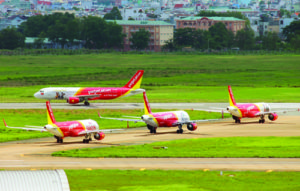
New routes, a broadened international reach and plans for an initial public offering are among the LCC’s success stories in the past year.
Having controversially launched in 2007 with bikini-clad stewardesses on some flights, the budget carrier has dominated Vietnam’s skies with cut-cost airfares. It today boasts a fleet of 40 A320 and A321 aircraft operating around 350 flights daily on 53 routes.
In 2016, it introduced a string of domestic and international routes including Hanoi to Taipei City and Tainin (October), Hai Phong to Bangkok (October), and Ho Chi Minh City to Kaohsiung and Hong Kong (December).
VietJet president and CEO Nguyen Thi Phuong Thao aims to boost the fleet to more than 200 aircraft by 2023 – a move that could be made possible by burgeoning growth revenue of more than 200 per cent to US$488 million in 2015.
She also plans to capture 50 per cent of Vietnam’s domestic market, having increased capacity in 2016 by at least 29 per cent on the top 10 domestic routes. Further growth on domestic routes are expected in 2017.
Jeff Redl, managing director of Diethelm Vietnam, said: “VietJet’s (growing) connections will meet and stimulate demand, especially among young adults, business and leisure travellers.”
But despite deals advertising fares for as low as US$10, Redl says there are many hidden costs and taxes. Moreover, flights are often delayed or rescheduled due to late arrivals or technical difficulties, and the lack of transit counters are a hassle for connecting passengers, he noted.
Japan
By Julian Ryall
Japan Airlines
With the Japanese government’s ban on the company launching new routes expiring on April 1, Japan Airlines (JAL) is expected to announce a direct route to John F Kennedy International Airport in New York, which will make New York its third US destination from Haneda, after Honolulu and San Francisco.
The Japanese national carrier went into bankruptcy protection in 2010 but with government assistance was able to rebuild its business and re-listed on the stock exchange in 2012.
Geoffrey Tudor, senior analyst for Japan Aviation Management Research, said: “I expect JAL to start making more use of its international slots at Haneda from now on and to start looking at possible new destinations they can serve with their new fleet of Boeing 787 Dreamliner aircraft and Airbus A350s.”
Outbound agencies specialising in North America are also excited about the possibilities that a direct Haneda-New York flight opens up.
Hiromitsu Isoi, president of American Holidays, said: “New York is our most popular East Coast destination, although it is still behind San Francisco and Los Angeles because they are both much closer to Japan. But Japanese travellers want to go shopping in New York, take in a show on Broadway and see the sights.”
Isoi added that his company sends about 2,000 Japanese on package tours to New York every year, but direct JAL flights could sharply increase the number.
Peach Aviation
Japan’s largest LCC, headquartered at Osaka’s Kansai International Airport, has unveiled an ambitious expansion plan that includes opening new hubs in Sendai and Hokkaido’s New Chitose Airport.
The expansion into northern Japan, Hokkaido in particular, is designed to improve demand and access to the region’s attractions. Shinichi Inoue, CEO of the airline, sees potential to “accelerate inbound and outbound demand and activate new destinations” in Hokkaido.
Besides directly linking Hokkaido with cities across Asia, Peach intends to open up access to lesser known parts of Hokkaido from overseas markets, a move that the trade too expects will bolster the region’s appeal for Asian travellers.
“Having a base at Shin-Chitose Airport will enable more more people to come to Hokkaido from other parts of Japan and overseas,” said Akihiko Iwatate, manager of tourism and MICE promotion department, City of Sapporo.
Chris Pickering, director and group general manager of Hokkaido Tourism Management, agreed: “Shin-Chitose has for far too long been focused on the domestic market. This could really help us attract travellers from growing markets such as Hong Kong, Singapore, Malaysia, Thailand and Taiwan.”
Meanwhile, Peach plans to double its fleet to 40 aircraft by 2020, according to Inoue. The airline reported a 120 per cent surge to 6.1 billion yen (US$52.6 million) in operating profit for the year ending March 2016.
Hong Kong
By Prudence Lui
Cathay Pacific
Having invested over US$1 billion to upgrade its aircraft and airport lounges since 2010, Cathay Pacific saw lounge upgrades in London Heathrow and the rebranding of Dragonair to Cathay Dragon among its most prominent milestones for 2016.
On top of partnerships with notable restaurants to improve inflight meals, the enhanced baggage policy has seen substantial allowance increases.
The airline has launched seven new routes over last two years, including Newark, Boston, Manchester, Gatwick, Zurich, Dusseldorf and Madrid, while services to Tel Aviv will commence on March 26, 2017.
By 2020, Cathay Pacific will take delivery of 48 Airbus A350s with innovative new features including Wi-Fi connectivity in all classes, an enhanced inflight entertainment system and upgraded seats.
Hong Kong Express
HK Express has been steadily growing its flight network to 29 destinations in Asia from its Hong Kong base.
After adding secondary Asian destinations such as Hualien (Taiwan), Chiang Rai (Thailand), Nha Trang (Vietnam), Takamatsu and Ishigaki (Japan) and Guam in 2016, commercial director of HK Express, Luke Lovegrove, said the airline plans to launch six to 10 routes this year, including to Saipan (starting January 17) and Luang Prabang.
He continued: “In three years HK express has become an important catalyst for growth at Hong Kong Airport, propelling its LCC market share to over 10 per cent.”
To keep up with growth, it is expected to employ over 1,300 staff, a 44 per cent year-on-year increase. As well, 10 more A321s and 12 environmentally friendly A320neos are on order.
In 2016, the LCC carried 2.8 million passengers in 2016, up 36.4 per cent from the previous year, while load factor year-to-date increased three per cent to reach the 89 per cent mark.
HK Express joins three other founding members – Lucky Air, Urumqi Air and West Air – to establish the U-Fly Alliance in January 2016, and was later joined by South Korea’s Easter Jet in July.
India
By Rohit Kaul
Vistara
A joint venture between Tata Sons and Singapore Airlines, Vistara has been making waves in India’s domestic market since its inception as an Indian full-service carrier in January 2015.
Within six months in 2016, it launched six new destinations, namely Jammu, Srinagar, Kochi, Chandigarh, Kolkata and Port Blair, bringing its total destination count to 18 with 515 flights a week.
Phee Teik Yeoh, CEO, Vistara, commented: “As a new entrant, we believe in challenging the status-quo in the market to disrupt and bring to customers the ‘new feeling of flying’, which would eventually help us (gain market share).”
International expansion is definitely on the cards for Vistara, although Yeoh is keeping mum on specifc plans.
And with the scrapping of the 5/20 rule, which requires domestic airlines seeking to fly international to be operational for five years with at least 20 aircraft, Uniglobe Swiftravel’s chairman Rajji Rai thinks it is “only a matter of time” before the Vistara spreads its wings overseas.
As well, Vistara has launched its own lounge near the boarding gates at the Terminal 3 of Delhi’s Indira Gandhi International Airport, and also partnered Axis Bank to introduce the first co-branded travel credit card – Axis Bank-Vistara Credit Card – to enhance its Club Vistara frequent flyer programme.
The additional competition and products the two-year-old airline brings to the marketplace has been a boon for the trade.
“The entry of Vistara has raised the service level of domestic airlines in India. A world-class product coupled with a fresh appeal make it ideal for catering to business travellers,” said Praveen Chugh, president, Business Travels.
Rai added: “Unlike many other airlines, Vistara has not resorted to flash sales for filling seats and has hence maintained its customer profiling. The airline was also the first one to introduce a premium economy class on domestic routes.”
IndiGo
At a time when most Indian carriers are bleeding, Indigo managed to stay in the black, which president Aditya Ghosh boils down to the airline’s operational efficiency.
“Our business idea has been a structural differentiator. The disciplined execution of LCC principles with single aircraft type and higher aircraft utilisation has helped us maintain low operating costs,” the airline chief commented.
In 2016, IndiGo added new destinations like Dehradun and Port Blair as part of its focus on non-metro Indian cities. India’s largest airline by market share, the carrier operates to 18 destinations across the country and flew around 2.5 million passengers as of August 2016.
The Indian LCC also gained 24 more aircraft including the A320neo, whose more effiicent engines and large wing tips have purpotedly improved fuel savings by over 14 per cent.
Uniglobe Swiftravel’s Rai said: “With (the new fuel-efficient A320neo) aircraft at its disposal it has been the most aggressive airline to connect new destinations,” observed Uniglobe Swiftravel’s Rai.
Australia
By Rebecca Elliot
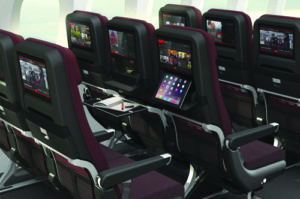 Qantas
A finetuning of its business stuctures and realignment of focus on Asia are some changes steering Qantas’ way forward.
Just two thirds its way through a Transformation Programme – involving cost cutting, efficiency, fleet investment, infrastructure and technology, refreshed service approach and a restructuring of global network and alliances – the airline is already seeing “the best result in Qantas’ 95-year history”, according to Benjamin Tan, Qantas’ senior vice president, Asia.
He continued: “We’ve been adding flights and launching routes into Asia – with 75 per cent of our international growth last year focused on the region.”
“Around 50 per cent of Qantas and Jetstar’s international capacity is now dedicated to the region, compared with 30 per cent 10 years ago,” Tan shared. Flights were added to Singapore, Hong Kong, Japan, the Philippines and Indonesia in 2016.
Moving forward, Qantas plans to return to Beijing with daily flights from Sydney in time for the Chinese New Year. The service, operated on an Airbus A330-300 aircraft, will add 3,300 seats weekly and represent an 18 per cent increase in Qantas’ total capacity into Greater China and seven per cent into Asia, Tan elaborated.
When the airline takes delivery of Boeing 787-900 in 2017, it will usher in an era for “ultra-longhaul travel” for Qantas, stated Tan. Other plans include the launch a new Melbourne-Tokyo (Narita) service since December 2016 and the opening of new lounges in Brisbane and London this year.
Virgin Australia
In 2016, Virgin Australia laid the groundwork to foray into Asia over the coming years, while continuing to grow its core North American market.
“As part an alliance with China’s HNA (announced in May 2016), we are planning to introduce flights between Australia and Asia in 2017. The alliance will also involve codesharing, frequent flyer programmes, lounge access and the promotion of tourism and business travel,” said a Virgin Australia spokesperson.
“This will accelerate our access to the Chinese market… A record one million Chinese visited Australia last year, illustrating the opportunity for growth.”
Not neglecting the potential of Asian destinations closer to home, its LCC subsidiary Tigerair Australia commenced inaugural services to Bali in March 2016.
In 2017, the airline’s A330-200 aircraft will be deployed on a longhaul international route for the first time, with thrice-weekly services between Perth and Abu Dhabi set to commence in June. This increases utilisation of the A330 fleet, which has mostly served Perth and Australia’s east coast so far, the spokesperson added.
As well, Virgin will continue to focus on North America with plans to commence five-times weekly services between Melbourne and Los Angeles in April 2017.
Other plans include the implementation of the Better Business programme, which includes fleet simplification, and the introdution of in-flight Wi-Fi.
This article was first published in TTG Asia January 2017 issue. To read more, please view our digital edition or click here to subscribe.






 Twenty-sixteen was a year of upheaval for the travel trade in Kyushu, as Japan’s southernmost island suffered a series of powerful earthquakes and aftershocks in April – which caused 50 deaths and wrecked havoc on landmarks such as Kumamoto Castle. Barely six months later, Kyushu was dealt another blow in early October when Mount Aso – one of the region’s most popular attractions – erupted for the first time in nearly two decades.