In an era of unprecedented global integration and growing uncertainty, five industry leaders ponder how technology, proactive measures plus a bit of innovative thinking can make travel safer and seamless. By Raini Hamdi.
 Travelling made easier with tech
David Topolewski
The CEO of mobile learning provider Qooco examines how advances in technology will make travel breezier
We are living in one of the most exciting times to be a traveller. The Internet is uncovering yet unknown places to visit; air travel is growing at one of the fastest rates in history, becoming more affordable and accessible than ever; and mobile apps are allowing us to stay in people’s homes around the world at the fraction of the price of a hotel.
Yet despite this progress, the act of travelling is still associated more with stress than (ease), and with the growth of technology comes complex problems too.
Take for example the recent system glitches and crashes experienced by n United Airlines and British Airways, thanks in part to compatibility issues between old ‘legacy’ systems and newer technology. Cyber attacks on hotels make travellers wary about parting with their personal data (not that they have any choice), and hotel key cards have a knack of not working when you need them to.
Technology can create more complexity, but it can also make life significantly easier and worry-free.
As any traveller will tell you, a delayed or cancelled flight can mean the difference between a dream holiday and hours on end lying on an airport bench, followed by the bureaucratic hell of claiming refunds.
Blockchain technology could potentially take some of the sting away with instant insurance. A company called FlightDelay allows users to receive instant cashback on any delayed flight, circumventing the laborious, time-consuming claims process via airlines. As costs are eliminated, insurance becomes zero sum, allowing customers to keep more of their wealth. While in its early stages and is highly dependent on accurate third-party data, this model could also potentially eliminate the travel insurance market.

Wearable technology will become so advanced that your loved ones will know where you are based on the signals sent from your wearable device. Aside from location, other vital signs such as heart rate and blood sugar levels can also be checked. This will not only allow those who suffer from serious conditions to do more, but placate nervous relatives and friends when their loved one decides to be adventurous.
Landing in a foreign and underdeveloped country, one of the most worrisome moments is deciding how to get from the airport to the hotel, and whether the taxi driver understands you and not rip you off. Driverless cars should put an end to this and GPS technology can take you to any location you wish accurately, efficiently, transparently and safely. With driverless car technology improving, transportation will become automated and efficient.
These are only a few examples of how technology can reduce the stress and worry in travel, among others. There are so many touch points along a traveller’s journey that could cause concern, from immigration to airport transfers. If tech applications can make just some of those points smoother and more efficient, then the world of travel will get even better.
 Jetting into safer skies
Conrad Clifford
IATA’s regional vice president, Asia-Pacific affirms that flying, backed by statistics and measures in place, remains one of the safest ways to travel
There are many things we need to worry about in life, but air travel is not one of them.
A look at the industry’s past safety performance will reveal that aircraft accidents are extremely rare. In 2015, there was one major accident for every 3.1 million flights, a 30 per cent improvement from the previous five-year rate of one accident for every 2.2 million flights.
Safety is the top priority for the industry. Although we work hard to prevent any loss of life, accidents do happen. This year we saw accidents involving FlyDubai and EgyptAir. In 2015, the industry experienced four fatal hull loss accidents – all involving turboprop aircraft – with a total of 136 fatalities. This compares positively with the average 17.6 fatal accidents and 504 fatalities per year in the previous five-year period.
One notable point is that the 2015 figures do not include two tragedies – the losses of Germanwings 9525 and Metrojet 9268. Both were deliberate events and were not accidents. Indeed, 2015 is similar to 2014 in this regard. If we look at the 2014/2015, the industry’s safety performance has been affected primarily by events that could be previously classified as almost “unthinkable”.
Our goal is to have zero accidents. As an industry, we have become very good at applying lessons learnt from past accidents via a systematic, well-researched and collaborative process based on global standards and best practices. This has been the industry’s modus operandi for decades and has helped to make aviation the safest form of long-distance travel the world has ever known.
Global standards are vital to sustaining safety improvements. This is shown in the performance of airlines on the IATA Operational Safety Audit (IOSA) registry.In 2015, the total accident rate for IOSA-registered carriers was nearly three times as good as the rate for non-IOSA carriers. When compared over the last five years, the rate is more than three times better.
And we have enhanced the IOSA process by transitioning it from a snapshot of compliance to a continuous management process across the two-year cycle of the audit. Today, there are over 400 airlines around the world that are using IOSA, including 55 from the Asia-Pacific region.
Global standards are also helping to tackle emerging issues. Aircraft tracking came to the forefront in 2014 with the loss of Malaysia Airlines flight 370. Under the International Civil Aviation Organization’s leadership and with input from the industry, a global tracking standard has been established, which will be globally applicable from November 2018. And our capabilities may grow more robust in the near future as space-based technologies mature.
So have a worry-free journey – flying is the safest way to travel, and we are working towards making it even safer!
 Smart technology for smarter airports
Ilya Gutlin
President, Asia-Pacific of aviation technology company SITA examines how smart technology can improve both the airport security and passenger experience alike
How can we make travel more secure without making the passenger experience unbearable? How do we stop those who shouldn’t be getting on planes without ruining the journey of the vast majority of innocent travellers? Over the last 15 years we have seen measures introduced which arguably have not delivered the right balance.
But there is an answer. We can get smart. Technology is available so that border security agencies across the world can work smarter and use automation to get passengers processed quickly and securely.
In the face of growing threats, government agencies need to have the very best information and intelligence on travellers as early as possible. Pre-travel authorisation includes advance passenger processing or interactive advance passenger information, which integrates the pre-travel screening process with airline check-in procedures.
This real-time technology allows border authorities to process travellers in advance and prevent unauthorised persons from making their journey in the first place. What this does is essentially pushing the border to the point of departure and in advance of travel. Doing this means that unauthorised travellers are prevented from stepping on a plane.
This concept is not new. Australia has long been a leader in this area and has now introduced interactive exit checks so that unauthorised travellers are prevented from leaving the country.

Two developments which offer the opportunity to check passengers at the border quickly and securely are biometrics and the use of e-passports.
Recent advances have made biometric technology fast and accurate. A trial of SITA biometric gates showed that 92 per cent of eligible travellers had their documents and biometric checks successfully completed with no operator intervention, and we’ve recorded up to 60 per cent decrease in wait times with our automated border control kiosks.
Today, more than 100 countries have implemented e-passports and their use is widespread. Travellers are enthusiastic about using self-service technology. So why not let low-risk passengers process themselves? It is possible to keep passengers moving while freeing border agencies to focus on those posing a greater risk.
This shouldn’t be limited to border checks. A fast, secure and seamless walkthrough experience at every checkpoint at the airport is within reach of passengers today.
For instance, SITA Smart Path allows passengers to move through the airport and board the aircraft simply by presenting themselves for a biometric check. Once verified there is no need for the passenger to present a boarding pass, a passport or travel document again.
This smart technology can be easily integrated into existing airport infrastructure and airline systems, which makes it cost-effective and fast to deploy.
Secure, seamless travel is possible. The world needs to get smarter about using technology to make it happen.
Technology is available so that border security agencies across the world can work smarter and use automation to get passengers processed quickly and securely.
 Making meaning of crises and challenges
Laurent Kuenzle
Asian Trails’ group CEO shares the toughest crisis he has ever handled and why people remains at the heart of his DMC operations
We have had to overcome many crises over the past 15 years in Asia, but the most difficult one and which had the biggest impact in all the countries we operate in was SARS in 2003.
The scare was on a massive scale and we faced a situation where all bookings we had in our books to all our destinations were cancelled within days, and no new bookings came in. It affected every segment – leisure, corporate and MICE – and all our source markets. When people fear that they might catch a disease, however remote that possibility actually is, they won’t travel.
In such a situation where no income will be generated for months, the key to survival is of course cash flow. We are in an industry where short-term bank loans are hard to come by and cash is king. The immediate focus in such a crisis is the need to reduce costs to the minimum. For a DMC such as us, it is staff costs that make the bulk of expenses.
Yet we did not want to make our staff redundant, as they are our most important asset. We have always been an employer where, if times are good, we let staff benefit as much as possible; if times are difficult, we will all carry the burden together. We therefore introduced salary cuts (depending on the rank of the staff), encouraged them to take unpaid leave and use the time for further training and education. We also cut the bonus for that year. All our staff understood it was for the overall benefit of everyone and, with the exception of a few, supported us.
On the marketing side we stopped all short-term activities except attending key trade shows. We embarked on an information policy, to provide real facts to our B2B customers to the best of our knowledge even if the press continued to paint a dim future.
It took about six months for business to start coming back. Some source markets took longer to return to Asia. It was a matter of national character to a certain extent, where some markets were just more sensitive to negative news than others.
We reversed our salary cuts as soon as we were able to. And with our staff retention policy, when the tourists returned, we had skilled and experienced staff to look after them and hence guaranteed the quality of our services at all our destinations. A year later we were even able to pay our staff an extraordinary bonus since business recovered faster than expected.
The lessons learnt? Focus on the long term, have a healthy cash flow, treat your staff as well as you can and keep a tight grip on your expenses. Also, mitigate risks by operating in several countries and have a focused but wide source market client base.
 Empowering readiness to crisis management
Jennifer Cronin
An essential but often overlooked part of crisis preparedness is incorporating routineness within the crisis plan, says president of Marco Polo Hotels, Hong Kong
As the global village becomes more connected, crises impact a wider group of communities across borders, regions and continents.
Crisis events cover a broad spectrum of political, environmental, technological and health issues from both man-made and natural perspectives; and sadly, hotels are now seen as soft targets by terrorists. These events can quickly gather an uncontrollable momentum on a global platform of communication connectivity.
There has never been a greater need to provide insights and theoretical updates on crisis management in order to prepare societies, organisations and individuals with the tools to deal with a crisis event in the most effective way possible.
Crises are seen as an inevitable part of the travel business today, and, as a consequence, the tourism sector is fast recognising the need for effective crisis and risk management. However, these strategies require leadership to have the foresight and drive to establish a culture of crisis preparedness.
In 2010, after experiencing four years of political turmoil in Thailand, I embarked on a research journey to establish how leadership could prepare better for a crisis event. Taking a three-year sabbatical from a senior hotel management role, I immersed myself in understanding how crisis leadership efficacy is accelerated when institutional memory is formalised. As a result of this empirical study, a Living Manual is posited to address those complacencies and to put in practice the theory developed from the research.
As explained in the findings of the research titled Empowering Readiness – Influencing Crisis Management Success Outcomes, even though many organisations advocate a leadership culture that encourages knowledge-based crisis management preparedness, in reality, the “it won’t happen to us” or “it can’t get that bad” mentality permeates many hotel operations.
However, there is clear evidence that experiential learning embraced by a hotel’s senior management creates a best-practice crisis plan – where incorporating routineness ensures a more competent crisis-ready organisation.
While current literature has provided an extensive road map of tourism crisis management frameworks and studies to follow in the event of a crisis, scant regard has been given to the initial phase of crisis readiness, when senior management dedicates the resources to a systematic crisis planning regime.
The study reinforces the importance of the cognitive strength of crisis experience and the experiential learning gained from participation in crisis phenomena. When applied to crisis plan development, the experiential factor creates a robust 360-degree perspective on addressing the needs of all parties during a possible crisis event in the future.
Moreover, a crisis plan must not be left on the shelf or allowed to gather dust.
Instead, the organisation that has the vision to plan ahead, engage stakeholders and embrace the learned routineness of a crisis plan through simulations and scenario workshops will set the scene for a positive crisis leadership process.
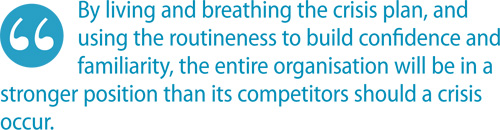
By living and breathing the crisis plan, and using the routineness to build confidence and familiarity, the entire organisation will be in a stronger position than its competitors should a crisis occur.
The routineness derived from experience can be forgotten, especially in an industry like hospitality which is characterised by high staff turnover rates. The learned experience through institutional memory can also be lost. This is why a Living Manual should be given priority by senior management to be incorporated into the organisation’s day-to-day operations, engaging staff at all levels and providing a reliable toolkit in the event of a crisis.
A crisis-ready organisation will stand the test of a high-pressure negative impact better than one that ignores crisis planning at its peril. An informed organisation will be able to meet the crisis event head on with the knowledge and confidence that their crisis leadership capabilities will reduce the negative outcomes and ensure sustained business continuity. The conclusions and implications for the future are not restricted to the hotel sector alone and can also be applied to a wide range of service-related industries.
Organisations cannot ignore the increased power of a company-wide inclusive empowerment programme which provides clear directions and allocates roles and responsibilities. A sense of loyalty to the organisation and its stakeholders, as well as the need to confirm business continuity and therefore job security, also strengthens staff commitment to crisis management objectives and goals. This commitment should be harnessed by empowering staff with the necessary procedures and resources to enact upon their crisis readiness training.
This article was first published in TTG Asia December 2016 issue. To read more, please view our digital edition or click here to subscribe.