Ang: greater awareness of attractions beyond Universal Studios
Although Sentosa continues to receive high international arrivals, the island grapples with the challenge of attracting visitorship beyond its centrepiece attraction, Resorts World Sentosa.
To draw visitors to other areas on the island, Sentosa Development Corporation (SDC) is reaching out to the trade by participating in international roadshows with Singapore Tourism Board, during which it rolls out special bundles for buyers.
Ang: greater awareness of attractions beyond Universal Studios
It has also stepped up its digital efforts to reach out to international visitors. One effort is partnering with Ctrip to push attraction tickets, editorial content and special promotions to outbound Chinese, one of its biggest source markets.
SDC’s chief marketing officer, Lynette Ang, told TTG Asia: “For our key tourist markets, Sentosa has very high brand recognition… Most people know about Universal Studios Singapore because that’s a brand name, but they’re not sure what else there is (on Sentosa).”
She said that “fun experiences that you cannot get anywhere else in Singapore”, including Skyline Luge Sentosa and AJ Hackett Tower, can benefit from greater awareness among international markets.
Ang added that SDC is currently building a new mobile app, on which visitors can purchase attraction passes, plan their itineraries on the island and access maps and trail information. The app is set to launch in early 2018.
To complement these efforts, SDC has also recently formed an internal data analytics committee to look into problem statements – such as how to improve guest experiences – that can be addressed using data.
“Data is very critical. Our island partners have a lot of data, but we’ve not accessed it,” said Ang. She added that with the new focus on data, SDC can now offer its partners insights in exchange for transaction and survey data.
With efforts to launch Japan National Tourism Organization (JNTO)’s Manila office underway, newly-appointed executive director of the preparation office, Daisuke Tonai, is optimistic that a stronger presence in the market will help drive more traffic to the Land of the Rising Sun.
Previously, Tonai was a director with the Japan Convention Bureau, but he is currently in Manila and working to get the new office up and running as soon as possible. Assisting him in Manila is Daiki Nobekawa, who transitions from being senior assistant manager of JNTO’s inbound promotion department South-east Asia to the director of the Manila preparation office.
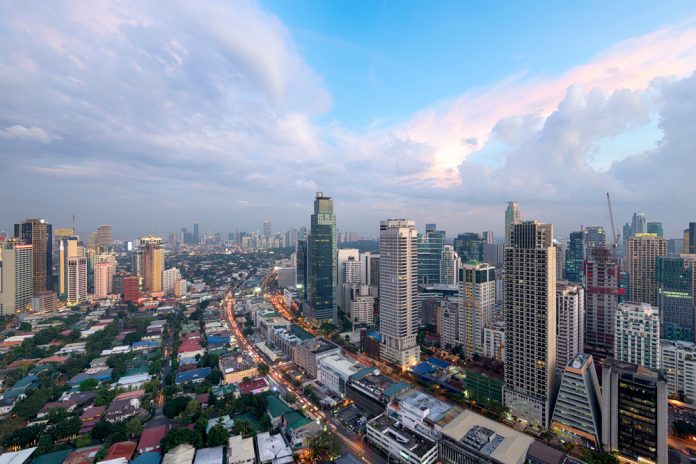
The skyline of Makati, a city in the Metro Manila region
While the launch date is yet to be announced, Tonai proffered other details to TTG Asia. For example, JNTO plans to have five staff members when the office officially opens, and will place equal emphasis on both the leisure and business events markets.
On why JNTO decided to open a branch in Manila, Tonai shared: “Philippines is one of the prospective markets, as the number of Filipino visitors to Japan has been rapidly growing in the past few years. The number of Filipinos who visited Japan in 2016 was 347,861, which was a 29.6 per cent growth year-on-year.”
Currently, the Philippines is the 10th top inbound market. From January to September this year, the number of Filipinos who visited Japan numbered 292,800. This is a 22.1 per cent increased compared to the same period last year.
“Aside from the Philippines, other markets in South-east Asia have also increased, and that is why the region is one of Japan’s most important markets,” Tonai pointed out.
As of September 15, 2017, Japan surpassed the 20 million visitor mark, and is well on its way to surpass its record of 24 million arrivals last year. The Japanese government’s eventual goal is to increase the total number of international visitors to Japan to 40 million by 2020.
“To achieve this goal, marketing and promotion in emerging markets is very important,” he said.
Aside from the soon-to-open Manila office, JNTO opened two other South-east Asian offices in Hanoi and Kuala Lumpur, in February and March this year, respectively. In total, the organisation has 20 offices around the globe that engages in promotional activities.
Reigning European soccer champions Real Madrid are to participate in a giant new leisure park in southern China as part of their promotional campaign to capture new fans in Asia, and in doing so help attract more visitors to their home city.
The plan is to set up a museum at the Hengqin Novotown cultural and entertainment complex in Zhuhai, near Macau. This was presented in Beijing by former Real and Spanish national team forward Emilio Butragueño, now the club’s director of institutional relations.
The attraction will open as part of a project by Lai Sun Group; photo credit: IP2 Entertainment
Due to open in 2021 as part of a development by Hong Kong’s Lai Sun Group, the 12,000m2 pavilion will offer various interactive experiences, a team kit shop, and a themed restaurant.
Other companies involved in the project include National Geographic and film producer Lionsgate.
“The Chinese market is full of opportunities and it is only by working from the inside that we can be successful,” said the club’s director general, José Ángel Sánchez.
Real Madrid, which has set up its own business office in Beijing, is the most successful club in European football history, having won the UEFA Champions League 12 times, and its predecessor, the European Cup.
The main aim of the park is to further attract the interest of the estimated 185 million Chinese people who regularly follow world football, he said.
A spokesperson from the Spanish capital’s tourism board Destino Madrid said Real Madrid is “one of the most valued tourist attractions for this market”.
Real Madrid’s original museum forms part of its home ground complex, the Santiago Bernabeu Stadium, which the spokesperson has pointed out “has become one of the most visited (attractions) in the city”.
“Football is an asset and a recognisable brand for Madrid. The successes of the Madrid teams have made these clubs great ambassadors, and promoting the city beyond our frontiers.”
Taking luxury on planes to the next level, Singapore Airlines is adding Suites – complete with full beds and bathrooms – to its A380 fleet.
Each Suite is now furnished with a flat bed with an adjustable recline and a separate chair. For couples travelling together, the beds in the first two Suites of each aisle can be converted to form a double bed. When not in use, the bed can be stowed completely, creating even more space within each Suite.
A bed in the Suite
Each Suite also has a 32-inch full HD monitor that can swivel for different viewing angles, a full-sized personal wardrobe, customised handbag stowage compartment and amenity box. The Suites cabin also features two lavatories, one of which has a sit-down vanity counter.
The new cabin products will enter service next month on the first of five new A380 aircraft entering the fleet. Retrofit work will also take place on 14 existing aircraft to ensure product consistency across the airline’s entire A380 fleet.
Lavatory within the Suite
The research, design, development and installation of the new products on all 19 Singapore Airlines A380s represents an investment of about US$850 million.
The new Singapore Airlines A380 will be configured with 471 seats in four classes, featuring six Suites and 78 Business Class seats on the upper deck, as well as 44 Premium Economy Class seats and 343 Economy Class seats on the main deck.
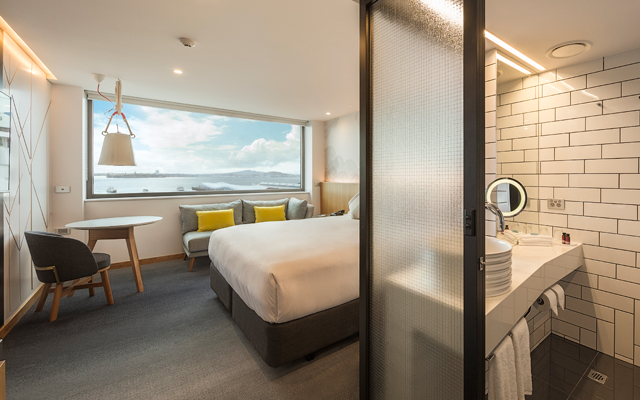
M Social Auckland
Millennium Hotels and Resorts has opened their second M Social-branded property in Auckland. The hotel, previously known as the Copthorne Harbour City, now boasts 190 guestrooms and suites across seven categories, all of which feature wall-to-wall windows overlooking the Auckland Harbour. Those staying in a Social Club Room, or any of the suites, will have access to the Social Lounge – a shared area with communal workstations, and a pool table. Facilities on-site include all-day dining restaurant Beast & Butterflies, a delicatessen, self check-in kiosks, as well as meeting spaces capable of handling events for five to 50 guests.
Shinta Mani Angkor – Bensley Collection
Shinta Mani Hotels will launch its flagship 10-villa Bensley Collection property in Siem Reap this coming December. Each 156m2, two-level villa will have all the trappings of luxury such as a nine-metre private lap pool, rooftop living room, and outdoor bath. Six of the villas can be combined into three 312m2 two-bedroom villas – each with its own pool – to accommodate larger groups. Guests will have full access to the restaurants, bars, spa and facilities in the adjacent Shinta Mani Angkor, or can choose to opt for butler service. The property is now open for bookings.
Kisarazu Washington Hotel
Located on the shores of Tokyo Bay, and one minute away from the Kisarazu Japan Railway station, stands the 146-key Kisarazu Washington Hotel. All of the guestrooms feature separate toilets and bathrooms, and come furnished with a TV, Wi-Fi access, kettle, and fridge. Amenities on the property include the Bonsalute restaurant with an open kitchen, and a 307m2 banquet room. The property is approximately a 30-minute drive away from Haneda airport, and a 50-minute drive from Tokyo’s city centre.
The Fairfield by Marriott, Indore
The latest India opening by Marriott International is in the business hub of Indore, in the state of Madhya Pradesh. The 106-room property’s design uses indigenous stone, wood and textiles, and draws inspiration from the rich colours of Indian embroidered textiles. Facilities include all-day dining restaurant Kava, Kava Bar, a 24/7 convenience store called The Market, fitness centre, business centre, and three event spaces. Attractions nearby include the 18th-century Rajwada royal residence, Lal Baag Palace and the Indore Museum.
Courtyard by Marriott Tianjin Hongqiao
Marriott International has opened a Courtyard by Marriott-branded property in the north-east Chinese city of Tianjin. There are 258 guestrooms (including a junior suite), each furnished with a HDTV, an ergonomic sofa, and a working area with access to high-speed Internet. Facilities include all-day restaurant Pavilion, a Lobby Lounge, 24-hour gym, as well as six meeting rooms ranging from 32m2 to 160m2. The hotel is a 30-minute drive from Tianjin Binhai International Airport, while nearby local attractions include the Eye of Tianjin, Ancient Culture Street, Tianjin Italian Style Town and Drum Tower.
What would you say to travel suppliers who still regard the Muslim travel market as niche?
The Muslim Travel Market already represents around 10 per cent of the global travel market, (and hence) is not really a niche market. In fact, in terms of international visitor arrivals, it is as big as the Chinese outbound market.
Factors such as the growth of the overall population, the middle class and the younger demographics make it extremely important for travel suppliers to have a strategy to cater to them. It will be very difficult to ignore their needs as the market continues to grow.
The spotlight is on Muslim millennials at this year’s Halal in Travel Summit. What does focusing on a “segment within segment” say about the weight that Muslim millennials have in travel?
While the bulk of our research up until now has (chiefly) focused on the size of the overall Muslim market, over the years we have discovered the importance of understanding the different sub-segments of the market. The two main segments of the market are family travellers and the growing sub-segment of Muslim millennials.
More than 55 per cent of the Muslim population is under 30 years old and in the next few years, they will represent a considerable bulk of Muslim travellers.
And it is not just millennials, but increasingly even the Gen Z, who are becoming hugely influential as decision-makers during travel planning. In the past, first-generation parents of Muslim millennial travellers typically engaged travel agents to coordinate their travel plans. However, with the increase in accessibility to online information and ease of purchase, it is now their children who take on the role.
All considered, it is becoming very important for travel suppliers to understand and predict the travel behaviour of this sub-segment. The Muslim Millennial Travel report by Mastercard and HalalTrip is the first such report looking at this sub-segment.
What are some interesting findings from the report?
Some early findings reveal that Muslim millennials make travel plans one to six months in advance, and travel at least two to five times a year on average. The numbers illustrate that (even for younger Muslims), travel is not a luxury.
Also, we had initially anticipated that a significant section of Muslim millennials would opt for more affordable accommodation options such as apartments or shared housing, but surprisingly 63 per cent of the responses prefer hotels instead.
There is still much more to learn about this sub-segment and we will continue our research to better comprehend their behavioural patterns. In particular, given the preliminary findings, we have identified engagement at various stages of travel – from planning, booking and to when they are on holiday – as key focus areas. We would like to better understand what triggers Muslim millennials to travel – be it social media or friends or travel websites – and the (different) levels of motivations behind them.
We believe it is about (delving past) the surface to gain an in-depth understanding of how being a Muslim millennial fits into the overall travel experience.
What destinations have been successful in appealing to novelty-seeking Muslim millennial travellers and why?
We think the obstacle (in the way of more unconventional destinations) is not in the lack of Muslim-friendly amenities but the lack of knowledge about the needs of the Muslim travel segment. More needs to be done to educate smaller businesses offering localised and exotic experiences.
(Take for example) the non-Muslim majority countries gaining popularity among Muslim millennials, namely Japan and South Korea. These destinations have implemented strategies to cater to this market such as making available Halal food and prayer places at some attractions.
How can hotels, travel agencies and destinations be more successful in winning over the Muslim travel market?
It often is not about creating new facilities but improving current ones. At the very basic level, it (comes down to) providing easy access to Halal food and prayer places, etc.
But it is also about getting discovered and having an online presence during the trip planning stages, (taking into account) Muslim millennials’ penchant for direct online bookings for flights and transport.
For travel agencies, this signals a strong need to adapt to the digitisation of travel in order to cater to such prevalent travel trends. Traditional travel agents not only need to embrace technology whole heartedly, but also equip their organisation with talents who can empathise with millennial (mindsets). With their finger on the pulse of Muslim millennials, they will be able to instantly react and adapt to the (constantly) evolving behavior and requirements of this segment.
One challenge is travel agencies are (keeping within traditional boundaries), even though we see in some of our early findings that Muslim millennials prefer FIT arrangements (70 per cent) as opposed to fully packaged tours (four per cent). Travel suppliers need to better understand the behaviour and travel planning process of various traveller profiles, including family travellers, young couples and Muslim millennials.
Raudha Zaini Marketing manager, Halal Trip
What does the future look like for Muslim travel?
Muslim millennials will be the driving force in global Muslim travel. They will have a huge impact on how travel innovates and strategises to cater to them, which would benefit the broader industry. (To give an idea of innovation already at work), at HalalTrip, we have seen an interest in themed retreats, such as the Productive Muslim retreat we did last year. We are planning to launch a few such activities next year. We notice a lot of interest in our HalalTrip mobile app features, such as Inflight Prayer Times, Nearby Halal Food and Nearby tools.
Travel restrictions will not stop Muslims from exploring destinations where they feel safe and welcomed. It is key to educate travel stakeholders in the destination on the potential of the Muslim market and what their needs are. Once there is a good understanding, facilities and services catering to their needs will follow.
SWISS TRAVEL SYSTEM - Wengernalpbahn bei den Staubbachfaellen, Lauterbrunnen, Berner Oberland.
Wengernalpbahn at the Staubbach falls, Lauterbrunnen, Bernese Oberland.
Copyright by: Jungfraubahnen AG/Swiss Travel System By-line: swiss-image.ch
South-east Asian arrivals to Switzerland are looking healthy year-to-date compared to the mixed-bag performance last year which saw Singapore and Malaysia dropping 12 per cent and 7.7 per cent respectively, while Thailand grew 21.3 per cent, the Philippines 10.8 per cent and Indonesia, barely at 0.1 per cent.
Switzerland Tourism’s director-South-east Asia based in Singapore, Ivan Breiter, described the region’s performance so far this year as being “on a record streak”.
He expects all-time high arrivals from Indonesia, Thailand and the Philippines, which are growing in double digits, while Singapore and Malaysia are showing five to six per cent increases – respectable when viewed against the declines last year.
Thailand is Switzerland’s largest South-east Asian market with 117,777 arrivals last year, followed by Singapore (64,664), Indonesia (43,347), Malaysia (33,378) and the Philippines (13,270). All arrivals data are at point of accommodation, i.e. real overnights and exclude the day visits of low-yield tour group series taking the traditional Italy over Switzerland to France route.
Breiter noted a trend towards repeat travellers, younger travellers who are more independent, FITs and incentive groups from South-east Asia. This fits well with the destination’s quality and premium positioning, he said.
It translates to higher earnings and, more importantly, tourism is being distributed to more places in Switzerland than the usual Lucerne and Interlaken.
Using arrivals from Thailand as an example, Breiter said: “When we started our operation in South-east Asia in 2012, only a dozen Swiss destinations received more than 1,000 overnights per annum from Thailand. Within five years, we have doubled the number of Swiss destinations that gets more than 1,000 overnights from Thailand.”
He believes that luxury longhaul travel from South-east Asia will grow “over-proportionately” in the coming years and that Switzerland is well-positioned to take advantage of it.
“Switzerland is the cradle of hospitality and the ideal luxury hideaway. Guests are younger and travelling more individually, and with our public transport system being almost perfect it’s a breeze to travel around Switzerland,” said Breiter.
Sales of the Swiss Travel Pass, which gives visitors unlimited travel on rail, bus, boat and tram in the Swiss Travel System network, have tripled in the last five years, he pointed out.
Added Breiter: “Travellers are looking for more engaging activities, be they yodelling classes, snow-shoeing, wildlife-watching, watch-making, skiing, paragliding, sledging, etc, and Switzerland can offer the right activities to suit their personal desires. Incentive trips have also become more and more popular. We have MICE specialists in the (South-east Asian) markets and in Switzerland to help them achieve the perfect trip.”
Given the trends, Switzerland Tourism is stepping up efforts to be the perfect “match-makers”, i.e. ensuring that customers get their “ideal” products. That starts with training of sales staff and frontliners in the South-east Asian industry, said Breiter.
“With our online education tool, Swiss Travel Academy, travel agents can learn the basics about the country, then specialise their knowledge for their specific customer base. They can become Switzerland experts for family travel, outdoor enthusiasts, luxury travellers, and so on.
“We also help travel planners to learn how to get the best deals, say, by planning their mountain stays during mid-week and city stays during the weekends,” he said.
The one thing he wishes for is to see many more South-east Asian travellers take advantage of Switzerland’s pristine landscape for outdoor activities.
“That’s why we have created specific products like the First Ski Experience (see Hot Stuff) that makes sliding on our winter slopes more accessible to customers who are not yet familiar with snow sports,” he concluded.
The German National Tourism Board is targeting key South-east Asian markets to achieve its goals of scoring longer average nights and higher tourist traffic to lesser-known parts of Germany, writes Pamela Chow
Since opening an office in Singapore, the German National Tourism Board (GNTB) has intensified its marketing efforts in Singapore, Indonesia, Thailand and Malaysia.
These were earlier identified as the top four South-east Asian markets by growth in visitor numbers. The volume of arrivals from Singapore, Thailand and Malaysia rose by 15.4, 15.5 and 16.1 per cent respectively from 2015 to 2016. Information about Indonesian arrivals is unavailable as press time.
The factors spurring this growth include increased media coverage of Germany in South-east Asia, diplomatic and business co-operation between Germany and the region as well as marketing of the country’s tourism brand Destination Germany, explained Chun Hoy Yuen, director of marketing & sales for Germany National Tourism Office (GNTO) – Singapore (ASEAN).
He said: “Destination Germany is becoming more interesting for FITs or smaller groups looking for less-rushed regional tours.”
Popular activities that are “usual components of any holiday tour package” include sightseeing at famous historical and scenic towns in and around the main cities, eating street food and outlet shopping.
Chun expects arrivals from the four target markets will “rise significantly” with these lures.
To increase its mileage in the region, GNTO (ASEAN) this month made its rounds in key markets with an ASEAN Roadshow, where German suppliers met with invited local trade representatives at a week-long series of networking dinners in Bangkok, Kuala Lumpur, Jakarta and Singapore.
Among its goals is increasing the number of nights spent in the country, said Chun, as “many South-east Asian travellers start or end their journey in Germany” and typically clock in an average stay of three to five nights according to agent feedback.
To encourage longer stays, GNTB aims to “extend the routes also towards the north and the German shoreline as well as focus on the beautiful scenery in the east of Germany”, explained Chun. “Germany-exclusive routes usually focus on the alpine region, the Black Forest region and the capital city of Berlin.”
“Berlin has seen a very big increase in the number of visitors. Several major German cities, such as Hamburg, Stuttgart and Cologne are increasingly (included) on the tour routes of many South-east Asian travellers who have researched what to do and see in Germany,” he remarked.
GNTB is also boosting its digital marketing, with an emphasis on social media campaigns and collaborations. Under Destination Germany, 2018’s themes are set to be Culinary Germany, the 200th anniversary of Karl Marx’s birth and the European Athletics Championships in August at The Olympiastadion Berlin.
With these efforts, the board has forecasted that overnight stays by visitors from the Asia-Pacific region will increase by 122.7 per cent by 2030.
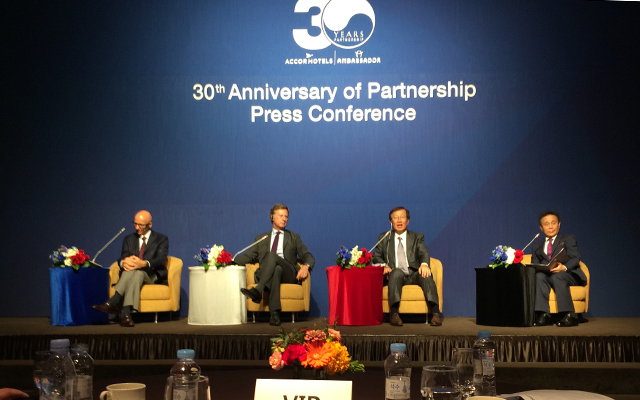
Bazin and Suh in the middle: trust, respect and admiration for what the other party does is the key to the success of Accor Ambassador Korea joint venture
AccorHotels chairman and CEO Sebastien Bazin is thinking big on South Korea even as the media badgered him about the current oversupply and discounting at an event yesterday in Seoul marking 30 years of Accor’s partnership with Ambassador Hotel Group of Korea.
Although the Accor Ambassador Korea (AAK) joint venture is set to manage 32 hotels in the country by 2021, from 23 properties now, Bazin, responding to a question from TTG Asia, said: “As good as 32 is, this is not big enough for me. We could afford to have 100 hotels here in the foreseeable future and this is what I aim to build with my friend and partner (referring to chairman of Ambassador Hotel Group, Jungho Suh).”
To questions from the local media on the current slowdown, brought about both by new supply and frosty China-South Korea relations, Bazin urged South Korea not to underestimate its ability to attract “many, many more” visitors, including Chinese, in the future, because it has a strong economy, base of multinationals, culture and attractions.
Bazin and Suh (middle): trust, respect and admiration for what the other party does is the key to the success of Accor Ambassador Korea joint venture
AAK’s latest management contract, a new-build ‘hotelplex’ in Seoul dubbed ‘Seoul Dragon City’, alone adds 1,700 rooms in four Accor-branded hotels, Grand Mercure, Novotel, Novotel Suites and Ibis Styles under one roof. TTG Asia understands it is doing occupancies of 25 to 30 per cent with half the inventory opened since last month. The other half will come on stream in the next few months.
But Bazin is unfazed. Said Bazin: “I sensed in the last couple of months some sense of panic and people questioning the quality of hotels, number of hotels, competency of the operators. Seoul is the seventh destination (city) in the world. It is not here by accident. You have very strong economy, very strong culture, very strong education, very strong multinationals…The only way they will come to Seoul is whether hotels exist or whether sharing economy exists. Accor will do both.
“So, as much as people are suffering from China tourism ban, please accept that in any sector, you could suffer two or three years. But the future is bright, including in hospitality. And anybody who is frustrated or afraid, is making the wrong decision. My job is to build for the next 10-20 years ahead, not the next two or three years ahead.”
Bazin pointed out that Accor alone operates more than 300 hotels in Australia (including its recent Mantra Group acquisition, subject to regulatory approval) – and Australia’s population is half that of South Korea’s (over 50 million). France has 18,000 hotels; Accor has 1,600 hotels there, he said.
“Yes, in our industry, you could have in some years supply outpacing demand and you could suffer for 24-36 months. But a hotel investment lasts 40 years. Don’t ever lose faith in your 40-year investment. China will come back. China travellers will be bigger than ever before for (South) Korea. I said before, from 120 million now, it could be 200 million Chinese visitors in 20 years. The bigger decision you have to make is how to ‘mix’ Chinese guests efficiently with non-Chinese or domestic guests (due to cultural differences that may require this).”
He added: “I’ve been told about oversupply in Seoul, New York, Amsterdam, and they are all wrong. It takes time to catch up, but there’s always greater demand than supply. People forget there’s a new emerging class in every country in the world who can afford to travel. Why they can afford it? It’s the enormous increase in LCCs in Asia, Europe, the US – the price of the same travel is 30 per cent cheaper than seven years ago.”
Ambassador Hotel Group’s Suh likewise is upbeat, saying South Korea and China relations will improve. Moreover, Suh pointed out that with increased quality of life, domestic tourism will increase. As well, with Accor’s acquisition of FRHI, AAK, which has been focusing largely on midscale, will be able to expand its portfolio of luxury brands. A Fairmont Ambassador Seoul, Accor’s first luxury hotel in South Korea, will open in 2020.
“So while times may be challenging now, longhaul there is a bright future,” he said.
“Having hotels is not a problem, it’s what kind of hotels. Those without competitiveness will not survive. We, with a global hotel group, will.”
Bazin said the one lesson from the ban was the importance of not relying too heavily on any market, as South Korea has done with China. “We (AAK) realised in the last 10 months that we probably missed spending time investigating the domestic market, and we have (subsequently) been able to attract domestic Korean travellers to our hotels, which we did not pay attention to before. The lesson is don’t ever depend on one source.”
New ‘hotelplex’ in Seoul a test for Accor – read all about it in tomorrow’s daily
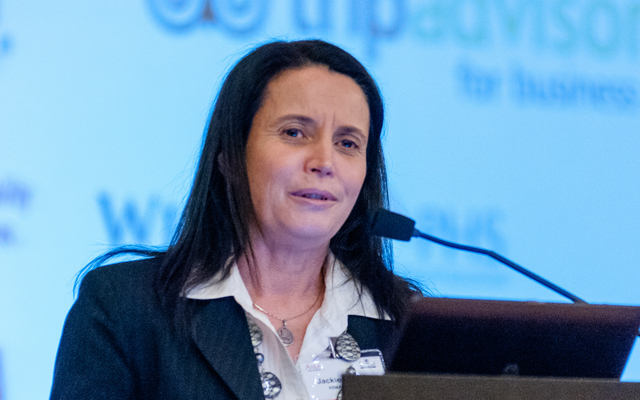
Douglas: hotels struggling to fill revenue management roles
Hospitality Sales Marketing Association International (HSMAI) Asia-Pacific has developed a new training programme featuring an online industry education platform to help fill the revenue management training gap in Asia’s hospitality industry.
Developed by the HSMAI Revenue Advisory Board – which includes the heads of revenue for several global and local hotel chains in Asia-Pacific – the Certificate in Revenue Management (Hospitality) course comprises practical exercise and fast-track learning chapters.
Douglas: hotels struggling to fill revenue management roles; photo credit: HSMAI Asia Pacific
Through this comprehensive programme, trainees will be educated on key aspects of revenue management, including forecasting, distribution, pricing, market segmentation, data analysis, business intelligence and marketing.
Jackie Douglas, president HSMAI Asia Pacific, observed that hoteliers “have been struggling to fill positions in their fast-growing revenue management teams with properly trained employees”.
She explained: “The revenue director role is evolving quickly and they are taking on extra responsibilities such as digital marketing, meeting space and F&B, but until now there hasn’t been a cost-effective training option… It was vital we addressed this imbalance through the new training programme.”
The programme will be supported by Marina Bay Sands (MBS), a HSMAI Platinum Educational Partner, which hosts two educational events for the Singapore chapter each year.
Mike Lee, vice president of sales, MBS, told TTG Asia: “Markets in the South-east Asian region are thriving, hence there is a growing need for greater educational resources and professional training for members of the hotel sales, marketing, and revenue management industries.”
He added that MBS can “play a part in contributing to the region’s business landscape” by sharing its expertise, especially as gained from HSMAI, which can in turn “attract new customer segments to markets such as Singapore”.







 Shinta Mani Angkor – Bensley Collection
 Kisarazu Washington Hotel
 Courtyard by Marriott Tianjin Hongqiao
 What would you say to travel suppliers who still regard the Muslim travel market as niche?