InterContinental Hotels Group (IHG)’s Hotel Indigo brand will debut in Japan with an opening in the hot spring town of Gora slated in 2019.
The debut is the result of a partnership between IHGA Hotels Group Japan – IHG and All Nippon Airways joint venture – and GHS K.K. and Daiwa House Industry.
Hotel Indigo Hakone Gora will feature about 100 guestrooms and suites, each with an open-air onsen (natural hot spring) tub on the balcony, in addition to a Neighbourhood café, a bar, spa treatment rooms and a health club.
It will be located 10 minutes’ walk from Gora terminus on the Hakone Tozan Train, or two minutes from Miyaginobashi bus stop on the Hakone Tozan Bus.
The location is seen as a good fit for Indigo’s neighbourhood-story concept, with the hot springs of Hakone dating back about 1,200 years ago to the Nara period, according to IHG.
Thailand’s Cabinet reshuffle on November 24 sees the return of former minister of tourism and sports, Weerasak Kowsurat, to the role, replacing Kobkarn Wattanavrangkul who held the post for three years.
Weerasak was also chairman of the Thailand Convention & Exhibition Bureau.
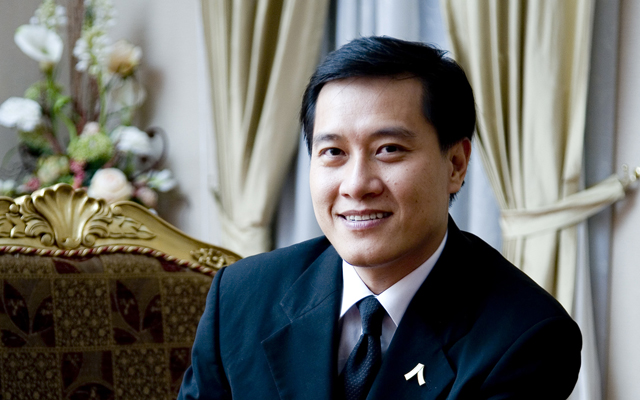
Weerasak returns to post
In general his appointment received positive nods from economic analysts who referred to his experience with the tourism and MICE industries as a big plus. However, sentiments showed that Kobkarn would be sorely missed.
“Great pity. She stood head and shoulders above most ministers of tourism in the region. She had a passion and knowledge of her subject that really set her apart. Plus she was so easy to engage, happy to take on board criticism as well as platitudes, and gave the impression she listened,” said David Kevan, a director at Chic Locations based in London.
Kobkarn’s last public trade appearance was at the World Travel Market, her fourth, during which she recapped a few of the key achievements of Thai tourism industry this year. This included the successful hosting of WTTC in April, and the recognition that sustainable tourism development was needed for the country.
“The good news is that the number of foreign tourists visiting Thailand rose nearly nine per cent to 32.6 million in 2016, bringing in 1.64 trillion baht worth of business, up nearly 13 per cent from 2015. Those are undoubtedly impressive figures and ones that give me, as minister for tourism and sports, enormous satisfaction because it reflects consumer confidence in our products, services and most important, our people.
“On the other hand, we have to accept that this growth is putting enormous pressure on our infrastructure and our environment. This is what will be at the forefront of our tourism development agenda in future,” she said.
Thailand 4.0 national development strategy would focus on health and wellness, food and agriculture, smart devices and robotics, digital technology and the Internet of Things, and creative, culture and high-value services.
“To complement the government’s vision of Thailand 4.0, we need to strike a balance on three fronts. Of course, we aim to maintain the growth in tourist numbers and revenue. At the same time, we need to ensure that our product remains worth buying across all fronts. This means preserving our heritage, ensuring safety and security, protecting the environment and much more. Visitors do not want to come to Thailand to experience rubbish-strewn beaches and burned-out forests that have been harvested by villagers who have not benefited from the tourism windfall,” she had said.
At least 445 flights cancelled due to airport closure
Amid mounting flight cancellations and an extended airport closure, Indonesia’s tourism minister Arief Yahya is urging the travel industry in Bali and Lombok to handle stranded travellers with care. And Bali industry players are doing just that.
“It is not their wish to extend their stay (beyond their plan). This is a force majeure that we cannot avoid, so I urge the travel industry to help ease their burden,” Arief said.
The minister is also recommending airlines and hotels to make concessions for travellers stranded in the destination.
At least 445 flights cancelled due to airport closure
“Let the stranded passengers return to the hotels, give them one night free and 50 per cent discount the following night,” he urged.
For airlines, especially LCCs, he recommends for cancellation fees to be waived.
“If the tourist visas are expired, the immigration office should give an automatic extension of one month stay. (Travellers) should be given ease and comfort in processing their visa (extension),” he added.
Such measures are important if tourism stakeholders in the destination want the affected travellers to return, he said.
The regional authority has also provided free land transportations to Mengwi bus station for those who opt leaving Bali on roads to Surabaya or Banyuwangi (on Java Island).
As well, the Bali Tourism Board (BTB) and Badung Regency have spent two billion rupiah (US$154,000) to assist passengers stranded at the airport yesterday with free accommodation for two nights.
Ida Bagus Agung Partha, chairman of Bali Tourism Board, told the media yesterday: “No passenger should sleep at the airport, so BTB and Badung regency are providing the accommodation for them for tonight (November 27) and tomorrow (November 28) night, should the airport still be closed.”
Meanwhile, the closure of Bali’s I Gusti Ngurah Rai International Airport has been extended by another 24 hours until 06.00 on November 29, according to Angkasa Pura I, the Bali airport authority.
The decision was made following the meteorological watch office released observation by the Darwin Volcanic Ash Advisory Centre that volcanic ashes were bursting as high as 30,000 feet, moving south-southwest at a speed of five to 10 knots towards the airport.
“Please, do not go to the airport to avoid congestions,” the statement released this morning read.
At least 445 of flights were cancelled and 10 flights were redirected due to the closure of Bali airport yesterday.
Airlines and travel companies are “doing all they can” to help their stranded passengers.
Garuda Indonesia last night announced 49 arriving and 46 departing flights to and from Bali were cancelled today. Similarly 11 flights from and 11 flights to Lombok will also be cancelled, although the airport which was closed for the second time after the eruption yesterday had been reopened this morning.
Henky Heriandono, Garuda vice president corporate secretary, in a press statement said: “Garuda is giving passengers affected by the cancellations choices of rescheduling their flights, extending their ticket validity up to six months since the force majeure, rerouting, changing passenger’s name in the ticket once, or full refund.”
Citilink announced last night it would cancel all its flight to and from Bali and Lombok today and the airline is offering refund and reschedule of booked tickets.
PACTO, which has some 400 passengers from India and 150 passengers from Europe, claimed it had prepared for the situation and are protecting their clients with an extended hotel stay.
“This is low season, so, considering the volume we are used to handling, the situation is manageable,” according to Umberto Cadamuro, its COO inbound.
He said: “As in all force majeure events, the departure schedule will depend on airline planning, so we are not rushing towards other airports but carefully coordinating with the airlines while our guests can comfortably relax in the hotel awaiting further developments.”
Celebrity Cruises, the luxury cruise brand operated by Royal Caribbean Cruises, is looking to grow longhaul demand between Singapore and destinations such as Europe, the US and the Galapagos Islands.
To tap fly-cruise demand in and out of Singapore, it plans to deepen its footprint in the city by collaborating with the Singapore Tourism Board, hotel groups and airlines here.
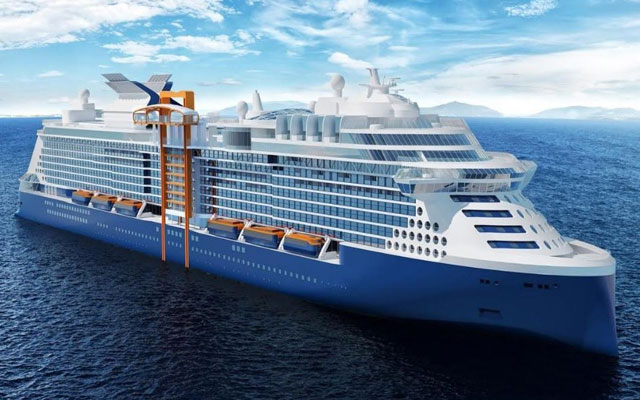
Celebrity Edge will be the first in the company’s new Edge class of ships
It is currently working with brands such as Shangri-La Hotels and Resorts and Singapore Airlines to promote its itineraries to target markets, said Jo Rzymowska, vice president & managing director, UK & Ireland and Asia, Celebrity Cruises.
She explained that the cruise line is seeing rising inbound traffic into Singapore from the UK, America and Europe.
To stretch its mileage in these markets, Celebrity Cruises will also begin including Singapore as a port-of-call in more itineraries. The island’s “incredible” connectivity and accessibility to local attractions is one of the reasons that encouraged this demand, added Rzymowska.
The luxury brand recently launched its newest and highest-tier vessel, Celebrity Edge, the first of which will begin sailing in the summer of 2019 and call at ports in the eastern and western Caribbean, Spain, France and Italy.
Rzymowska said that with a total of five Celebrity Edge ships, Celebrity Cruises will be watching the growth of the brand and demand in its markets to consider where the remaining four vessels will sail.
FIT Ruums, launched just last year as Webjet’s travel distributor in Asia, has its 10th office in the region with its latest opening in Japan.
The Osaka office joins the company’s network which includes Singapore, Hong Kong, Taiwan, South Korea, Indonesia, Malaysia, Thailand, China and India.
Makoto Ochiai from FIT Ruums’ new Japan office
By establishing a presence in Japan, FIT Ruums wants to secure a broader choice of hotels in the country and better rates for its clients across Asia, the company said in a press release.
FIT Ruums is now ramping up its contracting activities across Japan, making the country’s hotels available worldwide via WebBeds’ multiple B2B distribution channels – including the recently acquired JacTravel, based in London – as well as Sunhotels and Lots of Hotels, which will generate longhaul bookings from key markets in Europe, the Middle East, Africa and North & South America.
Daryl Lee, CEO of FIT Ruums, commented: “This is the perfect time to enter Japan, as the country’s travel and tourism industry grows from strength to strength.
“Driven by the continued growth of intra-regional travel in Asia, the proliferation of new airlines and routes, and the enduring appeal of Japanese culture, Japan’s tourism industry is currently experiencing a period of unprecedented growth. With the promise of major international events on the horizon, we believe that Japan will become a major global force in the travel and tourism industry in the coming years.”
The country welcomed a record 24 million international visitors in 2016, up 22 per cent year-on-year, and is on track to exceed this number in 2017, having already received 18.9 million arrivals in the first eight months of this year.
John Vasatka will take over as CEO this month for the Ani Villas’ collection of private resorts in Anguilla, Sri Lanka and Thailand, as well as a fourth property due to open later next month in the Dominican Republic.
Vasatka has worked with upscale luxury hotels for nearly two decades, including 12 years as general manager at various Aman Resorts’ locations in the Caribbean, the Middle East, Sri Lanka and Thailand.
His most recent position was general manager at the Malliouhana, an Auberge resort on Anguilla. He will continue to be based there.
In the wake of Vasatka’s appointment, outgoing CEO Ira Bloom will focus on acquisition and management of the assets of the group as owner’s representative for its principal Tim Reynolds, who parted company from Jane Street Capital some years ago to focus on the development of Ani Villas and its philanthropic effort, the Ani Art Academies.
(Two on the right) Big Bus Tours' Ana Araque and Omid Golshan
Ctrip.com International has partnered Big Bus Tours, said to be the world’s largest operator of open-top sightseeing tours, to offer bus tours in 19 cities and four continents.
At present, Chinese travellers can book hop-on hop-off sightseeing tours in 13 cities. Six more Big Bus Tours destinations will be made available online in the coming months.
(Two on the right) Big Bus Tours’ Ana Araque and Omid Golshan
The two will also work together in innovative marketing and product diversification, according to Ctrip.
In particular, the partnership will allow Chinese travellers to use QR codes to join tours and select different sightseeing routes for more a personalised product.
Jiali Wong has been seconded from the Singapore Tourism Board (STB) to the newly-created position of regional manager for Asia at Cruise Lines International Association (CLIA).
Based in Singapore, Wong will be responsible for growing industry engagement in the region and supporting the continued growth of cruising in Asia. This includes responsibilities for event development and growing CLIA’s Executive Partner programme in the region.
Wong most recently headed the Cruise Business Development team at STB where she forged interest and networks in the cruise industry. In her previous roles, she handled business development and events management in sectors such as BT MICE and tourism development.
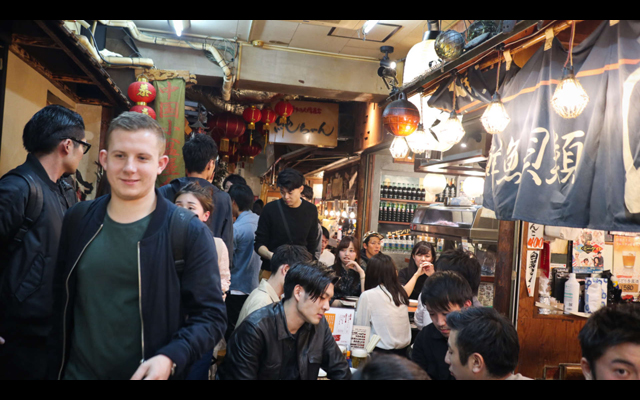
A new Japanese company, Libra Inc, has launched the Tokyo Bar Hopping Tour, taking solo travellers around alleys in Shinjuku and Shibuya where locals usually go to have drinks in Tokyo.
Yasuhiro Suzuki, CEO of Libra Inc, said the idea for the tours came about quite by accident.
Tours offered on Libra Inc’s tour booking site (photo credit: Magical Trip)
Soon after Libra Inc started hiring people from different parts of the world, it became apparent that these foreign colleagues never went out by themselves at night, despite valuing interactions with locals and enjoying nomikai (after-work parties) at izakayas (taverns). Common concerns were if pubs were for regular customers only, language barrier and safety.
When Libra Inc realised there was a lack of groups, tours and meet-ups that could help ease its foreign friends into the drinking culture, it pursued its new tour idea and target audience.
“There just wasn’t enough offers focusing on nightlife for solo travellers that can live up to capturing Japan’s unique drinking culture. At night the local people become so friendly and outgoing even though they are relatively shy in the daytime,” said Iwase Ryosuke, marketer at Libra Inc.
Today, the mission of Tokyo Bar Hopping is to help travellers experience a night out like the locals do.
In the near future, the Japanese company – which recently launched tour booking website Magical Trip – hopes to become a platform for connecting solo travellers with locals.
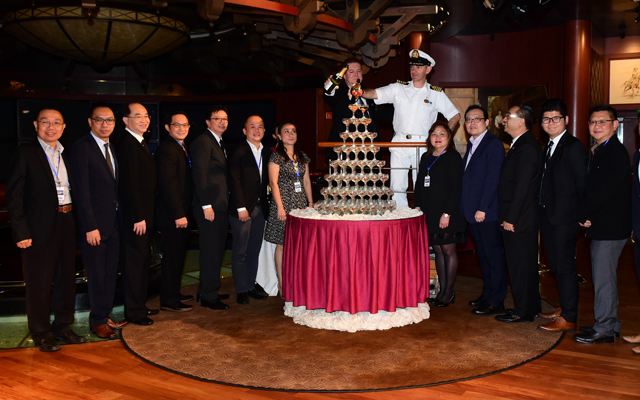
Ship captain Paolo Ravera readies the champagne waterfall while star travel agents pose with Princess' Farriek Tawfik (fifth from left)
Celebrating its fifth anniversary of operations in South-east Asia, Princess Cruises hosted 150 guests comprising travel agents, Captain’s Circle members and travel partners onboard the Sapphire Princess.
Ship captain Paolo Ravera readies the champagne waterfall while star travel agents pose with Princess’ Farriek Tawfik (fifth from left)
As the ship commenced its homeport season at Singapore’s Marina Bay Cruise Centre, travel agents from Singapore, Indonesia and Malaysia were recognised for their top sales performance in the respective markets.
Guests were also treated to a musical performance by the Princess Entertainment Team and a dinner at the fine-dining restaurant onboard.