

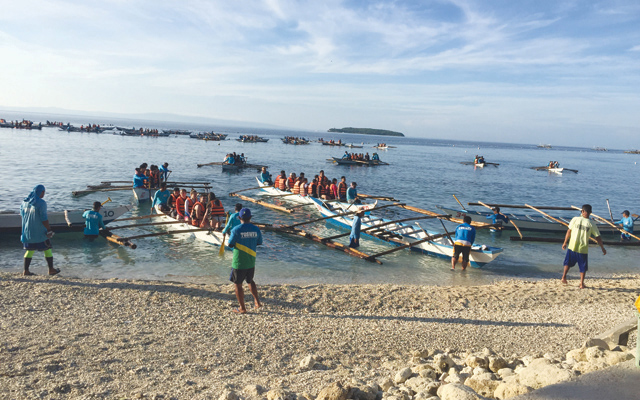
Whale shark watching in Oslob, Cebu is disturbing, the exploitation of these gentle giants abhorrent. But that’s getting ahead of how this profitable attraction, and all its flagrant violations of ethical, responsible and sustainable tourism, remains untouchable.
In August, a visiting American friend and I drove two hours from Cebu City to Oslob to see whale sharks, locally known as butandings. The daily watch and interaction begins at 06.00 in the morning, ending before noon. When we reached the centre at 06.30, it was noisy and teeming with local and foreign tourists. I counted more than 30 boats already in the waters.
There is a short orientation for tourists, only in English. How would non-English speakers cope? Held every 10 to 15 minutes, there are at least 50 tourists per orientation. The lady doing this has memorised her spiel, including the do’s and don’t’s like no touching of the butandings and no use of sunblock lotion. Questions are not encouraged and there’s no video support.
It seems easy to break the rules. For instance, have they bothered to check how many applied sunblock lotion that day? What did they do to penalise the violators?
For a 30-minute thrill, foreign tourists pay US$21 to snorkel while locals pay US$11 to snorkel and US$6 to watch the butandings from the boat.
It’s a lot of money for the 200 or so fishermen. I was told that they earn up to US$530 a month, a tidy sum in that part of the country compared to what they would have earned from fishing – which they have stopped altogether.
I stayed on the boat while my friend opted to snorkel. The boats are about 15 meters away from the shore, and the water is about 4.5m deep. Since a butanding can be about 4.5m in width, it cannot be in a comfortable horizontal position in that water level. The boatman told me they also have to make the butanding “stand” so tourists can see it.
The feeder on the boat has krill that stunk and attracted flies. This is the controversial daily feeding that’s been going on for years. Whale sharks equate the boat and people with food so they come unafraid.
As such, many tourists also choose come here because of guaranteed sighting unlike in Donsol, Sorsogon which has strict rules protecting these butandings.
The boatman said that each butanding needs 30kg of krill daily and there can be four to five in a day. There isn’t enough krill in Oslob so they buy from Dumaguete, Negros Oriental and freeze them.
I know from a previous whale shark experience in Donsol that butandings feed on plankton. These migratory creatures head to Donsol when plankton is in season then go elsewhere during off season. In contrast, butandings overstay in Oslob due to the daily feeding. I wondered whether krill was nutritious enough. Plus, how does the daily feeding affect the marine eco-system in Oslob, and the life and habits of these gentle giants?
My friend declared that snorkelling with butandings was the best highlight of her Cebu trip. But this was followed by a long discussion. For how long can the fishermen use poverty as an excuse to exploit the whale sharks?
My friend said the fishermen need to be informed and educated, and there are other ways of making this a better tourist attraction without harming the whale sharks.
For example, there’s no coffee shop nor restaurant nearby. It would be a good idea to open a restaurant, and perhaps a B&B. They can also improve the layout by moving the carpark from the beach front, add a souvenir shop, and offer a tour package that includes the nearby sandbar, hot springs, and waterfalls.
Upsetting as it is that these fishermen are exploiting the whale sharks, to me the bigger questions are what are the Department of Tourism, travel trade associations, local government doing to and start protecting the whale sharks, while educating these fishermen. Do they even care at all?


 Swiss-Belsuites Pounamu Queenstown
 Sheraton Petaling Jaya
 Fairfield by Marriott, Coimbatore







In response to German National Tourist Board’s (GNTB) promotions in South-east Asia, agents are optimistic that Germany can become a viable off-the-beaten-track mono-destination for the region’s travellers.
However, it is held back by the lack of awareness and a more exciting image in the region, opined both agents and stakeholders in the Germany tourism industry.
A main grouse is that the country is limited by common associations such as business, Oktoberfest and beer, when other aspects of the country can be marketed.
Alan Ang, managing director of EU Holidays, said: “Singaporeans’ perception of Germany is very skewed towards Bavaria, Munich and Berlin.”
He added that not many know about Germany’s “hidden gems”, which can be better marketed and have the potential to draw in bigger crowds from South-east Asia.
Examples of this are the historic operational Roman baths of Wiesbaden and the country’s oldest beer brewery, located 35 minutes and 40 minutes respectively by train from Frankfurt Airport.
Deeming awareness of the country insufficient, tourism stakeholders have taken marketing into their own hands. Frankfurt Airport has stepped up to exhibit at roadshows to promote the city and its surrounds, said its director of international tourism markets, Stefan M Kopp, and also launched an online portal to engage with travel agents and familiarise them with the airport’s services.
However, things are starting to look up for trade players with GNTB’s latest efforts, said Hanne Lim, deputy general manager, operation centre, travel business division, Kaytrip.
The Munich-based agency, which specialises in bringing Chinese-speaking tourists into Europe, has begun developing Germany-specific tours that ply routes like Southern Germany.
Lim said that although the country has to vie with crowd favourites like Iceland and Northern Europe, Germany can woo customers who are looking for “in-depth sight-seeing”, and that more needs to be done to build awareness in Asia.
The board in late-October wrapped up a week-long South-east Asian Roadshow, which stopped in Bangkok, Kuala Lumpur, Jakarta and Singapore, and connected local agents with German tourism operators.
The board earlier identified these four markets as South-east Asian economies with the most growth potential, and will be increasing mono-destination promotions in these markets.
By 2030, GNTB hopes to grow its overnight stays in Germany by two million to 3.2 million.